Singapore’s tap water still safe to drink: Grace Fu新加坡自来水仍可安全饮用:傅海燕
Videos of blackish, soot-coloured rainwater collected amid the haze have made its rounds on social media. Read more at straitstimes.com.
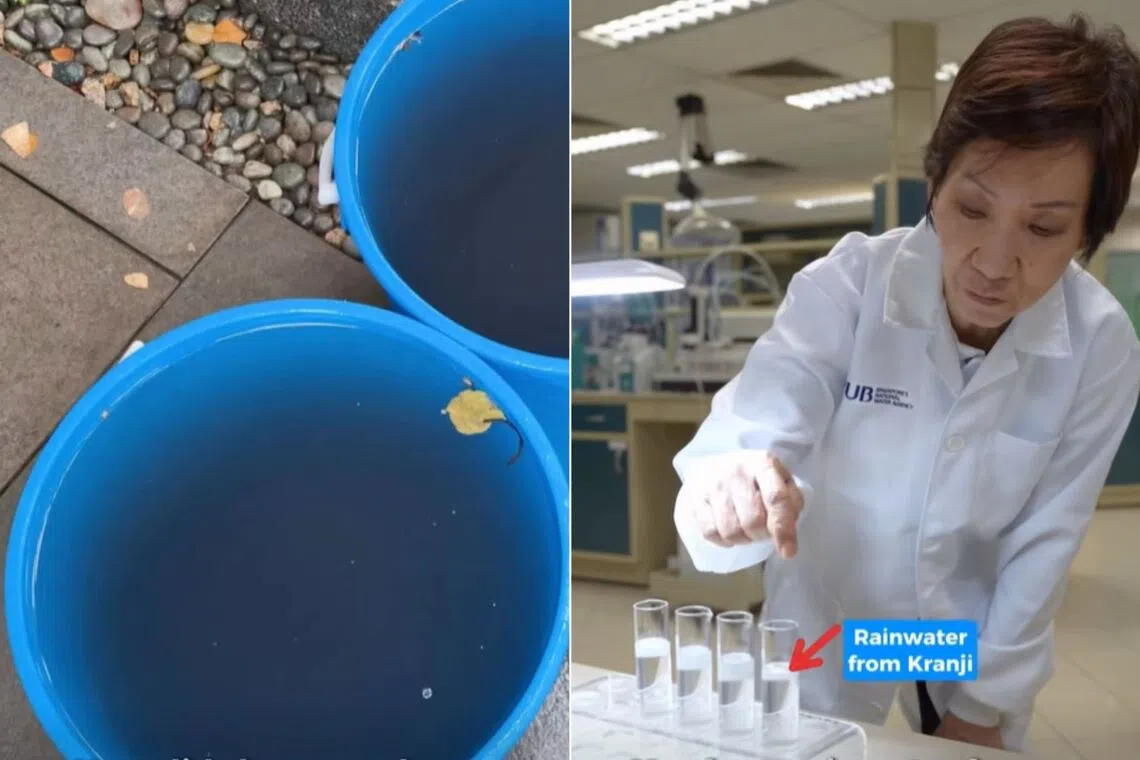
Checks carried out by national water agency PUB have not found any unusual changes in the quality of Singapore’s treated water.
PHOTOS: SCREENGRAB FROM GRACE FU/FACEBOOK
Published Oct 24, 2026, 07:15 PM
Updated Oct 24, 2026, 07:15 PM
SINGAPORE – Singapore’s tap water remains safe to drink , despite the recent persistent haze and viral social media clips of blackish, soot-coloured rainwater causing concern among some Singaporeans .
In a video uploaded to Facebook on Oct 24 , Minister for Sustainability and the Environment Grace Fu said that tests carried out by national water agency PUB have not found any unusual changes in the quality of Singapore’s treated water.
In the video , Fu referred to social media posts that showed blackish rainwater collected amid the haze. She said she visited the PUB Water Quality Laboratory to find out what caused the discolouration and whether it affected tap water.
PUB collected some water samples on Oct 17 , when the Pollutant Standards Index (PSI) was 193 , Fu said. A figure of 101 to 200 on that index indicates unhealthy air quality .
Pointing to a rack of test tubes containing rainwater collected from Kranji and Ulu Pandan, run-off from Yew Tee and tap water , she said that rainwater collected during hazy conditions may be slightly more acidic and contain higher levels of particles and organic matter.
She added : “This is expected, as rainwater can pick up airborne particles and substances as it passes through the atmosphere.
“But the extent of discolouration, in other words, how black it looked, depended on whether it’s rainwater collected directly or rainwater collected from run-off.”
She stressed that, “haze or not” , rainwater collected should not be used for drinking, cooking or personal hygiene.
An infographic in the video showed that the pH level of the rainwater collected on Oct 17 was 5.7 , compared with 6.6 for “moderate-haze” rainwater, 6.8 f or “normal-day” rainwater and 7.8 for treated water.
The pH scale – which ranges from 0 to 14 – measures how acidic or alkaline a substance is. A value of less than 7 indicates that the substance is acidic, and a value greater than 7 shows that it is alkaline.
Another infographic in the video, using nephelometric turbidity units (NTU) as a measure of turbidity, showed that the level for rainwater collected on Oct 17 was 5.7 , compared with 3.6 for “moderate-haze” rainwater , 2.1 for “normal-day” rainwater and 0.21 for treated water . A higher value indicates cloudier water.
Water collected in Singapore’s reservoirs undergo several stages of treatment to remove dirt, tiny particles and other impurities , Fu said.
Singapore’s water treatment processes can filter out particles up to a hundred times smaller than PM2.5, which are removed during the treatment processes, she added.
PM2.5 refers to fine particulate matter measuring 2.5 micrometres or less, and is the dominant pollutant during periods of transboundary haze.
As added precautions, PUB has also stepped up checks on water quality across the country , Fu said.
She added: “Our tests have not found any unusual changes in our treated water quality.
“So while the blackish water seems worrying, our tap water remains clean and safe to drink.”
Daniel Lai is a journalist at the ST Now team, covering breaking news and international affairs.
Ministry of Sustainability and the Environment
新加坡国家水务局 (PUB) 进行的检查并未发现新加坡处理后的水质有任何异常变化。
照片:截图来自 GRACE FU/FACEBOOK
发布于 2026 年 10 月 24 日下午 7:15
更新于2026年10月24日晚上7:15
新加坡——尽管最近持续的雾霾和社交媒体上疯传的黑色、煤烟色雨水视频引起了一些新加坡人的担忧,但新加坡的自来水仍然可以安全饮用。
10 月 24 日,新加坡永续发展及环境部长傅海燕在 Facebook 上发布的一段视频中表示,国家水务局 (PUB) 进行的测试并未发现新加坡处理后的水质有任何异常变化。
视频中,傅女士提到社交媒体上流传着一些照片,照片显示雾霾中积聚了呈黑色的雨水。她说她已前往公用事业局水质实验室,调查水质变色的原因以及是否会影响自来水。
傅先生表示,公用事业局于10月17日采集了一些水样,当时污染物标准指数(PSI)为193。该指数在101至200之间表示空气质量不健康。
她指着一排试管,里面装着从克兰芝和乌鲁班丹收集的雨水、油池的径流和自来水,她说,在雾霾天气下收集的雨水可能酸性稍强,并且含有更高浓度的颗粒物和有机物。
她补充说:“这是意料之中的,因为雨水在穿过大气层时会带走空气中的颗粒物和物质。”
“但变色的程度,也就是看起来有多黑,取决于它是直接收集的雨水还是从径流中收集的雨水。”
她强调,“无论是否有雾霾”,收集的雨水都不应用于饮用、烹饪或个人卫生。
视频中的一张信息图显示,10 月 17 日收集的雨水的 pH 值为 5.7,而“中度雾霾”雨水的 pH 值为 6.6,“正常日”雨水的 pH 值为 6.8,处理后的水的 pH 值为 7.8。
pH值(范围从0到14)用于衡量物质的酸碱性。pH值小于7表示该物质呈酸性,大于7表示该物质呈碱性。
视频中的另一张信息图以浊度单位(NTU)作为浊度指标,显示10月17日收集的雨水的NTU值为5.7,而“中度雾霾”雨水的NTU值为3.6,“正常天气”雨水的NTU值为2.1,处理后的水的NTU值为0.21。NTU值越高,表示水越浑浊。
傅先生表示,新加坡水库收集的水要经过多个处理阶段,以去除污垢、微小颗粒和其他杂质。
她补充说,新加坡的水处理工艺可以过滤掉比 PM2.5 小一百倍的颗粒,这些颗粒会在处理过程中被去除。
PM2.5 指的是直径小于等于 2.5 微米的细颗粒物,是跨境雾霾期间的主要污染物。
傅先生表示,作为额外的预防措施,公用事业局也加强了对全国水质的检查。
她补充说:“我们的测试没有发现处理后的水质有任何异常变化。”
“所以,虽然黑水看起来令人担忧,但我们的自来水仍然干净,可以安全饮用。”
Daniel Lai 是 ST Now 团队的记者,负责报道突发新闻和国际事务。
可持续发展与环境部