This Is The World’s Fastest Production Submarine’s Crazy Molten Metal Cooled Reactor这是世界上速度最快的量产潜艇的疯狂熔融金属冷却反应堆
The reactor used molten lead-bismuth for coolant, which meant it turned into a brick if it stopped circulating, but gave big power for its size.
Updated Apr 19, 2020 3:54 PM EDT
When it comes to nuclear fast attack submarines (SSNs), it doesn’t get more hot-rod than the Soviet Alfa class. With a hull built of titanium, a highly automated control system run by a skeleton crew, and a reactor that was cooled by molten lead-bismuth, the Alfa class was absolutely cutting-edge when it debuted in the early 1970s. Able to hit speeds in excess of 40 knots while submerged, the Alfas were rocketships of the undersea world, with only the one-off K-222 “Golden Fish” submarine eclipsing their speed capabilities. They were also remarkably small, partially due to their reactor design, which had many advantages, but if its molten metal coolant stopped circulating, it turned into a mummified brick. Now, pictures from the removal of one of these reactors from a decommissioned Alfa class boat give us an idea of just how compact the class’s exotic reactors really were.
Before you continue on, you can read and should read all about this marvel of a submarine in this past feature of mine . It’s essential to get a better understanding of just how remarkable these submarines were when they first emerged and the many tradeoffs in their design that truncated their fleet size to just seven boats.
Alfa class submarine K-373 during better times. , Unknown
Rare color photo of an Alfa class submarine underway while surfaced. , Unknown
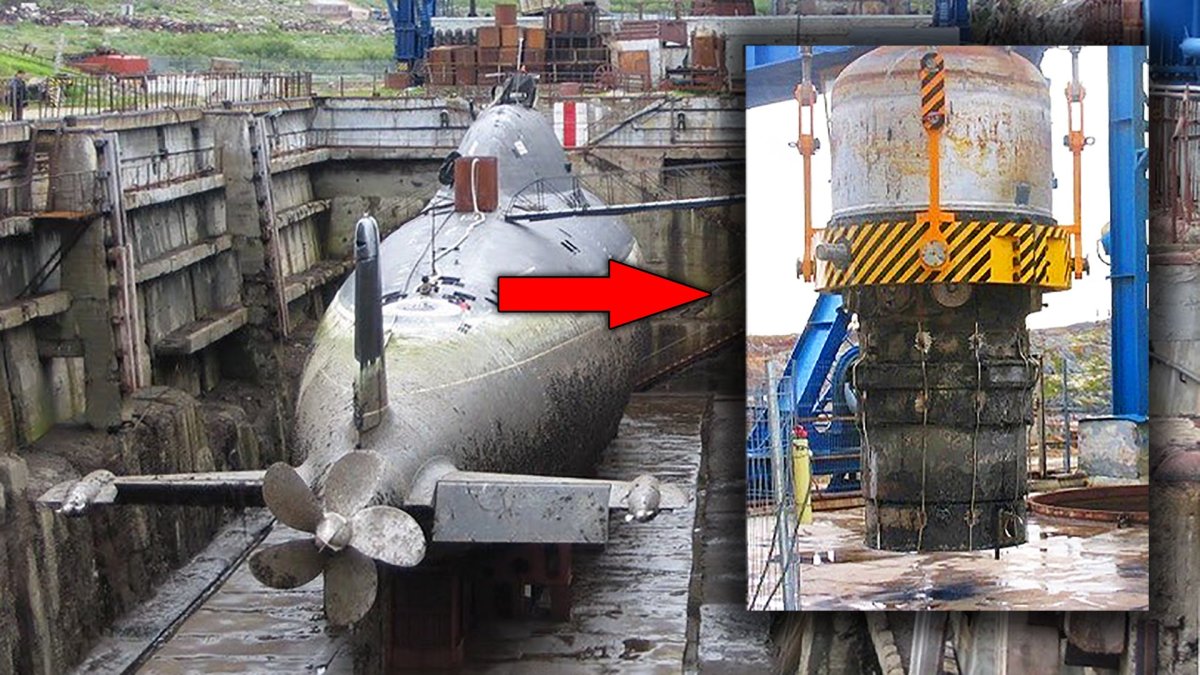
@Captain_Navy , a must-follow on twitter if you are into naval warfare, posted the shot below this weekend. They are from the 2005 de-fueling of the Alfa class submarine K-123, which was decommissioned in 1996. They are some of the best shots of an Alfa class of all time, which is known as something of a looker in submarine aficionado circles. K-123 was put into service in 1977 after a construction period lasting a decade.
Note the propulsors in addition to the main propeller. , via @Captain_Navy
There and then… pic.twitter.com/qL5ZSeJJ90 — Capt(N) (@Capt_Navy) April 18, 2020
There and then… pic.twitter.com/qL5ZSeJJ90
Another great Twitter follow, @Saturnax1 , added a couple of shots of the submarine’s BM-40A reactor. This compact unit put out a whopping 155 megawatts, which equated to 40,000 shaft horsepower driving the submarine’s propeller. That’s a ton of juice for a sub that displaced just 3,200 tons submerged. In comparison, the nuclear fast attack submarine that proceeded it, the Victor class, displaced more than twice as much tonnage, but ran on a far larger pressurized water reactor.
The relatively tiny reactor compartment aboard K-123 seen during its reactor removal. , via @Saturnax1
BM-40A liquid metal cooled reactor being pulled from K-123. , via @Saturnax1
Here's her nuclear reactor vessel after removal (1st picture). The same reactor upside down to allow coolant draining (2nd picture). @AuthorJP_Ronald @subvet88 @Jimmyfish2019 @shtatsky_ru @JivTurky @WolfSonar @NavyGeo @PararamTadam @MikiAV8BHarrier @mrkimnmobile @simonharley pic.twitter.com/CJctOs8lXs — Saturnax 🇸🇰🇪🇺🇺🇦 (@Saturnax1) April 18, 2020
Here's her nuclear reactor vessel after removal (1st picture). The same reactor upside down to allow coolant draining (2nd picture). @AuthorJP_Ronald @subvet88 @Jimmyfish2019 @shtatsky_ru @JivTurky @WolfSonar @NavyGeo @PararamTadam @MikiAV8BHarrier @mrkimnmobile @simonharley pic.twitter.com/CJctOs8lXs
The compact liquid metal cooled reactors on these boats were amazing in many ways, but proved problematic. Just five years into its service life, K-123 suffered a major reactor failure. Globalsecurity.org describes the major tradeoffs in regards to the reactor design and the Alfa class’s capabilities as such:
Project 705 and 705K submarines had record high underwater speed (more than 40 knots) and maneuverability, they successfully completed several long autonomous trips. It took them about 1 minute to accelerate to full speed, and it took 42 seconds to circulate with a 180° turn. For speed, the submarine of project 705 was even listed in the Guinness Book of Records. At the same time, even with good PPU, the operation of the boats of projects 705 and 705K with LMT had certain difficulties, such as the difficulty of eliminating malfunctions due to the tightness of the reactor compartment, the need for an external energy source when being at the base with the reactor shut off, the need for regular regeneration of the coolant … for these problems in the early 90s, when the submarine fleet began to decline, they began to be decommissioned. The K-705 submarines were decommissioned in 1990, and the 705K submarines in 1996. The commanders and officers of submarines with reactor facilities developed at the IPPE gave a very high rating to the submarine itself and its nuclear power plant, calling it a “miracle boat” that was far ahead of its time. Today it can be considered universally recognized that in the IPPE under the direction of A.I. Leypunsky laid the foundations for a new direction in nuclear energy, and a unique reactor technology was demonstrated on an industrial scale. This made it possible to ensure the compactness of the reactor installation, which is important when creating submarines of limited displacement, to ensure high maneuverability, and to increase the reliability and safety of the reactor installation. … With the withdrawal of the last submarine from the Navy from the Navy, a certain stage in the development of ship nuclear energy was completed. The use of liquid metal coolant reactors in nuclear submarines has two opposing views. Some, and most of them, considered this a mistake due to the accident rate and low reliability of the equipment. Others pointed to the high combat qualities of the nuclear submarines: project 705 and 705K boats could successfully evade enemy torpedoes precisely at the expense of speed and maneuverability, short time to bring the reactor out of a subcritical state into energy mode, and ease of control. … In April 1982, during a cruise of the K-123 nuclear submarine, a PPU accident occurred – due to improper crew actions, the alloy was thrown into the compartment through the impulse pipe of the gas system. PPU had to be taken out of action and “frozen”. The subsequent revision of the PUF also revealed irreparable great corrosion damage to the steam generator pipe systems from the side of the secondary circuit, which required a complete replacement of the PPU compartment (there was a replacement BM-40A installation kit).
Project 705 and 705K submarines had record high underwater speed (more than 40 knots) and maneuverability, they successfully completed several long autonomous trips. It took them about 1 minute to accelerate to full speed, and it took 42 seconds to circulate with a 180° turn. For speed, the submarine of project 705 was even listed in the Guinness Book of Records.
At the same time, even with good PPU, the operation of the boats of projects 705 and 705K with LMT had certain difficulties, such as the difficulty of eliminating malfunctions due to the tightness of the reactor compartment, the need for an external energy source when being at the base with the reactor shut off, the need for regular regeneration of the coolant … for these problems in the early 90s, when the submarine fleet began to decline, they began to be decommissioned. The K-705 submarines were decommissioned in 1990, and the 705K submarines in 1996.
The commanders and officers of submarines with reactor facilities developed at the IPPE gave a very high rating to the submarine itself and its nuclear power plant, calling it a “miracle boat” that was far ahead of its time.
Today it can be considered universally recognized that in the IPPE under the direction of A.I. Leypunsky laid the foundations for a new direction in nuclear energy, and a unique reactor technology was demonstrated on an industrial scale. This made it possible to ensure the compactness of the reactor installation, which is important when creating submarines of limited displacement, to ensure high maneuverability, and to increase the reliability and safety of the reactor installation.
With the withdrawal of the last submarine from the Navy from the Navy, a certain stage in the development of ship nuclear energy was completed. The use of liquid metal coolant reactors in nuclear submarines has two opposing views. Some, and most of them, considered this a mistake due to the accident rate and low reliability of the equipment. Others pointed to the high combat qualities of the nuclear submarines: project 705 and 705K boats could successfully evade enemy torpedoes precisely at the expense of speed and maneuverability, short time to bring the reactor out of a subcritical state into energy mode, and ease of control.
In April 1982, during a cruise of the K-123 nuclear submarine, a PPU accident occurred – due to improper crew actions, the alloy was thrown into the compartment through the impulse pipe of the gas system. PPU had to be taken out of action and “frozen”. The subsequent revision of the PUF also revealed irreparable great corrosion damage to the steam generator pipe systems from the side of the secondary circuit, which required a complete replacement of the PPU compartment (there was a replacement BM-40A installation kit).
A conceptual drawing of a liquid metal cooled reactor. , Idaho National Library derivative work by Bea o
Although very fast, the Alfa class was far from being considered the quietest attack submarine in the ocean when running at flank speed. Some who faced it in the 1980s noted that at full charge you could hear one farther away than pretty much anything else at the time, but you couldn’t catch it, regardless.
They were truly the aquatic ‘pocket rockets’ of their day—the MiG-25 Foxbats of the underworld.
Once again, for more on these fascinating submarines and their unique propulsion systems, read my previous piece linked here.
Contact the author: Tyler@thedrive.com
Comments couldn’t be loaded. Please refresh the page.
更新于美国东部时间2020年4月19日下午3:54
说到核动力快速攻击潜艇(SSN),苏联的阿尔法级潜艇绝对是其中的佼佼者。阿尔法级潜艇采用钛合金艇体,配备高度自动化的控制系统,由精简的艇员操作,反应堆则使用熔融铅铋合金进行冷却。在20世纪70年代初问世时,阿尔法级潜艇堪称尖端科技的代表。水下航速可超过40节,阿尔法级潜艇堪称水下世界的火箭,只有K-222“金鱼”号潜艇的速度超过了它们。它们的体积也相当小巧,部分原因在于其反应堆的设计。这种设计虽然有很多优点,但如果熔融金属冷却剂停止循环,反应堆就会变成一块“木乃伊砖”。如今,从一艘退役的阿尔法级潜艇上拆除反应堆的照片中,我们可以直观地感受到该级潜艇独特的反应堆究竟有多么紧凑。
在继续阅读之前,建议您先阅读我之前撰写的关于这种潜艇的专题文章,这篇文章详细介绍了这种令人惊叹的潜艇。了解这些潜艇在最初问世时是多么卓越,以及其设计中存在的诸多权衡取舍(最终导致其舰队规模缩减至仅有七艘),至关重要。
阿尔法级潜艇K-373在鼎盛时期。,未知
一张罕见的彩色照片,展示了一艘阿尔法级潜艇浮出水面航行的情景。,作者不详
如果你对海战感兴趣,那么推特账号@Captain_Navy绝对值得关注。他本周末发布了以下照片。这些照片拍摄于2005年,记录了阿尔法级潜艇K-123的燃料卸载过程。该潜艇已于1996年退役。这些照片堪称阿尔法级潜艇的最佳照片之一,阿尔法级潜艇在潜艇爱好者圈子里以外形出众而闻名。K-123于1977年服役,建造周期长达十年。
注意除了主螺旋桨之外的辅助推进器。(图片来自 @Captain_Navy)
就在那时…… pic.twitter.com/qL5ZSeJJ90 — Capt(N) (@Capt_Navy) 2020年4月18日
就在那时…… pic.twitter.com/qL5ZSeJJ90
另一位值得关注的推特用户@Saturnax1发布了几张潜艇BM-40A反应堆的照片。这款紧凑型反应堆功率高达155兆瓦,相当于4万轴马力,驱动着潜艇的螺旋桨。对于一艘水下排水量仅为3200吨的潜艇来说,这动力相当强劲。相比之下,其前身——维克托级核动力快速攻击潜艇——的排水量是其两倍多,但却配备了更大的压水反应堆。
在K-123反应堆拆卸过程中,可以看到其相对较小的反应堆舱。(图片来自@Saturnax1)
BM-40A液态金属冷却反应堆正从K-123号航天飞机上拆卸下来。(图片来自@Saturnax1)
这是她核反应堆压力容器拆卸后的样子(图1)。同一反应堆倒置以便冷却剂排出(图2)。@AuthorJP_Ronald @subvet88 @Jimmyfish2019 @shtatsky_ru @JivTurky @WolfSonar @NavyGeo @PararamTadam @MikiAV8BHarrier @mrkimnmobile @simonharley pic.twitter.com/CJctOs8lXs — Saturnax 🇸🇰🇪🇺🇺🇦 (@Saturnax1) April 18, 2020
这是她核反应堆压力容器拆卸后的样子(图1)。这是同一个反应堆倒置以便排出冷却剂的样子(图2)。@AuthorJP_Ronald @subvet88 @Jimmyfish2019 @shtatsky_ru @JivTurky @WolfSonar @NavyGeo @PararamTadam @MikiAV8BHarrier @mrkimnmobile @simonharley pic.twitter.com/CJctOs8lXs
这些潜艇上紧凑的液态金属冷却反应堆在很多方面都令人惊叹,但也存在诸多问题。服役仅五年后,K-123 号潜艇就发生了一次严重的反应堆故障。Globalsecurity.org 网站对反应堆设计及其与阿尔法级潜艇性能之间的主要权衡取舍进行了如下描述:
705型和705K型潜艇拥有创纪录的水下航速(超过40节)和机动性,成功完成了多次长距离自主航行。它们加速到全速大约需要1分钟,完成180°转弯需要42秒。705型潜艇甚至因其速度而被载入吉尼斯世界纪录。然而,即使配备了性能优异的动力装置,705型和705K型潜艇在运行过程中仍存在一些困难,例如由于反应堆舱室密闭而难以排除故障,在基地关闭反应堆时需要外部能源,以及需要定期再生冷却剂等等。由于这些问题,在20世纪90年代初,随着潜艇舰队规模的缩减,这些潜艇开始陆续退役。 K-705型潜艇于1990年退役,705K型潜艇于1996年退役。配备IPPE(核动力装置研究所)研制的反应堆装置的潜艇指挥官和军官对潜艇本身及其核动力装置给予了极高的评价,称其为“奇迹之艇”,远远超越了时代。如今,人们普遍认为,在AI Leypunsky的领导下,IPPE为核能发展的新方向奠定了基础,并在工业规模上验证了一种独特的反应堆技术。这使得反应堆装置的紧凑性成为可能(这对于建造排水量有限的潜艇至关重要),同时确保了潜艇的高机动性,并提高了反应堆装置的可靠性和安全性。……随着最后一艘潜艇从海军退役,舰载核能发展的一个阶段也宣告完成。关于在核潜艇中使用液态金属冷却剂反应堆,存在着两种截然相反的观点。一些人,以及大多数人,认为这是一个错误,因为这种反应堆事故率高,设备可靠性低。另一些人则指出核潜艇具有很高的作战性能:705型和705K型潜艇能够成功躲避敌方鱼雷,但代价是速度和机动性有所降低,反应堆从次临界状态切换到高能模式所需时间短,且易于操控。……1982年4月,K-123号核潜艇在一次巡航中发生了一起PPU事故——由于艇员操作不当,合金通过气体系统的脉冲管被抛入舱室。PPU不得不停止工作并“冻结”。随后对PUF的检查还发现,二次回路侧的蒸汽发生器管道系统存在无法修复的严重腐蚀,需要彻底更换PPU舱室(当时有BM-40A型替代安装套件)。
705型和705K型潜艇拥有创纪录的水下航速(超过40节)和机动性,成功完成了多次长距离自主航行。它们加速到全速大约需要1分钟,完成180°转弯需要42秒。705型潜艇甚至因其速度而被载入吉尼斯世界纪录。
与此同时,即使配备了性能良好的动力装置,705型和705K型潜艇在运行中仍存在一些困难,例如由于反应堆舱室密闭而难以排除故障、反应堆停泊在基地时需要外部能源、需要定期再生冷却剂等等。由于这些问题,在20世纪90年代初,随着潜艇舰队规模的缩减,这些潜艇开始陆续退役。K-705型潜艇于1990年退役,705K型潜艇于1996年退役。
在 IPPE 开发的配备反应堆设施的潜艇的指挥官和军官们对潜艇本身及其核动力装置给予了非常高的评价,称其为“奇迹之艇”,远远领先于时代。
如今,人们普遍认为,在莱普斯基领导下的IPPE为核能发展的新方向奠定了基础,并实现了独特的反应堆工业化生产。这使得反应堆装置的紧凑性得以保证(这对于建造排水量有限的潜艇至关重要),同时确保了潜艇的高机动性,并提高了反应堆装置的可靠性和安全性。
随着最后一艘潜艇从海军退役,舰载核能发展的一个阶段也宣告完成。关于核潜艇采用液态金属冷却剂反应堆,存在两种截然相反的观点。一些人,甚至大多数人,认为这是一个错误,因为这种反应堆事故率高、设备可靠性低。另一些人则指出,核潜艇具有很高的作战性能:705型和705K型潜艇能够以牺牲速度和机动性为代价,成功规避敌方鱼雷,反应堆从次临界状态切换到高能状态所需时间短,且易于操控。
1982年4月,K-123核潜艇在一次巡航中发生了一起PPU事故——由于船员操作不当,合金材料通过气体系统的脉冲管被抛入舱室。PPU被迫停止运行并“冻结”。随后对PUF的检查还发现,二次回路侧的蒸汽发生器管道系统存在无法修复的严重腐蚀,因此需要彻底更换PPU舱室(当时有BM-40A型替代安装套件)。
液态金属冷却反应堆的概念图。爱达荷州国家图书馆,Bea o 的衍生作品
尽管速度极快,但阿尔法级潜艇在全速航行时远称不上是海洋中最安静的攻击型潜艇。一些在20世纪80年代与它交战过的人指出,在全速航行时,你能听到它比当时几乎任何其他潜艇都更远的距离,但无论如何你都追不上它。
它们堪称当时水生世界的“袖珍火箭”——水下世界的米格-25狐蝠战斗机。
再次提醒,想了解更多关于这些迷人的潜艇及其独特推进系统的信息,请阅读我之前的文章(链接在此)。
联系作者:Tyler@thedrive.com
评论加载失败,请刷新页面。