SAF puts mobile anti-drone system and airborne 5G network to the test at Exercise Wallaby新加坡武装部队在“袋鼠演习”中测试移动反无人机系统和机载5G网络
SAF tests mobile anti-drone system and airborne 5G network at Exercise Wallaby to boost battlefield communications and drone defence. Read more at straitstimes.com.
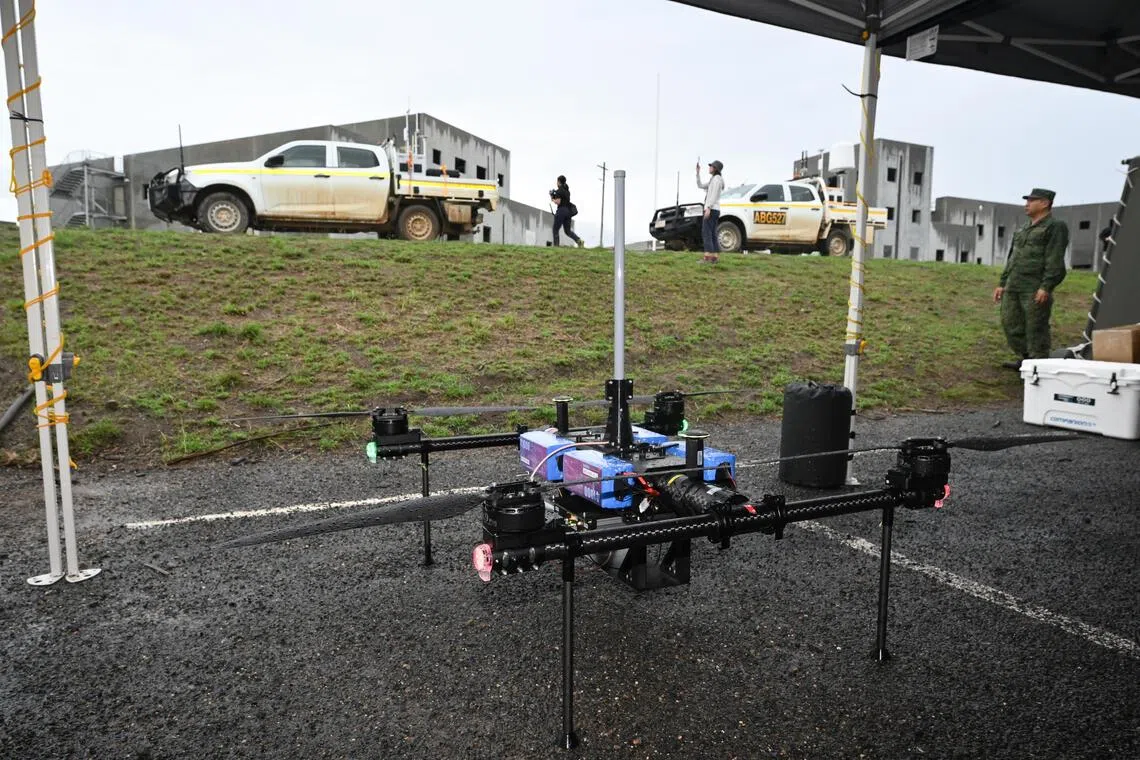
The aerial communications node works by deploying an aerial drone which provides 5G cellular network connectivity in a 400m area around it.
ST PHOTO: LIM YAOHUI
Published Oct 25, 2026, 06:00 PM
Updated Oct 25, 2026, 06:00 PM
The SAF is testing an improved aerial communications node and a mobile counter-drone system at Exercise Wallaby 2026 to strengthen battlefield links and protect troops.
The upgraded ACN is now untethered, giving 5G coverage up to 2km away in a 400 metre radius for frontline soldiers needing high data throughput.
The C-UAS uses sensors and jamming to spot and stop drones, while field tests in Australia help the SAF fix weak points and improve tactics.
ROCKHAMPTON – If the calling card of the modern battlefield is a swarm of cheap but lethal drones, its lifeblood is spectrum: the invisible, radio frequency waves that carry data, such as flight instructions and reconnaissance footage.
At Exercise Wallaby 2026, the Singapore Armed Forces is experimenting with two key systems that will enable it to prevail in today’s congested and networked battle space.
The first is an improved aerial communications node (ACN), a 5G base station in the air that will provide forward-deployed units with a data link back to headquarters, even if they are in a zone with no friendly signal coverage.
The second is a mobile counter-unmanned aerial system (C-UAS), which can be rapidly moved around the battlefield to detect and bring down enemy drones.
Together, the two systems seek to secure the air waves for the SAF while degrading the enemy’s ability to do in today’s battlefield where soldiers are dispersed and vast volumes of information need to be processed, said Chief Signal Officer, Colonel Dean Chua.
“When you see unmanned systems flying around, what they need to fly and use to fly is spectrum, and spectrum is also the one resource that allows our soldiers to stay connected,” he said.
Dominating the spectrum space therefore defends the SAF against unmanned threats, while also protecting its communications, Chua added.
When the ACN was first tested at Exercise Wallaby 2025, the drone was tethered to the ground.
This year, the SAF and the Defence Science and Technology Agency (DSTA) have cut the cord, enhancing its mobility and effective range.
The counter-unmanned aerial system takes down enemy drones. ST PHOTO: LIM YAOHUI
The counter-unmanned aerial system takes down enemy drones.
The ACN works by extending 5G coverage from a base station up to 2km away, said Captain Jerome Chua from the 10th Command, Control, Communications, Computers and Intelligence Battalion (10 C4I), not unlike a Wi-Fi repeater.
Where it hovers, it provides network coverage in a 400 metre radius. This can provide soldiers at the frontline who require high data throughput, said Chua.
DSTA’s technology development director Ho Cheeng Tse said that the tethering rope had limited where the drone could be deployed. But operating in such a wide environment with troops distributed all over called for a more flexible and mobile solution.
The Shoalwater Bay Training Area where Exercise Wallaby is being carried out is roughly five times the size of Singapore.
“When we remove the rope, that helps the soldiers to be able to receive the videos and the communication that they need, based on where operations require them to be at right now,” said Ho.
Meanwhile, the C-UAS system is a suite of drone detection sensors and countermeasures. Sensors such as radar detect aerial objects, and use algorithms to differentiate enemy drones from other flying objects such as birds or big aircraft.
DSTA’s technology development director Ho Cheeng Tse in front of a counter-unmanned aerial system on Oct 23. ST PHOTO: LIM YAOHUI
DSTA’s technology development director Ho Cheeng Tse in front of a counter-unmanned aerial system on Oct 23.
When a threat is located, effectors are then deployed that can neutralise it by jamming communications signals back to its pilot, thereby forcing the drone to land, said Ho.
This year, different configurations of the C-UAS system were mounted on pickup trucks to test their effectiveness for different operational needs, she added.
“We can detect and jam while (the vehicle) is on the move, and that’s what we have experimented at this exercise,” she said.
These tests in the vast Australian landscape help the SAF to stretch the limits of these systems and identify areas for improvement.
For instance, Ho said soldiers had provided feedback to DSTA that under certain scenarios the C-UAS could not provide the required detection on time. In others, the detection proved difficult to follow up on consistently, due to the terrain and other factors.
Such feedback lets the agency go back to find better solutions, such that the existing C-UAS suite can be made more robust for different operational scenarios, she said.
“Because of modern conflicts the field of C-UAS is evolving rapidly, so we are always keeping track of the latest developments and thinking about how that would actually change (our) tactics,” she said. “And then we work closely with the Singapore Armed Forces to discuss what possible tactics that could be.”
Colonel Dean Chua, the Chief Signal Officer, said the technology will help soldiers who may be dispersed in the fast-paced battlefield of today. ST PHOTO: LIM YAOHUI
Colonel Dean Chua, the Chief Signal Officer, said the technology will help soldiers who may be dispersed in the fast-paced battlefield of today.
The Republic’s quest to build its drone capabilities while simultaneously defending against the emerging threat was ramped up in 2025.
At the debate on MINDEF’s budget in 2025, then defence minister Ng Eng Hen announced that the SAF would form a Counter-UAS Development and Operations group that would work with other government agencies to guard the Republic against UAS threats.
Ng also announced that the air force and army had set up specialised centres to scale up UAS warfare and integration within their units.
Colonel Chua said the ACN and C-UAS trials are part of the SAF’s continuous efforts to respond to evolving threats.
He said: “The C-UAS (platform) is one effort for the SAF to really protect our soldiers and protect our units when we have to go to the battlefield.”
Defence and military
空中通信节点的工作原理是部署一架无人机,在其周围 400 米的范围内提供 5G 蜂窝网络连接。
ST 照片:林耀辉
发布于2026年10月25日下午6:00
更新于2026年10月25日下午6:00
新加坡武装部队正在“袋鼠2026”演习中测试改进型空中通信节点和移动反无人机系统,以加强战场联系并保护部队。
升级后的 ACN 现已摆脱线缆束缚,可在 400 米半径范围内提供 2 公里外的 5G 覆盖,满足前线士兵对高数据吞吐量的需求。
C-UAS 利用传感器和干扰技术来发现和阻止无人机,同时在澳大利亚进行的实地测试有助于新加坡武装部队发现弱点并改进战术。
罗克汉普顿——如果说现代战场的标志是成群廉价但致命的无人机,那么它的生命线就是频谱:携带数据的不可见的无线电频率波,例如飞行指令和侦察画面。
在“袋鼠2026”演习中,新加坡武装部队正在试验两个关键系统,以使部队能够在当今拥挤且网络化的战场上取得胜利。
第一个是改进的空中通信节点 (ACN),这是一个空中 5G 基站,即使前沿部署的部队处于没有友军信号覆盖的区域,也能为他们提供与总部之间的数据链路。
第二种是移动式反无人机系统(C-UAS),它可以快速在战场上移动,以探测和击落敌方无人机。
首席信号官蔡迪安上校表示,这两个系统共同致力于保障新加坡武装部队的无线电波安全,同时削弱敌人在当今战场上的作战能力,因为士兵分散部署,需要处理大量信息。
他说:“当你看到无人系统在空中飞行时,它们飞行和飞行所需的资源是频谱,而频谱也是让我们的士兵保持联系的唯一资源。”
蔡补充说,因此,控制频谱空间既能保护新加坡武装部队免受无人机威胁,又能保护其通信安全。
ACN 首次在 2025 年“袋鼠”演习中进行测试时,无人机被系在地面上。
今年,新加坡武装部队和国防科技局 (DSTA) 切断了连接线,提高了机动性和有效射程。
反无人机系统用于击落敌方无人机。(海峡时报照片:林耀辉)
反无人机系统用于击落敌方无人机。
第 10 指挥、控制、通信、计算机和情报营 (10 C4I) 的杰罗姆·蔡上尉表示,ACN 的工作原理是将 5G 覆盖范围从基站扩展到 2 公里以外,这与 Wi-Fi 中继器非常相似。
蔡先生表示,该设备悬停的位置可提供半径400米的网络覆盖。这可以为需要高数据吞吐量的前线士兵提供服务。
国防科技局(DSTA)技术发展总监何正泽表示,系绳限制了无人机的部署范围。但要在部队分散在如此广阔的环境中作战,需要一种更加灵活、机动性更强的解决方案。
正在进行“袋鼠演习”的浅水湾训练区面积大约是新加坡的五倍。
“当我们移除绳索后,就能帮助士兵们接收他们需要的视频和通信,这取决于当前作战行动的要求,”何说。
同时,反无人机系统(C-UAS)是一套无人机探测传感器和对抗措施。例如,雷达等传感器可以探测空中目标,并利用算法将敌方无人机与其他飞行物(例如鸟类或大型飞机)区分开来。
10月23日,国防科技局(DSTA)技术发展总监何正泽在反无人机系统前。(海峡时报摄影:林耀辉)
10月23日,国防科技局技术发展总监何正泽站在反无人机系统前。
何先生表示,当发现威胁时,就会部署干扰器,通过干扰无人机与其飞行员之间的通信信号来使其无法被摧毁,从而迫使无人机降落。
她补充说,今年,不同配置的反无人机系统被安装在皮卡车上,以测试其在不同操作需求下的有效性。
“我们可以在(车辆)行驶过程中进行检测和干扰,而这正是我们在这次演习中尝试的内容,”她说。
在广袤的澳大利亚土地上进行的这些测试有助于澳大利亚武装部队拓展这些系统的极限,并找出需要改进的领域。
例如,何先生表示,士兵们曾向国防科技局反馈,在某些情况下,反无人机系统无法及时提供所需的探测结果。在其他情况下,由于地形和其他因素,难以持续跟进探测结果。
她表示,这样的反馈可以让该机构回过头来寻找更好的解决方案,从而使现有的反无人机系统套件能够更好地适应不同的操作场景。
“由于现代冲突的性质,反无人机系统领域发展迅速,因此我们始终关注最新进展,并思考这些进展将如何改变我们的战术,”她说道。“然后,我们会与新加坡武装部队密切合作,探讨可能的战术方案。”
信号兵司令蔡迪安上校表示,这项技术将有助于在当今快节奏的战场上分散作战的士兵。海峡时报摄影:林耀辉
首席信号官蔡迪安上校表示,这项技术将帮助在当今快节奏的战场上分散作战的士兵。
2025年,共和国加大了发展无人机能力并同时防御新兴威胁的力度。
在2025年国防部预算辩论中,时任国防部长黄永宏宣布,新加坡武装部队将成立一个反无人机系统发展和行动小组,与其他政府机构合作,保卫新加坡免受无人机威胁。
吴还宣布,空军和陆军已设立专门中心,以扩大无人机作战规模,并将其整合到各自的部队中。
蔡上校表示,ACN 和 C-UAS 试验是新加坡武装部队为应对不断变化的威胁而持续努力的一部分。
他说:“C-UAS(平台)是新加坡武装部队为真正保护我们的士兵和部队在战场上安全而做出的努力之一。”
国防和军事