Relax at ‘Gardens by the Bay’ before surgery at KKH: Virtual reality helps to calm patients在KKH医院手术前,可在“滨海湾花园”放松身心:虚拟现实技术有助于缓解患者紧张情绪。
KKH uses virtual reality to ease patients’ anxiety before surgery and improve recovery, with plans to extend the service to children. Read more at straitstimes.com.
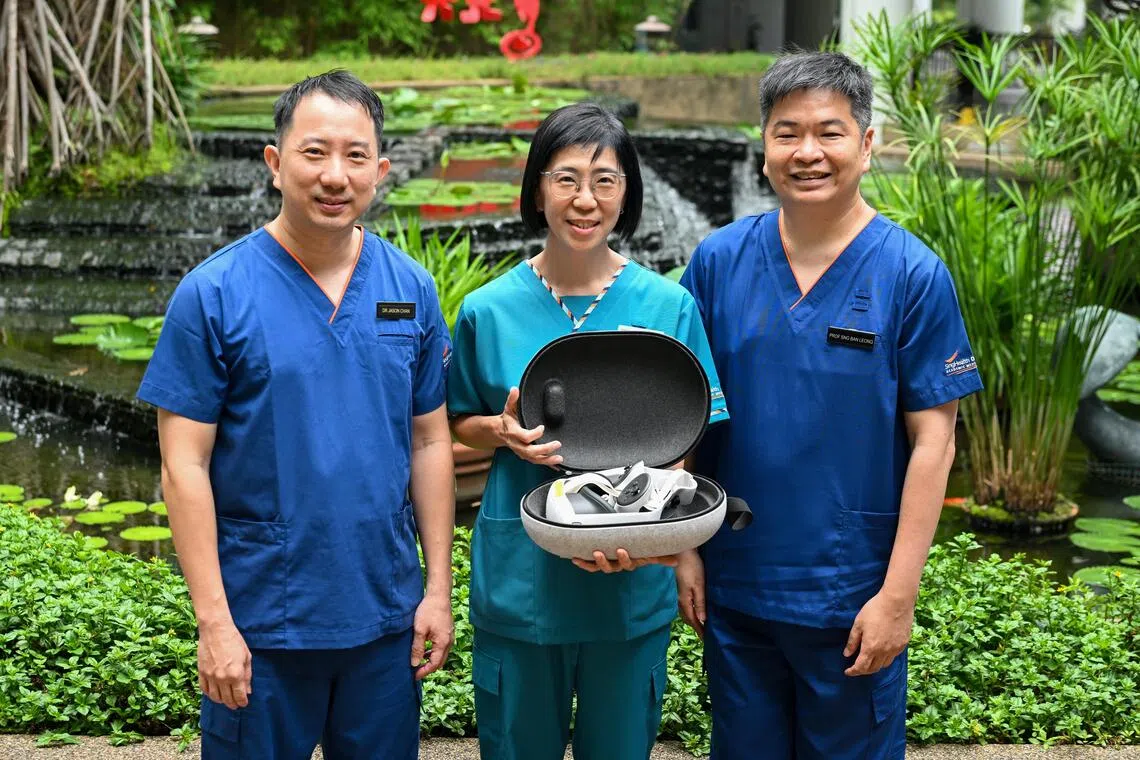
The development team from KK Women’s and Children’s Hospital comprises (from right) senior consultant Sng Ban Leong, nurse clinician Ong Siok Hoon and senior consultant Jason Chan.
ST PHOTO: AZMI ATHNI
Published Oct 25, 2026, 06:00 PM
Updated Oct 25, 2026, 06:00 PM
KKH uses virtual reality before surgery to cut anxiety and improve recovery. The 2025 service may help up to 250 women a year.
Patients can choose calming videos, such as a beach, forest, Gardens by the Bay, or the operating theatre. The service is free, and about 70% accept it.
KKH studies found anxiety fell by a third in 2020 and stayed lower for three days after surgery in 2026. The hospital may extend VR to children and other procedures.
SINGAPORE – Eileen Tan was anxious about having her fibroids removed under general anaesthesia even though her surgeon had explained that the procedure is generally safe.
She was offered an option to calm her nerves by watching some virtual reality (VR) videos, and she took it.
“I realised it actually relieved me of my anxiety, and I asked the nurse if I could continue watching, and they allowed me to. I watched the videos so many times until the battery level went low before I returned the headset,” said Tan.
The use of immersive VR at KK Women’s and Children’s Hospital (KKH) has helped to reduce the pre-surgery anxiety levels of patients by around 30%, as well as facilitated smoother recovery, with patients reporting less anxiety for up to three days after surgery.
With the data gathered from studies, KKH integrated the technology into actual clinical practice in 2025.
The VR intervention is expected to benefit up to 250 women each year, said KKH.
It is currently offered without extra cost to patients scheduled for gynaecological operations , such as to remove benign tumours or tissues, including fibroids and cysts, or even the uterus.
KKH is looking to extend the VR option to children before their surgery in the hospital, or for other outpatient procedures or services.
About an hour or two before the planned operation, patients will be briefly introduced to the VR option.
If they say yes, they will wear a VR headset and watch one or more of four videos: a beach scene set to background meditation music, a forest with guided breathing exercises, a visit to the Gardens by the Bay, and a walkthrough of KKH’s operating theatre.
Each video is five to 10 minutes long.
There is currently no evidence on whether longer VR exposure will lower the anxiety levels more. It is up to the patient to decide if the VR experience is beneficial and comfortable to use, said Sng Ban Leong, a senior consultant at KKH’s department of women’s anaesthesia.
Jason Chan, senior consultant at the same department, said anxiety can be caused by many factors, including the type of illness, medical condition or surgery, as well as the fear of complications, pain or other fears.
Hence, those who have had operations before could still feel highly anxious, he said.
Less anxiety for up to 3 days
KKH had run clinical trials to validate the benefits of the VR intervention.
The first study in 2020 with 108 patients saw their pre-surgical anxiety levels drop by a third after going through the VR intervention.
Anxiety levels were measured through a self-assessment “hospital anxiety and depression scale” questionnaire.
Another study, conducted in March 2026 with 104 patients, found that besides lowering pre-surgery anxiety levels, the VR intervention also maintained lower anxiety levels for up to three days after the surgery .
It also improved the patient’s physical comfort in the crucial first 24 hours of recovery.
Patients scheduled for gynaecological operations at KK Women’s and Children’s Hospital, such as to remove benign tumours or tissues, can use immersive virtual reality to ease their anxiety before surgery. ST PHOTO: AZMI ATHNI
Patients scheduled for gynaecological operations at KK Women’s and Children’s Hospital, such as to remove benign tumours or tissues, can use immersive virtual reality to ease their anxiety before surgery.
Although VR intervention can enable a smoother recovery journey, Sng said this does not necessarily translate into a shorter hospitalisation, as the total length of hospital stay depends on many factors, including the severity of a patient’s condition.
Women giving birth by caesarean section are not in the target group. KKH said mothers-to-be are currently offered other interventions, such as music services that can last the entire delivery process, during which the women are awake.
Those with motion sickness or visual problems, as well as those admitted for urgent operations are also not offered the VR intervention.
About 70% of those offered VR intervention had taken it up, said Ong Siok Hoon, nurse clinician at KKH’s day surgery department.
The remaining 30% relied on other ways to reduce anxiety, such as reading materials prepared by KKH, chatting with the nurses, using their own mobile phones, or simply resting while waiting to enter the operating theatre, she added.
‘Like practising yoga’
Eileen Tan (right) used the virtual reality headset to calm her nerves before her fibroid removal surgery in May. Assisting her is Ong Siok Hoon, a nurse clinician at KK Women’s and Children’s Hospital’s day surgery department. ST PHOTO: AZMI ATHNI
Eileen Tan (right) used the virtual reality headset to calm her nerves before her fibroid removal surgery in May. Assisting her is Ong Siok Hoon, a nurse clinician at KK Women’s and Children’s Hospital’s day surgery department.
Tan, a 45-year-old administrator, was scheduled in early May for fibroid removal surgery – it was the first invasive surgery she had to undergo and required her to be under general anaesthesia.
Naturally, she had concerns.
“Although my gynaecologist said he has performed such operations many times, and it is a generally safe procedure, I was still concerned about the outcomes, including whether I would ever wake up from the surgery,” Tan said.
On the day of her surgery, while in the waiting area, she found herself in a very busy environment with staff walking around. Having to deal with text messages from her parents and husband did not help with her anxiety.
She described the VR experience as calming, “and the breathing techniques are similar to what we do for yoga, which actually helps me to relax my mind and reduce my anxiety”.
The day after her surgery, she could eat all of the breakfast and lunch served, and even told hospital staff that she felt well enough to be discharged that day, instead of staying for one more night.
Wei Qiang is a correspondent at The Straits Times. He is on the health beat, with a special interest in healthcare policies.
KK Women's and Children's Hospital
KK妇女儿童医院的研发团队成员包括(从右至左)高级顾问Sng Ban Leong、护士临床医师Ong Siok Hoon和高级顾问Jason Chan。
ST 摄影:AZMI ATHNI
发布于2026年10月25日下午6:00
更新于2026年10月25日下午6:00
KKH在术前使用虚拟现实技术来减轻焦虑并促进术后恢复。这项服务预计到2025年每年将惠及多达250名女性。
患者可以选择观看舒缓身心的视频,例如海滩、森林、滨海湾花园或手术室的场景。这项服务是免费的,约有70%的患者接受了这项服务。
KKH 的研究发现,2020 年焦虑症患者的比例下降了三分之一,并且在 2026 年手术后三天内焦虑水平仍然较低。该医院可能会将 VR 技术推广到儿童和其他手术中。
新加坡——尽管外科医生解释说,在全身麻醉下切除子宫肌瘤的手术通常是安全的,但陈爱琳仍然感到焦虑。
她可以选择观看一些虚拟现实(VR)视频来缓解紧张情绪,她接受了这个选择。
“我发现这确实缓解了我的焦虑,于是我问护士是否可以继续观看,她们同意了。我反复观看视频,直到耳机电量低了才归还,”谭说道。
KK妇女儿童医院(KKH)使用沉浸式VR技术,已帮助患者术前焦虑程度降低了约30%,并促进了更顺利的康复,患者报告称术后三天内焦虑程度有所降低。
根据研究收集的数据,KKH 于 2025 年将该技术整合到实际临床实践中。
KKH表示,VR干预预计每年将使多达250名女性受益。
目前,对于计划进行妇科手术(例如切除良性肿瘤或组织,包括肌瘤和囊肿,甚至子宫)的患者,该服务无需额外费用。
KKH 正在考虑将 VR 选项扩展到儿童,用于他们在医院接受手术前、其他门诊手术或服务。
在计划手术前一到两个小时,患者将被简要介绍VR手术方案。
如果他们同意,他们将戴上 VR 头显,观看以下四个视频中的一个或多个:以冥想音乐为背景的海滩场景、带有引导呼吸练习的森林、参观滨海湾花园以及参观 KKH 手术室。
每个视频时长为五到十分钟。
目前尚无证据表明延长VR体验时间是否能进一步降低焦虑水平。竹脚妇幼医院(KKH)妇科麻醉科高级顾问宋班良表示,VR体验是否有益且舒适,最终取决于患者自身感受。
该部门的高级顾问 Jason Chan 表示,焦虑可能由多种因素引起,包括疾病类型、医疗状况或手术,以及对并发症、疼痛或其他恐惧。
因此,他说,即使是以前做过手术的人,也可能仍然会感到非常焦虑。
焦虑感减轻,持续长达3天。
KKH曾进行临床试验以验证VR干预的益处。
2020 年的第一项研究对 108 名患者进行了研究,结果显示,经过 VR 干预后,他们的术前焦虑水平下降了三分之一。
焦虑水平通过“医院焦虑抑郁量表”自我评估问卷进行测量。
另一项于 2026 年 3 月对 104 名患者进行的研究发现,除了降低术前焦虑水平外,VR 干预还能在术后长达三天内维持较低的焦虑水平。
它还改善了患者在康复初期关键的24小时内的身体舒适度。
在KK妇女儿童医院接受妇科手术(例如切除良性肿瘤或组织)的患者,可以使用沉浸式虚拟现实技术来缓解术前焦虑。ST PHOTO:AZMI ATHNI
在KK妇女儿童医院接受妇科手术(例如切除良性肿瘤或组织)的患者,可以使用沉浸式虚拟现实技术来缓解术前焦虑。
Sng表示,虽然VR干预可以使康复过程更加顺利,但这并不一定意味着住院时间会缩短,因为住院总时长取决于许多因素,包括患者病情的严重程度。
剖腹产的妇女不属于目标人群。KKH表示,目前医院为准妈妈们提供其他干预措施,例如在整个分娩过程中提供音乐服务,在此期间妇女保持清醒。
患有晕动症或视力障碍的人,以及因紧急手术入院的人,也无法获得虚拟现实介入治疗。
KKH日间手术科的护士临床医生Ong Siok Hoon表示,约有70%接受过VR干预的人接受了干预。
她补充说,其余 30% 的人则依靠其他方式来减轻焦虑,例如阅读 KKH 准备的材料、与护士聊天、使用自己的手机,或者只是在等待进入手术室时休息。
“就像练习瑜伽一样”
艾琳·谭(右)在五月份接受子宫肌瘤切除手术前,使用虚拟现实头盔来缓解紧张情绪。协助她的是竹脚妇幼医院日间手术部的护士王淑芬。(海峡时报摄影:阿兹米·阿特尼)
今年五月,Eileen Tan(右)在接受子宫肌瘤切除手术前,使用虚拟现实头盔来缓解紧张情绪。协助她的是KK妇女儿童医院日间手术部的护士Ong Siok Hoon。
45岁的行政人员谭女士原定于5月初接受子宫肌瘤切除手术——这是她第一次接受侵入性手术,需要全身麻醉。
她自然会感到担忧。
“虽然我的妇科医生说他做过很多次这样的手术,而且这通常是一个安全的手术,但我仍然担心手术结果,包括我是否能从手术中醒来,”谭女士说。
手术当天,她在候诊区等候时,发现周围人来人往,工作人员走来走去,非常嘈杂。父母和丈夫发来的短信更是加剧了她的焦虑。
她形容虚拟现实体验令人平静,“呼吸技巧与我们做瑜伽时所用的技巧类似,这确实有助于我放松身心,减轻焦虑”。
手术后的第二天,她就能吃下医院提供的所有早餐和午餐,甚至告诉医院工作人员,她感觉身体状况良好,当天就可以出院,而不用再留院观察一晚。
魏强是《海峡时报》的记者,主要负责健康领域的报道,尤其关注医疗政策。
KK妇女儿童医院