PAP’s new CEC shows distinction between government and party leadership; emphasis on continuity人民行动党新任中央执行委员会展现了政府领导层与党领导层之间的区别;强调连续性。
Sunday’s ballot saw an unchanged slate in the ruling People’s Action Party’s top decision-making body, with the 12 elected and two co-opted all returning faces. Older members such as senior ministers Lee Hsien Loong and K Shanmugam and Foreign Affairs Minister Vivian Balakrishnan remained.
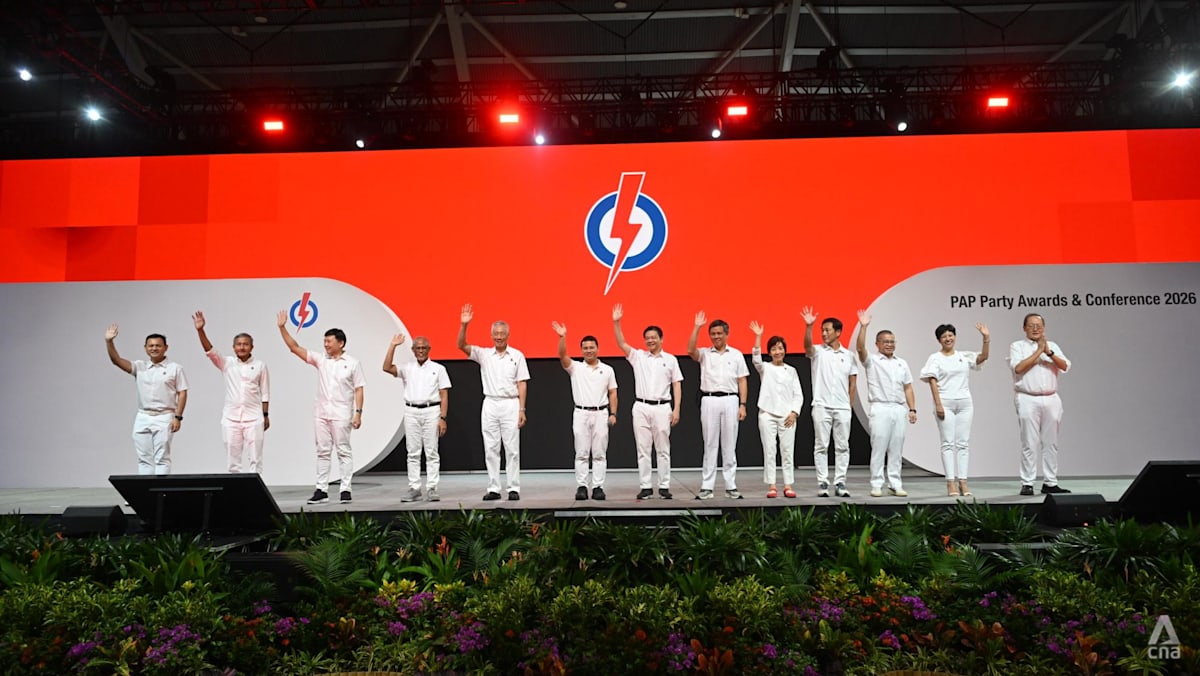
Sunday’s ballot saw an unchanged slate in the ruling People’s Action Party’s top decision-making body, with the 12 elected and two co-opted all returning faces. Older members such as senior ministers Lee Hsien Loong and K Shanmugam and Foreign Affairs Minister Vivian Balakrishnan remained.
The newly elected PAP central executive committee members at the PAP Awards and Conference on Oct 25, 2026. (Photo: CNA/Syamil Sapari)
This audio is generated by an AI tool.
SINGAPORE: The outcome of the People’s Action Party (PAP) central executive committee election on Sunday (Oct 25) showed that the cadres drew a distinction between government leadership and party leadership, and that Prime Minister Lawrence Wong might have faced some challenges in renewal, although that remains high on the party’s agenda.
Analysts pointed to how some first-term MPs have taken on Cabinet positions but didn’t make it into the PAP leadership this time, reflecting how the cadres view the government separately from the party and assess them differently based on other considerations.
Sunday’s ballot saw an unchanged slate in the party’s top decision-making body, with the 12 elected and two co-opted all returning faces. Older members such as senior ministers Lee Hsien Loong and K Shanmugam, and Foreign Affairs Minister Vivian Balakrishnan remained.
Former Deputy Prime Minister Heng Swee Keat, who was elected to the CEC in 2024, stepped down following his retirement from politics in 2025. His place was subsequently filled by ex-MP Faishal Ibrahim, who was in turn replaced by Mr Zaqy Mohamad. The acting minister-in-charge of Muslim affairs was part of Sunday’s slate of 14.
CNA Games Guess Word Crack the word, one row at a time Buzzword Create words using the given letters Mini Sudoku Tiny puzzle, mighty brain teaser Mini Crossword Small grid, big challenge Word Search Spot as many words as you can Show More Show Less While Transport Minister Jeffrey Siow and Acting Manpower Minister Jasmin Lau were nominated but ultimately not voted in, they could still be co-opted into the committee as part of the party’s longer-term renewal, added the observers. Both first-term Members of Parliament were part of the initial shortlist of 19 nominees, which did not include fellow first-term minister David Neo, who is in charge of the Ministry of Culture, Community and Youth. “Just because one is in Lawrence Wong’s core team does not automatically mean that this person is also core in the eyes of party cadres,” political observer Mustafa Izzuddin, a social and international affairs consultant, told CNA. Observers also noted that Sunday’s outcome is a signal from the party faithful that the preference is for continuity over change, with experienced leaders at the helm as Singapore rides global and regional turbulence. “With the multi-faceted challenges facing the country ranging from AI to geopolitics, the party cadres — as the barometer — are indicating that the imperative for change must be balanced against the need for the party to demonstrate stability, strength, and experience which the older leaders possess,” said Singapore Management University associate law professor Eugene Tan. Dr Tan Ern Ser, an adjunct principal research fellow at the Institute of Policy Studies (IPS), said the election result suggests that cadres want the first-termers to prove themselves further. “I reckon it suggests that party cadres still strongly support those who have a longer track record, while they probably believe that the new ministers need more time to gain their trust and support,” he said. MORE TIME TO GAIN TRUST Mr Siow and Ms Lau did not get voted into the CEC as they are still new and have not earned the full support of the party’s cadres, said political observers. “They are still very new to the party as they joined the party just before the May 2025 GE, so no surprises that they are still not as popular as their more established colleagues,” said Assoc Prof Tan. Independent political observer Felix Tan called it an indication that cadre members would prefer to see them “tested for a little longer”. “They are still relatively new faces, and there may be a preference to allow them more time to build their political experience, establish a stronger track record and demonstrate themselves in their current roles before taking on more senior responsibilities within the party,” he said. It also partly has to do with the fact that they were seen as fast-tracked to becoming ministers in a short time, said Dr Tan Ern Ser. Observers noted that the duo are nevertheless likely to enter the party CEC at some point. “It is not a question of if, but when,” said Mr Malminderjit Singh, managing director of political consultancy Terra Corporate Affairs, adding that the cadres may also want Mr Siow and Ms Lau to spend more time growing in their ministerial portfolios first. Dr Mustafa said that even if they do not get co-opted into the CEC this time round, they could be inducted in the next vote in 2028. The next vote would be significant as it would be building up the team with an eye on the next general election, which has to be held by 2030, said observers. GOVERNMENT VERSUS PARTY Sunday’s vote also drew the distinction between leadership in government and at the party level. “This is a distinction that is drawn and one that increasingly needs to be drawn. In a one-party dominant system, the distinction between party, government and state needs to be even more clearly drawn,” said Assoc Prof Eugene Tan. He said the CEC election results suggest that the PAP ranks recognise that the party is distinct from the government, and that experience in retail politics and winning elections matter just as much as policy-making nous. “There is virtue in the party leadership being somewhat different from the nation’s political leadership. After all, the party must first win a General Election convincingly in order to form a popular government,” he added. The ballot outcome also signalled to other political office holders that they need to do a lot more to gain the support of the party cadres, said Dr Mustafa. Dr Felix Tan said the CEC election outcome in some ways sits “somewhat awkwardly” with the prime minister’s emphasis on leadership renewal and bringing new voices into the fold. “I am not sure how far retaining essentially the same CEC line-up will necessarily bring about the ‘fresher’ perspectives that have been talked about,” he said. Mr Singh noted that the 4G team, while at the helm of the current government, does have younger members who can bring in new perspectives. In fact, Cabinet members such as Education Minister Desmond Lee and Mr Zaqy Mohamad are “not very far in age from the 5G”, he added. Mr Lee, for instance, is just two years older than Mr Siow, he said. PACE OF RENEWAL While he acknowledged that there is value in institutional continuity in a time of uncertainty, Dr Felix Tan said Sunday’s result also hints at the constraints that Mr Wong faces in renewing the party’s leadership team. “After all, unless we are suggesting that this is not really a democratic decision and that the outcome ultimately rests with the prime minister, there must be limits to how much influence he can exercise over the process,” he said. Dr Mustafa said the line-up aimed at maintaining operational consistency within the party ranks to “ensure that the PAP remains the dominant party of choice among the Singaporean electorate to govern the country under the leadership of Lawrence Wong”. It could also be attributed to favouring a “strong internal core” of leaders to tackle acute global challenges, he added. Observers said uncertainties and challenges include the current energy crisis with Indonesia, the upcoming US mid-term elections, which could further complicate the regional and global landscape, and the ongoing war in the Middle East, which shows little sign of abating. As such, it comes as no surprise that the PAP would choose continuity and err on the side of caution, said Dr Felix Tan. “The more important question is whether this continuity is simply a holding position before further renewal takes place, or whether it signals a more cautious pace of change than initially expected,” he said. Observers noted that the CEC line-up is still not finalised, as there can still be four more members co-opted. Other co-opted members, as well as specific appointments within the committee – such as chairman, secretary-general, treasurer and organising secretaries – will be announced in the weeks ahead. The timing for this has varied in the past. It took 10 days in 2024, 20 days in 2022, and 11 days in 2020. The co-opted members need not be from the 19 names shortlisted on Sunday. “The newer members could be younger ministers like Jasmin and Jeffrey. I expect them to be co-opted,” said Mr Singh, adding that there could also be a renewal in the key appointments within the CEC. Assoc Prof Tan said that one or more of the 5G leaders could be co-opted and appointed as organising secretaries. Minister in the Prime Minister’s Office Ng Chee Meng is also expected to be co-opted by virtue of his being the labour chief and of the symbiotic relationship between the PAP and the National Trades Union Congress, he added.
While Transport Minister Jeffrey Siow and Acting Manpower Minister Jasmin Lau were nominated but ultimately not voted in, they could still be co-opted into the committee as part of the party’s longer-term renewal, added the observers.
Both first-term Members of Parliament were part of the initial shortlist of 19 nominees, which did not include fellow first-term minister David Neo, who is in charge of the Ministry of Culture, Community and Youth.
“Just because one is in Lawrence Wong’s core team does not automatically mean that this person is also core in the eyes of party cadres,” political observer Mustafa Izzuddin, a social and international affairs consultant, told CNA.
Observers also noted that Sunday’s outcome is a signal from the party faithful that the preference is for continuity over change, with experienced leaders at the helm as Singapore rides global and regional turbulence.
“With the multi-faceted challenges facing the country ranging from AI to geopolitics, the party cadres — as the barometer — are indicating that the imperative for change must be balanced against the need for the party to demonstrate stability, strength, and experience which the older leaders possess,” said Singapore Management University associate law professor Eugene Tan.
Dr Tan Ern Ser, an adjunct principal research fellow at the Institute of Policy Studies (IPS), said the election result suggests that cadres want the first-termers to prove themselves further.
“I reckon it suggests that party cadres still strongly support those who have a longer track record, while they probably believe that the new ministers need more time to gain their trust and support,” he said.
MORE TIME TO GAIN TRUST
Mr Siow and Ms Lau did not get voted into the CEC as they are still new and have not earned the full support of the party’s cadres, said political observers.
“They are still very new to the party as they joined the party just before the May 2025 GE, so no surprises that they are still not as popular as their more established colleagues,” said Assoc Prof Tan.
Independent political observer Felix Tan called it an indication that cadre members would prefer to see them “tested for a little longer”.
“They are still relatively new faces, and there may be a preference to allow them more time to build their political experience, establish a stronger track record and demonstrate themselves in their current roles before taking on more senior responsibilities within the party,” he said.
It also partly has to do with the fact that they were seen as fast-tracked to becoming ministers in a short time, said Dr Tan Ern Ser.
Observers noted that the duo are nevertheless likely to enter the party CEC at some point.
“It is not a question of if, but when,” said Mr Malminderjit Singh, managing director of political consultancy Terra Corporate Affairs, adding that the cadres may also want Mr Siow and Ms Lau to spend more time growing in their ministerial portfolios first.
Dr Mustafa said that even if they do not get co-opted into the CEC this time round, they could be inducted in the next vote in 2028.
The next vote would be significant as it would be building up the team with an eye on the next general election, which has to be held by 2030, said observers.
GOVERNMENT VERSUS PARTY
Sunday’s vote also drew the distinction between leadership in government and at the party level.
“This is a distinction that is drawn and one that increasingly needs to be drawn. In a one-party dominant system, the distinction between party, government and state needs to be even more clearly drawn,” said Assoc Prof Eugene Tan.
He said the CEC election results suggest that the PAP ranks recognise that the party is distinct from the government, and that experience in retail politics and winning elections matter just as much as policy-making nous.
“There is virtue in the party leadership being somewhat different from the nation’s political leadership. After all, the party must first win a General Election convincingly in order to form a popular government,” he added.
The ballot outcome also signalled to other political office holders that they need to do a lot more to gain the support of the party cadres, said Dr Mustafa.
Dr Felix Tan said the CEC election outcome in some ways sits “somewhat awkwardly” with the prime minister’s emphasis on leadership renewal and bringing new voices into the fold.
“I am not sure how far retaining essentially the same CEC line-up will necessarily bring about the ‘fresher’ perspectives that have been talked about,” he said.
Mr Singh noted that the 4G team, while at the helm of the current government, does have younger members who can bring in new perspectives.
In fact, Cabinet members such as Education Minister Desmond Lee and Mr Zaqy Mohamad are “not very far in age from the 5G”, he added. Mr Lee, for instance, is just two years older than Mr Siow, he said.
While he acknowledged that there is value in institutional continuity in a time of uncertainty, Dr Felix Tan said Sunday’s result also hints at the constraints that Mr Wong faces in renewing the party’s leadership team.
“After all, unless we are suggesting that this is not really a democratic decision and that the outcome ultimately rests with the prime minister, there must be limits to how much influence he can exercise over the process,” he said.
Dr Mustafa said the line-up aimed at maintaining operational consistency within the party ranks to “ensure that the PAP remains the dominant party of choice among the Singaporean electorate to govern the country under the leadership of Lawrence Wong”.
It could also be attributed to favouring a “strong internal core” of leaders to tackle acute global challenges, he added.
Observers said uncertainties and challenges include the current energy crisis with Indonesia, the upcoming US mid-term elections, which could further complicate the regional and global landscape, and the ongoing war in the Middle East, which shows little sign of abating.
As such, it comes as no surprise that the PAP would choose continuity and err on the side of caution, said Dr Felix Tan.
“The more important question is whether this continuity is simply a holding position before further renewal takes place, or whether it signals a more cautious pace of change than initially expected,” he said.
Observers noted that the CEC line-up is still not finalised, as there can still be four more members co-opted.
Other co-opted members, as well as specific appointments within the committee – such as chairman, secretary-general, treasurer and organising secretaries – will be announced in the weeks ahead.
The timing for this has varied in the past. It took 10 days in 2024, 20 days in 2022, and 11 days in 2020.
The co-opted members need not be from the 19 names shortlisted on Sunday.
“The newer members could be younger ministers like Jasmin and Jeffrey. I expect them to be co-opted,” said Mr Singh, adding that there could also be a renewal in the key appointments within the CEC.
Assoc Prof Tan said that one or more of the 5G leaders could be co-opted and appointed as organising secretaries.
Minister in the Prime Minister’s Office Ng Chee Meng is also expected to be co-opted by virtue of his being the labour chief and of the symbiotic relationship between the PAP and the National Trades Union Congress, he added.
Get our pick of top stories and thought-provoking articles in your inbox
Stay updated with notifications for breaking news and our best stories
Join our channel for the top reads for the day on your preferred chat app
周日的选举中,执政的人民行动党最高决策机构成员名单保持不变,12名当选议员和2名增选议员均为老面孔。资深部长李显龙、尚穆根以及外交部长维文·巴拉克里希南等资深成员继续留任。
2026年10月25日,新当选的PAP中央执行委员会成员在PAP颁奖典礼暨大会上合影。(图片:CNA/Syamil Sapari)
这段音频是由人工智能工具生成的。
新加坡:人民行动党(PAP)中央执行委员会选举结果(10月25日,星期日)显示,党员干部区分了政府领导和党领导,总理黄循财在党的更新换代方面可能面临一些挑战,尽管这仍然是该党的重要议程。
分析人士指出,一些第一任期的国会议员虽然担任了内阁职务,但这次却未能进入人民行动党领导层,这反映出干部们将政府与党分开看待,并根据其他因素对政府进行不同的评估。
周日的选举中,该党最高决策机构的名单保持不变,12名当选议员和2名增选议员均为老面孔。资深部长李显龙、尚穆根以及外交部长维文·巴拉克里希南等资深成员继续留任。
前副总理王瑞杰于2024年当选中央执行委员会委员,并于2025年退出政坛后卸任。他的席位随后由前国会议员费沙尔·易卜拉欣接任,费沙尔·易卜拉欣之后又由扎基·穆罕默德先生接任。负责穆斯林事务的代理部长是周日公布的14人名单之一。
CNA游戏 猜词游戏 逐行破解单词 流行词游戏 用给定的字母组成单词 迷你数独 小谜题,脑力挑战 迷你填字游戏 小方格,大挑战 单词搜索 尽可能多地找出单词 显示更多 显示更少 观察人士补充说,虽然交通部长萧正祥和人力部代部长刘嘉玲被提名但最终未获通过,但他们仍有可能作为该党长期更新计划的一部分被增选进入委员会。这两位都是第一任期的国会议员,他们都在最初的19人提名名单中,该名单不包括同样是第一任期的文化、社区及青年部部长梁振英。“仅仅因为某人是黄循财的核心团队成员,并不意味着这个人在党内干部眼中也是核心成员,”社会及国际事务顾问、政治观察家穆斯塔法·伊祖丁告诉CNA。观察人士还指出,周日的选举结果表明,党内忠实拥护者倾向于保持现状而非变革,希望经验丰富的领导人继续掌舵,带领新加坡应对全球和区域动荡。新加坡管理大学法学副教授陈永健表示:“新加坡面临着从人工智能到地缘政治等多方面的挑战,党内干部——作为风向标——表明,变革的必要性必须与党展现稳定性、实力和经验的需求相平衡,而这些正是资深领导人所具备的。” 政策研究所(IPS)兼职首席研究员陈恩瑟博士表示,选举结果表明,干部希望新任部长们进一步证明自己的能力。“我认为这表明,党内干部仍然强烈支持那些资历更老的领导人,同时他们可能认为新部长需要更多时间来赢得他们的信任和支持。”政治观察人士表示,萧先生和刘女士未能当选中央执行委员会成员,是因为他们入党时间尚短,尚未获得党内干部的全力支持。陈副教授表示:“他们是在2025年5月大选前不久才加入党的,所以他们目前的人气不如资深党员并不令人意外。”独立政治观察员陈菲利克斯认为,这表明干部成员更希望看到他们“接受更多考验”。他说:“他们毕竟是新面孔,党内可能更倾向于让他们有更多时间积累政治经验,建立更可靠的政绩,并在目前的岗位上证明自己,然后再承担党内更高级别的职责。”陈恩瑟博士指出,部分原因还在于他们被认为在短时间内就被“快速提拔”为部长。观察人士指出,尽管如此,两人最终还是有可能进入中央执行委员会。 “这不是会不会发生的问题,而是何时发生的问题,”政治咨询公司Terra Corporate Affairs的董事总经理马尔明德吉特·辛格先生说道。他还补充说,干部们可能也希望萧先生和刘女士先花更多时间在各自的部长职位上积累经验。穆斯塔法博士表示,即使他们这次未能被增选进入中央执行委员会,他们也可能在2028年的下次投票中获得席位。观察人士指出,下次投票意义重大,因为它将着眼于2030年之前举行的下届大选,组建团队。政府与政党:周日的投票也凸显了政府领导层和政党领导层之间的区别。“这是一个需要明确区分的领域,而且越来越需要。在一党独大的体制下,政党、政府和国家之间的区别需要更加清晰地界定,”副教授陈永健说道。他表示,中央执行委员会(CEC)选举结果表明,人民行动党(PAP)党员认识到党与政府的区别,并且基层政治经验和赢得选举的能力与政策制定能力同等重要。“党领导层与国家政治领导层有所不同,这本身就是一种优势。毕竟,党必须首先赢得大选,才能组建一个受民众拥护的政府。”他补充道。穆斯塔法博士表示,此次选举结果也向其他政治官员发出信号:他们需要付出更多努力才能赢得党员干部的支持。陈福林博士表示,中央执行委员会的选举结果在某些方面与总理强调的领导层更新和引入新声音的理念“有些格格不入”。他说:“我不确定基本保留相同的中央执行委员会成员阵容,是否真的能带来人们所说的‘新鲜’视角。”辛格先生指出,虽然第四代领导班子执掌着现任政府,但他们当中确实有一些年轻成员,可以带来新的视角。事实上,他补充说,像教育部长李智陞和扎基·穆罕默德这样的内阁成员“年龄与5G时代相差不远”。例如,李智陞只比萧先生大两岁。更新步伐:尽管他承认在不确定时期保持制度连续性具有价值,但陈福林博士表示,周日的选举结果也暗示了黄循财先生在更新党内领导团队方面面临的限制。“毕竟,除非我们认为这不是一个真正的民主决定,最终结果取决于总理,否则他对这一过程的影响力必然是有限的,”他说。穆斯塔法博士表示,此次选举旨在保持党内运作的一致性,以“确保人民行动党在黄循财的领导下,继续成为新加坡选民首选的执政党,治理国家”。他还补充说,这也可以归因于倾向于建立一个“强大的内部核心”领导层,以应对严峻的全球挑战。观察人士指出,不确定因素和挑战包括当前印尼的能源危机、即将到来的美国中期选举(这可能进一步加剧区域和全球局势的复杂性)以及持续不断的中东战争(目前尚无缓和迹象)。因此,人民行动党选择维持现状并采取谨慎态度并不令人意外,陈福林博士表示。“更重要的问题是,这种维持现状仅仅是在进一步改革之前的过渡阶段,还是意味着变革的步伐将比最初预期的更为谨慎,”他说道。观察人士注意到,中央执行委员会的阵容尚未最终确定,仍有可能增选四名成员。其他增选成员以及委员会内部的具体任命——例如主席、秘书长、司库和组织秘书——将在未来几周内公布。过去,这些任命的公布时间并不固定。 2024年耗时10天,2022年耗时20天,2020年耗时11天。增选成员不一定非得是周日公布的19位候选人。“新成员可能是像贾斯敏和杰弗里这样年轻的部长。我预计他们会被增选,”辛格先生说,并补充道,中央执行委员会的关键任命也可能进行更新。陈副教授表示,一位或多位5G领导人可能会被增选并任命为组织秘书。他还补充说,总理公署部长黄志明预计也会被增选,因为他是劳工部长,而且人民行动党与全国职工总会之间存在着密切的合作关系。
观察人士补充说,虽然交通部长萧正树和人力部代理部长刘嘉敏被提名但最终没有当选,但他们仍有可能作为该党长期更新计划的一部分被吸纳进委员会。
这两位第一任期的国会议员都入选了最初的 19 位候选人名单,但该名单中不包括同样是第一任期的部长大卫·尼奥,他负责文化、社区和青年部。
“仅仅因为某人是黄循财的核心团队成员,并不意味着这个人也在党内干部眼中是核心成员,”社会和国际事务顾问、政治观察家穆斯塔法·伊祖丁告诉亚洲新闻台。
观察人士还指出,周日的选举结果表明,党内忠实拥护者更倾向于保持现状而非变革,希望由经验丰富的领导人掌舵,带领新加坡应对全球和区域动荡。
新加坡管理大学副法学教授陈永健表示:“面对从人工智能到地缘政治等多方面的挑战,作为风向标的党内干部表明,变革的必要性必须与党展现其老领导人所拥有的稳定性、实力和经验的需求相平衡。”
政策研究所(IPS)兼职首席研究员陈恩瑟博士表示,选举结果表明,干部们希望新任官员进一步证明自己。
“我认为这表明党内干部仍然强烈支持那些资历较深的人,而他们可能认为新任部长需要更多时间来赢得他们的信任和支持,”他说。
更多时间来赢得信任
政治观察人士表示,萧先生和刘女士未能当选中央执行委员会成员,因为他们还是新人,尚未获得党内干部的全力支持。
“他们加入党的时间还很短,因为他们是在 2025 年 5 月大选前才加入的,所以他们不如那些资历更深的同事受欢迎也就不足为奇了,”副教授陈说。
独立政治观察家费利克斯·谭称,这表明干部成员更希望看到他们“接受更长时间的考验”。
他说:“他们仍然是相对的新面孔,或许应该让他们有更多的时间来积累政治经验,建立更强大的政绩,并在目前的岗位上证明自己,然后再承担党内更高级别的职责。”
陈恩瑟博士表示,部分原因还在于他们被视为在短时间内迅速晋升为部长。
观察人士指出,尽管如此,两人仍有可能在某个时候进入党中央执行委员会。
“这不是会不会发生的问题,而是何时发生的问题,”政治咨询公司 Terra Corporate Affairs 的董事总经理 Malminderjit Singh 先生说,他还补充道,干部们可能也希望萧先生和刘女士先花更多时间在各自的部长职位上成长。
穆斯塔法博士表示,即使他们这次没有被吸纳进中央执行委员会,他们也可能在 2028 年的下次投票中被吸纳。
观察人士表示,下一次投票意义重大,因为它将为下一次大选(必须在 2030 年之前举行)组建团队。
政府与政党之争
周日的投票也明确区分了政府层面的领导和政党层面的领导。
“这是一个需要区分的概念,而且越来越需要加以区分。在一党独大的体制下,政党、政府和国家之间的区别更需要明确界定,”副教授陈永健说道。
他表示,中央执行委员会的选举结果表明,人民行动党内部认识到该党与政府是不同的,而且基层政治经验和赢得选举的能力与政策制定能力同样重要。
他补充说:“党的领导层与国家的政治领导层有所不同,这本身是有好处的。毕竟,党必须首先赢得大选,才能组建一个受民众拥护的政府。”
穆斯塔法博士表示,投票结果也向其他政治官员发出信号,他们需要做更多的工作来赢得党内干部的支持。
费利克斯·陈博士表示,中央执行委员会选举结果在某些方面与总理强调领导层更新和引入新声音的理念“有些尴尬”。
他说:“我不确定基本保留相同的CEC阵容是否一定能带来人们所说的‘更新鲜’的视角。”
辛格先生指出,虽然第四代政府团队掌握着现任政府的领导权,但其中确实有一些年轻成员,可以带来新的视角。
事实上,他补充说,像教育部长李智陞和扎基·穆罕默德先生这样的内阁成员“年龄与5G时代相差不远”。例如,李智陞只比萧先生大两岁。
尽管陈福林博士承认在不确定时期保持制度连续性具有价值,但他表示,周日的选举结果也暗示了黄之锋先生在更新党内领导团队方面面临的限制。
“毕竟,除非我们认为这不是一个真正的民主决定,最终结果取决于首相,否则他对这一过程的影响力必然是有限的,”他说。
穆斯塔法博士表示,此次人事调整旨在保持党内运作的一致性,以“确保人民行动党继续成为新加坡选民首选的执政党,并在黄循财的领导下治理国家”。
他还补充说,这可能也与倾向于建立一个“强大的内部核心”领导层来应对严峻的全球挑战有关。
观察人士表示,不确定因素和挑战包括目前与印度尼西亚的能源危机、即将到来的美国中期选举(这可能会进一步加剧地区和全球局势的复杂性)以及中东持续不断的战争(这场战争几乎没有缓和的迹象)。
因此,人民行动党选择保持政策的连续性并采取谨慎的态度也就不足为奇了,陈菲利克斯医生说。
“更重要的问题是,这种延续性仅仅是在进一步更新之前的过渡阶段,还是预示着变革的步伐将比最初预期的更加谨慎?”他说道。
观察人士指出,中央执行委员会的阵容尚未最终确定,因为还可以增选四名成员。
其他增选成员以及委员会内的具体任命——如主席、秘书长、司库和组织秘书——将在未来几周内公布。
过去,这一过程所需的时间各不相同。2024年用了10天,2022年用了20天,2020年用了11天。
增选成员不一定是从周日公布的 19 位候选人名单中选出的。
辛格先生表示:“新成员可能是像贾斯敏和杰弗里这样年轻的部长。我预计他们会被增选。”他还补充说,中央执行委员会的关键任命也可能会进行更新。
陈副教授表示,可以吸纳一位或多位 5G 领导人担任组织秘书。
他还补充说,总理公署部长黄志明也有望被增选,因为他是劳工部长,而且人民行动党与全国职工总会之间存在共生关系。
订阅我们的邮件,即可获取精选热点新闻和引人深思的文章。
订阅通知,第一时间获取突发新闻和精彩报道。
加入我们的频道,即可在您常用的聊天应用上获取当日热门文章。