Singapore launches five-year energy infrastructure plan to meet growing demand, sets new solar target新加坡启动五年能源基础设施计划以满足不断增长的需求,并设定新的太阳能目标
Five new natural gas-fired power plants, an expanded power grid and increased energy storage capacity are among the key areas of development.
Five new natural gas-fired power plants, an expanded power grid and increased energy storage capacity are among the key areas of development.
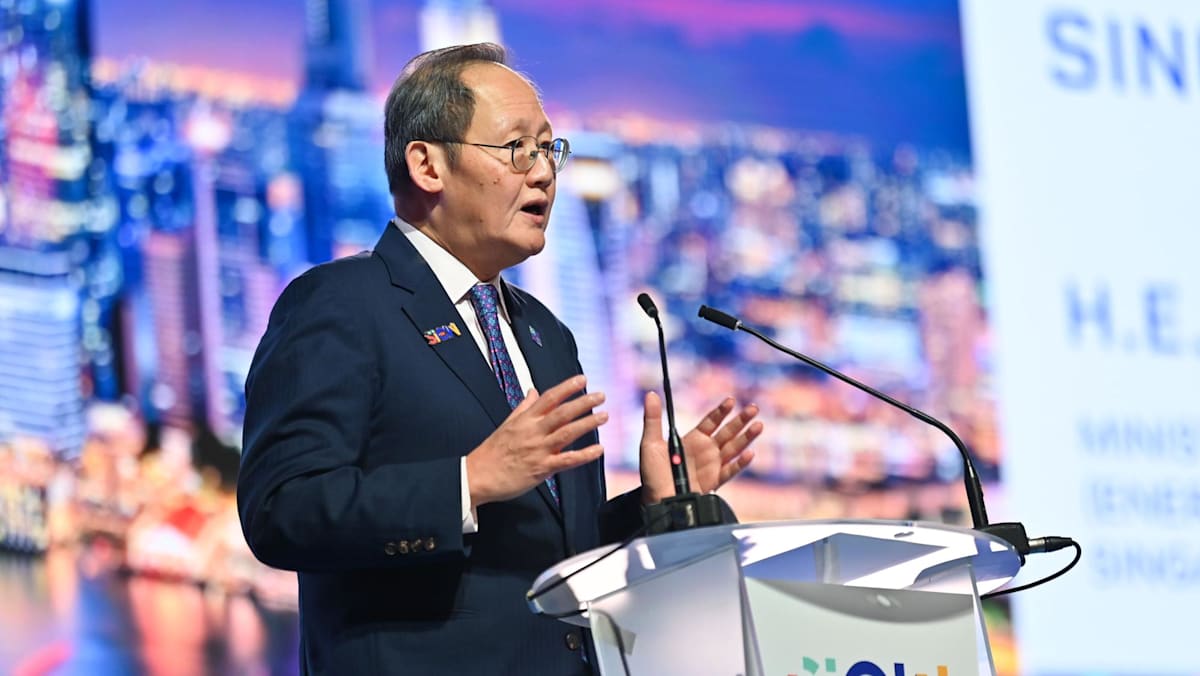
Minister for Energy, Trade and Industry (Energy and Industry) Tan See Leng giving the Singapore Energy Lecture at the Singapore International Energy Week 2026 on Oct 26, 2026. (Photo: CNA/Alyssa Tan)
This audio is generated by an AI tool.
SINGAPORE: Singapore will embark on a five-year energy infrastructure plan to meet growing demand, with more power plants, an expanded power grid and increased solar capacity among the key developments.
The plan outlines Singapore’s upcoming infrastructure developments covering power generation, natural gas, the electricity grid, solar deployment, energy storage and low-carbon electricity imports.
According to the Energy Market Authority (EMA), Singapore's peak electricity demand as of August was 8.6 gigawatts (GW). Peak demand could reach between 9.9GW and 13GW by 2031.
“This increase will mainly be due to new demand from energy-intensive sectors such as semiconductor manufacturing and data centres, as well as wider use of electric transport,” EMA said in a media release on Monday (Oct 26).
“The pace of demand growth will depend on when these new developments come onstream.”
Delivering a lecture at the start of Singapore International Energy Week 2026 on Monday, Minister for Energy, Trade and Industry (Energy and Industry) Tan See Leng said the five-year plan would be the "most significant build-up of our energy infrastructure in decades".
He noted that over the past weekend, Indonesia began cutting gas supplies to Singapore. The reduction amounts to less than 2 per cent of the country’s total daily gas demand .
Dr Tan said Singapore has dealt with similar past disruptions without incident due to measures it had invested in over many years.
“So, for Singapore ... we can keep calm and carry on,” he added, reiterating his remarks on the topic after the People’s Action Party’s conference on Sunday.
“Our households and our businesses can be assured that our energy security is always at the top of our minds. We will continue to maintain, we will continue to expand our options, strengthen our partnerships around the world, and build even greater resilience.”
Singapore will not be able to "insulate" itself from regional or global shocks, such as the crisis in the Strait of Hormuz.
During a supply crunch, countries may prioritise their domestic needs, he said.
“This trend of resource nationalism is particularly concerning, especially if it undermines established contractual agreements. Such moves will increase business risks and deter investments in the energy sector, with negative long-term implications,” the minister added.
“For energy importers like Singapore, we will have to take into account the increased risks of such supply disruptions. And this is why we have established multiple lines of defence to give ourselves the ability to mitigate the impact of disruptions and to ensure adequate energy supplies across a wide range of scenarios.”
CNA Games Guess Word Crack the word, one row at a time Buzzword Create words using the given letters Mini Sudoku Tiny puzzle, mighty brain teaser Mini Crossword Small grid, big challenge Word Search Spot as many words as you can Show More Show Less
To maximise domestic solar deployment and diversify Singapore’s energy supply, more solar capacity will be added to reservoirs, vacant land sites and building rooftops, EMA said.
The authority said that Singapore has achieved 2.3 GWp of solar capacity to date and is "well on track" to meet its existing solar target of deploying 3 GWp of solar by 2030.
It will work towards an expanded solar deployment target of 4 GWp by 2035.
Dr Tan said that solar energy is still Singapore's "most viable indigenous renewable energy source".
But even with a bigger push, solar power can meet no more than 10 per cent of the country’s projected electricity demand in 2050, he added.
EXPANDING POWER GRID
The power system will grow more complex as Singapore integrates more diverse and variable energy sources, said Dr Tan, adding that the grid must be able to handle greater variability in both electricity supply and demand.
Singapore is projected to invest up to S$5.3 billion (US$4.15 billion) between 2025 and 2029 to expand its power grid - 11 times the investments over the preceding five years.
These investments will support the building of seven new transmission substations by 2031, up from four in the previous five years.
The transmission cable network, which carries large amounts of electricity at high voltage from power plants to different parts of Singapore, will be expanded from around 7,700km currently to about 9,100km by 2030.
The distribution network, which comprises lower-voltage substations and electricity cables that deliver electricity to homes, industries and organisations will be strengthened to support new sources of supply and demand, such as solar panels and electric vehicle charging.
To support longer-term transmission needs as electricity demand grows, Singapore is studying the feasibility of more than tripling the length of cable tunnels from about 50km currently.
Cable tunnels allow for faster expansion of the grid, easier access to electricity cables for maintenance, and lower frequency and duration of road works for grid upgrades, such as laying new cables.
The extended network will also support areas with strong demand growth, such as Tampines Wafer Fab Park.
“Singapore’s electricity transmission and distribution network, such as substations and electricity cables, must also be expanded over time to support growing electricity needs,” said EMA.
Between 2026 and 2031, five new natural gas-fired power plants will be operational, which will expand Singapore’s electricity generation capacity by around 26 per cent from about 12 GW currently.
EMA is also evaluating proposals for additional natural gas-fired power plants that will be operational by 2032.
The agency will launch more requests for proposals over the next five years if electricity demand continues to grow strongly.
Singapore is also studying the feasibility of establishing a new energy cluster at Pulau Tekong .
New energy infrastructure on the island could include hydrogen-ready natural gas-fired power plants, a liquefied natural gas (LNG) terminal, and other low-carbon energy technologies.
Alongside additional power plants, Singapore is boosting its LNG regasification capacity from 10 million tonnes per annum (Mtpa) to 15 Mtpa when the second LNG terminal at Jurong Port becomes operational by 2030.
Further expansion of the first LNG terminal at Jurong Island is also being studied.
"Coupled with expansion of the natural gas transmission network, Singapore’s gas supply system will be poised to serve existing and new power plants reliably and with resilience," EMA said.
Natural gas contributes around 95 per cent of Singapore’s electricity needs currently.
BOOSTING ENERGY STORAGE CAPACITY
Singapore will also increase its energy storage capacity from around 350 megawatt-hours (MWh) currently to just over 1 gigawatt-hour (GWh) by 2030.
Energy storage systems help to balance fluctuations in energy supply and demand. These will play a critical role in supporting the future power system, Dr Tan said.
Such systems can respond quickly to supply disruptions. They can also store electricity when spare network capacity is available and discharge it during peak demand while network upgrades are underway.
This helps strengthen the reliability and stability of the power system, while managing fluctuations in renewable energy generation.
"These developments increase the need for flexibility – the ability to adjust electricity supply and demand when needed," EMA said.
As part of its plans to boost capacity, EMA has launched an Energy Storage Systems Vision and Industry Consultation Paper for the industry to propose practical energy storage technologies, business models, and projects that can be commercially deployed at scale.
The authority will also gather feedback on existing rules, technical requirements, and infrastructure constraints that could hinder the deployment of energy storage systems and how these can be addressed.
It will also develop requirements governing how these systems operate and enable them to be centrally controlled when necessary, depending on their size and role in the power system.
EMA is also seeking interest in forming an industry-led workgroup to share experiences, develop practical solutions and address barriers to deploying energy storage systems.
“Singapore’s power system is changing. Electricity demand is expected to grow rapidly over the next several years, driven by new large demand loads such as semiconductors, data centres, and electrification of the transport system,” said EMA.
The Ministry of Energy, Trade and Industry (METI) and Saudi Arabia's Ministry of Energy also announced on Monday a joint intent to establish a crude oil arrangement in Singapore.
Under the proposed arrangement, Saudi crude oil would be stored at the Jurong Rock Caverns on Jurong Island, and storage operations are expected to start in the second half of 2027.
The stored crude oil will support Singapore's energy needs should there be a supply disruption, and would also "enhance the resilience of Saudi crude oil supply chain in Southeast Asia".
EMA and JTC Corporation exchanged a memorandum of understanding with the Saudi Arabian Oil Company as a first step towards realising this arrangement.
LOW-CARBON ELECTRICITY IMPORTS
Singapore is also expanding its sources of low-carbon electricity imports, with EMA granting conditional approval to Sembcorp Utilities to import 1.3GW of electricity to Singapore.
Sembcorp Utilities is working with MY Energy Consortium and Petrovietnam Technical Services Corporation to source and integrate low-carbon electricity from regional and domestic resources, including offshore wind from Vietnam and solar power from Malaysia.
Over the next few years, the consortium will continue to develop the project, including obtaining approvals from the various jurisdictions, concluding power purchase agreements with buyers, and securing sufficient financing.
Sembcorp Utilities is working towards starting electricity imports from the project by 2035.
"Low-carbon electricity imports form a key part of Singapore’s strategy to decarbonise the power sector," EMA said.
Singapore has to date granted conditional approvals and conditional licences to electricity import projects from Australia, Cambodia, Indonesia, Malaysia, and Vietnam.
"EMA will continue to engage companies with credible and commercially viable proposals that can contribute to the decarbonisation of Singapore’s power sector,” it added.
To facilitate the flow of low-carbon electricity imports, Singapore will progressively develop sufficient electricity import landing sites to connect subsea cables to its power grid.
Detailed feasibility studies for a second electricity interconnection between Singapore and Peninsular Malaysia are underway. If realised, the interconnector could support up to 2GW of capacity by 2030, complementing the existing link which allows up to 1 GW of bi-directional electricity flows.
“Singapore will continue to monitor electricity demand and review its energy infrastructure plans based on evolving needs, to ensure that the power system remains reliable and resilient even as demand grows,” said EMA.
Dr Tan said that a connected regional grid where countries trade electricity and share reserve capacities would “lend considerable momentum to the energy transition” for Singapore and neighbouring countries.
Even as the government pursues decarbonisation, it must never come at the expense of Singapore’s livelihoods and system security, Dr Tan said.
“We will ensure that our market frameworks support a competitive and a commercially sustainable power sector, and that our households and businesses do not face an undue burden,” he added.
Get our pick of top stories and thought-provoking articles in your inbox
Stay updated with notifications for breaking news and our best stories
Join our channel for the top reads for the day on your preferred chat app
五个新的天然气发电厂、扩建的电网和增加的储能能力是重点发展领域。
2026年10月26日,能源、贸易及工业部长(能源及工业)陈诗龙在2026年新加坡国际能源周上发表新加坡能源讲座。(图片:CNA/Alyssa Tan)
这段音频是由人工智能工具生成的。
新加坡:新加坡将启动一项为期五年的能源基础设施计划,以满足不断增长的需求,其中重点发展项目包括建设更多发电厂、扩大电网和增加太阳能发电容量。
该计划概述了新加坡即将开展的基础设施发展项目,涵盖发电、天然气、电网、太阳能部署、储能和低碳电力进口。
根据新加坡能源市场管理局(EMA)的数据,截至8月份,新加坡的电力需求峰值为8.6吉瓦(GW)。到2031年,电力需求峰值可能达到9.9吉瓦至13吉瓦之间。
欧洲市场管理局(EMA)周一(10月26日)在一份新闻稿中表示:“这一增长主要归因于半导体制造和数据中心等能源密集型行业的新需求,以及电动交通工具的更广泛使用。”
“需求增长的速度将取决于这些新项目何时投入运营。”
周一,在新加坡国际能源周 2026 开幕式上,能源、贸易和工业部长(能源和工业)陈世龙发表讲话称,这项五年计划将是“几十年来我国能源基础设施建设的最重大举措”。
他指出,上周末,印尼开始削减对新加坡的天然气供应。减量幅度不到该国每日天然气总需求的2%。
陈医生表示,新加坡过去曾多次成功应对类似的突发事件,没有发生任何意外,这得益于新加坡多年来在相关措施上的投入。
“所以,对于新加坡来说……我们可以保持冷静,继续前进,”他补充道,重申了他在人民行动党周日会议后就此话题发表的言论。
“我们的家庭和企业可以放心,能源安全始终是我们最关注的问题。我们将继续保持现有水平,不断拓展能源选择,加强与世界各地的合作伙伴关系,并构建更强大的韧性。”
新加坡无法“隔绝”自身免受区域或全球冲击,例如霍尔木兹海峡危机。
他表示,在供应短缺的情况下,各国可能会优先考虑国内需求。
部长补充说:“这种资源民族主义趋势尤其令人担忧,特别是如果它破坏了既定的合同协议。此类举措将增加商业风险,阻碍能源领域的投资,并产生负面的长期影响。”
“对于像新加坡这样的能源进口国来说,我们必须考虑到此类供应中断带来的风险增加。正因如此,我们建立了多重防御机制,以便能够减轻中断的影响,并确保在各种情况下都能获得充足的能源供应。”
CNA游戏 猜词游戏 逐行破解单词 流行词游戏 用给定的字母组成单词 迷你数独 小小谜题,挑战你的大脑 迷你填字游戏 小方格,大挑战 单词搜索 尽可能多地找出单词 显示更多 显示更少
EMA表示,为了最大限度地利用国内太阳能并使新加坡的能源供应多样化,将在水库、空地和建筑物屋顶上增加更多的太阳能发电容量。
该机构表示,新加坡迄今为止已实现 2.3 GWp 的太阳能发电容量,并“有望”实现其到 2030 年部署 3 GWp 太阳能发电的既定目标。
它将努力实现到 2035 年太阳能部署规模扩大至 4 吉瓦峰值的目标。
陈博士表示,太阳能仍然是新加坡“最可行的本土可再生能源”。
但他补充说,即使加大力度,到 2050 年,太阳能发电也只能满足该国预计电力需求的 10%。
不断扩大的电网
陈博士表示,随着新加坡整合更多多样化和不稳定的能源,电力系统将变得更加复杂,电网必须能够应对电力供应和需求方面更大的波动。
预计新加坡将在 2025 年至 2029 年间投资高达 53 亿新元(41.5 亿美元)用于扩建电网,是前五年投资额的 11 倍。
这些投资将支持到 2031 年新建七座输电变电站,而前五年仅建成四座。
将大量高压电力从发电厂输送到新加坡各地的输电电缆网络,将从目前的约 7700 公里扩展到 2030 年的约 9100 公里。
配电网络(包括向家庭、工业和组织输送电力的低压变电站和电缆)将得到加强,以支持新的供需来源,例如太阳能电池板和电动汽车充电。
为了满足不断增长的电力需求,新加坡正在研究将电缆隧道长度从目前的约 50 公里增加三倍以上的可行性,以满足长期输电需求。
电缆隧道可以加快电网的扩展速度,方便对电力电缆进行维护,并减少电网升级(例如铺设新电缆)所需的道路施工频率和持续时间。
扩展后的网络还将支持需求增长强劲的地区,例如淡滨尼晶圆制造园区。
“新加坡的输配电网络,例如变电站和电缆,也必须随着时间的推移而扩建,以满足不断增长的电力需求,”EMA表示。
从 2026 年到 2031 年,将有五座新的天然气发电厂投入运营,这将使新加坡的发电能力从目前的约 12 吉瓦增加约 26%。
EMA 还在评估有关在 2032 年前投入运营的更多天然气发电厂的提案。
如果电力需求继续强劲增长,该机构将在未来五年内推出更多招标邀请书。
新加坡也在研究在德光岛建立新能源产业集群的可行性。
岛上的新能源基础设施可能包括可使用氢气的天然气发电厂、液化天然气 (LNG) 接收站和其他低碳能源技术。
除了建设更多发电厂外,新加坡还在裕廊港建设第二个液化天然气接收站,预计到 2030 年,该接收站投入运营后,新加坡的液化天然气再气化能力将从每年 1000 万吨 (Mtpa) 提高到每年 1500 万吨 (Mtpa)。
目前也在研究进一步扩建裕廊岛首个液化天然气接收站的方案。
“随着天然气输送网络的扩张,新加坡的天然气供应系统将能够可靠且有韧性地为现有和新建的发电厂提供服务,”EMA表示。
目前,天然气满足了新加坡约 95% 的电力需求。
提升储能能力
新加坡还将把储能能力从目前的约 350 兆瓦时 (MWh) 提高到 2030 年的略高于 1 吉瓦时 (GWh)。
谭博士表示,储能系统有助于平衡能源供需波动,将在支撑未来电力系统中发挥关键作用。
此类系统能够快速应对供电中断。它们还可以在电网容量有余时储存电力,并在用电高峰期释放电力,同时还能在电网升级改造期间使用备用电力。
这有助于增强电力系统的可靠性和稳定性,同时应对可再生能源发电的波动。
“这些发展趋势增加了对灵活性的需求——即在需要时调整电力供应和需求的能力,”欧洲电力市场管理局(EMA)表示。
作为提升产能计划的一部分,EMA 发布了《储能系统愿景和行业咨询文件》,供业界提出可大规模商业部署的实用储能技术、商业模式和项目。
该机构还将收集有关现有规则、技术要求和基础设施限制的反馈意见,这些限制可能会阻碍储能系统的部署,以及如何解决这些问题。
它还将制定管理这些系统运行方式的要求,并根据其规模和在电力系统中的作用,在必要时对其进行集中控制。
EMA 还希望组建一个由行业主导的工作组,以分享经验、制定切实可行的解决方案并解决部署储能系统的障碍。
“新加坡的电力系统正在发生变化。未来几年,受半导体、数据中心和交通系统电气化等新的大负荷需求推动,电力需求预计将快速增长,”EMA表示。
周一,韩国能源、贸易和工业部 (METI) 和沙特阿拉伯能源部也宣布了一项共同意向,即在新加坡建立原油供应安排。
根据拟议的安排,沙特原油将储存在裕廊岛的裕廊岩洞,预计将于 2027 年下半年开始储存作业。
如果供应中断,储存的原油将满足新加坡的能源需求,同时也将“增强沙特原油在东南亚的供应链的韧性”。
EMA 和 JTC 公司与沙特阿拉伯石油公司交换了谅解备忘录,这是实现该安排的第一步。
低碳电力进口
新加坡也在扩大其低碳电力进口来源,能源市场管理局 (EMA) 已向胜科公用事业公司 (Sembcorp Utilities) 有条件批准其向新加坡进口 1.3 吉瓦电力。
胜科公用事业公司正与 MY Energy Consortium 和越南石油技术服务公司合作,从区域和国内资源中采购和整合低碳电力,包括来自越南的海上风能和来自马来西亚的太阳能。
在接下来的几年里,该财团将继续推进该项目,包括获得各个司法管辖区的批准、与买家签订购电协议以及获得充足的资金。
胜科公用事业公司正努力争取在 2035 年前开始从该项目进口电力。
“低碳电力进口是新加坡电力行业脱碳战略的关键组成部分,”EMA表示。
新加坡迄今为止已向来自澳大利亚、柬埔寨、印度尼西亚、马来西亚和越南的电力进口项目颁发了有条件批准和有条件许可证。
“EMA将继续与那些能够为新加坡电力行业的脱碳做出贡献、提出可信且具有商业可行性方案的公司进行接洽,”该公司补充道。
为促进低碳电力进口,新加坡将逐步开发足够的电力进口登陆点,将海底电缆连接到其电网。
新加坡和马来西亚半岛之间第二条电力互联线路的详细可行性研究正在进行中。如果建成,该互联线路到2030年可支持高达2吉瓦的输电容量,与现有线路形成互补,现有线路可实现高达1吉瓦的双向电力传输。
“新加坡将继续监测电力需求,并根据不断变化的需求审查其能源基础设施计划,以确保即使需求增长,电力系统也能保持可靠和有韧性,”EMA表示。
陈博士表示,一个互联互通的区域电网,各国可以在此进行电力交易并共享备用容量,将“为新加坡及其邻国的能源转型注入相当大的动力”。
陈博士表示,即使政府致力于实现脱碳,也绝不能以牺牲新加坡人民的生计和系统安全为代价。
“我们将确保我们的市场框架支持一个具有竞争力和商业可持续性的电力行业,并确保我们的家庭和企业不会面临过重的负担,”他补充道。
订阅我们的邮件,即可获取精选热点新闻和引人深思的文章。
订阅通知,第一时间获取突发新闻和精彩报道。
加入我们的频道,即可在您常用的聊天应用上获取当日热门文章。