Government spokesman’s rebuke to the World Health Organisation (WHO). Keep out of Thai internal affairs政府发言人驳斥世界卫生组织(世卫组织):不要干涉泰国内政
WHO showdown in Bangkok as Anutin’s government moves to control billions in alcohol and tobacco taxes. ThaiHealth and three other bodies face budget uncertainty, while… Read More ›
新闻视频
October 26, 2026 at 11:21 am
in Economy , Living , Media , Politics , Thailand
A fierce row has broken out between Thailand’s government and the World Health Organisation over control of billions in alcohol and tobacco taxes. On Sunday, Prime Minister Anutin Charnvirakul’s spokesman warned the WHO against interfering in Thai affairs. The clash follows government plans to bring approximately ฿12–14 billion annually under Treasury control, ending dedicated funding for ThaiHealth and three other institutions. Meanwhile, the government has challenged spending on a luxury Koh Samui tobacco-control conference, citing hotel rooms costing ฿15,000 nightly. The WHO is defending Thailand’s internationally acclaimed health funding model, while public health leaders warn of political interference. Four institutions now face losing guaranteed revenue under legislation proposed to come into effect on the opening day of October 2027.
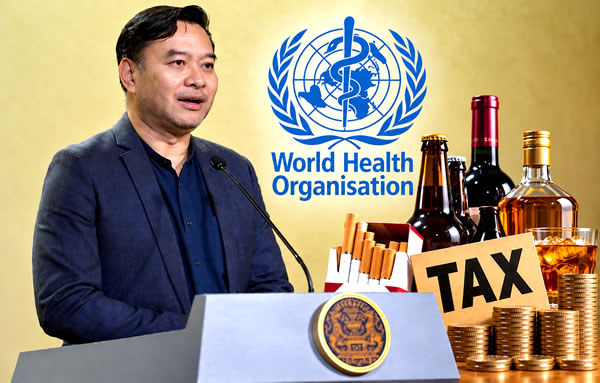
Government spokesman Ekkapop Pianpises rebukes the WHO over ฿12–14 billion in Thai sin taxes as ThaiHealth funding and luxury conference spending face scrutiny. ( Source: Thai Rath )
Thailand’s government has entered a bitter dispute with the World Health Organisation (WHO) over plans to overhaul alcohol and tobacco taxation. At stake is control over approximately ฿12–14 billion annually, collected through special levies on cigarettes and alcoholic drinks.
On Sunday, government spokesman Dr Ekkapop Pianpises warned the WHO against interfering in Thailand’s internal affairs. Meanwhile, Prime Minister Anutin Charnvirakul’s government faces opposition to changes affecting four major public institutions. The row has also widened into questions over luxury hotel conferences, expensive international travel and the use of taxpayers’ money.
The confrontation intensified on Sunday, 25 October 2026, following a direct intervention by WHO Director-General Tedros Adhanom Ghebreyesus. In a letter dated 14 October, Tedros urged Prime Minister Anutin to protect Thailand’s established public health financing arrangements.
WHO warning over ThaiHealth funding sparks sovereignty row as government defends its legal rights
Specifically, he called for the financial independence of the Thai Health Promotion Foundation, widely known as ThaiHealth, to be preserved. He also urged Thailand to maintain effective taxation of alcohol and tobacco products.
However, the government’s response was forceful. Ekkapop publicly challenged the WHO’s involvement in Thailand’s domestic legislative affairs.
The spokesman published his response on Facebook under the title Thank You to the WHO for Taking an Interest in Thailand’s Internal Affairs. He acknowledged the organisation’s responsibility to provide public health advice to member countries.
Nevertheless, he insisted that its recommendations must respect national sovereignty and avoid interference in domestic affairs.
Ekkapop argued that Thailand has established constitutional procedures for introducing, amending and repealing legislation. Furthermore, he stressed that the executive branch must honour commitments made to parliament and the public. He also referred to the judiciary’s separate constitutional responsibilities. His intervention followed criticism of the proposed changes from senior Thai public health specialists.
Government plans to redirect billions in sin taxes threaten dedicated funding for four Thai institutions
At the centre of the confrontation is legislation that would change how four major public institutions receive funding. Currently, those organisations receive dedicated revenue from special levies imposed on alcohol and tobacco excise duties.
The arrangements operate outside the government’s ordinary annual budget allocation process. Under the proposed amendments, these earmarked funding mechanisms would be abolished. Instead, the revenue would enter the Treasury and become subject to annual government budget decisions.
The four recipients are ThaiHealth, the National Sports Development Fund, the Older Persons Fund and Thai PBS. Together, they have received tens of billions of baht through the existing arrangements. Indeed, figures attributed to Thailand’s Excise Department show combined receipts of ฿58.031 billion between fiscal years 2022 and 2025. That represents an average of approximately ฿14.51 billion annually.
Contemporary estimates place the annual revenue affected by the proposed changes at approximately ฿12–14 billion. The final audited figures for fiscal year 2026, which ended on 30 September, have not been established in the available material. Even so, the historical figures demonstrate the substantial scale of the funding arrangements now under examination.
ThaiHealth funding of billions faces overhaul alongside sports, elderly welfare and public broadcasting
For ThaiHealth alone, average annual receipts during the four-year period reached approximately ฿4.04 billion. Its financial plan for fiscal year 2026 provides for approximately ฿4.58 billion.
Notably, that figure represents planned financing rather than confirmed collections from the special levy. The National Sports Development Fund received approximately ฿4.07 billion annually during the same four-year period.
Similarly, the Older Persons Fund received an annual average of approximately ฿4.38 billion. Thai PBS received approximately ฿2.01 billion annually. Consequently, the proposed legislation reaches far beyond Thailand’s principal health promotion foundation. It also affects funding for sports development, elderly welfare and the country’s public broadcasting service.
The existing arrangements are based on additional charges calculated against alcohol and tobacco excise tax liabilities. ThaiHealth receives a levy equivalent to 2% of the relevant excise duty. The National Sports Development Fund receives another 2%. Likewise, the Older Persons Fund receives 2%, while Thai PBS receives 1.5%. Together, the four levies amount to 7.5% of the underlying excise tax.
How Thailand collects alcohol and tobacco levies from producers and importers before consumers pay
Importantly, these percentages are not applied directly to the retail prices of cigarettes or alcoholic drinks. Instead, they are calculated on the amount of excise duty payable by manufacturers and importers.
For example, an excise liability of ฿100 generates an additional ฿2 for ThaiHealth. Another ฿2 goes to the National Sports Development Fund, while the Older Persons Fund receives the same amount. Thai PBS receives ฿1.50.
Therefore, the four levies increase the combined liability from ฿100 to ฿107.50. That calculation excludes other applicable charges, including the local or Interior surcharge and value-added tax. The system is administered through Thailand’s Ministry of Finance and the Excise Department.
For domestically manufactured products, excise tax generally becomes payable when goods leave factories or relevant bonded facilities.
In parallel, imported alcohol and tobacco products are subject to excise obligations when entering Thailand through customs. The duties apply to both domestic production and imported products. Although manufacturers and importers are responsible for payment, much of the financial burden passes through to consumers. As a result, the taxes are reflected in retail prices paid for cigarettes, beer, spirits and other taxable products.
Bhumjaithai defends Treasury control of sin taxes as critics warn ThaiHealth could lose independence
Alcohol excise calculations depend on both product value and alcohol content. Tobacco excise also incorporates value-based and quantity-based calculations. The special levies are then calculated against the resulting excise liabilities.
Under the proposed changes, these dedicated allocations would disappear. The government would adjust ordinary excise taxation and direct the resulting revenue into the Treasury.
Subsequently, the four organisations would seek funding through the annual national budget. The proposed amendments are associated with the Bhumjaithai Party, which leads the governing coalition. Bhumjaithai legal affairs chairman Supachai Jaisamut has defended the changes.
He argues that the legislation would not abolish ThaiHealth or necessarily terminate its existing programmes. Rather, the proposals would consolidate public revenue within the government’s fiscal system and strengthen oversight of expenditure financed through taxation.
Critics argue that the changes would remove an important guarantee of independent financing. Currently, ThaiHealth receives dedicated funding through a statutory mechanism linked to alcohol and tobacco excise collections. That arrangement allows the foundation to operate without depending entirely on annual government budget decisions. Under the proposed system, its funding would become subject to those decisions.
Proposed ThaiHealth law would give government wider control over funding from October 2027 onwards
The legislation would also change the wording governing government financial support for ThaiHealth. The existing annual subsidy obligation would be replaced by a provision for assistance as necessary.
Consequently, the government would gain greater discretion over the amount allocated to the foundation. The proposed ThaiHealth amendment is scheduled to take effect on 1 October 2027, subject to legislative approval.
However, the changes have not yet become law. Nor have future budget allocations for the four affected organisations been established. The financial implications are significant. Under the current arrangements, the recipients have statutory access to designated revenue streams. Under the proposed arrangements, those funds would become part of the central budget process.
The transfer would not automatically provide the government with ฿14 billion in additional income. The money is already collected under existing tax legislation. Instead, the principal change would concern control over its allocation and subsequent expenditure. Any additional resources available for other government priorities would depend on future funding decisions.
On another front, the government has questioned spending associated with ThaiHealth. On Saturday, 24 October, Ekkapop challenged expenditure connected with a tobacco-control conference on Koh Samui. The event was identified as the For a Smoke-Free Thai Society conference. It was held at a luxury hotel on the island.
Government spokesman questions luxury Koh Samui tobacco conference and costly international travel
The spokesman questioned why an event devoted to tobacco control required such expensive accommodation. Specifically, he cited hotel room rates starting at ฿15,000 per night. Those figures did not include additional expenditure on meals, conference facilities or travel. He also referred to accounts of expensive international conference arrangements.
According to Ekkapop, people in the pharmaceutical industry had described first-class air travel, luxury hotels and other costly arrangements. The spokesman also referred to six-star accommodation and luxury travel.
However, the available reporting does not establish that ThaiHealth financed all the expenditure he described. Nor does it establish that the foundation paid for the international travel arrangements mentioned.
Nevertheless, Ekkapop questioned the use of taxpayers’ money for expensive conferences and accommodation. He sought explanations from senior Department of Disease Control officials concerning the funding arrangements. His intervention added a dispute over spending to the wider argument about statutory financing. The following day, the spokesman turned his attention directly towards the WHO.
WHO defends Thailand’s award-winning ThaiHealth funding model and calls for sustainable health taxes
His Facebook statement challenged the organisation’s involvement in domestic legislative decisions. The sequence brought together two separate issues: financial accountability and international criticism of the proposed reforms. Meanwhile, the WHO has defended Thailand’s existing health promotion financing model.
ThaiHealth was established in 2001 and has operated for approximately 25 years. Its principal financing mechanism draws on special levies linked to alcohol and tobacco taxation.
The organisation uses these resources for health promotion and disease prevention programmes. In addition, its financing model has received international recognition.
In 2021, ThaiHealth received the WHO’s Nelson Mandela Award for Health Promotion. The award recognised its contribution to public health promotion. Consequently, the foundation occupies an established position in the WHO’s international health promotion work. In his letter to Anutin, Tedros described ThaiHealth as an internationally recognised model for financing preventive healthcare.
He urged Thailand to preserve sustainable funding for its activities. The WHO also raised the importance of maintaining effective taxation on products associated with preventable illness. Its intervention referred to the organisation’s 3 by 35 initiative. That programme promotes higher real prices for tobacco, alcohol and sugary drinks by 2035. The policy uses taxation and pricing measures to discourage consumption.
WHO offers technical assistance as Thai health specialists warn against political control of funding
The WHO did not demand that Thailand abandon its legislative proposals outright. Instead, it urged the government to protect health promotion financing and preserve the benefits of existing taxation. It also offered technical assistance to Thailand. In response, the government focused on the limits of international involvement in domestic policy.
Ekkapop acknowledged that the WHO could provide recommendations on public health matters. However, he maintained that legislative decisions must follow Thailand’s own constitutional procedures.
His statement also stressed the government’s obligations arising from its commitments to parliament. The exchange has therefore developed beyond a disagreement over tax revenue.
Meanwhile, opposition to the proposed changes has emerged within Thailand’s medical and public health communities. Dr Wichai Chokwiwat, chairman of the Senior Citizens Council of Thailand, has criticised the proposed funding arrangements.
He warned that placing ThaiHealth under the annual budget process could expose its programmes to political pressure. In particular, he questioned the implications of removing the foundation’s existing financial independence.
Former ThaiHealth leaders defend audits as critics challenge changes to earmarked public health taxes
Other critics have raised concerns about the continuity of long-term health promotion programmes. They argue that dedicated statutory financing provides greater certainty than annual budget allocations.
Separately, former ThaiHealth executives have defended the foundation’s existing financial oversight arrangements. They have pointed to annual audits and reporting requirements.
Their response challenges suggestions that independent financing necessarily means an absence of financial scrutiny. The rector of Mahidol University has also supported the WHO’s intervention. He has warned against changing the destination of revenue collected through the existing sin-tax system. The objections have added institutional weight to opposition from public health specialists.
Some critics have raised concerns about the possible influence of tobacco and alcohol interests. However, the available information does not establish improper industry influence over the legislative proposals. The government’s stated case remains focused on fiscal management, accountability and budgetary oversight. Supachai has maintained that the proposed changes would bring public revenues within a unified financial framework.
Opponents argue that this would alter the independence of organisations established for specific public purposes. The difference concerns how public money is allocated after collection.
It does not necessarily concern whether alcohol and tobacco excise duties should be abolished or reduced. Indeed, the proposed arrangements envisage continued taxation, with changes to the handling of the resulting revenue.
Four institutions face annual budget decisions as government seeks control over dedicated tax income
The four organisations currently receive funding according to statutory percentages of excise liabilities. Consequently, their receipts are linked to the operation of the tax system rather than individual annual budget decisions.
Under the proposed legislation, those automatic allocations would end. The government would instead determine funding through the national budget process.
For ThaiHealth, this would replace a dedicated revenue stream with allocations subject to government discretion. The same broad change would affect sports development, elderly welfare and public broadcasting. Together, the four recipients have received more than ฿58 billion over the four fiscal years examined. Their average annual receipts exceeded ฿14.5 billion during that period.
Meanwhile, ThaiHealth’s planned financing for fiscal year 2026 stands at approximately ฿4.58 billion. However, no confirmed replacement allocations have been established for the affected organisations. Nor has the government specified, in the available material, how much each would receive under future budgets.
Separately, Ekkapop’s allegations concerning the Koh Samui conference have introduced questions about specific expenditure. The spokesman cited accommodation rates of at least ฿15,000 per night. He also raised concerns about expensive international conference arrangements and luxury travel.
Koh Samui spending questions remain unresolved as WHO dispute puts ThaiHealth reform under scrutiny
However, the available information does not establish the total cost of the Koh Samui event. It also does not establish how much ThaiHealth paid towards the conference or related expenditure. Ekkapop has sought explanations from Department of Disease Control officials. The outcome of those inquiries has not been established in the supplied reporting.
His public criticism came immediately before his confrontation with the WHO. On 24 October, he challenged spending associated with a tobacco-control conference.
On 25 October, he warned the WHO against involvement in Thailand’s internal legislative affairs. Both interventions occurred against the background of the proposed overhaul of earmarked excise taxation.
Prime Minister Anutin is the direct recipient of the WHO director-general’s letter. The correspondence dated 14 October urged the preservation of ThaiHealth’s financial independence. It also offered assistance concerning sustainable health financing. In contrast, the government’s public response has emphasised sovereignty and domestic legislative authority.
Thailand remains a member of the WHO and participates in its international public health programmes. Nevertheless, Ekkapop has insisted that membership does not displace Thailand’s constitutional procedures. The legislative proposals remain subject to consideration and approval. Consequently, the existing funding mechanisms continue to operate pending any changes to the law.
ThaiHealth funding changes face parliamentary approval before proposed October 2027 commencement
The planned commencement date for the ThaiHealth amendment is 1 October 2027. Before then, the government must secure the legislative changes required to redirect the revenue. However, it has not established future annual allocations for the four organisations. The WHO has offered technical assistance, while the government spokesman has challenged its intervention.
Meanwhile, the spending questions raised over the Koh Samui conference remain unanswered in the available reporting. The total cost, financing arrangements and ThaiHealth’s precise contribution have not been established.
Ekkapop has demanded explanations from Department of Disease Control officials. Further scrutiny of those arrangements now accompanies parliamentary consideration of the proposed tax changes.
The next stage rests with the legislative process. If approved, the amendments would replace automatic statutory allocations with funding determined through annual government budgets. ThaiHealth and the other three recipients would remain eligible for public financing, but without their existing earmarked revenue arrangements. The proposed commencement date remains 1 October 2027, subject to parliamentary approval.
Failing foreign tourism sector at war over tourist levy and exactly who benefits from the billions raised
New taxes simply for going in and out of Thailand in addition to higher airport tax already implemented
New tourist tax of 450 baht a step closer with officials targeting early 2027 after cabinet approval is obtained
End of 2026 or early 2027 for tourist levy which has risen to 450 baht and will apply to incoming air passengers
6th Minister of Tourism and Sports in 3 years promises a tourist levy, a policy first proposed in 2015
Hardline foreign tourism confirmed by new minster. More charges, shorter visas and mandatory insurance
Visa entry period to go from 60 to 30 days. Agreement in principle as foreign tourism numbers fall by 10%
60-day visa regime to be ended confirms Minister responding to rising industry security concerns
Tourism boss warns Thailand it is facing a Chinese blacklist if another security controversy erupts
Ung Ing finally gives the order. Thailand pulls the plug on scam centre electricity in Burma. Cut at 9 am
PM on a mission to China to ask President Xi Jinping to help rein in heavy online criticism of the kingdom
Joseph Anthony is an expat from Ireland who has lived in Thailand for the last decade. He has worked extensively in the media including editorial positions in Ireland and Thailand. He is focused on economic and business stories in Thailand as well as the expat lifestyle.
All posts by Joseph O' Connor
Tourism industry shaken by the latest Chinese warning coming from its diplomatic missions in Thailand October 20, 2026 China warns its citizens of abductions and trafficking
PM orders hands off land and property by foreigners as enforcement to be moved ahead by December October 20, 2026 Anutin puts thousands of suspected foreign land
Chinese and Vietnamese links probed in police open files on nightlife activities in Bangkok and Rayong October 19, 2026 Police storm a karaoke bar at 4 am, arresting 13
Nigerian cocaine gang arrested after strict crackdown orders from the Immigration Bureau chief Big Nop October 18, 2026 Bangkok cocaine sting leads police from a dealer to a
Midnight raids in Rayong on karaoke clubs fronting for prostitution see local police chief sidelined pending enquiries October 17, 2026 Four unlicensed KTV clubs serving Chinese customers
American company director arrested in Bangkok Thursday for failing to over a million baht in wages October 17, 2026 Nearly four months after a court issued its first
Pheu Thai leadership assures PM of support in the No Conference debate and vote at the end of October October 17, 2026 Pheu Thai chiefs promise Anutin all 71 MPs to defeat a
Justice Ministry boss reveals ‘Black Research’ aimed at High School students. 3,000 sexual abuse images October 16, 2026 Schoolboys aged 15–17 were tricked into supplying
Man gunned down by motorcycle assassins outside a weed shop in Bangkok’s Laksi district early Friday October 16, 2026 Two motorcycle gunmen unleash more than ten shots
Police arrest South Korean after child reports mother being abused. Man found to have overstayed his visa October 16, 2026 A sudden call from a Thai woman’s child triggers
Base pipe bomb attack on Thursday in southern Yala province left five army officers with minor injuries October 16, 2026 Yala security forces come under bomb attack as
Prime Minister Anutin talks of an economy driven by ‘quality growth’ at the Bangkok IMF World Bank forum October 15, 2026 Anutin promises advanced industries, richer tourists
Thai Airways now says baggage failure was five times worse than admitted. Board orders compensation October 15, 2026 Thai Airways faces a worldwide reckoning after 25,000
Boss Surat Thani woman shot worker who borrowed a cooking pot and motorbike dead after he attacked her October 15, 2026 Roadside bloodshed in Surat Thani as a woman shoots
Malaysian couple on honeymoon with 40 litres of petrol spark security crisis at IMF World Bank summit October 14, 2026 Bomb squad police search a Malaysian couple’s
Ekniti clings to AI to buoy the Thai economy and even promises a second life for the ‘sick man of Asia’ October 14, 2026 Ekniti pitches an AI-powered revival at the
Child trafficked from Burma sold for 30k baht by her mother as top ministers smash vile ring in Bangkok October 13, 2026 Two arrested and six Burmese children rescued in
Hellish battle with UK Home Office for Brit seeking to bring Burmese fiancée and son home for Christmas October 20, 2026
7kg heroin in drink sachets bound for Australia found in a Samut Prakan premises after police tip off October 19, 2026
Much loved Robocop, a popular figure in Nonthaburi near Bangkok dies in a tragic road traffic accident October 19, 2026
Thai star Nene Royal faces trademark headaches in Thailand and South Korea as she secures her fortune October 18, 2026
Six dead in deadly clashes in Southern Thailand including a policeman killed on National Police Day October 17, 2026
Underfire southern MP says Prime Minister Anutin telephoned her and urged her to post a selfie online October 17, 2026
Prime Minister cock a hoop as IMF World Bank meet ends in Bangkok. Insists Thailand’s standing has risen October 17, 2026
Departures tax pushed by the Ministry of Finance is the death kiss for the tourist sector say top execs October 16, 2026
US Bangkok broadside to the IMF and the World Bank delivered by Scott Bessent who snubbed the meeting October 16, 2026
Friday protests by anti IMF World Bank activists continue after overnight camp event in central Bangkok October 16, 2026
Air hostess linked to international trafficking ring smuggling Chinese nationals in and out of Thailand October 16, 2026
Protests at the IMF World Bank meetings turn violent but Bangkok police deny being heavy handed October 15, 2026
Bhumjaithai Party Southern MP facing political strain as questions grow about her husband’s online fortune October 15, 2026
Portuguese woman’s 5 year stay in Thailand without a valid visa ends at a Phuket cookery class on Tuesday October 15, 2026
Thai police get involved in Hong Kong prostitution ring smashed last weekend which yielded vast returns October 14, 2026
Police arrest Chinese tourist thief who used Thai flights to snatch credit cards and run up charges on them October 14, 2026
UK man urgently sought by family after vanishing in Thailand over a week ago just before his flight home October 13, 2026
Tax grab targeted at outbound passengers is opposed by travel industry as ministry pushes a new agenda October 13, 2026
Upmarket Thai prostitution racket smashed by Hong Kong police. 16 people arrested in separate swoops October 13, 2026
Air force monitors Chinese base operation in Laos as Beijing strengthens military ties with neighbours October 12, 2026
Tourist police reach out to Russian Embassy to inform tourists visiting Thailand about laws and customs October 12, 2026
Police chief says Bangkok is ready for World Bank and IMF meetings with over 18,000 delegates visiting October 12, 2026
© 2026 Thai Examiner. All rights reserved.
2026年10月26日上午11:21
经济、生活、媒体、政治、泰国
泰国政府与世界卫生组织就数十亿泰铢的烟酒税收控制权问题爆发激烈争执。周日,泰国总理阿努廷·查恩维拉库尔的发言人警告世卫组织不要干涉泰国内政。此前,泰国政府计划将每年约120亿至140亿泰铢的税收纳入财政部控制,这将终止对泰国卫生署(ThaiHealth)和其他三个机构的专项拨款。与此同时,泰国政府质疑在苏梅岛举办的豪华控烟会议的支出,并指出会议期间酒店房间每晚费用高达1.5万泰铢。世卫组织则力挺泰国享誉国际的卫生筹资模式,而公共卫生领域的领导者则警告称,此举可能引发政治干预。根据一项拟于2027年10月初生效的法案,这四个机构将面临失去有保障的收入。
政府发言人埃卡波·皮安皮塞斯就泰国120亿至140亿泰铢的“罪恶税”问题斥责世界卫生组织,同时,泰国卫生基金和豪华会议支出也面临审查。(来源:泰叻报)
泰国政府与世界卫生组织(世卫组织)就烟酒税收改革计划展开激烈争论。此次争论的焦点在于每年约120亿至140亿泰铢的税收控制权,这些税收是通过对香烟和酒精饮料征收的特别税获得的。
周日,政府发言人埃卡波·皮安皮塞斯博士警告世界卫生组织不要干涉泰国内政。与此同时,总理阿努廷·查恩维拉库尔领导的政府因涉及四大公共机构的改革而面临反对。这场争论也扩大到豪华酒店会议、昂贵的国际旅行以及纳税人资金的使用等问题。
2026年10月25日星期日,在世界卫生组织总干事谭德塞直接介入后,双方对抗升级。谭德塞在10月14日的一封信中敦促泰国总理阿努廷保护泰国既有的公共卫生筹资安排。
世界卫生组织就泰国卫生部资金问题发出警告,引发主权争议,泰国政府捍卫其合法权利。
他特别呼吁维护泰国健康促进基金会(简称“泰健康基金会”)的财政独立性。他还敦促泰国继续对烟酒产品征收有效税款。
然而,政府的反应十分强硬。埃卡波公开质疑世卫组织干预泰国国内立法事务。
发言人在脸书上发表了题为《感谢世卫组织关注泰国内政》的回应。他承认世卫组织有责任向成员国提供公共卫生建议。
然而,他坚持认为,其建议必须尊重国家主权,避免干涉内政。
埃卡波认为,泰国已建立宪法规定的立法程序,包括立法的引入、修改和废除。此外,他强调行政部门必须履行对议会和公众的承诺。他还提及司法部门独立的宪法职责。此前,泰国资深公共卫生专家对拟议的修改方案提出了批评,埃卡波对此发表了讲话。
政府计划将数十亿泰国税收重新分配,这威胁到泰国四家机构的专项资金。
这场冲突的核心是一项立法,该立法将改变四家主要公共机构的资金来源方式。目前,这些机构的专项收入来自对烟酒消费税征收的特别税款。
这些安排独立于政府的年度预算拨款程序之外运作。根据拟议的修正案,这些专项拨款机制将被废除。取而代之的是,这笔收入将进入国库,并纳入政府年度预算决策的考量范围。
这四家受益机构分别是泰国健康保险公司(ThaiHealth)、国家体育发展基金、老年人基金和泰国公共广播公司(Thai PBS)。根据现有安排,它们共计已获得数百亿泰铢的资金。事实上,泰国税务局的数据显示,2022至2025财年间,这四家机构的资金总额达到580.31亿泰铢,平均每年约145.1亿泰铢。
根据目前的估计,拟议变更将影响每年约120亿至140亿泰铢的收入。截至9月30日结束的2026财年的最终审计数据尚未在现有资料中公布。即便如此,历史数据也表明,目前正在审查的融资安排规模巨大。
泰国卫生部数十亿泰铢的资金将面临改革,体育、老年人福利和公共广播等领域也将进行改革。
仅就 ThaiHealth 而言,四年期间的年均收入约为 40.4 亿泰铢。其 2026 财年的财务计划预算约为 45.8 亿泰铢。
值得注意的是,该数字代表的是计划融资额,而非特别税的实际征收额。在同一四年期间,国家体育发展基金每年大约收到40.7亿泰铢的拨款。
同样,老年人基金每年平均获得约43.8亿泰铢的拨款。泰国公共广播公司(Thai PBS)每年获得约20.1亿泰铢的拨款。因此,拟议的立法影响远不止泰国的主要健康促进基金会,它还会影响体育发展、老年人福利和国家公共广播服务的资金。
现行安排基于对烟酒消费税负债的额外征费。泰国健康促进基金会(ThaiHealth)收取相当于相关消费税2%的附加费。国家体育发展基金收取另外2%。同样,老年人基金收取2%,而泰国公共服务委员会(Thai PBS)收取1.5%。这四项附加费合计占基础消费税的7.5%。
泰国如何在消费者付款前向生产商和进口商收取酒类和烟草税?
需要注意的是,这些百分比并非直接应用于香烟或酒精饮料的零售价格。相反,它们是根据制造商和进口商应缴纳的消费税金额计算得出的。
例如,100泰铢的消费税负债可使泰国健康基金(ThaiHealth)额外获得2泰铢。另有2泰铢拨入国家体育发展基金,老年人基金也获得相同数额的款项。泰国公共服务委员会(Thai PBS)则获得1.50泰铢。
因此,这四项税费使总税额从100泰铢增加到107.50泰铢。该计算不包括其他适用费用,例如地方附加费或内陆附加费以及增值税。该系统由泰国财政部和税务局负责管理。
对于国内生产的产品,消费税一般在货物离开工厂或相关保税设施时缴纳。
与此同时,进口的酒精和烟草产品在经泰国海关进入泰国时,需缴纳消费税。该税项适用于国内生产和进口产品。虽然生产商和进口商负有缴税责任,但大部分经济负担最终会转嫁到消费者身上。因此,香烟、啤酒、烈酒和其他应税产品的零售价格中都反映了这些税费。
泰尚德党捍卫财政部对罪恶税的控制权,批评人士警告称,泰国健康保险机构(ThaiHealth)可能因此失去独立性。
酒精消费税的计算取决于产品价值和酒精含量。烟草消费税也采用基于价值和基于数量的计算方法。特别税款则根据由此产生的消费税负债进行计算。
根据拟议的改革方案,这些专项拨款将取消。政府将调整普通消费税,并将由此产生的收入纳入国库。
随后,这四个组织将寻求通过年度国家预算获得资金。这些拟议的修正案与领导执政联盟的泰自豪党有关。泰自豪党法律事务主席苏帕猜·贾伊萨穆特为这些修改辩护。
他认为,这项立法不会废除泰国健康保险计划(ThaiHealth),也未必会终止其现有项目。相反,这些提案旨在整合政府财政体系内的公共收入,并加强对税收资助支出的监督。
批评人士认为,这些改革将取消独立融资的一项重要保障。目前,泰国健康基金会通过与烟酒税收入挂钩的法定机制获得专项资金。这种安排使得该基金会能够在不完全依赖政府年度预算决策的情况下运作。而根据拟议的方案,其资金来源将受到政府预算决策的影响。
拟议的泰国健康法案将赋予政府从2027年10月起对医疗资金更大的控制权。
该法案还将修改有关政府对泰国健康保险计划(ThaiHealth)财政支持的措辞。现有的年度补贴义务将被一项按需援助条款所取代。
因此,政府将对拨付给该基金会的金额拥有更大的自主权。拟议的《泰国健康法案》修正案计划于2027年10月1日生效,但须经立法机构批准。
然而,这些变更尚未正式生效,也未确定未来四个受影响机构的预算拨款。其财务影响重大。根据现行安排,受益机构依法享有指定的收入来源。而根据拟议的安排,这些资金将纳入中央预算流程。
这项转移不会自动为政府带来140亿泰铢的额外收入。这笔钱已根据现行税法征收。主要变化在于对这笔资金的分配和后续支出拥有更大的控制权。任何可用于其他政府优先事项的额外资源,都将取决于未来的拨款决策。
另一方面,政府对与泰国健康基金会(ThaiHealth)相关的支出提出了质疑。10月24日星期六,埃卡波普(Ekkapop)对在苏梅岛举行的控烟会议的相关支出提出质疑。该会议名为“为了无烟泰国社会”,在岛上一家豪华酒店举行。
政府发言人质疑苏梅岛豪华烟草会议和昂贵的国际旅行。
发言人质疑,为何一个以控烟为主题的活动需要如此昂贵的住宿。他特别指出,酒店房间价格每晚起价15,000泰铢。这些费用还不包括餐饮、会议设施或差旅等其他开支。他还提及了国际会议高昂的安排。
据埃卡波普称,制药行业人士描述了头等舱机票、豪华酒店和其他昂贵的安排。这位发言人还提到了六星级酒店和豪华旅行。
然而,现有报道并未证实泰国健康基金会承担了他所描述的所有支出,也未证实该基金会支付了所提及的国际旅行安排费用。
然而,埃卡波普质疑用纳税人的钱举办昂贵的会议和住宿。他要求疾病控制部门的高级官员解释资金安排情况。他的介入使这场关于支出的争论,与关于法定资金的更广泛争论交织在一起。第二天,这位发言人将矛头直接指向了世界卫生组织。
世界卫生组织捍卫泰国屡获殊荣的ThaiHealth医疗筹资模式,并呼吁建立可持续的医疗税收制度。
他在脸书上发表声明,质疑该组织干预泰国国内立法决策的做法。这一连串事件将两个原本无关的问题联系在一起:财务问责制以及国际社会对拟议改革的批评。与此同时,世卫组织则为泰国现有的健康促进融资模式进行了辩护。
ThaiHealth成立于2001年,至今已运营约25年。其主要融资机制来自与酒精和烟草税收相关的特别税款。
该组织利用这些资源开展健康促进和疾病预防项目。此外,其融资模式也获得了国际认可。
2021年,泰国健康基金会荣获世界卫生组织颁发的纳尔逊·曼德拉健康促进奖。该奖项旨在表彰其在公共卫生促进方面做出的贡献。因此,该基金会在世卫组织的国际健康促进工作中占据了举足轻重的地位。谭德塞在致阿努廷的信中,将泰国健康基金会描述为国际公认的预防性医疗保健融资模式。
他敦促泰国为其各项活动维持可持续的资金来源。世界卫生组织也强调了对与可预防疾病相关的产品维持有效税收的重要性。世卫组织的发言提到了其“3 by 35”倡议。该倡议旨在到2035年提高烟草、酒精和含糖饮料的实际价格。这项政策通过税收和价格措施来抑制消费。
世界卫生组织提供技术援助,与此同时,泰国卫生专家警告称,资金可能受到政治控制。
世界卫生组织并未要求泰国彻底放弃其立法提案,而是敦促泰国政府保护卫生促进资金,并维护现有税收政策的益处。世卫组织还向泰国提供了技术援助。对此,泰国政府则强调国际社会干预国内政策的局限性。
埃卡波承认世界卫生组织可以就公共卫生问题提出建议。但他坚持认为,立法决定必须遵循泰国自身的宪法程序。
他的声明还强调了政府根据其对议会的承诺所承担的义务。因此,双方的交锋已不再局限于税收方面的分歧。
与此同时,泰国医疗和公共卫生界也出现了反对这些拟议改革的声音。泰国老年人理事会主席维猜·乔克维瓦特博士批评了拟议的资金安排。
他警告说,将泰国健康基金会纳入年度预算编制流程可能会使其项目面临政治压力。他尤其质疑取消该基金会现有的财务独立性会带来哪些影响。
泰国卫生部前领导人为审计工作辩护,批评人士则质疑公共卫生专项税的改革。
其他批评人士则对长期健康促进项目的持续性表示担忧。他们认为,专项法定拨款比年度预算拨款更能确保项目的持续性。
此外,泰国健康基金会的前高管们也为该基金会现有的财务监管安排辩护。他们指出,基金会设有年度审计和报告机制。
他们的回应驳斥了独立融资必然意味着缺乏财务审查的说法。玛希隆大学校长也支持世界卫生组织的干预。他警告不要改变现有罪恶税制度所征收收入的用途。这些反对意见为公共卫生专家的反对立场增添了制度上的分量。
一些批评人士对烟草和酒精行业可能施加的影响表示担忧。然而,现有信息并未证实相关行业对立法提案存在不正当影响。政府的立场依然是强调财政管理、问责制和预算监督。苏帕猜坚称,拟议的改革将使公共收入纳入统一的财政框架。
反对者认为,这将改变为特定公共目的而设立的组织的独立性。分歧在于公共资金征收后如何分配。
这并非必然涉及是否应取消或降低烟酒消费税。事实上,拟议的安排设想继续征税,只是改变由此产生的税收收入的处理方式。
政府寻求控制专项税收收入,四个机构面临年度预算决策。
这四个组织目前根据法定比例的消费税负债获得资助。因此,它们的收入与税收系统的运作挂钩,而非与个别年度预算决策挂钩。
根据拟议的法案,这些自动拨款将终止。政府将改为通过国家预算程序来确定资金来源。
对泰国健康基金会(ThaiHealth)而言,这将取代其专项收入来源,转而采用由政府酌情决定的拨款方式。同样的重大变革也将影响体育发展、老年人福利和公共广播等领域。在所考察的四个财政年度中,这四个受益机构共计获得超过580亿泰铢的拨款。在此期间,它们的平均年收入超过145亿泰铢。
与此同时,泰国健康促进局(ThaiHealth)2026财年的计划融资额约为45.8亿泰铢。然而,目前尚未确定受影响机构的替代拨款方案。政府在现有资料中也未明确说明各机构在未来预算中将获得多少资金。
此外,Ekkapop 对苏梅岛会议的指控也引发了人们对具体支出的质疑。这位发言人指出,住宿费用至少为每晚 15,000 泰铢。他还对昂贵的国际会议安排和豪华旅行表示担忧。
苏梅岛的支出问题仍未解决,世卫组织的争议使泰国医疗改革受到密切关注。
然而,现有信息并未确定苏梅岛活动的全部费用,也未说明泰国健康促进基金会为此次会议或相关支出支付了多少费用。Ekkapop已向疾病控制部门官员寻求解释,但所提供的报道中并未提及调查结果。
在他与世卫组织发生冲突之前,他立即发表了公开批评言论。10月24日,他质疑了与一次控烟会议相关的支出。
10月25日,他警告世卫组织不要干涉泰国的内部立法事务。这两次干预都发生在拟议改革专项消费税的背景下。
阿努廷总理是世卫组织总干事信函的直接收件人。这封日期为10月14日的信函敦促泰国卫生署维护其财政独立性,并就可持续卫生筹资问题提供了援助。与之形成鲜明对比的是,泰国政府的公开回应则强调了主权和国内立法权。
泰国仍是世界卫生组织成员国,并参与其国际公共卫生项目。然而,埃卡波普坚持认为,成员国身份并不凌驾于泰国的宪法程序之上。相关立法提案仍需审议和批准。因此,在法律做出任何修改之前,现有的资金机制将继续运作。
ThaiHealth 的资金变更方案需经议会批准后方可生效,预计生效日期为 2027 年 10 月。
泰国卫生法案修正案计划于2027年10月1日生效。在此之前,政府必须完成必要的立法修改,以重新分配这笔收入。然而,政府尚未确定未来对这四个组织的年度拨款。世界卫生组织已表示愿意提供技术援助,但政府发言人对世卫组织的介入提出质疑。
与此同时,现有报道仍未解答有关苏梅岛会议支出方面的问题。总成本、融资安排以及泰国健康保险公司(ThaiHealth)的具体出资额均未确定。
埃卡波普已要求疾病控制部门官员作出解释。目前,在议会审议拟议的税收改革方案的同时,这些安排也将受到进一步审查。
下一阶段取决于立法程序。如果获得批准,这些修正案将以年度政府预算确定的资金取代自动法定拨款。泰国健康保险公司(ThaiHealth)和其他三个受益机构仍有资格获得公共资金,但不再享有现有的专项收入安排。拟议的生效日期仍为2027年10月1日,但需经议会批准。
外国旅游业举步维艰,双方就旅游税问题争执不下,究竟谁能从筹集的数十亿美元中获益。
除了已经实施的更高机场税之外,泰国还将新增出入境税。
新旅游税450泰铢的实施计划又向前迈进了一步,官员们计划在获得内阁批准后于2027年初实施。
旅游税将于2026年底或2027年初开始征收,目前已上调至450泰铢,并将适用于入境航空旅客。
三年内第六位旅游和体育部长承诺征收旅游税,这项政策最早于2015年提出。
新任部长确认将对外国旅游采取强硬措施。增加收费、缩短签证期限并强制购买保险。
签证入境期限由60天缩短至30天。鉴于外国游客数量下降10%,该提议已原则上达成一致。
部长确认将取消60天签证制度,以回应日益增长的行业安全担忧
泰国旅游业负责人警告称,如果再次爆发安全争议,泰国将面临被中国列入黑名单的风险。
翁英终于下达了命令。泰国切断了缅甸诈骗中心的电力供应。上午9点结束
首相奉命访问中国,请求习近平主席帮助遏制网络上对沙特阿拉伯王国的猛烈批评。
约瑟夫·安东尼是一位来自爱尔兰的侨民,过去十年一直居住在泰国。他曾在爱尔兰和泰国的媒体行业担任过编辑职务,拥有丰富的媒体从业经验。他主要关注泰国的经济和商业新闻,以及侨民的生活方式。
约瑟夫·奥康纳的所有帖子
泰国旅游业受到中国驻外使领馆最新警告的震动 2026年10月20日 中国警告其公民提防绑架和人口贩运
总理下令禁止外国人侵占土地和房产,执法行动将于2026年10月20日前推进。阿努廷将数千块疑似外国土地划为非法占地。
2026年10月19日,警方公开调查曼谷和罗勇夜生活场所的中国和越南关联,并展开调查。凌晨4点,警方突袭一家卡拉OK酒吧,逮捕13人。
2026年10月18日,在移民局局长“大诺普”(Big Nop)的严厉打击下,一个尼日利亚可卡因团伙在曼谷落网。此次缉毒行动将警方从一名毒贩引向了最终的犯罪团伙。
2026年10月17日午夜,罗勇府警方突击搜查以卖淫为幌子的卡拉OK俱乐部,当地警察局长因接受调查而被停职。四家无证KTV俱乐部为中国顾客提供服务。
一名美国公司董事周四在曼谷被捕,原因是拖欠超过一百万泰铢的工资(2026年10月17日)。此前近四个月,法院首次发出逮捕令。
为泰党领导层向总理保证,将在10月底的反对党大会辩论和投票中给予支持。2026年10月17日,为泰党领导人向阿努廷承诺,将动用全部71名议员的力量,击败反对党大会。
司法部部长揭露针对高中生的“黑名单”调查。2026年10月16日,3000张性虐待图片曝光。15至17岁的男学生被骗提供图片。
2026年10月16日星期五凌晨,一名男子在曼谷叻西区一家大麻店外遭摩托车枪手射杀。两名摩托车枪手开了十多枪。
警方逮捕一名韩国男子,此前一名儿童举报其母亲遭到虐待。该男子被发现签证过期滞留。2026年10月16日,一名泰国女子的孩子突然来电,引发了一系列事件。
2026年10月16日,亚拉省南部一处军事基地发生管状炸弹袭击,造成五名军官轻伤。亚拉安全部队遭到炸弹袭击。
2026年10月15日,阿努廷总理在曼谷举行的国际货币基金组织和世界银行论坛上谈到,经济将以“高质量增长”为驱动力。阿努廷承诺发展先进产业,并吸引更多富裕的游客。
泰国航空现称行李事故比之前承认的严重五倍。董事会于2026年10月15日下令赔偿。在造成25000人次事故后,泰国航空面临全球舆论的谴责。
2026年10月15日,素叻他尼一名女子枪杀了一名借给她锅碗瓢盆和摩托车的工人,此前该工人曾袭击她。
2026年10月14日,一对马来西亚夫妇蜜月旅行时携带40升汽油,引发国际货币基金组织世界银行峰会安全危机。警方拆弹小组搜查了这对马来西亚夫妇的行李。
Ekniti 力挺人工智能以提振泰国经济,甚至承诺让“亚洲病夫”重获新生。2026年10月14日,Ekniti 提出了一项人工智能驱动的复兴计划。
2026年10月13日,曼谷高级官员捣毁一个令人发指的贩卖儿童团伙,两名缅甸儿童被捕,六名缅甸儿童获救。一名从缅甸被拐卖的女童被其母亲以3万泰铢的价格卖掉。两名缅甸儿童被捕,六名缅甸儿童获救。
一名英国男子试图将缅甸未婚妻和儿子带回家过圣诞节,却与英国内政部展开了一场艰苦卓绝的斗争(2026年10月20日)
2026年10月19日,警方根据线报在北榄府一处房屋内查获7公斤海洛因,这些海洛因藏在饮料袋中,原计划运往澳大利亚。
深受喜爱的“机械战警”(Robocop)是曼谷附近暖武里府的知名人物,于2026年10月19日因一场悲惨的交通事故去世。
泰国明星妮妮·罗亚尔(Nene Royal)在泰国和韩国面临商标纠纷,她正努力保住自己的财富。2026年10月18日
泰国南部发生致命冲突,造成六人死亡,其中包括一名在2026年10月17日国家警察日当天殉职的警察。
备受争议的南方议员称,总理阿努廷于2026年10月17日致电她,敦促她在网上发布一张自拍照。
泰国总理在曼谷举行的国际货币基金组织和世界银行会议闭幕之际沾沾自喜,坚称泰国的地位已经提升。(2026年10月17日)
财政部力推的离境税是旅游业的致命一击,高管们表示 2026年10月16日
美国驻曼谷大使斯科特·贝森特向国际货币基金组织和世界银行发出严厉警告,他缺席了2026年10月16日举行的会议。
2026年10月16日,在曼谷市中心举行通宵露营活动后,反对国际货币基金组织和世界银行的活动人士的抗议活动仍在继续。
2026年10月16日,一名空姐被曝与国际人口贩运团伙有关联,该团伙负责将中国公民偷渡出泰国。
国际货币基金组织和世界银行会议期间的抗议活动演变为暴力事件,但曼谷警方否认使用暴力手段 2026年10月15日
泰自豪党南部议员因其丈夫的网上财富受到质疑而面临政治压力 2026年10月15日
一名葡萄牙女子在没有有效签证的情况下在泰国滞留了五年,于2026年10月15日星期二在普吉岛的一堂烹饪课上结束了她的滞留。
泰国警方参与了上周末捣毁的香港卖淫团伙,并缴获了巨额赃物 2026年10月14日
警方逮捕了一名利用泰国航班抢夺信用卡并进行高额消费的中国游客(2026年10月14日)
一名英国男子在泰国失踪,家人正在紧急寻找他。他于一周多前失踪,当时正准备搭乘2026年10月13日的航班回国。
针对出境旅客的税收政策遭到旅游业的反对,与此同时,该部正力推一项新议程 2026年10月13日
香港警方捣毁泰国高档卖淫团伙,16人于2026年10月13日分批出动逮捕。
美国空军密切关注中国在老挝的军事基地运作,北京正加强与邻国的军事联系 2026年10月12日
旅游警察联系俄罗斯大使馆,向前往泰国的游客介绍当地的法律和习俗(2026年10月12日)
曼谷警察局长表示,曼谷已为2026年10月12日举行的世界银行和国际货币基金组织会议做好准备,预计将有超过18000名代表到访。
© 2026 Thai Examiner。版权所有。