S’pore commits $138m to food research, with new focus on climate and global supply risks新加坡承诺投入1.38亿美元用于食品研究,重点关注气候和全球供应风险。
Singapore commits $138m to food research, focusing on climate risks, supply disruptions and food resilience. Read more at straitstimes.com.
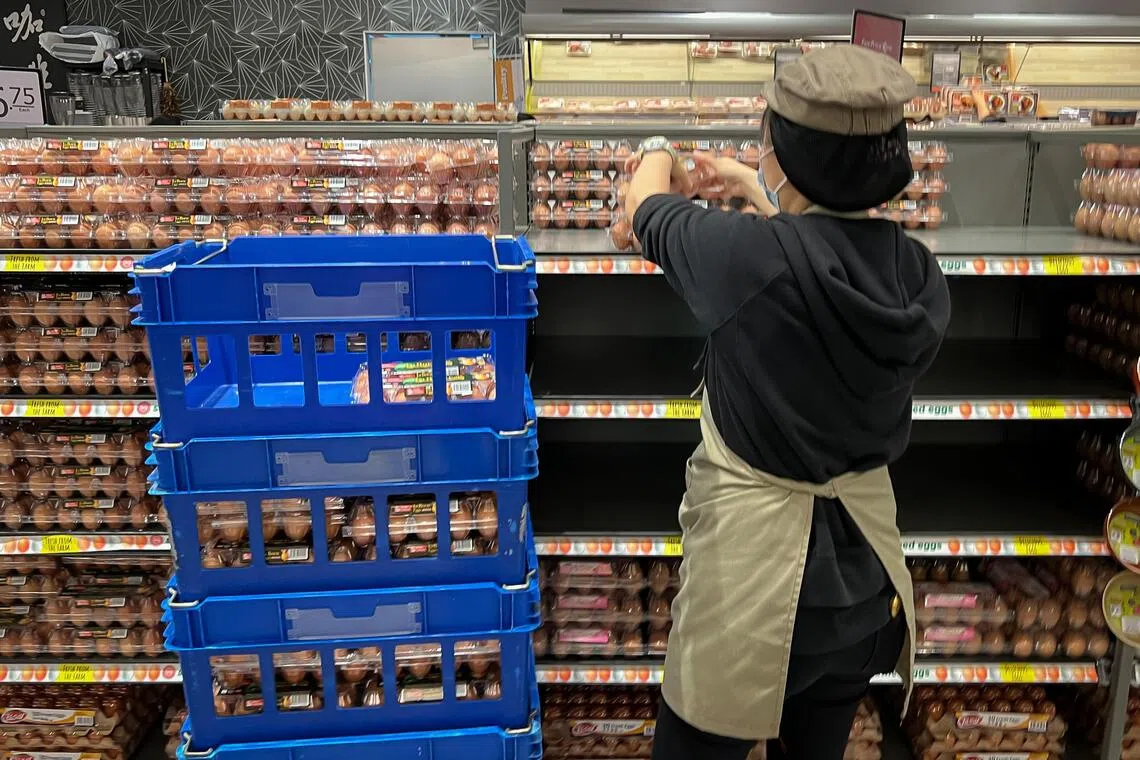
Eggs from Seng Choon Farm on the shelves of a FairPrice outlet at Vivocity. Singapore will invest $138 million in food research and development over the next five years.
Published Oct 27, 2026, 11:25 AM
Updated Oct 27, 2026, 11:25 AM
Singapore has given S$138 million to the RIE 2030 food R&D programme to boost food resilience, aquaculture, agriculture, future foods and food safety.
Grace Fu said climate change and haze show why Singapore needs a “diversified and adaptable food system”, as the country imports more than 90 per cent of its food.
SFA also signed a deal with JAPFA to improve tropical aquaculture through AI disease monitoring, digital tools and better farm management.
SINGAPORE – Singapore will invest $138 million in food research and development over the next five years, with a new focus on strengthening resilience to climate-related risks and global supply disruptions.
With the funding, the Singapore Food Agency (SFA) will support research into better forecasting of such risks using data and modelling, as well as develop technologies to extend the shelf life of food and optimise stockpile management.
It will also support research in four existing areas: aquaculture, agriculture, future foods and food safety.
Minister for Sustainability and the Environment Grace Fu said on Oct 27 that as climate change and other challenges place increasing pressure on food production, “we need to ensure that agriculture is not only productive, but also sustainable and resilient for the long term”.
Delivering the keynote address at the Asia-Pacific Agri-Food Innovation Summit at the Suntec Convention Centre, Fu cited the current haze situation, calling it “a reminder that climate change is not a distant challenge but one that is already affecting the region”.
She said practices such as peatland drainage and open burning bring short-term gains, but the repeated burning can reduce soil fertility and damage ecosystems that support agriculture.
“They can ultimately undermine agricultural productivity, livelihoods, and food security in the long run,” she added.
Peatland drainage and open burning bring short-term gains, but they can ultimately undermine agricultural productivity, livelihoods, and food security in the long run, said Minister for Sustainability and the Environment Grace Fu. AFP
Peatland drainage and open burning bring short-term gains, but they can ultimately undermine agricultural productivity, livelihoods, and food security in the long run, said Minister for Sustainability and the Environment Grace Fu.
Singapore imports more than 90 per cent of the country’s food.
“We cannot insulate ourselves from global disruptions simply by producing more food locally. We must instead build resilience through a diversified and adaptable food system,” said Fu, who is also the Minister-in-charge of Trade Relations.
Citing the Singapore Food Story 2, the country’s refreshed food resilience strategy, the minister said it provides a framework for strengthening food resilience.
The strategy has four key pillars: diversifying imports; working with like-minded global partners to secure food trade; stockpiling food and growing it locally; and developing additional capabilities and options to cope with global supply chain disruptions.
“For a small, resource-constrained country like Singapore, innovation is essential to overcoming our limitations and strengthening the resilience and competitiveness of our agri-food sector,” she said.
The $138m funding comes under the Research, Innovation and Enterprise (RIE) 2030, Singapore’s next five-year research, innovation and enterprise plan.
This amount is under RIE2030, the third tranche allocated for food research and development.
The first tranche was in 2020 when $144m was committed; and the second was in 2025 for a sum of $165m.
Fu said the focus of RIE2030 would be on strengthening Singapore’s food resilience and accelerating the development and adoption of solutions that deliver tangible value to the industry.
Apart from food supply resilience, the other four key areas are aquaculture, agriculture, future foods and food safety.
Research in aquaculture will focus on breeding better-quality fish fry and fingerlings adapted to local tropical conditions; improving fish feed and fish health; and enhancing farming systems to raise productivity on local farms.
Under agriculture, scientists will develop seed varieties suited to tropical conditions, and precision cultivation technologies that increase crop yield and reduce energy use.
For future foods, research capabilities in engineering biology, bioprocessing, nutrition and sensory science will be advanced to improve production efficiency, affordability and nutritional quality.
Under food safety, efforts will focus on strengthening Singapore’s ability to identify and assess emerging food safety hazards, and develop advanced risk assessment methods such as New Approach Methodologies and Next Generation Risk Assessment to safeguard public health.
SFA deputy chief executive officer Leong Der Yao said: “Building on capabilities established through earlier RIE investments, RIE2030 will sharpen our focus on critical agri-food research capabilities ... expand into the new domain of food supply resilience, and strengthen partnerships...to translate ideas into practical and scalable solutions.”
SFA, JAPFA to advance tropical aquaculture
To promote tropical aquaculture, SFA signed a pact with JAPFA, a leading integrated agri-food company in Asia, to develop practical solutions in aquatic health and digitalisation.
These two areas are critical to improving farm resilience and productivity.
Potential areas of collaboration include AI-enabled disease monitoring and diagnostics, farm decision-making and traceability.
The two partners will explore how Singapore’s research capabilities can enhance the commercial, operational and digital expertise of JAPFA and its aquaculture business. Headquartered in Singapore, JAPFA has farming, processing and distribution networks across Indonesia, Vietnam, India, Myanmar, and Bangladesh.
The partnership also offers opportunities for Singapore’s research institutions, technology providers and industry partners to co-develop solutions for earlier detection of disease and environmental risks, and better farm management.
JAPFA director and chief operating officer of corporate shared services Gabriella Santosa said food production needs approaches “developed and refined under local conditions” and enabled by the latest technologies.
SFA chief executive officer Damian Chan added that the partnership would bring together Singapore’s research capabilities and JAPFA’s operational and technological expertise to “accelerate the development and adoption of practical solutions” in aquatic health, disease management and digital aquaculture.
SFA/Singapore Food Agency
A*Star/Agency for Science, Technology and Research
新加坡怡丰城(VivoCity)一家职总平价超市(FairPrice)的货架上摆放着来自成春农场(Seng Choon Farm)的鸡蛋。新加坡将在未来五年内投资1.38亿美元用于食品研发。
发布于 2026 年 10 月 27 日上午 11:25
更新于2026年10月27日上午11:25
新加坡已向 RIE 2030 食品研发计划拨款 1.38 亿新元,以增强食品韧性、水产养殖、农业、未来食品和食品安全。
傅海燕表示,气候变化和雾霾表明,新加坡需要一个“多样化和适应性强的食品体系”,因为该国90%以上的食品依赖进口。
SFA 还与 JAPFA 签署了一项协议,通过人工智能疾病监测、数字工具和更好的农场管理来改善热带水产养殖。
新加坡——新加坡将在未来五年内投资 1.38 亿美元用于食品研发,重点加强应对气候相关风险和全球供应链中断的能力。
有了这笔资金,新加坡食品局 (SFA) 将支持利用数据和建模更好地预测此类风险的研究,以及开发延长食品保质期和优化库存管理的技术。
它还将支持四个现有领域的研究:水产养殖、农业、未来食品和食品安全。
永续及环境部长傅海燕于10月27日表示,随着气候变化和其他挑战给粮食生产带来越来越大的压力,“我们需要确保农业不仅具有生产力,而且具有可持续性和长期韧性”。
傅海燕在新加坡新达城会展中心举行的亚太农业食品创新峰会上发表主旨演讲时,提到了当前的雾霾情况,称其“提醒我们气候变化不是遥远的挑战,而是已经影响到该地区的挑战”。
她表示,泥炭地排水和露天焚烧等做法虽然能带来短期收益,但反复焚烧会降低土壤肥力,破坏支撑农业的生态系统。
她补充说:“从长远来看,它们最终会损害农业生产力、生计和粮食安全。”
永续及环境部长傅海燕表示,泥炭地排水和露天焚烧虽然短期内有利,但从长远来看,最终会损害农业生产力、民生和粮食安全。(法新社)
永续及环境部长傅海燕表示,泥炭地排水和露天焚烧虽然能带来短期收益,但从长远来看,最终会损害农业生产力、民生和粮食安全。
新加坡进口食品占全国食品总量的90%以上。
“我们不能仅仅依靠本地生产更多粮食来抵御全球动荡。相反,我们必须通过多元化和适应性强的粮食系统来增强抵御能力,”傅海燕说道,他同时也是主管贸易关系的部长。
部长援引新加坡食品故事2(该国更新后的食品韧性战略)表示,该战略为加强食品韧性提供了一个框架。
该战略有四大支柱:进口多元化;与志同道合的全球伙伴合作,保障粮食贸易;储备粮食并在本地种植;以及开发更多能力和选择,以应对全球供应链中断。
她表示:“对于新加坡这样一个资源匮乏的小国来说,创新对于克服我们的局限性、增强我们农业食品行业的韧性和竞争力至关重要。”
这笔 1.38 亿美元的资金来自新加坡的下一个五年研究、创新和企业计划 (RIE) 2030。
这笔款项属于 RIE2030 计划,是分配给食品研究和开发的第三批资金。
第一批资金于 2020 年到位,金额为 1.44 亿美元;第二批资金于 2025 年到位,金额为 1.65 亿美元。
傅先生表示,RIE2030 的重点将是加强新加坡的食品韧性,并加速开发和采用能够为该行业带来切实价值的解决方案。
除了粮食供应韧性之外,其他四个关键领域是水产养殖、农业、未来食品和食品安全。
水产养殖研究将着重于培育更适合当地热带条件的优质鱼苗和鱼种;改善鱼饲料和鱼类健康;以及改进养殖系统,以提高当地养殖场的生产力。
在农业领域,科学家们将开发适合热带条件的种子品种,以及能够提高作物产量和减少能源消耗的精准耕作技术。
为了未来的食品,工程生物学、生物加工、营养学和感官科学领域的研究能力将得到提升,以提高生产效率、降低成本并提高营养质量。
在食品安全方面,各项工作将着重加强新加坡识别和评估新出现的食品安全危害的能力,并开发先进的风险评估方法,例如新方法论和下一代风险评估,以保障公众健康。
新加坡食品局副局长梁德耀表示:“RIE2030 将以之前通过 RIE 投资建立的能力为基础,进一步聚焦关键的农业食品研究能力……拓展到食品供应韧性这一新领域,并加强伙伴关系……将理念转化为切实可行的可扩展解决方案。”
新加坡渔业总局(SFA)和日本水产养殖协会(JAPFA)将共同推进热带水产养殖业的发展。
为了促进热带水产养殖,SFA 与亚洲领先的综合性农业食品公司 JAPFA 签署了一项协议,旨在开发水生健康和数字化方面的实用解决方案。
这两个领域对于提高农场的韧性和生产力至关重要。
潜在的合作领域包括人工智能辅助的疾病监测和诊断、农场决策和可追溯性。
双方将探讨如何利用新加坡的科研能力提升JAPFA及其水产养殖业务的商业、运营和数字化能力。JAPFA总部位于新加坡,其养殖、加工和分销网络遍布印度尼西亚、越南、印度、缅甸和孟加拉国。
该合作关系也为新加坡的研究机构、技术提供商和行业合作伙伴提供了共同开发解决方案的机会,以便更早地检测疾病和环境风险,并更好地进行农场管理。
日本农业食品协会 (JAPFA) 总监兼企业共享服务首席运营官 Gabriella Santosa 表示,食品生产需要“在当地条件下开发和完善”的方法,并借助最新技术来实现。
新加坡食品局首席执行官陈达明补充说,此次合作将结合新加坡的研究能力和日本水产养殖协会的运营和技术专长,以“加速水生健康、疾病管理和数字水产养殖方面实用解决方案的开发和采用”。
新加坡食品局
新加坡科技研究局/新加坡科学、技术与研究局