German defense minister laments long-range strike ‘gap’ caused by planned US drawdown德国国防部长对美国计划撤军造成的远程打击“缺口”表示遗憾
Both of Berlin’s planning scenarios for getting Typhon launchers – through a U.S. Army formation, or a purchase for the Bundeswehr - are not panning out.
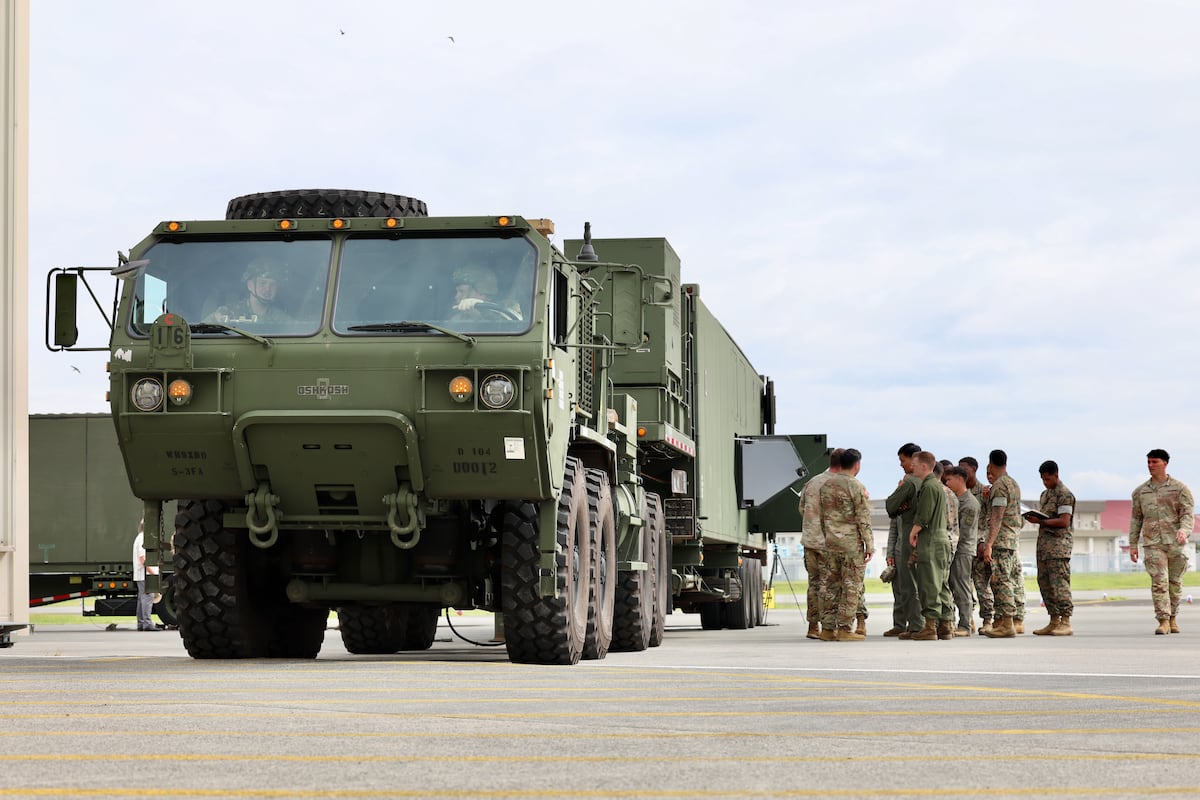
VIENNA — Germany’s ambitions to close a long-range strike capability gap are facing a fresh setback after the Trump administration moved to withdraw thousands of U.S. troops from German soil and effectively shelved a Biden-era plan to temporarily deploy Tomahawk cruise missiles and SM-6 missiles there.
Defense Minister Boris Pistorius, speaking Monday in Munster, Germany, after a major Bundeswehr combined-arms exercise, said the reported decision meant Germany would be left with a capability gap.
“That was an agreement between Joe Biden and Chancellor Olaf Scholz at the time − as a temporary bridge, until we as Europeans had developed our own systems,” Pistorius told reporters, referring to the former U.S. and German leaders “That this may now not happen in the way we had assumed tears this capability gap open again. We have to look at how we can compensate for that.”
“There are ideas, but no solution yet,” said the defense minister.
The Biden administration announced in July 2024 that it would temporarily station a Multi-Domain Task Force in Germany equipped with the Typhon ground-launched system, which can fire Tomahawk cruise missiles and SM-6 interceptors, in what officials described as a bridging measure ahead of European alternatives coming online.
That plan is now in doubt following fresh reports that the Trump administration intends to withdraw approximately 5,000 U.S. troops from Germany, with President Donald Trump suggesting the actual figure could be significantly higher.
German Defense Minister Boris Pistorius sits on a GTK Boxer vehicle during a demonstration of capabilities by the German army on May 4, 2026, near Munster, Germany. (Morris MacMatzen/Getty Images)
At the government’s regular press conference on Monday in Berlin, Defense Ministry state secretary Kornelius Müller laid out Berlin’s three-pronged response to fielding a long-range missile capability.
The first thrust involves modernizing existing Taurus cruise missile stocks and accelerating development of the Taurus Neo successor, a program approved by the Bundestag’s budget committee in late 2025. The second pillar − the purchase of market-available systems, with a formal Letter of Request for Typhon launchers submitted to U.S. Defense Secretary Pete Hegseth last July − remains officially “in process,” though Müller declined to say whether Washington had responded to the ask.
The third pillar is the European Long-Range Strike Approach, or ELSA, a joint program involving six European nations − France, Germany, Italy, Poland, Sweden and the United Kingdom. Berlin and London are also separately co-developing deep-strike capabilities beyond the 2,000 kilometer range under the bilateral Trinity House framework, and Pistorius indicated that France intends to join that effort as well.
The timeline, however, remains uncertain. When pressed on whether ELSA-derived capabilities would be ready before 2030, Müller declined to commit to any date. “I cannot say anything about a timeline,” he told reporters, citing dependence on industrial availability and technology development.
In Munster, Pistorius pointed to the ongoing European effort. “We began in 2023, together with the British, and now the French want to join, to develop the precision-strike systems ourselves as Europeans − as fast as possible,” he said. “At the same time, we need an instrument − with U.S. help or via other paths − to close the capability gap in that bridging period as quickly as possible.”
The admission underscores how dependent Germany’s defense planning remains on American cooperation at a moment when that bond is increasingly uncertain. It also suggests that both of Berlin’s planning scenarios for obtaining Typhon launchers – by way of a U.S. Army formation stationed in Germany, or through a Bundeswehr purchase for use by national forces – are now deemed dead ends.
Müller sought to downplay the operational implications, insisting that NATO’s defense plans account for capability contributions across allied nations and that no gap would emerge at the alliance level. “It is not Germany’s deep-precision-strike capabilities alone on which the deterrence and defense capability of Europe hangs,” he said.
Pistorius has previously warned, including as far back as 2023, that European NATO members would need to adapt to a reduced U.S. footprint on the continent as Washington pivots toward the Indo-Pacific.
Editor’s note: This story was updated to correct a description of European-based, long-range strike efforts in which Germany partakes.
Linus Höller is Defense News' Europe correspondent and OSINT investigator. He reports on the arms deals, sanctions, and geopolitics shaping Europe and the world. He holds master’s degrees in WMD nonproliferation, terrorism studies, and international relations, and works in four languages: English, German, Russian, and Spanish.
维也纳——特朗普政府采取行动从德国撤出数千名美军,并实际上搁置了拜登时代在德国临时部署战斧巡航导弹和SM-6导弹的计划,这使得德国弥合远程打击能力差距的雄心壮志面临新的挫折。
德国国防部长鲍里斯·皮斯托里乌斯周一在德国明斯特参加完联邦国防军的大规模联合兵种演习后表示,据报道的这一决定意味着德国将面临能力缺口。
皮斯托瑞斯告诉记者:“那是乔·拜登和奥拉夫·朔尔茨总理当时达成的一项协议——作为一座临时桥梁,直到我们欧洲人开发出自己的系统为止。”他指的是美国和德国的前领导人。“但现在情况可能无法按我们预想的方式发展,这再次拉大了能力差距。我们必须考虑如何弥补这一差距。”
国防部长表示:“我们有一些想法,但还没有解决方案。”
拜登政府于 2024 年 7 月宣布,将在德国临时部署一支多域特遣部队,该部队配备 Typhon 陆基发射系统,可发射战斧巡航导弹和 SM-6 拦截导弹。官员们称此举是在欧洲替代方案上线之前采取的过渡措施。
有最新报道称,特朗普政府打算从德国撤出约 5000 名美军,而唐纳德·特朗普总统暗示实际数字可能会更高,这使得该计划目前面临不确定性。
2026年5月4日,在德国明斯特附近,德国国防部长鲍里斯·皮斯托瑞斯在德国陆军的一次能力展示活动中,坐在GTK Boxer装甲车上。(Morris MacMatzen/Getty Images)
周一,在柏林举行的政府例行新闻发布会上,国防部国务秘书科尔内柳斯·穆勒阐述了柏林应对部署远程导弹能力的三管齐下的措施。
第一阶段重点在于对现有的金牛座巡航导弹进行现代化改造,并加快研发金牛座Neo的后继型号。该项目已于2025年底获得德国联邦议院预算委员会的批准。第二阶段——采购市场上现有的系统,并于去年7月向美国国防部长皮特·赫格塞斯正式提交了采购台风导弹发射装置的请求函——目前仍处于“进行中”阶段,但穆勒拒绝透露华盛顿方面是否已对此请求作出回应。
第三支柱是欧洲远程打击方案(ELSA),这是一项由六个欧洲国家——法国、德国、意大利、波兰、瑞典和英国——参与的联合计划。柏林和伦敦还在双边“三位一体之家”框架下,分别合作开发射程超过2000公里的纵深打击能力。皮斯托瑞斯表示,法国也打算加入这项工作。
然而,具体时间表仍不确定。当被问及基于ELSA的技术能否在2030年前准备就绪时,穆勒拒绝给出任何具体日期。他告诉记者:“我无法给出任何时间表”,并指出这取决于工业产能和技术发展。
在明斯特,皮斯托瑞斯指出欧洲正在进行的努力。“我们从2023年开始,与英国合作,现在法国也想加入,以欧洲人的身份尽快自主研发精确打击系统,”他说。“与此同时,我们需要一种机制——无论是在美国的帮助下,还是通过其他途径——来尽快弥合过渡期内的能力差距。”
这一表态凸显了德国国防规划对美国合作的依赖程度,而此时美德关系却日益不明朗。这也表明,柏林此前获取“台风”导弹发射器的两种方案——通过驻德美军部队或联邦国防军采购供本国部队使用——如今都已被视为死路一条。
穆勒试图淡化行动层面的影响,坚称北约的防御计划已经考虑到了各盟国的能力贡献,联盟层面不会出现能力缺口。他说:“欧洲的威慑和防御能力并非仅仅依赖于德国的纵深精确打击能力。”
皮斯托瑞斯此前曾多次警告,早在 2023 年就曾表示,随着华盛顿将重心转向印太地区,欧洲北约成员国将需要适应美国在欧洲大陆影响力的下降。
编者按:本文已更新,以更正对德国参与的以欧洲为基础的远程打击行动的描述。
林努斯·霍勒是《防务新闻》的欧洲记者和开源情报调查员。他报道影响欧洲乃至全球的军火交易、制裁和地缘政治。他拥有大规模杀伤性武器不扩散、恐怖主义研究和国际关系三个硕士学位,并精通英语、德语、俄语和西班牙语四种语言。