Those Old OV-10 Broncos Sent To Fight ISIS Were Laser Rocket-Slinging Manhunters那些被派去打击ISIS的老式OV-10“野马”攻击机是发射激光火箭的“猎杀者”战机。
Their mission was to find, fix, and finish the enemy—and they did just that.
Updated Jul 2, 2020 2:51 PM EDT
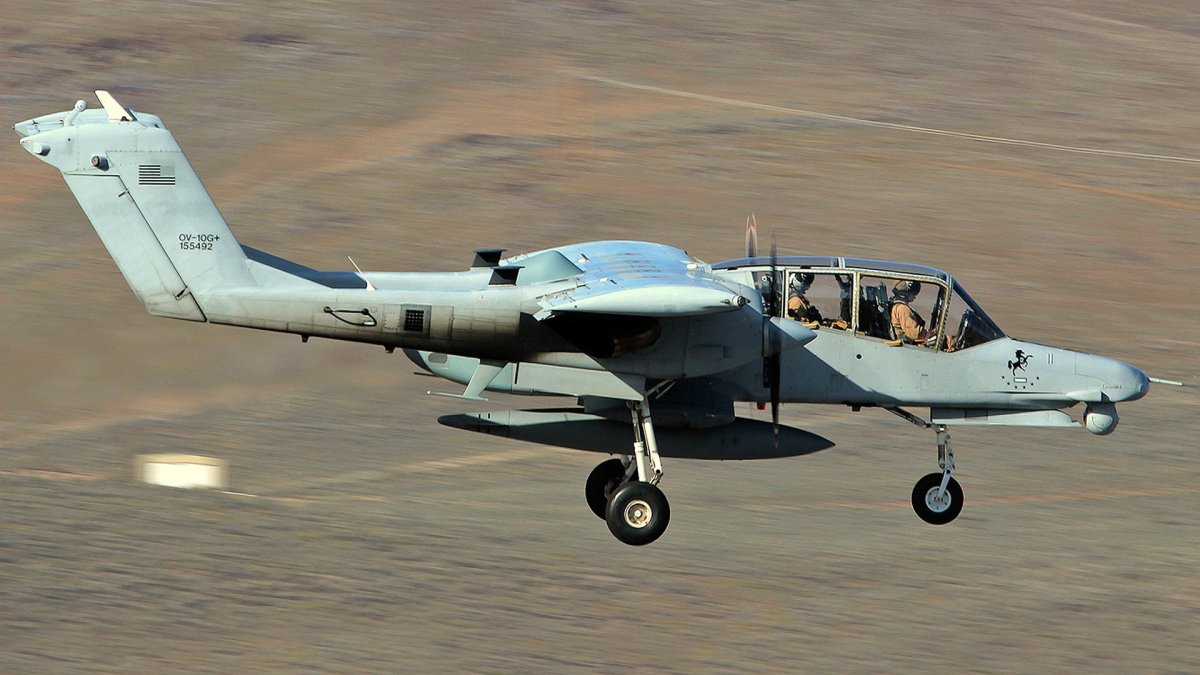
The news that the Pentagon was sending a pair of refurbished and highly-upgraded Vietnam-era OV-10 Broncos to Iraq to take on ISIS raised a lot of eyebrows. It was a new twist in a decade and a half of counter-insurgency warfare in Iraq and Afghanistan, where the United States has never used a light air support and surveillance aircraft. For many, the OV-10’s appearance in Iraq had been very long overdue .
Now, The War Zone reveals details of what the pair of OV-10G+ Broncos were doing in Iraq, and how they went about it with impeccable results.
The Broncos were used to find, fix and finish the enemy. In the past, this process was largely accomplished by at least two very different aircraft and platform communities , both of which usually had their own unique command and control structures. By condensing all the required capabilities into a single platform—the OV-10— the kill chain could be drastically compressed and save gobs of money in the process.
The truth is, OV-10s weren’t really close air support aircraft in the traditional sense at all—they were manhunters.
The Bronco’s weapon of choice for this unique mission set was the relatively new but highly promising Advanced Precision Kill Weapon System , or the APKWS, a 70 mm rocket with a laser seeker and control section attached. Just like standard unguided 70 mm “Hydra” rockets, APKWS’s can be carried in bulk on various US and allied aircraft, with 7- and 19-count rocket pods commonly used. This bulk capability means a dramatic increase in precision firepower on everything from light helicopters to A-10 warthogs. The Bronco is far from a one trick pony.
Laser-guided rockets can be fired either very close or miles away from their target, and at different angles, so aircrews can use creative tactics to achieve “unique” effects on the battlefield. In the right hands, these smart rockets can take out enemy personnel and destroy lightly armored vehicles under circumstances that no other guided munition could touch—at least not without causing significant collateral damage.
Not only was APKWS adequate, but when paired with the upgraded OV-10 Broncos it seems to have been a match made in heaven, or hell depending on which side you’re on.
In some ways the Broncos wrote a new book on APKWS tactics during their tour in Iraq. When key officials were briefed on what the Broncos did during their time there, and hours of footage of the APKWS slinging OV-10s in action was shown, those officials were flabbergasted with what they saw.
The Bronco’s “match grade” MX-15HD FLIR turret and big high-def display in the cockpit make the aircraft among the most accurate precision strike platforms on the planet. Night after night, the OV-10s put this capability to work. Instead of blowing up buildings or convoys, Bronco crews were killing ISIS fighters standing in dark windows, or in a single truck surrounded by others.
As far as just how precise the OV-10 crews could be with their laser-guided rockets and high-end targeting sensors, the Bronco’s prowess in this department was almost freakish. It wasn’t just taking out bad guys in windows—they were doing the same with fighters hiding under eaves, overhangs, dense cover and in doorways. Essentially, the Broncos were flying snipers for special operations forces hunting ISIS in Iraq. They could observe with great clarity from on high, collect intelligence and stalk the enemy. They could also kill that enemy with incredible accuracy. Instead of using a sniper’s bullet, the Broncos used the Pentagon’s guided munition equivalent, laser-guided rockets.
One shot, one kill, even under the most demanding of combat conditions.
The OV-10s were packed with intelligence gathering electronics, an armada of communications systems and data-links (including multiple sat-com systems), defensive countermeasures, Scorpion helmet-mounted displays for both crew, and a centerline fuel tank. This extra gas helped the Broncos complete an average mission time between three and four hours—a sweet-spot duration for the types of special operations sorties they were regularly tasked with supporting.
The human element that took the Broncos back to war was equally as impressive. The small cadre of Navy pilots were handpicked and were among the very best the service had to offer. All were weapons school instructors. The Weapon System Officers were from the Tomcat and Super Hornet communities, and had been embedded as special operations Joint Terminal Attack Controllers (forward air controllers) with SEAL units operating on the ground in the world’s most notorious hellholes.
These senior-ranking and highly experienced officers had incredible insight into how SEALs operated on the ground and how to properly apply air power where necessary to achieve very specific effects on the battlefield. The experience and dedication of the Broncos aircrews were huge factors in making its experimental tour in Iraq so successful.
The OV-10’s maintenance needs were also unique. The souped-up Broncos required just a single maintainer per aircraft, with the aircrews assisting in maintenance and support. It was an almost laughably affordable support footprint for an aircraft capable of identifying, hunting and killing the enemy entirely on its own.
This barebones infrastructure also meant that the twin-turboprop powered aircraft were highly flexible when it came to basing. Crews could just load their gear in the OV-10’s cargo hold along with the maintainers, if needed, and self-deploy basically anywhere including austere and improvised airfields.
Central Command has been the driving force behind the OV-10 program and is pushing for it to evolve. Now that there is a load of data pointing to cost-effective success in Iraq, the hope is that Special Operations Command will invest into expanding the program significantly. Such a move is long overdue but better late than never.
Why were the Broncos picked for this proof-of-concept deployment in the first place? In the mid to late 2000s, the Navy tested a similar special operations air support and counter-insurgency light aircraft concept stateside under the Imminent Fury and Combat Dragon programs . During Imminent Fury, the Brazilian-built Embraer Super Tucano was successfully proven to be a flexible special operations close air support and surveillance platform, but it was clear that moving that aircraft into an operational role would be a major hurdle.
The Combat Dragon II package was originally developed for the Super Tucano, and this Navy Special Warfare program led to USAF interest. Yet the fact that the Super Tucano was a foreign import raised flags for established US aircraft manufacturers—namely Hawker-Beechcraft, which was developing the smaller AT-6. That aircraft was an armed light attack and surveillance version of the T-6 Texan II primary trainer that the Pentagon already owned hundreds of. The nimble team leading the program was able to bypass big defense procurement politics by taking advantage of a pair of available OV-10 Broncos, which had been used by Department of State Air Wing in Colombia.
This same small and enterprising team remains at the helm of the current OV-10G+ program today.
Interestingly, the Pentagon ended up procuring the A-29 Super Tucano, though only after a long procurement battle between Embraer-Sierra Nevada Corp and Hawker-Beechcraft. The USAF is currently flying the type today in small numbers to train and equip Afghani aircrews. These aircrews are now putting the type to use over Afghanistan to provide precision close air support and surveillance . Think of them as a manned, more dynamic, but shorter-ranged MQ-9 Reaper—on the cheap.
With the A-29 now in the Pentagon’s inventory, and its capacity to be upgraded with similar gear as the OV-10G+s have that are flying with today, it’s possible the Bronco could pass the torch to a modified A-29 if the program is allowed to expand. Will the OV-10 go back into production? If the recent past is any indication, not unless SOCOM decides to go big and fund large fleet of Combat Dragon II derived aircraft. The idea was floated in the late 2000s and Boeing supposedly wanted a commitment of at least 100 aircraft to make it happen.
Then again, in the world of special operations, anything is seemingly possible I guess. I mean the fact that OV-10s were put to use fighting ISIS decades after their official retirement is just proof of that.
Contact Tyler at tyler@thedrive.com
A special thank to John Lequerica for his Bronco image featured at the top of this article, see more of his work here , and also thanks to our good friend Nick Thomas for his imagery used in this article, you can see more of his work here.
Comments couldn’t be loaded. Please refresh the page.
更新于美国东部时间2020年7月2日下午2:51
五角大楼将向伊拉克派遣两架经过翻新和大幅升级的越战时期OV-10“野马”轻型空中支援和侦察机,以打击ISIS的消息,引起了广泛关注。这在美伊两国长达十五年的反叛乱战争中是一个全新的尝试,因为美国此前从未在伊拉克和阿富汗使用过这种轻型空中支援和侦察机。对许多人来说,OV-10出现在伊拉克早已是众望所归。
现在,《战区》节目将详细揭露这两架 OV-10G+ 野马攻击机在伊拉克执行的任务,以及它们如何取得完美战果。
“野马”战机用于发现、锁定并摧毁敌机。过去,这一过程主要由至少两个截然不同的飞机和平台群体完成,而这两个群体通常都有各自独特的指挥控制结构。通过将所有必要的能力集成到单一平台——OV-10——上,杀伤链得以大幅缩短,并在此过程中节省大量资金。
事实上,OV-10 根本不是传统意义上的近距离空中支援飞机——它们是猎杀敌机的飞机。
野马战机执行这项特殊任务时选择的武器是相对较新但极具前景的先进精确杀伤武器系统(APKWS),这是一种70毫米火箭弹,配有激光导引头和控制系统。与标准的70毫米“九头蛇”无制导火箭弹一样,APKWS可以大量挂载于美国及其盟国的各种飞机上,常用的火箭弹发射器为7枚装和19枚装。这种大规模携带能力意味着从轻型直升机到A-10“疣猪”攻击机等各种机型的精确火力都将得到显著提升。野马战机的用途远不止于此。
激光制导火箭既可以近距离发射,也可以远距离发射,而且发射角度各不相同,因此机组人员可以运用各种创造性战术,在战场上取得“独特”的作战效果。在经验丰富的飞行员手中,这些智能火箭能够在其他制导武器无法企及的情况下——至少在不造成重大附带损害的情况下——消灭敌方人员并摧毁轻型装甲车辆。
APKWS 不仅足够好用,而且与升级后的 OV-10 Broncos 搭配使用时,简直就是天作之合,或者说是地狱般的结合,这取决于你站在哪一边。
在某种程度上,野马队在伊拉克的行动为APKWS战术撰写了一本新书。当一些重要官员听取了野马队在伊拉克期间的行动简报,并观看了APKWS吊挂OV-10直升机的数小时实战录像后,他们都被眼前所见震惊了。
OV-10“野马”攻击机配备了“比赛级”MX-15HD前视红外转塔和座舱内的大型高清显示器,使其成为地球上最精准的精确打击平台之一。OV-10飞行员夜复一夜地运用着这一优势。他们不再像以往那样摧毁建筑物或车队,而是精准地击毙站在黑暗窗户后或被其他武装分子包围的卡车里的ISIS武装分子。
OV-10“野马”攻击机机组人员使用激光制导火箭和高端目标传感器的精准度令人惊叹,其在这方面的能力几乎超乎想象。他们不仅能击毙窗户里的敌人,还能消灭藏身于屋檐、悬垂物、茂密掩体和门口的武装分子。实际上,“野马”攻击机就像是特种部队在伊拉克追击“伊斯兰国”的空中狙击手。他们可以从高空清晰地观察目标,收集情报并追踪敌人,还能以惊人的精准度击毙敌人。与狙击手使用的子弹不同,“野马”攻击机使用的是五角大楼的制导武器——激光制导火箭。
一枪毙命,即使在最严酷的战斗条件下也是如此。
OV-10飞机配备了大量的情报收集电子设备、庞大的通信系统和数据链(包括多套卫星通信系统)、防御对抗措施、供机组人员使用的“蝎子”头盔显示器以及一个位于机身中线的副油箱。额外的燃油使“野马”飞机的平均任务时长保持在三到四个小时之间——对于它们经常执行的特种作战任务而言,这是一个理想的飞行时长。
让“野马”中队重返战场的人员素质同样令人印象深刻。这支精挑细选的海军飞行员队伍,囊括了海军最优秀的飞行员。他们全部都是武器学校的教官。武器系统军官则来自“雄猫”和“超级大黄蜂”战斗机部队,他们曾作为特种作战联合终端攻击控制员(前线空中管制员)与海豹突击队一同部署在世界上最臭名昭著的战场上。
这些资深且经验丰富的军官对海豹突击队的地面作战方式以及如何在必要时恰当运用空中力量以在战场上取得特定效果有着深刻的理解。“野马”特遣队机组人员的经验和奉献精神是其在伊拉克试验性任务取得巨大成功的关键因素。
OV-10的维护需求也十分独特。这种经过改装的“野马”战机每架只需一名维护人员,机组人员也会协助进行维护和支援。对于一款能够完全自主识别、追踪和击落敌机的战机而言,如此低廉的维护成本简直令人难以置信。
这种简易的基础设施也意味着,双涡轮螺旋桨飞机在基地选择方面非常灵活。机组人员只需将装备装入OV-10的货舱,必要时还可以带上维护人员,即可自行部署到几乎任何地方,包括简陋的临时机场。
中央司令部一直是OV-10项目的幕后推手,并不断推动其发展。如今,大量数据表明OV-10在伊拉克取得了成本效益显著的成功,人们希望特种作战司令部能够加大投入,大幅扩展该项目。此举虽姗姗来迟,但总比没有好。
为什么当初会选择“野马”战机进行这项概念验证部署?在2000年代中后期,美国海军曾在本土开展过类似的特种作战空中支援和反叛乱轻型飞机概念测试,分别名为“迫在眉睫的狂怒”(Imminent Fury)和“战斗龙”(Combat Dragon)。在“迫在眉睫的狂怒”项目中,巴西航空工业公司制造的“超级巨嘴鸟”(Embraer Super Tucano)战机被成功验证为一款灵活的特种作战近距离空中支援和监视平台,但很明显,要让这款飞机投入作战使用将是一个巨大的挑战。
“战斗龙II”套件最初是为“超级巨嘴鸟”战斗机开发的,而海军的这项特种作战计划也引起了美国空军的兴趣。然而,“超级巨嘴鸟”作为外国进口飞机,引起了美国老牌飞机制造商——尤其是当时正在研发小型AT-6教练机的霍克-比奇公司的注意。AT-6是T-6“德克萨斯人II”初级教练机的武装轻型攻击和侦察版本,而五角大楼当时已经拥有数百架T-6“德克萨斯人II”教练机。领导该项目的灵活团队巧妙地绕过了复杂的国防采购政治,利用了美国国务院航空联队在哥伦比亚使用的两架OV-10“野马”攻击机。
如今,这支精干而富有进取精神的小团队仍然领导着当前的 OV-10G+ 项目。
有趣的是,五角大楼最终还是采购了A-29超级巨嘴鸟攻击机,但这却是巴西航空工业公司(Embraer-Sierra Nevada Corp)和豪客比奇公司(Hawker-Beechcraft)之间旷日持久的采购竞争的结果。目前,美国空军正在少量使用该机型,用于训练和装备阿富汗飞行员。这些飞行员现在正在阿富汗上空使用该机型,提供精确的近距离空中支援和监视。你可以把它想象成有人驾驶的、更灵活但航程更短的MQ-9“死神”无人机——而且价格更低。
鉴于A-29现已加入五角大楼的装备序列,并且能够像现役的OV-10G+一样进行升级,如果该项目获准扩展,那么“野马”(OV-10的绰号)有可能将接力棒交给改进型的A-29。OV-10会重新投入生产吗?如果以近期的情况来看,除非特种作战司令部决定大手笔投入,资助建造一支庞大的“战斗龙II”(Combat Dragon II)衍生机型机队,否则不太可能。这个想法在2000年代末期就有人提出,据说波音公司当时希望至少订购100架飞机才能实现。
不过话说回来,在特种作战领域,似乎一切皆有可能。我的意思是,OV-10战机在正式退役几十年后仍被用于打击ISIS,这本身就证明了这一点。
请联系Tyler,邮箱地址是tyler@thedrive.com
特别感谢 John Lequerica 为本文顶部提供的 Bronco 图片,点击此处查看他的更多作品;还要感谢我们的好朋友 Nick Thomas 为本文提供的图片,点击此处查看他的更多作品。
评论加载失败,请刷新页面。