Confessions Of An A-6 Intruder Pilot一位A-6入侵者飞行员的自白
Strap in alongside veteran pilot Francesco "Paco" Chierici for a trip back in time when A-6s still rocketed through canyons in the black of night.
Updated Sep 28, 2021 6:23 PM EDT
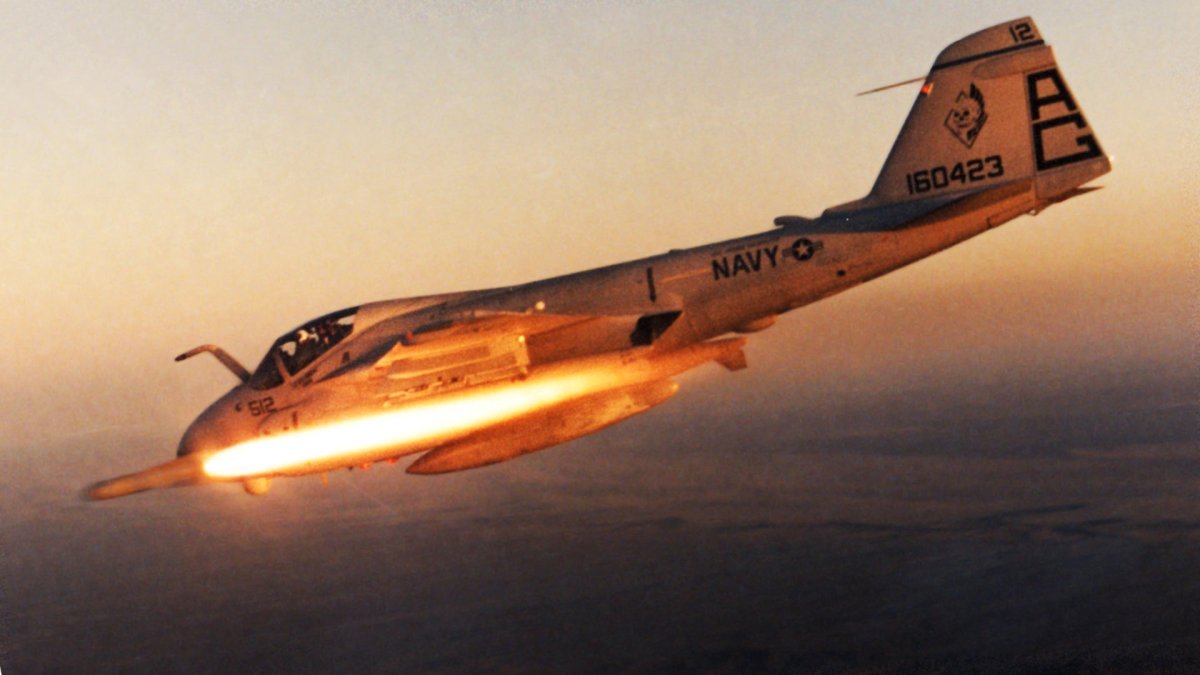
It may not be as well known as its maker’s point-nosed, swing-wing counterpart, the F-14 Tomcat , but Grumman’s A-6 Intruder was also a movie star and served as the backbone of the carrier air wing’s all weather, deep strike capability for decades. The all-business A-6 was capable of doling out a very heavy punch far from its home at sea and it was most at home down low, deep in the weeds, barrelling through enemy territory under the darkness of night.
One A-6 pilot, Francesco “Paco” Chierici, flew the blunt-nosed attack jet during the twilight of its career and is about to share exactly what it is like to strap into the ‘flying drumstick’ and take it over hostile territory, down deep and dark ravines, and into the history books as it began to fade from the Navy’s inventory once and for all.
Paco’s experiences at the controls of the Intruder are especially noteworthy as he would go on to fly higher-performance aircraft, transitioning into the F-14 and later becoming an aggressor pilot in the F-5 —areas we will discuss in part two of this series. So, suffice it to say, with thousands of hours in fast jets, Chierici has plenty to compare the A-6 to.
Paco has thousands of hours in fast jets, with the A-6 being the first fleet aircraft he was assigned to fly. , Francesco “Paco” Chierici
This tell-all feature also comes just as Paco released his first novel, Lions Of The Sky . If what you are about to read is any indication, his novel should be outstanding and we look forward to reviewing it soon.
So, without further ado, let’s climb the intakes and step into the side-by-side cockpit of Grumman’s legendary deep strike phenom, and launch on alongside Paco on a ride to remember.
So ugly you had to force yourself to be fiercely proud of it
I’ll never forget the first time I walked up to an A-6. It was huge compared to the TA-4 Skyhawk jet trainer I had most recently flown. Nearly three times heavier. Two engines, versus one. Whereas the TA-4 was sleek and spindly on its tall landing gear, the Intruder was beefy and serious. The TA-4 looked nimble, the Tomcat was movie-pretty, the Intruder looked like what it was—a war club.
The cockpit of the Intruder was radically different as well. The visibility over the big bulbous nose wasn’t as good as the Skyhawk, but the side glass went all the way down to my hip. It was insane, you could practically see underneath the plane without even rolling.
The instrument panel was much more serious, as well. It was absolutely filled with screens and switches. It was clearly a huge step up from the trainers I’d spent the last few years mastering. Now it would be less about the flying and more about the mission.
The biggest difference in the Intruder cockpit was the seat to my right, though. The Bombardier/Navigators (BNs) sat just below and aft of the pilot, but basically beside us. It was initially irritating to give up half of the cockpit, sacrificing visibility and primacy, to the BN, but I soon discovered that the camaraderie in that cockpit was unlike anything I would ever experience again. We would literally high-five after rolling off-target and spotting the bomb hit.
The Intruder’s unique side-by-side seating layout, Bill Abbott/Wikicommons
One of my favorite stupid-pilot tricks was asking the BN to check the right side just before coming into the overhead break. While he was looking out, I would disconnect his G-suit hose just before break-turning at 6.5Gs. I got Gradymon Hackwith to pass out a couple of times. He would punch me in the arm until I rolled into the groove and he was forced to let me fly the ball to landing.
I would be laughing so hard there were tears.
The exterior of the Intruder was dominated by its giant nose. The plane was quite obviously built around the enormous terrain-following radar. We also had an extremely prominent refueling probe permanently jutting out from where the radome met the lower part of the windscreen.
The plane was kind of like a bulldog, so ugly you had to force yourself to be fiercely proud of it.
One of the great things about the Intruder was its punch. During its heyday, it was second only to the B-52 in payload. That was remarkable because she was only 54 feet long with a wingspan of 53 feet, as compared to the BUFF, which is 159 feet long and 185 feet wide. Also, she was launching off of a 1,100-foot carrier, whereas the BUFF rumbled down a two-mile runway before it was able to claw itself into the sky.
Without any modifications, the A-6 could carry 28 MK-82 500-pound bombs. If the gear doors were removed, it was an even 30. That was 15,000 pounds of ordnance on a plane that only weighed 27,000 pounds empty. Fill her up with gas and we were launching off the deck in 300 feet, zero to 160 knots, at 60,000 pounds of gross weight.
That was quite a ride.
One of the advantages of having such an aerodynamically challenged airframe was that she didn’t handle much differently fully loaded than when she was clean. Alright, that’s a bit of an exaggeration, but in all honesty, she was a dream to fly low, fast, and laden with weapons.
The wing root, where the wing attached to the fuselage, was enormously thick. We could fly all day (and night) with a serious bomb load-out at low-level and pull five Gs or more. The Intruder was impervious.
The addition of the FLIR (Forward Looking Infrared) pod—which happened well before my time—enabled the A-6 to transition from a mere heavy-hitter to a precision striker. Whereas before there were two basic modes of delivery, the pilot doing a visual dive and the BN using the radar to drive the plane to a bomb release point, the FLIR introduced a level of precise aim-point fine-tuning that was completely unique at the time.
In the target area, the BN would transition from the radar picture to the FLIR. Using the laser and the crosshairs in the FLIR picture he would fine tune the information the pilot used to arrive at the proper delivery point. Those capabilities enabled the Intruder to precisely deliver iron bombs and laser-guided bombs in almost any weather conditions and at night.
A-6Es releasing thousands of pounds of Mk82 Snakeye bombs., USN
A dark wizard by your side
The Intruder was unlike any other plane I flew in that it was built with the other crew in mind—the BN. The A-6 was an all-weather, low-level, day/night, medium attack plane. Basically, a bad-ass bomber that could fly at treetop level through the enemy’s backyard and drop tons of ordnance.
To accomplish that mission we had an amazing terrain following radar—again that big ugly thing on the nose. We also had a super-capable FLIR gimbaling pod under the chin. The FLIR pod didn’t add anything to the appearance, it looked like a wart on a witch’s chin, but it did add precision to the already impressive payload.
The BN was responsible for using the radar to navigate through steep valleys and canyons using the raw returns. The pilot used computer-generated information on the screen in front of him to hand fly the plane along the general path the BN laid out. Once the target area was penetrated, the BN would activate the FLIR ball. He would ‘laze’ the target, both for accurate ranging regardless of what weapons were delivered, and as a target designator for laser-guided ordnance. He would also slew the crosshairs of the FLIR to sweeten up the final phase of targeting. The pilot would again follow the computer-generated guidance on our screens derived from all of the BNs efforts, flip the Master Arm on, and then pickle off the weapon.
We would routinely do this at night, though the mountains, in the clouds and rain, and at 200 feet and 420 knots. There was zero automation, the pilot hand-flew the plane at all times. But to me, the craziest aspect was that the BNs stuck their heads in the boot covering the radar and FLIR screens through the whole mission.
The boot was essentially a shroud with a padded hole where the BN would stick his face. It shielded the cockpit from the light of the radar so it wouldn’t blind the pilot during night flying. But when using it, the BN couldn’t see what was going on outside in the real world. So we would be flying through steep ravines at seven miles a minute at night as low as we dared, I would be glancing nervously at the granite cliff wall I could barely make out and the BN was stuck with his head down, arms spinning dials and switches like some dark wizard, immersed in his virtual world of radar returns and seemingly oblivious to the violent yanking and banking as we jinked through the low-level route.
The flying became even more aggressive once we entered the target area and executed any number of dynamic weapons delivery pops, all while the BN kept his head glued in his boot.
Because of that dedication to the mission and the simple fact that the Intruder was designed to be optimized by the BN, the community was as flat as any I’ve ever seen. Meaning that there was almost no greater weight placed on whether someone was a pilot or a BN. This was definitely not true in the fighter communities, where pilots considered themselves far superior to anyone, whether they were in aviation or not.
An accidental fighter pilot
I was as close as you can be to an accidental fighter pilot. As a kid, I built plane models and hung them from the ceiling of my room in a huge Battle of Britain dogfight. But as I got older, I drifted away from the romance of aviation.
I didn’t grow up around planes. No one I knew was a pilot. I wasn’t one of those kids who washed Pipers at the local airport for gas money. Fortunately, I needed money to pay for college and I joined the Navy ROTC. What began as a means to an end morphed into an opportunity of a lifetime.
As a Midshipman, I was exposed to all of the communities that were available to me after graduation. After a couple of years, I was strongly inclined to pursue Naval Aviation and then something decisive happened the summer before Junior year. I got a back-seat ride in an F-14 with VF-51 and it was love at first flight. I couldn’t imagine doing anything else after I got a taste.
In the spring of our senior year, we received our community assignments. All the graduating ROTC and Naval Academy kids were ranked, then the slots were given out in order. It was, and is, extremely competitive to get aviation and I was beyond thrilled to receive my dream shot.
Hundreds of SNAs—Student Naval Aviators—gathered in the Cradle of Naval Aviation—Pensacola, Florida—that summer and we churned our way through the sausage factory that was flight school. I made it through all the fail points: academics, physical training, and primary training in the T-34. After all that I was selected for jets.
I went through intermediate training in the T-2 Buckeye, where I saw the carrier for the first time, and finally advanced flight training in the TA-4J Skyhawk. After carrier qualifying in the Skyhawk, I had finally completed the multi-year odyssey that began when I was first smitten.
The winging ceremony was an emotional, momentary personal victory. I was finally a Naval Aviator sporting wings of gold.
Little did I realize that the real work was about to begin.
A young Paco standing in front of his mount. , Francesco Chierici
The night is dark and full of terrors
The A-6 was super honest to land. It had a great combination of wing sweep, responsive engines, and drag which allowed for quick and fine corrections while flying the meatball.
Near the completion of training, we would carrier qualify, day and night. It was a big deal, our final exam. In the Intruder community, we would go to the boat for the first time with a fellow student, a BN that was our classmate. I was lucky enough to go with my good friend Gradymon. It was an intense experience for both of us, but especially for Grady since he had never seen an aircraft carrier from the air. The first time the BNs ever got to land on a ship was with a fellow knucklehead student (who routinely disconnected his G-suit hose at inappropriate times) piloting him.
Those guys were either crazy or brave as shit.
The day landings were awesome and similar to the landings I had done in the T-2 and TA-4, but the night landings were going to be a completely new ballgame for me. It was going to be a huge comfort to have Grady by my side. Unfortunately, we didn’t make it up that night.
We spent the evening on the USS Ranger , having dinner and waiting for our turn to climb into a jet. The plan was for us to hot-switch into a plane that our classmates were currently flying. After their last night landing, they would be chained to the deck. With the engines still running, we would switch crews one at a time until Grady and I were safely strapped into the still running jet. Then we’d get fueled up and taxi to the catapult to take our turn at six night traps.
We tracked our jet as she went around the pattern, successfully landing five times. After she took off for the last time, we made our way up to flight deck control to await the last landing and the hot-switch. There were multiple TVs and a window facing the landing area.
I’ll never forget watching my jet on the TV as she was about to land. I leaned over to tighten my chest strap and she hit the deck and caught a wire. As I stood up, I could see her through the window. One moment she was decelerating with both engines howling at full power, just as normal. The next, the pilot and BN ejected, the jet angled out of the landing area toward a row of parked F/A-18s, slammed into them, then flipped into the water.
One of the F/A-18s snapped out of her chains and flipped into the water as well. Another was impacted so hard it also snapped its chains and spun 180 degrees, managing to barely stay on the deck. I stood there in Flight Deck Control with my hands still on my straps, my jaw hanging open.
The Intruder I was supposed to climb into and fly my very first night carrier landings had just broken its tailhook, smashed into three Hornets, and flipped into the sea.
Welcome to naval aviation!
At home in the weeds
In the Intruder, flying nap-of-the-earth was our bread and butter. We did it during the day, free and loose, darting down the tiniest riverbeds and through the slightest cracks we could find. During the night and in bad weather, we also flew low and fast, but in a much more prescribed manner.
The low levels we flew were delineated in a huge manual, which contained the lat/long fixes defining the routes themselves. For the most part, the routes were ten miles wide, five miles to each side of the center-line running from fix to fix. A ten-mile corridor actually gives a pilot a tremendous amount of leeway to find the most tactically relevant course through the terrain, as well as the most fun. So, even the same route was not always the same.
Night low levels were a different beast. To become night proficient, a pilot and BN crew would have to complete three steps within a week. First, they would have to fly a route in the dome simulator. Then they would fly the same route during the day, and finally at night. This gave the crew two opportunities for the BN to familiarize himself with the radar picture before flying the actual route in darkness.
Once you were night low-level qualified, you could then fly any route, day or night.
A-6 Intruder rocketing through a very deep canyon as seen from the BN’s position., Unknown
One of the missions the A-6 was initially designed for was nuclear delivery of the B61 tactical nuclear bomb , affectionately known as the ‘dial-a-yield.’ There was literally a rotating switch inside a panel where the ordnancemen could select from .3 to 340 kilotons for when the bomb detonated. It was an incredible amount of power in a weapon that measured only twelve feet by one-foot and weighed just 700 pounds. By comparison, ‘Little Boy’ which was dropped on Hiroshima, weighed almost 10,000 pounds and had a defined yield of 15 kilotons.
It was chilling to imagine that something so diabolically versatile and powerful could be carried on a small jet and weigh less than an AGM-88 Hight-Speed Anti-Radiation Missile (HARM).
The main method of delivering the B61 was through a specific maneuver selectable in the computer, the LABS-IP, which stood for Low Altitude Bombing System – Initial Point. To practice this delivery, we would ingress to the target at low-level, usually at 480 knots, and once reaching the target area, we would accelerate to 540 knots.
B61 and its components. , DOE
At a certain distance from the target, which the BN was constantly fine-tuning through the radar and FLIR, the computer would command the pilot to pitch up. We would get guidance on our primary instrument commanding us into a 4G pull and we had to correct the horizontal flight path as well. Despite the Gs, we had to be as smooth as possible because at some point during the pull, 50-75 degrees nose high, the computer would release the weapon into a massive loft. The pilot would then keep his pull through a Half Cuban Eight , ending the maneuver heading in the direction they came from, at 200 feet, pedaling as fast as they could go.
The bomb would be lofted as high as six miles into the sky, and depending on the programming for the specific target, a parachute would open allowing the B61 to float toward earth, thus giving the delivery aircraft valuable time to race away before detonation.
The procedures called for each crew to close one eye at the time of detonation, in case the flash caused blindness. We used to joke that the pilots would close both eyes and the BNs would keep theirs open, since their jobs were done.
It was a heartless crowd.
I came into the fleet just after Gulf War I, in the summer of 1991. The Cold War was done, and we had just shed the onerous nuke delivery mission. I was one of the first pilots in my squadron not to have to go through the two-month drudgery of getting my ‘Nuke Cert.’
The Navy was out of the tactical nuclear bomb delivery business by the early 1990s. , FAS.ORG
I joined VA-155 the day they triumphantly flew in from their Gulf War cruise. The Silver Foxes were heroic in the conflict. They flew the first-night sorties into Bagdad at low-level, attacking vital military targets as surface-to-air missiles flew in all directions overhead. Throughout the forty-day air campaign, they were instrumental in completely demolishing Saddam’s military. Tragically, they lost one plane in combat in the waters just off Kuwait.
After combat ended, they partied their way home through various exotic ports of call, drunk from all their death-defying exploits. I remember swelling with pride as I stood in my khaki uniform on the flight line and watched them fly in.
The next six months, on the other hand, sucked as bad as any in my Navy career.
VA-145 A-6E on the ramp in 1992. , USN
I was the first new pilot the Foxes had gotten in over a year. They were all heroes and I was just the FNG (F’n New Guy). It was almost impossible to penetrate the camaraderie they had naturally forged. It took a few of the older guys rotating out and an additional influx of new guys, including a bunch of my classmates, for us to finally feel like we belonged.
The Foxes ended up being an amazing experience for me, filled with incredible adventures and great people.
The work-ups for our first cruise were instrumental in building the new collection of Foxes into a cohesive squadron. The experienced aviators trained the new guys well and we quickly bonded into an effective unit.
It was during this early stage of my fleet career that I first experienced the shattering pain of loss. Air Wing Two lost a Tomcat during a night mission while we were all at NAS Fallon. And much closer to home, my good friend Grady and his pilot Dewey, fellow Silver Foxes, perished in a low-level training accident.
Of the twenty-plus friends I lost during my career, Grady’s was one of the most difficult to endure. We had come up through the RAG together as fast friends. I had flown with Grady more than any other single BN in my brief career. We rejoiced when we were both assigned to VA-155 and looked forward to three more years of fun and flying.
The sudden shock of his death shook me to my core, damaging my confidence for months.
Intruder’s place in the Air Wing
When I cruised on the Ranger, we were the last of the all-Grumman Air Wings [read all about this unique arrangement in this past post of ours ]. There were a number of other NSFW and non-PC terms that were used to reference the absence of the new kid on the block, the F/A-18 Hornet.
Air Wing Two was composed primarily of two squadrons of Tomcats and two of Intruders. My first squadron assignment was with VA-155, the Silver Foxes. Our sister squadron was VA-145, the Swordsmen.
Air Wing Two on the Ranger was basically the last of the old-school air wings. The division of labor was absolutely clear, if you needed the skies swept of enemy jets, the Tomcats took to the air. If you needed bridges demolished, buildings leveled, hardened bunkers penetrated, ground-armor destroyed, troops-in-the-open decimated, or SAM sites taken out, then the Intruder was on the job.
Though in the competition between Top Gun and Flight of the Intruder movies, the f^@%!*g Tomcats clearly won the battle. But the long list of accomplishments achieved by the Intruders in Air Wing Two during the first Gulf War clearly overshadowed their more glamorous Grumman brethren.
Ranger with its Grumman Air Wing. , USN
Most of my career was spent operating in the Persian Gulf where we had ample Air Force tanker support, but I flew a handful of tanker hops where we would strap four 2,000-pound drop-tanks and a centerline mounted D-704 refueling-pod, which aside from containing the retracting hose and basket, held another 2,000-pounds of gas.
The most fun tanker hops were the daytime yo-yo missions where you would launch before the fighters and strikers, meet them a couple hundred miles from the carrier along their strike route, give them almost all of your gas (18,000-20,000 pounds of give!) and then race back to the carrier for a solo shit-hot break.
The most rewarding tanker hops were when you were assigned as a recovery tanker for the last event of the night. Your job was to orbit overhead and be prepared to offer emergency gas to the planes that were coming down to land in the event they boltered (missed all the wires) or were waved off.
During Blue-Water ops, when we operated beyond the range of possibility to divert to a land-based runway, it was particularly challenging and a massive responsibility. Carrier-based jets are fuel-critical from the moment we start our engines. When we fly far enough out to sea where calling ‘uncle’ and landing on a runway isn’t possible, every ounce of gas becomes precious.
An A-6E Intruder about to tank from a KA-6D Intruder. The KA-6Ds were uniquely configured with an internal hose and drogue system and were notoriously hard worn with extreme limits on their flight envelope due to being passed around from deployment to deployment. By the time Paco was flying Intruders, the A-6E carrying a refueling pod was the common ‘buddy tanker’ setup., USN
Once the night missions are complete and it’s time to land, the jets have enough gas for maybe two attempts to catch a wire. Throw in some weather, a pitching deck, a dark night and the knowledge that you either are landing safely on the ship, or ejecting into the frigid ocean, a pilot can get so tense that they practically suck the seat cushion up their butt.
Read all about how to land a jet on a carrier at night in this previous feature of ours .
Everyone I know has had a ‘night-in-the-barrel,’ a night where they had difficulty beyond normal catching a wire. And after every miss, the tension became more intense. You knew that five-thousand people were watching your every failed attempt, including your peers, your CO, the Skipper of the ship, and most likely the Strike-Group Admiral.
As the recovery tanker you were the last line of hope for a strung-out pilot who had already failed to land a few times. His, or her, nerves were surely shattered and confidence was in their boots. On the last pass before the troubled plane would need to refuel, the recovery tanker would drop down to shadow, or ‘hawk,’ the jet.
You would have to maneuver yourself to time it perfectly so that if the jet failed to land once again you would be just in front of them at 2,000 feet. Then that shaky, panicky pilot could spot you immediately as they cleaned up and climbed to your altitude right behind you. Then they would have to perform an activity just slightly less challenging than landing on a carrier at night, they would have to plug their refueling probe into a basket dangling into the slipstream fifty feet behind the tanker at night, maybe in bad weather, at 2,000 feet. Or, they were going swimming. And the reward for a successful plug and refuel was another look at the boat.
I know a guy who had to go around so many times he plugged the hawking tanker three times. After he finally landed, he was so wrung out he had to be helped from the cockpit.
And after all the drama was complete for the night, the recovery tanker had to come in and land. And there was no one hawking you with extra gas if you couldn’t make it aboard.
I didn’t love flying tanker missions and thankfully I didn’t have to fly many, but the yo-yo, and especially the recovery tanker missions were always gratifying.
Ranger into the storm
By the time our workups were complete and we headed out on my first deployment I felt very comfortable in the Intruder and in the squadron. There was an undeniable thrill about leaving on my first deployment. It felt very grown-up, even though I was barely twenty-five. I was a junior officer, though we had had enough new guys where I wasn’t an FNG anymore. I had been in the squadron for over a year and become a Landing Signals Officer (LSO) as well, which was a fantastic position of responsibility and a job I thoroughly enjoyed.
After multiple detachments to Fallon and working from the Ranger I also felt extremely comfortable as a member of the Air Wing. Many of my friends from flight school ended up in the same Air Wing, scattered throughout the Tomcat, Intruder, Prowler, and Hawkeye squadrons. It was one of the closest Air Wings I was a part of, with great friendships and camaraderie across all the squadrons.
We pulled into Yokosuka, Japan. I climbed Mt. Fuji after a big night at the O-Club, which ended up being more of a challenge than it should have. Many of us spent five days partying in Tokyo, which was amazing. The ship left Japan for Busan, Korea, spending a few days at sea so the pilots could all fly at night.
Ranger pulling into Yokuska in 1992 with Paco and VA-155 onboard. , USN
At sea, each pilot is required to get a minimum of one night trap aboard the ship every seven days. One of the lesser-known pains of leaving port after four to five days of hard-charging was climbing into the cockpit for a night ‘re-qual’ all exhausted and hung over.
It was in Busan, on our second day of a planned four-day visit, where the cruise ratcheted up in intensity. The entire Strike Group was emergency recalled to their ships. We were pulling out immediately. Saddam had repeatedly violated the terms of the 1991 Cease Fire agreement. The powers that be demanded a US carrier on scene in the Persian Gulf to keep the dictator in check. The Ranger and her Strike Group sped away from the Korean Peninsula with great urgency.
It seemed there was action to be had again.
Leadership was so intent to have a carrier presence as soon as possible that Ranger was sent directly through a Category 4 typhoon while en route. All of the other ships in the Strike Group were sent far south in the Indian Ocean to skirt around the massive storm, delaying them by many days. The Ranger rocked like a cork for three straight days. All non-essential activities were suspended, inside and out. The galleys closed and the only food available was sandwiches and cereal.
The ship was rolling so steeply that when you walked along the passageways it felt as if you were walking on the walls at times. We stuck our flight boots under the edges of our mattresses so we wouldn’t roll out of the bunk beds.
I’ll never forget watching the TV footage of the flight deck. During the peak of the storm, the Ranger , an 80,000-ton displacement, 1,000-foot, Forrestal class supercarrier with 70 aircraft on board, was hitting the waves so steeply that we were taking green water over the bow. Not sea spray, not splashes. The bow of the huge ship, with an entire Air Wing worth of airplanes exposed and chained to the deck, was digging into the oncoming waves so deeply that it was briefly submerged.
Needless to say, after we came out the other side, the planes were a mess. Our incredible maintainers had a week to perform a miracle. They essentially had to rebuild a third of the planes that had been bathed in corrosive salt water. It was one of the most incredible feats of dedication I witnessed in my career. Those guys worked around the clock untill they dropped so that when we arrived in the Gulf we would have up jets to cross the beach with.
The transit from Korea to the Gulf was an amazing feat in itself. The Ranger steamed over 7,000 NM in under two weeks. A trip that would normally have taken three weeks, plus a port call in Singapore, to accomplish.
Sound asleep over Iraq
I’ll never forget the excitement that was building those last few days before we relieved the Independence on-station in the Persian Gulf. The other new guys and I were certain we were going to leap right into combat missions. My new BN, Pauly B, and I were tasked with planning the first mission in country. This was a huge honor and responsibility—or so I thought.
Ranger relieving Independence on station in Persian Gulf in 1992. , USN
Pauly and I stayed up for two days straight planning a 25-plane mission that involved three KC-135 Air Force tankers and two laps around Southern Iraq. I was so spooled up I couldn’t sleep the night before. Pauly and I briefed a packed ready room full of aircrew from the entire Wing. We were putting Saddam on notice, the Ranger and Air Wing Two were on station and we were ready to play.
The brief ended in the early afternoon and Pauly and I grabbed a quick dinner. We dressed and launched as the sun hung low on the horizon. I was fielding massive waves of excitement and trepidation as we flew toward the tanker rendezvous on the Saudi/Iraqi border. Not only was I leading my first mission in-country, but I had never before tanked off the feared KC-135, known as the ‘Iron Maiden.’
It certainly didn’t help my nerves that night was falling rapidly. If I failed to tank, I would have to return to Ranger in shame. If I damaged the basket by being ham-handed, the entire evolution could be scrapped.
An A-6E approaches a KC-135E equipped with the dreaded Iron Maiden. The basket, which is attached to the KC-135’s boom via an adapter, is made of metal instead of the softer materials found on other hose and drogue systems. This makes it far less forgiving and it can even wheel around in turbulence and smash into the aircraft causing damage. Hence its other nickname—The Wrecking Ball., USN
Fortunately, I was able to fight my way through the ordeal and get my gas.
Once the whole package had tanked, Pauly conducted the roll call and we were off, heading into Iraq for our first lap.
I’ve had never seen anything as black as western Iraq. There wasn’t a light on the ground for a thousand miles. It was a moonless night and the stars were the brightest I had ever seen, but they provided no illumination of the earth below. I felt as if we were flying into a black hole.
The Intruder had a basic autopilot, just heading and altitude, and I engaged it once we were on the correct heading. After two sleepless nights and the excitement of the mission and stress of meeting the Iron Maiden under such intense circumstances, I was absolutely drained. My eyes blinked longer and longer until I actually fell asleep in a combat-loaded A-6E Intruder flying through hostile territory while leading a strike package.
Not one of my prouder moments. But as it turned out, Pauly B was dead asleep right next to me, too.
I still get shivers thinking about how long we would have flown on that heading. How far we would have gone. We were pointed directly at Syria, which surely would not have appreciated a U.S. Navy strike package coming close to its border. Ultimately, we were saved by chance, though it nearly gave me a heart attack.
While I was sleeping on a hard ejection seat in a cramped cockpit as deeply as I’ve ever slept in my life, our ALR-67 radar warning receiver (RWR) began a high warble. We had been locked up by a radar. I woke with my heart in my mouth disengaged the autopilot and jinked hard.
I looked down at the ALR-67 screen to determine the direction of the radar and saw that we had been locked up by one of the F-14s in our group. The RIO came up on the secure radio and quickly apologized. It was one of their new guys screwing around with his radar. He hadn’t meant to lock us up.
Pauly and I looked at each other, realizing we had both been asleep and that we had just dodged a virtual bullet. We were wide awake, but it only lasted fifteen minutes before exhaustion set in again. We worked really hard telling dirty jokes and stories for the next four hours till the terror of the night trap was enough to bring us fully awake again.
The remainder of our four months in the gulf was a series of similar patrol missions punctuated by port calls in Dubai. Though I never saw any action in Iraq, I did achieve a measure of detente with the KC-135’s Iron Maiden. She never bit off my probe or shattered my canopy, I never ripped off her basket.
How to kill MiGs in an Intruder
At its prime, which unfortunately coincided with its retirement from service, the Intruder could carry just about every piece of air-to-mud ordnance in the US inventory. And, the AIM-9 Sidewinder.
Being a frustrated fighter pilot, I devised a game plan for how I would get the first Intruder air-to-air kill should any Iraqi MiG-29 be so foolish as to come at us. If we were flying a counter-radar mission our standard loadout was an AGM-88 High-Speed Anti-Radiation Missile (HARM) missile and an AIM-9 Sidewinder.
Silver Foxes’ sister squadron, the Swordsman, seen carrying an AIM-9 Sidewinder during a mission over the Persian Gulf in 1992. , USN
My plan of record was to go nose-to-nose with the Fulcrum, wait till he got to three miles on our nose then shoot the HARM in his direction. The big missile with a huge smoke trail would spook the Iraqi fighter into break turning just in front of me. When he was close enough, I would fire the Sidewinder for the victory.
In the folly of youth, I thought this was an excellent plan and no so secretly hoped an unwitting MiG-29 would come poking around. Thankfully it never became an issue. Though I still like to think it might have worked.
Intruding into Somalia
As we were nearing the end of our time in the Gulf, another global hot-spot flared up and Ranger was, once again, tasked with being on-station. In early December of 1992, the feeble government of Somalia completely collapsed and the warlords were battling each other for primacy. The thugs were stealing farmers’ crops immediately after harvest and the country was on the verge of massive starvation. The United Nations was sending in relief but the warlords were stealing those supplies, as well.
The Ranger and Air Wing Two skipped our last port call in Dubai and made for the coast off Mogadishu at high speed. It was exciting to plan for a new mission in a new country. We were initially tasked with providing high cover and close-air-support for the U.N. personnel. The threat to us was minimal, ground fire from technicals—civilian pickup trucks modified with heavy guns. There was also a slim possibility of shoulder-launched SAMs, though none had been reported in the area. For the most part, we expected to operate with impunity, so long as we stayed above the range of the heavy guns.
USS Ranger taking part in Operation Restore Hope in 1992. , USN
The Commander of the Air Wing set the floor at 5,000 feet for normal operations and as low as we wanted for special circumstances. Those included low, fast fly-bys called ‘shows of force’ designed to strike fear into the hearts of bad actors on the ground below. We would come in at 50 feet and 500 knots, sneaking in from behind their position. It was a hugely effective and non-lethal tactic.
We were briefed that the biggest threat to our health was the diseases on the ground in the event we ejected. Since the Somalia visit was unplanned, none of us had received the proper inoculations. I’ll never forget our flight doc briefing the ready room about two additions to our flight gear. Two pre-filled syringes loaded with a cocktail of who-knows-what designed to keep us reasonably safe should our boots actually hit Somali soil. If we punched out, the moment we landed we were supposed to yank out the syringes, pop the tops and inject ourselves straight through our G-suits into the meat of our thighs.
By this time, the various squadron crews in the Wing had become very close. The E-2 Hawkeye guys were not allowed to cross feet-dry. One day, while we were telling them about the incredible views we were enjoying as we flew, they told us they couldn’t see us on their radars after we were a certain distance inland. Naturally, we devised a code word so we could break the 5,000-foot deck and fly low, where the Intruder was meant to be.
Read all about the E-2 Hawkeye’s work near Somalia and so much more in this past feature of ours
Whenever we flew with all junior officer crews, we would skim over the Somali heartland marveling at the change in topography. We saw giraffes and camels and strange chimney-like structures that, after some time, we determined were actually massive anthills. It was depressing to see fertile farm fields filled with water and crops, but devoid of farmers. They were starving because the warlords stole their harvest, not a lack of production.
My most enduring memory from the three weeks over Somalia was flying high cover for the amphibious landing. My BN and I began orbiting at 0400 in the pitch-black directly over the landing spot on the beach, loaded with laser-guided bombs. The BN scanned the shoreline with his FLIR, ensuring there was no opposition while dozens of landing craft came ashore disgorging trucks, APCs, and Marines.
VA-155’s sister squadron seen flying over Somalia during the Ranger’s mission there in 1992., USN
Over the course of a couple of hours watch the empty beach fill with troops and machinery in an orderly manner and organize into a massive formation. As the sun peeked over the horizon, the headlights came on and the mechanized columns snaked away, dispersing in various directions into the countryside. It was an impressive and slightly emotional display.
A few days later, the Ranger and her Strike Group were released from Operation Restore Hope and we proceeded to Perth, Australia for our first port call in over six weeks.
Six quick interesting thoughts on flying Intruders
1) The Intruder was super fun to fly low and fast. It was like a Cadillac, smooth, powerful, and stable, with great visibility.
2) There were a number of landmarks along low-level routes that were traditional check-in-the box items. For instance, a derelict red pickup truck rusting away high in the Cascade Mountains in Washington. My personal favorite was checking the price of unleaded gas on a station marquee just before Winnemucca, Nevada when flying to Fallon.
3) We had the Pickle Barrel bombing patch. To earn it the pilot had to literally drop a Mk-76 ‘Blue Death’ practice bomb into a barrel on the Boardman, Oregon target range on his first visual delivery of the month. Only one chance every month.
Took me forever to get that damn patch.
4) We had a not-so-stealthy manner of doing awesome fly-bys of the Officer’s Club, which was on the beach at NAS Whidbey Island. Coming back to base you could request an “Intruder Attack.” If the pattern was clear, it was generally approved. Ostensibly, we were conducting a practice bombing run on the valuable assets of the base. In reality, it was a license to do a 200 foot, 420-knot run right over all your buddies heads at the club.
Everyone would come out to watch. It was truly awesome.
5) Even though we had spin/departure procedures in the event of out-of-control flight, in reality, all the pilot had to do was release any pressure on the stick and rudders. The giant nose was an Earth-seeking magnet. Eventually, you ended up pointed at the dirt and the plane was flying again.
6) When we flew through clouds and rain at night, as we often did in the Pacific Northwest, we would frequently get arcing blue static electricity across the windscreen called Saint Elmo’s Fire. What was unique to the Intruder was that the refueling probe sticking up prominently between the windscreen panels would also be affected, developing a bizarre cone of blue static electricity pointed aft.
Retiring the Intruder to conquer the Cat
Shortly after returning from the ’92-’93 cruise, VA-155 was decommissioned. It had been planned for a long time so it was no surprise, but it still stung.
Most of the junior officers were dispersed into other fleet squadrons. I was lucky, I got to go to our sister squadron in Air Wing Two, VA-145 The Swordsmen. I showed up for work in April of ’93 only to discover that the Swordsmen had just been put on the chopping block, as well. VA-145 was to be decommissioned five months later, at the end of September.
The nice thing was that they were a good squadron whom we were familiar with and we all flew our butts off in those few months together. The challenge was that now there would be another thirty pilots on the streets looking for a home.
I had not-so-secretly always wanted to fly the Tomcat since my backseat ride as a Midshipman. I spent many weeks putting together a bulletproof transition package to submit to the board, which was ultimately approved. I left for the east coast RAG (Replacement Air Group training squadron) in September of ’93 as excited for a move as I had ever been.
Going through a RAG the second time was almost stress-free, even though I was completing the full, new-guy syllabus. The basic systems were almost identical—thank you Grumman Iron Works—so the academic portion was fairly rote. But quite obviously, despite sharing a huge amount of DNA, the Tomcat was a significantly different beast than the Intruder. And I was absolutely thrilled to the core!
The power differential even in just the F-14A-model with the TF-30 engines was so insanely superior I didn’t stop smiling for three months. The B-model with the F110 engines was just ludicrous .
During my B-model demo hop I was flying in the Whiskey areas, about a hundred miles east over the ocean. The RIO (Radar Intercept Officer) had me go down to 200 feet, accelerate to 450 knots, then pull 4 Gs till I was straight up as I plugged in full afterburner. The plane had no tanks nor rails—slick as a newborn—and she leaped into the sky like a Saturn-5 rocket. Maybe 30 seconds later I was rolling over to level at 50,000 feet while still doing 250 knots.
The air-to-air mission was also completely new to me. But I found it intuitive and creative in a manner that felt very natural. I loved working with the RIO to solve the angles for the long-range intercepts and missile employment and I had waited my whole life to dogfight in the visual arena. If I had been half as skilled at dogfighting as I was enthusiastic, I would have been pretty good.
All in all, I enjoyed the three-year head start in flying fleet jets over my classmates immensely, but all of that came to a screaming halt when it came time to bring the beast aboard the ship, especially at night.
I already had a couple hundred fleet traps in the Intruder and I was an experienced LSO. The ship didn’t intimidate me, in fact I had been the Top Nugget – the best new guy – on my first cruise. But landing the Tomcat was a completely different, and quite humbling, affair.
Where the Intruder was instantly responsive to power, angle of attack (AOA), and glide slope corrections, the Tomcat was anything but. The TF-30 engines had a nasty lag, which made power corrections a combination of guesswork and experience. The wings stuck out to 20 degrees in the landing configuration, which was much more than the Intruder. Combined with a massive, flat fuselage designed in itself to provide significant lift, the airframe had a tendency to float and decelerate when power was removed.
Lastly, the Tomcat had a massive hook-to-eye distance meaning that as the pilot sat far head, at the very tip of the jet, maneuvering to keep his eyeballs on the glide-slope, sixty-three feet behind him was a hook which hung about fifteen feet below. With even the slightest movement of the nose, the hook could move many feet at the end of that moment-arm causing the pilot to either catch a 1-wire or completely miss all the wires even if he could still see the meatball in the center.
In short, the F-14 was a huge challenge to land aboard the ship, much less to do it actually well consistently.
Bombcat’s brain trust
A few of my former Intruder peers and I were drafted into VF-213, the Blacklions, after the Tomcat RAG to help them spool up their air-to-ground program . As much as I’d always wanted to be a ‘fighter-guy’ flying nothing but BFM and air-to-air sorties at supersonic speeds, it was my experience in air-to-ground that brought me to the ‘World Famous Blacklions.’
VF-213 was in the process of integrating the LANTIRN targeting pod with the Tomcat and eager to get smart on air-to-mud tactics. The LANTIRN was a massively capable FLIR pod that was easily mounted on a shoulder station. It proved to be an immensely capable pairing between off-the-shelf technology and a legacy air-superiority fighter that extended the F-14’s service life for another fifteen years. With the LANTIRN pod the F-14 became the most capable platform in the Navy to deliver LGBs, far exceeding the F/A-18C’s targeting capabilities, speed, loiter time, and range.
Also, the Tomcat looked a billion times more badass.
Having a thorough background in delivering ground ordnance and weaponeering certainly made for an easy integration into the fighter Ready Room. We former A-6 folks were welcomed and tasked with sharing best practices with the rest of the squadron. But I thirsted for BFM missions more than anything.
Anytime I could get in the air for some high-aspect air combat maneuvering, I was happy. So, I made sure to include an off-target aerial engagement scenario at the end of the bombing hops whenever I could get away with it.
The age of the Intruder had come and gone
The newest jets I ever flew in the Navy were Intruders in VA-155. We began receiving newly winged SWIP (System Weapon Improvement Program) jets as soon as I checked in on board. Many had come right out of the factory, then diverted into the program to upgrade them with new wings and digital integration. I flew jets that had barely ten hours on them, with none of the paint worn off and all of the labels for the buttons and switches still visible.
Yet even with the upgrade in capabilities, the Intruder was not survivable in the modern battlespace. With the advent of the newest Russian SAM systems, the sanctuary of low-flight was removed. The Intruder could carry a massive bomb load, but modern warfare demanded precision over quantity. Anyone could carry LGBs at that point and the introduction of GPS-aided JDAM made delivering ordnance precisely in any weather almost as simple as entering GPS coordinates.
The mission the Intruder had been designed for and had excelled at, all weather, day/night, low-level delivery of tons of ordnance, had disappeared.
Editor’s note: In part two of our series, which will be posted soon, we will talk what it was like transitioning from moving mud to dogfighting, going on cruise with the F-14 compared to the A-6, losing comrades, becoming an aggressor, making an incredible documentary, and writing a novel based loosely on a lifetime of adventures in the air, as well as so much more.
A huge thanks to Paco for sharing his incredible experiences with us. And make sure to pick up a copy of his new book, Lions Of The Sky .
Contact the editor: Tyler@thedrive.com
Comments couldn’t be loaded. Please refresh the page.
更新于美国东部时间2021年9月28日下午6:23
格鲁曼公司的A-6“入侵者”攻击机或许不如其制造商的尖头可变后掠翼战机F-14“雄猫”那样家喻户晓,但它也曾是影星,并在数十年间一直是航母舰载机全天候纵深打击能力的中坚力量。这款全能型的A-6攻击机能够在远离母港的海域进行猛烈打击,尤其擅长低空穿梭于水草丛生的海域,在夜幕的掩护下突袭敌方领空。
一位名叫弗朗切斯科·“帕科”·基耶里奇的A-6飞行员,在A-6服役生涯的末期驾驶过这种钝头攻击机,他即将分享驾驶这架“飞行鼓槌”飞越敌方领土、深入幽暗的峡谷,最终载入史册,并最终从海军的装备库中彻底消失的感受。
帕科驾驶“入侵者”的经验尤其值得关注,因为他后来驾驶过性能更高的飞机,包括F-14,之后又成为F-5的假想敌飞行员——这些内容我们将在本系列的第二部分进行讨论。所以,毋庸置疑,拥有数千小时高速喷气式飞机飞行经验的基耶里奇有很多可以与A-6进行比较的经验。
帕科拥有数千小时的喷气式战斗机飞行经验,A-6是他被分配驾驶的第一架舰队战机。——弗朗切斯科·“帕科”·基耶里奇
就在帕科发布他的第一部小说《天空之狮》之际,这篇深度报道也随之而来。如果你即将读到的内容可以作为参考,那么他的小说应该会非常出色,我们期待尽快对其进行评述。
那么,事不宜迟,让我们登上进气口,进入格鲁曼传奇的远程打击神机的并排双座驾驶舱,与帕科一起踏上一段难忘的旅程。
丑到你不得不强迫自己为此感到无比自豪。
我永远不会忘记第一次见到A-6的情景。它比我最近驾驶的TA-4“天鹰”喷气式教练机要庞大得多,重量几乎是TA-4的三倍。A-6是双引擎,而TA-4只有一台。TA-4起落架高耸,机身线条流畅纤细,而A-6“入侵者”则显得粗犷而威猛。TA-4看起来灵活敏捷,雄猫战斗机外形俊美如电影,而A-6则像极了它本身——一把战争利器。
“入侵者”的驾驶舱也截然不同。虽然透过巨大的球状机头视野不如“天鹰”好,但侧窗一直延伸到我的臀部。这简直太疯狂了,你几乎不用翻滚就能看到飞机底部。
仪表盘也复杂得多,上面密密麻麻地布满了屏幕和开关。这显然比我过去几年一直在练习的教练机要复杂得多。现在,飞行本身的重要性将大大降低,而任务的完成也将变得更加重要。
“入侵者”轰炸机座舱最大的不同之处在于我右侧的座位。投弹手/领航员(BN)坐在飞行员下方偏后的位置,基本上就在我们旁边。一开始,把座舱的一半让给投弹手,牺牲了视野和优先权,确实有点让人恼火。但我很快发现,座舱里的那种战友情谊是我之后再也没有体验过的。每次飞机偏离目标,发现炸弹命中后,我们都会击掌庆祝。
Intruder 独特的并排座椅布局,图片来源:Bill Abbott/Wikicommons
我最喜欢的一个傻瓜飞行员伎俩就是让BN(飞行员)在进入高空急转弯前检查右侧。趁他注意的时候,我会在以6.5G过载急转弯前断开他的抗荷服软管。我让格雷迪蒙·哈克维斯昏过去了好几次。他会捶我的胳膊,直到我滚进滑行道,然后他不得不让我驾驶飞机安全着陆。
我会笑得眼泪都出来了。
“入侵者”战斗机的外观最引人注目的是它巨大的机头。很明显,这架飞机是围绕着那部巨大的地形跟踪雷达而设计的。此外,还有一个非常显眼的空中加油探管,它从雷达罩与挡风玻璃下部连接处永久伸出。
这架飞机就像一只斗牛犬,丑得让人不得不强迫自己为它感到无比自豪。
“入侵者”轰炸机的一大优点是其强大的火力。在其鼎盛时期,其有效载荷仅次于B-52轰炸机。这令人瞩目,因为“入侵者”机身仅长54英尺,翼展53英尺,而B-52轰炸机则长159英尺,宽185英尺。此外,“入侵者”是从1100英尺长的航母上起飞的,而B-52则需要在两英里长的跑道上滑行一段距离才能升空。
未经任何改装,A-6 就能携带 28 枚 MK-82 型 500 磅炸弹。如果拆除起落架舱门,就能携带 30 枚。这意味着这架空重仅 27,000 磅的飞机,却能携带 15,000 磅的弹药。加满油后,我们就能以 60,000 磅的总重,在 300 英尺的航程内从甲板上起飞,速度从零加速到 160 节。
那真是一段难忘的经历。
这种空气动力学设计缺陷的机身带来的一个好处是,它满载时的操控性能与空载时相差无几。好吧,这有点夸张,但说实话,它简直是低空高速满载武器飞行的梦想之机。
机翼根部,也就是机翼与机身连接的地方,非常厚实。我们可以携带大量炸弹低空飞行一整天(甚至一整夜),承受5G或更高的过载。“入侵者”战斗机坚不可摧。
在我服役之前很久,A-6 就加装了前视红外(FLIR)吊舱,这使得它从一款重型轰炸机转型为精确打击者。此前,A-6 的投弹方式主要有两种:飞行员目视俯冲和轰炸员利用雷达引导飞机飞向投弹点。而 FLIR 吊舱的出现,带来了一种在当时独一无二的精确瞄准微调能力。
在目标区域,轰炸员会将雷达图像切换到前视红外(FLIR)图像。他会利用FLIR图像中的激光和十字线,对飞行员用于定位目标点的信息进行微调。这些能力使得“入侵者”轰炸机几乎可以在任何天气条件下以及夜间精确投放铁制炸弹和激光制导炸弹。
美国海军A-6E攻击机投掷了数千磅Mk82“蛇眼”炸弹。
你身边有个黑巫师
“入侵者”A-6与我驾驶过的任何其他飞机都截然不同,它的设计充分考虑了机组人员的需求——轰炸机中队(BN)。A-6是一款全天候、低空、昼夜作战的中型攻击机。简而言之,它是一款性能卓越的轰炸机,能够贴着树梢飞行,深入敌后,投下大量弹药。
为了完成这项任务,我们配备了一台性能卓越的地形跟踪雷达——就是机头上那个又大又丑的玩意儿。此外,机头下方还装有一个功能强大的前视红外万向节吊舱。这个前视红外吊舱并没有给飞机增添任何美感,看起来就像女巫下巴上的一颗疣子,但它确实提高了原本就非常强大的有效载荷的精度。
营级指挥官负责利用雷达原始回波信号,在陡峭的山谷和峡谷中导航。飞行员则根据面前屏幕上的计算机生成信息,手动驾驶飞机沿着营级指挥官预先设定的大致航线飞行。一旦进入目标区域,营级指挥官就会启动前视红外(FLIR)瞄准器。他会用激光瞄准目标,这既可以用于精确测距(无论投放何种武器),也可以作为激光制导武器的目标指示器。他还会调整前视红外瞄准器的十字线,以优化最后阶段的瞄准。飞行员会再次根据屏幕上显示的、由营级指挥官所有工作生成的计算机生成导航信息,启动主武器系统,然后发射武器。
我们经常在夜间执行这项任务,穿越群山,在云雨交加中,以200英尺的高度和420节的速度飞行。飞机完全没有自动化装置,飞行员始终手动操控。但对我来说,最不可思议的是,那些步兵在整个任务过程中都把头伸进后备箱,遮挡住雷达和前视红外(FLIR)屏幕。
那靴子其实就是一个带衬垫的洞口的罩子,飞行员会把脸伸进去。它能遮挡雷达的光线,防止夜间飞行时刺瞎飞行员的眼睛。但用了它之后,飞行员就看不到外面的真实世界了。所以,我们会在夜里以每分钟七英里的速度,尽可能低空地穿过陡峭的峡谷。我会紧张地瞥一眼几乎看不清的花岗岩峭壁,而飞行员却低着头,像个黑巫师一样摆弄着各种旋钮和开关,沉浸在雷达回波的虚拟世界里,似乎对我们在低空航线上剧烈的拉扯和倾斜浑然不觉。
一旦我们进入目标区域,飞行就变得更加激进,并执行了无数次动态武器投放,而BN则一直把头埋在靴子里。
正是由于这种对任务的执着,以及“入侵者”战机的设计初衷就是为了更好地服务于战斗群,使得这个群体内部的阶层分化程度之低,是我前所未见的。这意味着,飞行员和战斗群成员的身份几乎无关紧要。这与战斗机飞行员群体截然不同,在战斗机飞行员群体中,飞行员们自认为高人一等,无论对方是否从事航空工作。
一名意外的战斗机飞行员
我算是离“误打误撞”当战斗机飞行员不远了。小时候,我喜欢做飞机模型,然后把它们挂在房间天花板上,上演一场规模宏大的不列颠空战。但随着年龄增长,我对航空的浪漫情怀渐渐淡去。
我从小就没接触过飞机。我认识的人里没有一个是飞行员。我也不是那种为了挣油钱而在当地机场洗飞机的孩子。幸运的是,我需要钱上大学,于是加入了海军后备军官训练队。原本只是为了谋生的手段,却意外地成为了我一生难得的机会。
作为一名海军学员,我接触到了毕业后可以选择的所有领域。几年后,我强烈倾向于加入海军航空兵,然后在大三前的那个夏天,发生了一件决定性的事情。我乘坐VF-51中队的F-14战斗机体验了一次后座飞行,从此便爱上了飞行。体验过之后,我无法想象自己还能从事其他任何职业。
高三那年春天,我们收到了社区分配通知。所有从预备役军官训练团和海军学院毕业的学生都进行了排名,然后按顺序分配名额。进入航空领域的竞争非常激烈,而我能够获得这个梦寐以求的机会,真是欣喜若狂。
那年夏天,数百名海军飞行学员(SNA)齐聚海军航空兵的摇篮——佛罗里达州彭萨科拉,在飞行学校这个如同香肠工厂般严苛的环境中艰难求生。我一路过关斩将,通过了所有考核:学术考试、体能训练以及T-34教练机的初级训练。最终,我被选中驾驶喷气式飞机。
我在T-2 Buckeye教练机上完成了中级训练,在那里我第一次见到了航母,最后在TA-4J Skyhawk战斗机上完成了高级飞行训练。在Skyhawk战斗机上获得航母起降资格后,我终于完成了这段始于我最初对飞行着迷之时的多年征程。
授翼仪式对我来说是一次激动人心、短暂而又意义非凡的个人胜利。我终于成为了一名海军飞行员,胸前佩戴着金色的飞行翼。
我当时丝毫没有意识到真正的工作才刚刚开始。
年轻的帕科站在他的坐骑前。弗朗切斯科·基耶里奇
夜色漆黑,充满恐惧。
A-6 的着陆性能非常出色。它拥有完美的机翼后掠角、响应灵敏的发动机以及适中的阻力组合,使得在飞行过程中能够快速、精准地修正方向。
训练接近尾声时,我们要进行航母着陆资格考核,日夜不停。这可是件大事,是我们的最终考核。在“入侵者”小队里,我们第一次上舰时,会和一位同班的学员——一位是我们的轰炸机兵——一起。我很幸运,能和我的好朋友格雷迪蒙一起去。对我们俩来说,这都是一次难忘的经历,尤其是对格雷迪来说,因为他从未从空中见过航空母舰。轰炸机兵们第一次在舰上着陆,是由一位同样有点儿笨拙的学员(他经常在不合时宜的时候拔掉抗荷服的软管)驾驶的。
那些家伙要么是疯子,要么是胆大包天。
白天的起降非常棒,跟我之前驾驶T-2和TA-4的起降很相似,但夜间起降对我来说将是全新的挑战。有格雷迪在身边真是太好了。可惜的是,那天晚上我们没能成功起飞。
我们在“游骑兵”号航空母舰上度过了那个夜晚,吃过晚饭后,等待轮到我们登上喷气式飞机。计划是让我们和同学们迅速交换驾驶的飞机。他们昨晚着陆后,会被用铁链固定在甲板上。在发动机仍然运转的情况下,我们会依次交换机组,直到我和格雷迪安全地系好安全带,坐进仍在运转的飞机里。然后我们会加满油,滑行到弹射器,轮流进行六次夜间起降。
我们一路追踪着那架喷气式飞机,看着它绕场飞行,成功着陆了五次。最后一次起飞后,我们前往驾驶舱控制室,等待最后一次着陆和紧急降落的启动。控制室里有多台电视,还有一扇窗户正对着着陆区。
我永远不会忘记当时电视屏幕上播放着我的喷气式飞机即将降落的画面。我俯身去系紧胸前的安全带,飞机就撞上了甲板,还缠住了一根电线。我站起身来,透过舷窗看到了飞机。前一秒,飞机还在减速,两台发动机全速运转,一切如常。下一秒,飞行员和弹射员就弹射出去了,飞机偏离着陆区,朝着一排停放的F/A-18战斗机飞去,撞了上去,然后翻滚着落入水中。
其中一架F/A-18战斗机挣脱了系泊链,也翻入了水中。另一架飞机受到的撞击力巨大,系泊链也断裂了,旋转了180度,勉强才停在甲板上。我站在飞行甲板控制室里,双手还抓着安全带,下巴张得老大。
我原本要登上“入侵者”战斗机,进行我的第一次夜间航母着舰训练,结果它的尾钩断了,撞上了三架“大黄蜂”战斗机,然后翻入了大海。
欢迎来到海军航空兵!
在杂草丛中如鱼得水
在“入侵者”号上,贴地飞行是我们的拿手好戏。白天,我们自由自在地飞行,沿着最狭窄的河床穿梭,钻过我们能找到的最细小的缝隙。夜间和恶劣天气下,我们也会低空快速飞行,但方式要规范得多。
我们飞行的低空航线都详细记录在一本厚厚的飞行手册中,手册里包含了定义航线的经纬度坐标。大多数航线宽十英里,中心线两侧各五英里,中心线连接着两个坐标点。十英里的航线实际上给了飞行员极大的自由度,让他们能够找到最具战术意义的航线,同时也能体验到飞行的乐趣。因此,即使是同一条航线,实际飞行体验也并非总是完全相同。
夜间低空飞行完全是另一回事。为了熟练掌握夜间飞行,飞行员和轰炸机机组人员必须在一周内完成三个步骤。首先,他们必须在穹顶模拟器中飞行一条航线。然后,他们会在白天飞行同一条航线,最后在夜间飞行。这使得轰炸机机组人员有两次机会在夜间实际飞行前熟悉雷达图像。
一旦获得夜间低空飞行资格,你就可以昼夜飞行任何航线。
从营部位置看到的景象:一架A-6“入侵者”攻击机正高速穿过一个非常深的峡谷。(未知)
A-6最初的设计任务之一是投掷B61战术核弹,这种核弹俗称“可调当量”。弹体面板内有一个旋转开关,军械员可以通过它选择0.3到340千吨的当量来决定炸弹的引爆时间。这种武器尺寸仅为12英尺乘1英尺,重量仅为700磅,却蕴含着惊人的威力。相比之下,投掷在广岛的“小男孩”原子弹重达近10000磅,当量为15千吨。
想到如此邪恶、用途广泛且威力强大的武器可以搭载在小型喷气式飞机上,重量却比 AGM-88 高速反辐射导弹 (HARM) 还轻,就令人不寒而栗。
B61轰炸机的主要投弹方式是通过计算机选择的特定机动程序LABS-IP,即低空轰炸系统-初始点。为了练习这种投弹方式,我们会以低空飞行接近目标,通常速度为480节;到达目标区域后,我们会加速到540节。
B61及其组成部分。,美国能源部
当距离目标一定距离时(这个距离由轰炸机部队通过雷达和前视红外系统不断微调),计算机会指令飞行员拉起机头。主仪表会发出引导指令,指示我们进行4G拉杆,同时我们还要修正水平飞行轨迹。尽管承受着巨大的过载,我们仍需尽可能保持平稳,因为在拉杆过程中,机头抬升50-75度时,计算机会将武器释放到一个巨大的弹道上。飞行员随后会继续拉杆,完成一个半古巴八字机动,最终在200英尺的高度以原方向结束机动,并尽可能快地踩踏板。
炸弹将被发射到高达六英里的空中,根据针对特定目标的程序设定,降落伞将打开,使 B61 炸弹飘向地面,从而为投送飞机争取宝贵的时间在引爆前逃离。
程序规定,引爆时每个机组人员都要闭上一只眼睛,以防闪光导致失明。我们以前常开玩笑说,飞行员会闭上双眼,而士兵们则会睁着眼睛,因为他们的任务已经完成了。
这是一群冷酷无情的人。
我是在第一次海湾战争结束后不久,也就是1991年夏天加入舰队的。冷战已经结束,我们也刚刚卸下了繁重的核武器投送任务。我是我们中队里第一批不用经历两个月枯燥乏味的“核武器飞行资格认证”的飞行员之一。
海军在20世纪90年代初就退出了战术核弹投放行动。(FAS.ORG)
我加入VA-155中队的那天,他们刚刚结束海湾战争的巡航任务凯旋归来。“银狐”中队在战争中英勇无畏。他们执行了第一波夜间低空突袭巴格达的行动,在四面八方飞来的地对空导弹的威胁下,攻击了重要的军事目标。在为期四十天的空袭行动中,他们为彻底摧毁萨达姆的军队做出了巨大贡献。不幸的是,他们在科威特附近海域的战斗中损失了一架飞机。
战斗结束后,他们一路狂欢,途经各个异国风情的港口,回国的路上还沉浸在惊险刺激的冒险经历中。我记得当时我穿着卡其布制服站在跑道上,看着他们飞回来,心中充满了自豪。
但接下来的六个月,却是我海军生涯中最糟糕的六个月之一。
1992年,VA-145中队的A-6E攻击机停在停机坪上。(美国海军)
我是“狐狸”飞行队一年多以来招进来的第一位新飞行员。他们个个都是英雄,而我只是个菜鸟。他们之间自然而然形成的深厚情谊几乎让人难以融入。直到几位老队员轮换离开,又有一批新队员加入,其中还包括我的一些同学,我们才终于有了归属感。
对我来说,“狐狸队”的经历最终成为了一段奇妙的旅程,充满了不可思议的冒险和很棒的人。
首次巡航前的准备工作对将新组建的“狐狸”中队打造成一支团结的作战队伍至关重要。经验丰富的飞行员对新队员进行了良好的训练,我们很快就融洽地组成了一个高效的团队。
正是在我舰队生涯的早期,我第一次体会到了失去亲人的巨大痛苦。当时我们都在法伦海军航空站,第二航空联队的一架“雄猫”战斗机在夜间任务中被击落。更令人痛心的是,我的好友格雷迪和他的飞行员杜威——他们也是“银狐”部队的成员——在一次低空训练事故中不幸遇难。
在我职业生涯中失去的二十多位朋友中,格雷迪的离世是最令人难以承受的。我们一起从预备役大队(RAG)一路晋升,成了铁哥们。在我短暂的职业生涯中,我和格雷迪一起飞行的次数比其他任何一个营都多。当我们都被分配到VA-155中队时,我们都欣喜若狂,期待着再一起享受三年飞行的乐趣。
他的突然离世让我深受打击,几个月来我的自信心都受到了影响。
入侵者在空军中的地位
我在“游骑兵”号航母上服役时,我们是最后一批全部使用格鲁曼飞机的联队(关于这种独特的配置,请阅读我们之前的这篇文章)。当时,为了形容新来的F/A-18“大黄蜂”战斗机的缺席,我们用了不少不雅和政治不正确的词汇。
第二航空联队主要由两个“雄猫”战斗机中队和两个“入侵者”攻击机中队组成。我的第一个中队是VA-155“银狐”中队。我们的姊妹中队是VA-145“剑客”中队。
游骑兵号上的第二航空联队基本上是最后一批老式航空联队。分工非常明确:如果需要清除空中的敌机,雄猫战斗机就出动;如果需要摧毁桥梁、夷平建筑物、突破坚固的碉堡、摧毁地面装甲、歼灭暴露的敌军或摧毁地空导弹阵地,那么入侵者飞机就派上用场。
虽然在《壮志凌云》和《入侵者》两部电影的较量中,雄猫战机显然更胜一筹,但第二航空联队“入侵者”战机在第一次海湾战争中取得的一系列战绩,却远远盖过了它们那些更耀眼的格鲁曼兄弟战机。
游骑兵号及其格鲁曼航空联队,美国海军
我的职业生涯大部分时间都在波斯湾度过,那里我们有充足的空军加油机支援,但我还是执行过几次加油任务,我们会绑上四个 2000 磅的副油箱和一个安装在机身中心线上的 D-704 加油吊舱,除了包含可伸缩软管和吊篮外,还能容纳另外 2000 磅的汽油。
最有趣的加油机跳跃任务是白天的往返任务,你会在战斗机和攻击机起飞之前出发,在距离航母几百英里的攻击路线上与他们汇合,把几乎所有的燃料(18000-20000磅的燃料!)都给他们,然后飞速返回航母,享受一次酣畅淋漓的单人休息。
最有成就感的加油任务莫过于被指派为当晚最后一场活动的救援加油机。你的职责是在上空盘旋,随时准备为那些降落时失控(错过所有降落伞)或被取消降落的飞机提供紧急燃油。
在远洋作战中,当我们飞越无法使用陆上跑道降落的区域时,挑战尤为艰巨,责任也极其重大。舰载机从启动引擎的那一刻起就对燃油极为敏感。当我们飞到足够远的海域,无法降落在跑道上时,每一滴燃油都弥足珍贵。
一架A-6E“入侵者”攻击机正准备从一架KA-6D“入侵者”攻击机上进行空中加油。KA-6D的独特之处在于其内部软管和锥套式加油系统,由于频繁地在不同部署地点之间调配,其磨损极其严重,飞行包线也受到极大限制。在帕科驾驶“入侵者”攻击机的时期,A-6E携带空中加油吊舱已成为常见的“伙伴加油机”配置。
夜间任务结束后,飞机准备降落时,燃料只够尝试两次抓住缆绳。再加上恶劣天气、摇晃的甲板、漆黑的夜色,以及要么安全降落在舰船上,要么弹射到冰冷的大海中的恐惧,飞行员会紧张到恨不得把座椅垫塞进屁股里。
请阅读我们之前的专题文章,了解如何在夜间驾驶喷气式飞机在航母上降落。
我认识的每个人都经历过“千钧一发之夜”,也就是在那种夜晚,他们连一根钢丝都很难钩住。每次失败后,紧张感都会加剧。你知道有五千人正注视着你的每一次失败尝试,其中包括你的同僚、你的指挥官、舰长,以及很可能还有打击群的指挥官。
作为救援加油机,你是那位已经多次着陆失败、精疲力竭的飞行员的最后一线希望。他(或她)的神经肯定已经崩溃,信心也所剩无几。在故障飞机需要加油前的最后一次飞行中,救援加油机将降低高度,紧随其后,如同“鹰隼”般盘旋在飞机周围。
你必须精准地把握时机,这样如果那架喷气式飞机再次着陆失败,你就能正好在它前方2000英尺的高度。然后,那个惊慌失措的飞行员就能立刻发现你,因为他们正在清理残骸,爬升到你所在的高度,紧随其后。接下来,他们要做一件比夜间在航母上着陆稍微轻松一点的事情:在夜间,或许是在恶劣天气下,在2000英尺的高度,把空中加油探管插入悬挂在油轮后方50英尺气流中的吊篮里。否则,他们就只能落水了。而成功完成加油的奖励,不过是再看一眼那艘船而已。
我认识一个人,他绕道飞行了太多次,以至于三次都撞坏了霍金加油机。最后着陆后,他筋疲力尽,不得不被人搀扶着离开驾驶舱。
当晚所有的惊险场面都结束后,救援油轮不得不驶入港口降落。如果你没能登上油轮,也没人会向你兜售额外的汽油。
我并不喜欢执行加油任务,而且幸运的是,我也不需要执行很多次,但是往返任务,尤其是救援加油任务,总是让我感到很有成就感。
游侠进入风暴
当一切准备就绪,我们启程执行我的首次部署任务时,我对“入侵者”无人机和中队都非常适应。即将踏上第一次部署之路,那种激动之情难以言表。虽然我当时才二十五岁,但感觉自己已经长大成人。我是一名初级军官,不过我们队里新兵已经不少,我不再是菜鸟了。我在中队已经待了一年多,还成为了一名着陆信号官(LSO),这是一个责任重大、我非常喜欢的职位。
在多次被派往法伦空军基地并在游骑兵基地服役后,我作为空军联队的一员感到非常自在。我飞行学校的许多朋友最终都加入了同一个空军联队,分散在雄猫、入侵者、徘徊者和鹰眼等中队。这是我待过的最紧密的空军联队之一,各个中队之间都建立了深厚的友谊和战友情谊。
我们抵达了日本横须贺。在O-Club狂欢了一夜之后,我去爬了富士山,结果比预想的要难得多。我们很多人在东京玩了五天,真是太棒了。之后,邮轮离开日本前往韩国釜山,在海上航行了几天,以便飞行员们都能练习夜间飞行。
1992年,游骑兵号航母载着帕科和VA-155中队驶入横须贺港。(美国海军)
在海上,每位引航员每七天至少要进行一次夜间登船训练。鲜为人知的是,在连续四五天高强度航行后离开港口时,还要筋疲力尽、宿醉未醒地爬进驾驶舱进行夜间“复训”,这无疑是一种痛苦。
在我们计划为期四天的釜山之行的第二天,巡航的紧张气氛骤然升级。整个打击群被紧急召回。我们立即撤离。萨达姆屡次违反1991年停火协议的条款。当权者要求美国航母在波斯湾部署,以遏制这位独裁者。游骑兵号航母及其打击群以极快的速度驶离朝鲜半岛。
看来又有行动可做了。
领导层急于尽快部署航母,以至于“游骑兵”号在前往目的地的途中直接穿越了一场四级台风。打击群中的其他所有舰艇都被派往印度洋南部,绕过这场巨大的风暴,导致它们延误了数天。“游骑兵”号像软木塞一样连续摇晃了三天。舰内外所有非必要活动都被暂停。厨房关闭,唯一供应的食物只有三明治和麦片。
船身摇晃得厉害,走在过道里,有时感觉就像踩在墙上一样。我们把飞行靴塞到床垫边缘,以免从卧铺上滚下来。
我永远不会忘记观看飞行甲板电视画面的情景。在风暴最猛烈的时候,排水量8万吨、长1000英尺的福莱斯特级超级航母“游骑兵”号,搭载着70架飞机,舰艏猛烈地拍打着海浪,绿色的海水从舰艏涌过。不是海浪飞溅,也不是水花四溅。这艘巨舰的舰艏,整整一个航空联队的飞机都暴露在外,用铁链固定在甲板上,舰艏深深地扎入迎面而来的海浪中,甚至一度被淹没。
毋庸置疑,当我们抵达彼岸时,飞机状况惨不忍睹。我们杰出的维护人员只有一周时间来创造奇迹。他们基本上要重建三分之一被腐蚀性盐水浸泡过的飞机。这是我职业生涯中见过的最令人难以置信的奉献精神之一。那些家伙日夜不停地工作,直到筋疲力尽,这样当我们抵达墨西哥湾时,才能有喷气式飞机穿越海滩。
从韩国到海湾的航程本身就是一项惊人的壮举。“游骑兵”号在不到两周的时间内航行了超过7000海里。而通常情况下,这段航程需要三周时间,外加在新加坡港口停靠。
在伊拉克酣睡
我永远不会忘记在波斯湾接替“独立”号战列舰执勤前那几天的兴奋之情。我和其他新兵都确信我们会立刻投入战斗任务。我和我的新营长保利·B的任务是策划在当地的第一次作战行动。这既是莫大的荣幸,也是重大的责任——至少我是这么认为的。
1992年,美国海军游骑兵号接替独立号在波斯湾的驻防任务。
我和保利连续两天熬夜,计划一项动用25架飞机的任务,其中包括三架KC-135空军加油机,以及在伊拉克南部上空盘旋两圈。我兴奋得前一天晚上都没睡着。我和保利在一个挤满了整个联队机组人员的准备室里进行了简报。我们要给萨达姆一个警告,“游骑兵”部队和第二航空联队已经就位,我们准备行动了。
简报在午后早些时候结束,我和保利匆匆吃了顿晚饭。我们穿戴整齐,在夕阳西下时起飞。飞往沙特/伊拉克边境的加油机会合点途中,我既兴奋又忐忑。这不仅是我第一次在伊拉克境内执行任务,而且我之前从未驾驶过令人闻风丧胆的KC-135加油机——它被誉为“铁娘子”。
那天晚上我的神经越来越紧绷,这无疑加剧了我的紧张情绪。如果我失败了,就得灰溜溜地回到游侠那里。如果我笨手笨脚地弄坏了篮子,整个进化计划就可能彻底泡汤。
一架A-6E攻击机接近一架配备“铁娘子”吊篮的KC-135E加油机。这个吊篮通过适配器连接到KC-135的吊杆上,它由金属制成,而非其他软管和锥套式加油系统常用的较软材料。这使得它更加难以驾驭,甚至会在湍流中旋转并撞击飞机,造成损坏。因此,它还有另一个绰号——“破坏球”。(美国海军)
幸运的是,我最终克服了困难,加到了油。
整个包裹散架后,保利进行了点名,然后我们就出发了,前往伊拉克开始我们的第一圈。
我从未见过像伊拉克西部那样漆黑的景象。方圆一千英里内,地面上连一丝光亮都没有。那是一个没有月亮的夜晚,繁星璀璨夺目,却是我见过的最亮的,但它们却无法照亮脚下的大地。我感觉我们仿佛正飞向一个黑洞。
“入侵者”攻击机配备了基本的自动驾驶系统,只有航向和高度信息,一旦我们到达正确的航向,我就启动了它。连续两个晚上没睡,再加上任务的兴奋和在如此紧张的情况下与“铁娘子”号交战的压力,我筋疲力尽。我的眼睛越来越睁不开,最后竟然在满载战斗物资、率领攻击编队飞越敌方领空的A-6E“入侵者”攻击机中睡着了。
这绝对不是我值得骄傲的时刻。但结果证明,保利·B当时也睡在我旁边,而且睡得很沉。
一想到我们当时要沿着那个方向飞多久,飞多远,我至今仍会不寒而栗。我们的目标直指叙利亚,叙利亚肯定不会欢迎美国海军的打击编队靠近其边境。最终,我们侥幸脱险,但这差点让我心脏病发作。
我当时正躺在狭小驾驶舱里坚硬的弹射座椅上,睡得异常沉,这是我这辈子睡得最香的一次。这时,我们的ALR-67雷达告警接收器(RWR)开始发出尖锐的啸叫声。我们被雷达锁定了。我惊醒过来,心跳都提到了嗓子眼,赶紧解除自动驾驶,猛打方向盘。
我低头看了看ALR-67屏幕,想确定雷达方向,结果发现我们被编队里的一架F-14锁定了。雷达拦截官通过保密无线电联系上我,赶紧道歉。原来是他们队里一个新来的家伙在捣鼓雷达,他不是故意锁定我们的。
保利和我面面相觑,这才意识到我们俩都睡着了,真是死里逃生。我们瞬间清醒过来,但仅仅过了十五分钟,疲惫感就再次袭来。接下来的四个小时里,我们卖力地讲着荤段子和故事,直到夜幕降临的恐惧再次将我们彻底唤醒。
我们在海湾地区的剩余四个月里,执行了一系列类似的巡逻任务,期间穿插着在迪拜的港口停靠。虽然我从未在伊拉克参与任何战斗,但我与KC-135的“铁娘子”号却达成了某种程度的友好关系。她从未咬断我的探测管,也从未弄碎我的座舱盖,我也从未扯断她的吊篮。
如何驾驶入侵者击落米格战机
在其鼎盛时期(可惜也正是在其退役之时),“入侵者”轰炸机几乎可以携带美国库存中的所有空对泥弹药,包括AIM-9“响尾蛇”导弹。
作为一名郁郁不得志的战斗机飞行员,我制定了一套作战计划,以防有伊拉克米格-29胆敢向我们袭来,从而在空对空交战中率先击落敌机。如果我们执行的是反雷达任务,我们的标准武器配置是一枚AGM-88高速反辐射导弹(HARM)和一枚AIM-9响尾蛇导弹。
银狐中队的姊妹中队“剑客”中队,于1992年在波斯湾执行任务时携带了一枚AIM-9“响尾蛇”导弹。(美国海军)
我的计划是与“支点”战机正面交锋,等到它逼近到离我三英里远的时候,再向它发射HARM导弹。这种拖着巨大烟雾的大型导弹会吓到伊拉克战机,迫使它在我面前急转弯。等它足够接近时,我就发射“响尾蛇”导弹,拿下胜利。
年轻气盛的时候,我以为这是个绝妙的计划,甚至暗暗希望会有不知情的米格-29过来捣乱。谢天谢地,这最终没成真。不过,我仍然觉得这计划或许真的会奏效。
入侵索马里
我们在海湾地区的任务即将结束之际,另一个全球热点地区爆发了,Ranger再次被派往现场。1992年12月初,索马里摇摇欲坠的政府彻底崩溃,军阀们为了争夺霸权而互相厮杀。暴徒们在收割后立即抢夺农民的庄稼,国家濒临大规模饥荒。联合国派遣了救援物资,但军阀们也抢走了这些物资。
“游骑兵”号和第二航空联队放弃了在迪拜的最后一次停靠,高速驶向摩加迪沙海岸。在一个陌生的国家筹划新的任务,令人兴奋不已。我们最初的任务是为联合国人员提供高空掩护和近距离空中支援。我们面临的威胁很小,主要是来自技术车辆(改装了重型火炮的民用皮卡)的地面火力。此外,也存在肩扛式地空导弹的可能性,尽管该地区尚未发现此类导弹的报告。总的来说,只要我们不飞越重型火炮的射程,我们预计可以安全地执行任务。
1992年,美国海军“游骑兵”号航空母舰参与了“恢复希望行动”。
空军联队指挥官规定,正常作战飞行高度下限为5000英尺,特殊情况下则可根据需要降低高度。这些特殊情况包括低空快速飞行,称为“武力展示”,旨在震慑地面上的不法分子。我们会以50英尺的低空和500节的速度从敌方阵地后方悄悄接近。这是一种极其有效且非致命的战术。
我们被告知,最大的健康威胁是弹射逃生后地面上的疾病。由于这次索马里之行是临时安排,我们所有人都没有接种必要的疫苗。我永远不会忘记我们的飞行医生在准备室里讲解飞行装备新增的两项内容。两支预装了不知名成分的注射器,据说是为了在我们真的踏上索马里土地时,能保证我们一定的安全。如果我们弹射逃生,着陆后立刻就要拔出注射器,拔掉盖子,隔着抗荷服直接注射到大腿肌肉里。
这时,联队里各个中队的机组人员关系已经非常密切了。E-2“鹰眼”预警机的飞行员们甚至不允许彼此赤脚接触。有一天,我们正跟他们讲述飞行途中看到的壮丽景色时,他们告诉我们,当我们飞到内陆一定距离后,他们的雷达就看不到我们了。于是,我们自然而然地约定了一个暗号,这样我们就可以突破5000英尺的飞行高度限制,低空飞行,去拦截“入侵者”飞机。
请阅读我们之前的专题报道,了解E-2“鹰眼”预警机在索马里附近的作战行动以及更多内容。
每当我们和全是初级军官的机组一起飞行时,我们都会掠过索马里腹地,惊叹于地形的变迁。我们看到了长颈鹿、骆驼,还有一些奇特的烟囱状建筑,过了一段时间,我们才确定它们其实是巨大的蚁丘。看到肥沃的农田里满是水源和庄稼,却不见农民的身影,真是令人沮丧。他们挨饿是因为军阀掠夺了他们的收成,而不是因为粮食短缺。
在索马里上空的三周里,我最难忘的记忆是为两栖登陆作战提供高空掩护。凌晨四点,我和我的营长开始在漆黑的夜色中盘旋,目标海滩登陆点正上方,飞机上装载着激光制导炸弹。营长用前视红外成像仪扫描海岸线,确保没有抵抗力量,随后数十艘登陆艇靠岸,卸下卡车、装甲运兵车和海军陆战队员。
1992年,VA-155的姊妹中队在索马里执行游骑兵任务期间飞越索马里上空。(美国海军)
几个小时内,空旷的海滩上部队和机械设备井然有序地排列起来,组成了一支庞大的队伍。当太阳从地平线上升起时,车灯亮起,机械化纵队蜿蜒而去,向四面八方散去,消失在乡间。这是一场令人印象深刻、略带感伤的场面。
几天后,“游骑兵”号及其打击群从“恢复希望行动”中解脱出来,我们前往澳大利亚珀斯,进行六周多以来的首次港口访问。
关于驾驶入侵者战机的六个有趣想法
1)驾驶“入侵者”低空高速飞行超级爽。它就像一辆凯迪拉克,平稳、动力强劲、飞行稳定,而且视野极佳。
2)低空航线沿途有很多标志性景观,都是传统的观光项目。例如,华盛顿州喀斯喀特山脉深处一辆锈迹斑斑的废弃红色皮卡。我个人最喜欢的是在飞往法伦的途中,在内华达州温尼马卡附近加油站的电子显示屏上查看无铅汽油的价格。
3)我们当时有“泡菜桶”轰炸徽章。飞行员要想获得它,必须在当月第一次目视投弹时,将一枚Mk-76“蓝色死神”练习炸弹投进俄勒冈州博德曼靶场的一个桶里。每个月只有一次机会。
我花了老半天才拿到那个该死的补丁。
4)我们用一种不太隐蔽的方式,对位于惠德比岛海军航空站海滩上的军官俱乐部进行精彩的低空飞行。返航时,你可以申请一次“入侵攻击”。如果航线畅通,通常都会获得批准。表面上,我们是在对基地的重要设施进行轰炸演习。实际上,这相当于获得了一张许可证,可以以420节的速度,从俱乐部所有战友的头顶200英尺(约61米)的高度掠过。
大家都出来观看。真是太棒了。
5)尽管我们制定了失控飞行时的螺旋/离场程序,但实际上,飞行员只需松开操纵杆和方向舵即可。巨大的机头就像一块吸引地面的磁铁。最终,机头会指向地面,飞机也会重新起飞。
6)当我们在夜间穿越云层和雨水时(这种情况在太平洋西北地区很常见),挡风玻璃上经常会出现电弧状的蓝色静电,被称为“圣埃尔莫之火”。“入侵者”战斗机的独特之处在于,突出于挡风玻璃面板之间的空中加油探管也会受到影响,形成一个指向后方的奇特蓝色静电锥。
让入侵者退役,征服猫
VA-155中队在1992-1993年的巡航结束后不久就退役了。这早已计划好,所以并不令人意外,但仍然让人感到痛心。
大多数初级军官都被分配到其他舰队中队。我很幸运,被派往第二航空联队的姊妹中队——VA-145“剑客”中队。1993年4月我到岗上班时才发现,“剑客”中队也即将被解散。VA-145中队将在五个月后的9月底正式退役。
好消息是,他们是一支我们很熟悉的优秀中队,在那几个月里,我们都拼尽全力地飞行。问题是,现在又有三十名飞行员流落街头,四处寻找归宿。
自从在海军学院当学员时坐在后座体验“雄猫”战斗机以来,我就一直梦想着驾驶它。我花了几个星期精心准备了一份万无一失的过渡方案,提交给委员会,最终获得了批准。1993年9月,我启程前往东海岸的后备航空大队训练中队,对这次搬家充满了前所未有的兴奋。
第二次参加RAG(飞行员培训)几乎毫无压力,尽管我学的是新兵的全部课程。基本系统几乎完全相同——感谢格鲁曼钢铁厂——所以理论部分相当死记硬背。但很明显,尽管拥有大量相同的DNA,雄猫战斗机和入侵者战斗机却是截然不同的两款机型。我简直兴奋极了!
即使是搭载TF-30发动机的F-14A型,其动力优势也强大得令人难以置信,我为此高兴了整整三个月。而搭载F110发动机的B型简直是荒谬至极。
在我的B型机试飞中,我飞越了威士忌海域,大约在东部一百英里外的海洋上空。雷达拦截官(RIO)命令我下降到200英尺,加速到450节,然后承受4G过载,直到飞机垂直爬升,同时我开启了加力燃烧室。这架飞机没有油箱也没有导轨——光滑得像个婴儿——它像土星五号火箭一样跃入天空。大约30秒后,我以250节的速度在50000英尺的高度翻滚并保持水平飞行。
空对空任务对我来说也是全新的体验。但我发现它既直观又富有创造性,而且感觉非常自然。我喜欢和雷达拦截官(RIO)一起计算远程拦截和导弹投放的角度,我毕生都在渴望在目视范围内进行空战。如果我的空战技巧能有我热情的一半,那我肯定能打得相当不错。
总而言之,我非常享受比同学们早三年驾驶舰队喷气式飞机的乐趣,但当要把这头“野兽”带上船的时候,尤其是在晚上,这一切都戛然而止了。
我在“入侵者”级战机上已经完成了几百次舰队拦截,而且我是一名经验丰富的着舰指挥官。这艘船并没有让我感到畏惧,事实上,在我的第一次巡航中,我还是“最佳新人”。但是驾驶“雄猫”战机则完全是另一回事,而且让我感到相当惭愧。
“入侵者”战斗机对动力、迎角和下滑道修正的响应都非常迅速,而“雄猫”战斗机则截然相反。TF-30发动机存在严重的动力滞后,使得动力修正只能依靠猜测和经验。在着陆构型下,其机翼外展角度达到20度,远大于“入侵者”战斗机。再加上其庞大而扁平的机身(旨在提供强大的升力),当动力关闭时,机身容易出现漂浮和减速的趋势。
最后,F-14“雄猫”战斗机的钩眼距离非常大,这意味着当飞行员坐在机头最前端,也就是飞机的最前端时,为了保持视线始终对准下滑道而进行机动,在他身后63英尺处有一个钩子,距离地面大约15英尺。即使机头发生最轻微的移动,钩子也会在力臂末端移动数英尺,导致飞行员要么只能抓住一根滑索,要么完全错过所有滑索,即使他仍然能看到滑索中心的“肉丸”。
简而言之,F-14 战机降落在舰上是一项巨大的挑战,更不用说要始终如一地出色完成降落了。
Bombcat 的智囊团
我和几位以前在“入侵者”战斗机部队的战友在“雄猫”战斗机训练任务结束后被调入VF-213中队——“黑狮”中队,帮助他们启动对地攻击项目。虽然我一直梦想成为一名纯粹的战斗机飞行员,驾驶战机执行超音速近距离格斗和空对空作战任务,但正是我在对地攻击方面的经验,最终将我带到了“世界闻名的黑狮”中队。
VF-213中队当时正在将LANTIRN瞄准吊舱集成到F-14“雄猫”战斗机上,并渴望掌握近地空空战术。LANTIRN是一款功能强大的前视红外(FLIR)吊舱,可轻松安装在肩部挂架上。事实证明,它将现成技术与传统的空中优势战斗机完美结合,使F-14的服役寿命延长了15年。有了LANTIRN吊舱,F-14成为海军中投放激光制导炸弹(LGB)能力最强的平台,其瞄准能力、速度、滞空时间和航程都远远超过了F/A-18C。
而且,雄猫战机看起来酷炫得多。
拥有丰富的地面弹药投放和武器操作经验,无疑让我能够轻松融入战斗机战备室。我们这些前A-6战机飞行员受到了热烈欢迎,并被委以重任,与其他中队成员分享最佳实践经验。但我最渴望的还是近距离空战任务。
只要有机会进行高空机动作战,我都会非常高兴。所以,只要条件允许,我都会在轰炸任务的最后阶段安排一次非目标空中交战演练。
入侵者的时代已经过去。
我在海军服役期间驾驶过的最新型喷气式飞机是VA-155中队的“入侵者”攻击机。我刚到部队报到,就开始接收新装机翼的SWIP(系统武器改进计划)飞机。很多飞机刚下工厂就被转入该计划,进行升级改造,包括更换新机翼和数字化集成。我驾驶的飞机飞行时间不到十个小时,机身上的油漆一点都没掉,按钮和开关上的标签都清晰可见。
然而,即便性能有所提升,“入侵者”无人机在现代战场上仍然难以生存。随着俄罗斯最新型地空导弹系统的出现,低空飞行的庇护所不复存在。“入侵者”无人机虽然可以携带大量炸弹,但现代战争更注重精确度而非数量。当时任何人都可以携带激光制导炸弹,而GPS辅助联合直接攻击弹药(JDAM)的出现,使得在任何天气条件下精确投放弹药几乎就像输入GPS坐标一样简单。
“入侵者”战机的设计初衷和卓越表现——全天候、昼夜、低空投放数吨弹药——已经不复存在了。
编者按:在本系列的第二部分中(即将发布),我们将讨论从泥地飞行过渡到空战的感受,驾驶 F-14 执行巡航任务与驾驶 A-6 执行巡航任务的比较,失去战友的痛苦,成为假想敌,制作一部精彩的纪录片,以及根据一生空中冒险经历创作一部小说等等。
非常感谢帕科与我们分享他精彩的经历。也别忘了购买他的新书《天空之狮》。
联系编辑:Tyler@thedrive.com
评论加载失败,请刷新页面。