RSAF trials new tools that significantly speed up mission planning沙特皇家空军试用可显著加快任务规划速度的新工具
Long planning times meant that pilots sometimes missed the small window of opportunity to carry out missions. Read more at straitstimes.com.
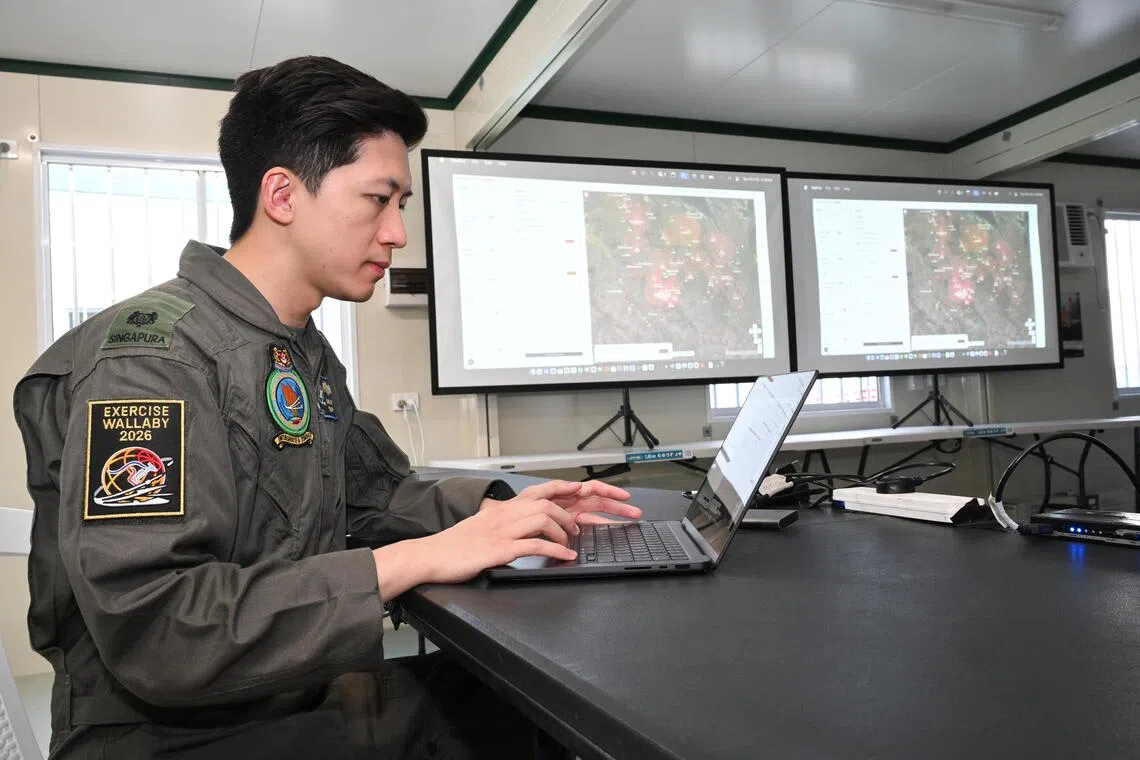
A Helicopter Decision Support System (Heli DSS) being trialled has cut the time taken to plan a flight mission from two hours to 20 minutes.
ST PHOTO: LIM YAOHUI
Published Oct 27, 2026, 06:47 PM
Updated Oct 27, 2026, 06:47 PM
The Republic of Singapore Air Force is field testing two new digital tools at Exercise Wallaby to significantly speed up mission planning and air strike coordination.
The Helicopter Decision Support System cuts flight planning from two hours to 20 minutes, while the DACAS app shortens air strike coordination by up to 80%.
Developers from the RSAF and the Defence Science and Technology Agency plan to integrate machine learning into the helicopter system and refine the air strike app's interface.
ROCKHAMPTON, Australia – The Republic of Singapore Air Force (RSAF) is field-testing two digital tools that have drastically sped up its ability to execute air missions, such as heliborne missions and air strikes.
At Exercise Wallaby, a Helicopter Decision Support System (Heli DSS) being trialled has cut the time taken to plan a flight mission from two hours to 20 minutes, freeing up pilots and ground controllers to focus on higher-order decision-making and contingency planning.
Meanwhile, an application called the Digitally-Aided Close Air Support (DACAS) has shortened the time needed to call an air strike by 50% to 80%.
Before the Heli DSS, two to three route planners had to pore over physical maps and scrutinise terrain contour lines – while factoring for weather conditions and troop locations – in order to chart flight paths.
Long planning times meant that pilots sometimes missed the small window of opportunity when it was optimal to carry out air missions and had to fly in less-than-ideal conditions, said system developer Ho Leong Hock from the RSAF Agile Innovation Digital (RAID). RAID is a start-up unit within the air force that deals with artificial intelligence and data analytics.
The new AI-enabled system uses discrete agents to process data from each domain, before an orchestrator layer brings them together and drafts a mission plan.
Heli DSS project lead Cai Weijun said the system suggests routes to the pilots, but the mission plan is ultimately subject to human approval. With feedback from pilots, the system was improved between each of the five flights it had been used for so far.
Similarly, the DACAS application has shortened the time ground forces need to coordinate close air support missions with strike controllers.
DACAS project lead Shayne Tan (left), 34, and DACAS developer Adriel Chua, 40. ST PHOTO: LIM YAOHUI
DACAS project lead Shayne Tan (left), 34, and DACAS developer Adriel Chua, 40.
Traditionally, the two sides go through a 12-step checklist before an air strike is greenlit. This checklist includes assessing the strike’s effectiveness, the safety of flying in and out, reading back coordinates and real-time situation updates.
The app has transformed a formerly voice-operated process into a digital one, saving time while addressing the challenges of voice communication, said project lead Shayne Tan.
For example, verbal communication may be cut off when an aircraft is behind terrain.
The tool also allows for a continuous information flow between ground and air units, which improves the tracking of enemy forces and target areas, said Tan . It uses the SAF’s Battlefield Management System to relay critical information, such as friendly and enemy positions, to pilots.
Voice communication had been a pain point for AH-64 pilot Tan Yao Bin, who said coordinates might get jumbled.
“With the string of latitude and longitude numbers and poor communication, pilots might read back the wrong information to the guys on the ground. Then they will go back and forth trying to clarify what is the correct information,” the pilot said.
He said the DACAS has been a huge improvement in how he carries out air strikes, compared with his experience in the previous two Exercise Wallaby outings.
The Digitally-Aided Close Air Support (DACAS) has shortened the time needed to call an air strike by 50% to 80%. ST PHOTO: LIM YAOHUI
The Digitally-Aided Close Air Support (DACAS) has shortened the time needed to call an air strike by 50% to 80%.
Exercise Wallaby frame 3 air director Ng Kehang said the deployment of both systems is crucial as the SAF adapts to congested operating environments, including airspace that is crowded with unmanned aerial vehicles.
Going forward, the project teams are focusing on several key enhancements.
The Heli DSS has been developed as a “white-box” AI system, where decision pathways are transparent to human operators. Cai said the immediate priority is integrating machine learning, where the system learns directly from commander and pilot feedback, refining future flight proposals based on which routes aircrews accept, tweak or reject.
For DACAS, developers from the RSAF and the Defence Science and Technology Agency (DSTA) said they intend to refine the app’s visual interface and readability, to ensure strike pilots can absorb critical targeting data even more seamlessly in high-tempo combat environments.
AI/artificial intelligence
正在试用的直升机决策支持系统(Heli DSS)将飞行任务的计划时间从两小时缩短到 20 分钟。
ST 照片:林耀辉
发布于 2026 年 10 月 27 日下午 6:47
更新于2026年10月27日下午6:47
新加坡共和国空军正在“袋鼠行动”演习中实地测试两款新的数字工具,以显著加快任务规划和空袭协调速度。
直升机决策支持系统将飞行计划时间从两小时缩短到 20 分钟,而 DACAS 应用程序可将空中打击协调时间缩短高达 80%。
新加坡空军和国防科技局的开发人员计划将机器学习技术集成到直升机系统中,并改进空袭应用程序的界面。
澳大利亚罗克汉普顿——新加坡共和国空军(RSAF)正在实地测试两种数字工具,这两种工具大大加快了其执行空中任务(如直升机任务和空袭)的能力。
在“袋鼠”演习中,正在试用的直升机决策支持系统(Heli DSS)将飞行任务的计划时间从两小时缩短到 20 分钟,使飞行员和地面控制人员能够专注于更高层次的决策和应急计划。
与此同时,一款名为“数字辅助近距离空中支援”(DACAS)的应用程序将呼叫空袭所需的时间缩短了 50% 至 80%。
在直升机决策支持系统出现之前,两到三名路线规划员必须仔细研究实物地图,仔细观察地形等高线,同时还要考虑天气状况和部队位置,才能绘制出飞行路线。
新加坡空军敏捷创新数字中心(RAID)的系统开发人员何良福表示,漫长的计划时间意味着飞行员有时会错过执行空中任务的最佳时机,不得不在不太理想的条件下飞行。RAID是空军内部一个专注于人工智能和数据分析的初创部门。
新的人工智能系统使用离散代理来处理来自各个领域的数据,然后由协调层将它们汇集在一起并制定任务计划。
直升机决策支持系统(Heli DSS)项目负责人蔡伟军表示,该系统会向飞行员推荐航线,但最终的任务计划仍需人工审批。在飞行员的反馈下,该系统在迄今为止的五次飞行中不断改进。
同样,DACAS 应用缩短了地面部队与打击控制人员协调近距离空中支援任务所需的时间。
DACAS 项目负责人 Shayne Tan(左),34 岁,和 DACAS 开发人员 Adriel Chua,40 岁。ST 照片:LIM YAOHUI
DACAS 项目负责人 Shayne Tan(左),34 岁,和 DACAS 开发人员 Adriel Chua,40 岁。
按照惯例,双方在空袭行动获得批准前,会进行一份包含12个步骤的检查清单。这份清单包括评估空袭效果、确保进出航线的安全、接收回传坐标以及实时更新战况信息。
项目负责人 Shayne Tan 表示,该应用程序将以前通过语音操作的流程转变为数字化流程,既节省了时间,又解决了语音通信的挑战。
例如,当飞机位于地形后方时,口头通讯可能会中断。
谭先生表示,该工具还能实现地面部队和空中部队之间的持续信息交流,从而提高对敌军和目标区域的追踪能力。它利用新加坡武装部队的战场管理系统,将友军和敌军位置等关键信息传递给飞行员。
语音通信一直是 AH-64 飞行员谭耀斌的痛点,他说坐标可能会被搞乱。
“由于只有一串经纬度数字,加上沟通不畅,飞行员可能会把错误的信息传达给地面人员。然后他们就得来回沟通,试图弄清楚哪个信息才是正确的,”这位飞行员说道。
他表示,与之前两次“袋鼠行动”演习的经历相比,“防空作战航空系统”极大地改善了他执行空袭的方式。
数字辅助近距离空中支援系统(DACAS)将呼叫空袭所需的时间缩短了50%至80%。海峡时报照片:林耀辉
数字辅助近距离空中支援(DACAS)将呼叫空袭所需的时间缩短了 50% 至 80%。
“袋鼠”演习第三阶段空中指挥官吴克航表示,随着新加坡武装部队适应拥挤的作战环境,包括无人机密集的空域,部署这两个系统至关重要。
接下来,项目团队将重点放在几个关键的改进上。
直升机决策支持系统(Heli DSS)被开发成一个“白盒”人工智能系统,其决策路径对操作人员完全透明。蔡教授表示,当务之急是集成机器学习功能,使系统能够直接从机长和飞行员的反馈中学习,并根据机组人员接受、调整或拒绝的航线来优化未来的飞行方案。
新加坡空军和国防科技局 (DSTA) 的开发人员表示,他们计划改进 DACAS 应用程序的视觉界面和可读性,以确保攻击飞行员能够在快节奏的战斗环境中更加无缝地吸收关键目标数据。
人工智能