Meet The Biggest And Baddest Ships In the US Army认识一下美国陆军最大最强的舰艇
The US Navy doesn’t have a monopoly on big boats.
Updated Jul 3, 2020 3:37 AM EDT
When you think of the US Army, large seagoing vessels don’t come to mind. Maybe they should; the service has its own expansive fleet of boats and ships, and the USAV SSGT Robert T. Kuroda and its sister ship the USAV Major General Robert Smalls are the biggest of them all.
While the Marines have their own specialized high-end armada of Navy ships, sometimes referred to as the “Gator Navy,” to support their amphibious operations, the Army has no such luxury. But what the Army does have is a far more understated beach landing and logistics naval force that relies on a simpler sea-bound logistics concept.
At the heart of this concept are the Army’s largest class of ships, the Logistic Support Vessels (LSVs) of the General Frank S. Besson class. Eight of these ships are in service with Army, six of which were built between 1987 and 1994. Following the retirement of the Newport class Landing Ship Tank (LST ), they are now the largest of their kind within the Pentagon’s inventory and are reminiscent of Russia’s massive amphibious landing ships.
The class has the ability to pull right up onto beaches., DoD
These first six ships are 273 feet long, 60 feet wide, and displace 4,200 tons. They were designed to convey cargo and vehicles, and can be loaded and unloaded by crane right onto their decks, or by ramps on the stern and on the bow of each vessel. The bow ramp in particular is designed for direct beach/shoreline access, with ships pulling right into the surf for loading and offloading.
Abrams tanks are loaded onto to the class’s 10,500 square-foot deck. , DoD
These ships are capable of carrying any of the Army’s land vehicles, including the massive M1 Abrams main battle tank. In fact, it can haul up to 15 of the Abrams at a time. It can also carry a maximum of 82 double-stacked 20-foot long ISO containers, a big tugboat —even a Boeing C-17 fuselage.
A huge Boeing C-17 fuselage being loaded onto a Besson class LSV., DoD
The maximum load for the early Besson class is 2,000 short tons spread over the vessel’s 10,500 square-feet of deck area. It’s an extraordinary accomplishment for a ship with a draft of just 13 feet. Drawing so little water helps for expeditionary operations when docks are not available.
An MRAP being loaded onto the ship via crane. , DoD
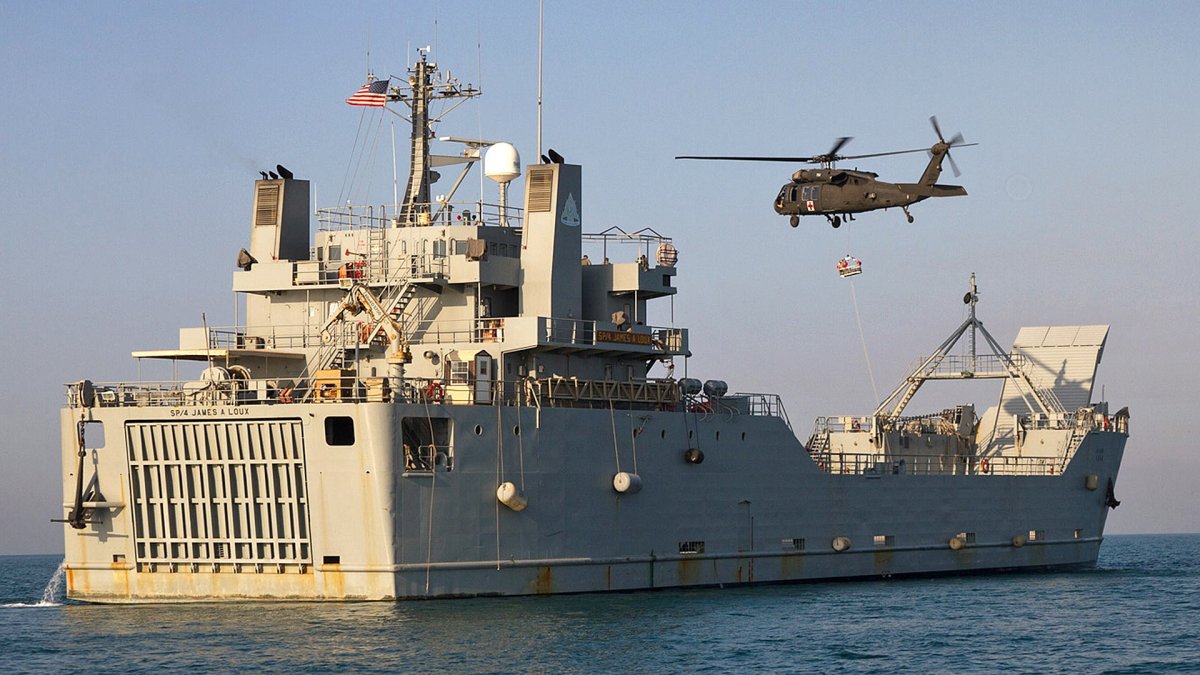
In the early 2000s a subclass of the type was launched consisting of two ships, USAV SSGT Robert T. Kuroda (LSV-7) and its sister ship USAV Major General Robert Smalls (LSV-8). These are the largest ships in the Army’s inventory, with 42 feet added to the earlier General Frank S. Besson class design.
Both variants of Besson class LSVs operated by the US Army seen side-by-side while deployed in the Persian Gulf. , DoD
This increased length is largely due to a modification of the ship’s bow. Instead of having the flat, shovel-like front dictated by the ship’s forward ramp, a “visor” is fitted that can lift up and down. When in the lowered position, this fairing makes the ship much more hydrodynamic, and capable of handling rougher seas than their predecessors.
LSV-8 with its rounded bow lifted., DoD
This modification, along with the ability to generate large quantities of fresh water, double the horsepower, and expanded internal volume for creature comforts, gives the subclass the ability to take on global missions better than its six forebeares. With a range of nearly 6,500 miles, these ships can reliably self-deploy to hotspots on short notice. These modifications come with the penalty of increased mass. The two $26 million ships displace an extra 1,800 tons each compared with the other ships in their class.
LSV crews train for operations in many conditions., DoD
The General Frank S. Besson class of ships, like other US Army vessels, are crewed by a little-known cadre of soldier-sailors (they prefer the name Army Mariner). Each of these ships has roughly eight Warrant Officers, and between 14 and 24 enlisted crew. Unlike most other parts of the service, Army vessels don’t run on rank structure necessarily , instead they run on a license-type hierarchy.
In general, it seems that morale aboard these ships and crew retention is exceptionally high, and let’s face it, saying that you are assigned to a ship in the Army is a great conversation starter—so that’s one big perk. Also, these crews work as small, close-knit units, and many get to see exotic ports around the globe—some of which big Navy ships don’t even get to call on.
An LSV tenders a foreign submarine during RIMPAC. , DoD
A further two variants of the same class were built for the Philippine Navy in the early 1990s, and are configured as multi-role patrol ships. Dubbed the Bacolod City class, these vessels are adaptable to different mission sets and are very inconspicuous. A helicopter pad is fitted to the rear of the variant’s superstructure, and small boats can deploy from the ship’s rear ramp area. These vessels can also still be used in a material transport role when needed and are up-gunned with 20mm cannons and enhanced sensors.
Bacolod City class LSV seen during US-Philippine exercises in the South China Sea. , DoD
The multi-role light helicopter carrier configuration—which the Bacolod City class is a version of—was one of a handful of alternative uses for the General Frank S. Besson class design. Semi-submersible and troop carrier variants were also put forward, but never fully developed.
When it comes to the ability to move a lot of hardware right to the beach the LSV reigns supreme within the Pentagon’s inventory. , DOD
The US Army’s small fleet of General Frank S. Besson class logistics vessels are gaining a whole new level of prominence as the Pentagon attempts to pivot away from sandy land warfare in the Middle East and towards the watery and remote challenges of Pacific.
A US Army LSD offloads vehicles directly onto the rear well deck of a “Gator Navy” amphibious assault/dock landing ship. , DoD
While the Navy, Air Force, and Marines have a front row seat at the table when it comes to fighting in a combined manner over the vast distances in the Pacific Theatre, the Army has struggled to find its place in this new strategic order. These LSVs, especially the more deployable two latter ships in the class, could be just the bridge the service needs to make itself more relevant.
An eclectic mix of US Army hardware on the deck of an LSV., DoD
The Navy is spending big bucks on creating huge mobile sea bases, and even Special Operations Command is getting in on the action by creating their own afloat mobile staging base . It would only seem logical for the Army’s LSVs to play a strong role in this growing sea basing and Pacific theatre expeditionary fighting strategy. If anything else, they represent an affordable bridge between small and rudimentary landing craft with localized reach and the Joint High Speed Vessels that are growing in number within the Pentagon’s war-fighting portfolio.
The LSV’s amphibious capabilities are undeniable. , DoD
With all this in mind, expect these little-known but capable and proud ships to become a much more “visible” Army capability,—and don’t be too surprised if the service decides to order more of them in the future.
Contact the author Tyler@thedrive.com
Comments couldn’t be loaded. Please refresh the page.
更新于美国东部时间2020年7月3日凌晨3:37
提到美国陆军,人们可能不会想到大型远洋舰艇。但或许应该想到;陆军拥有庞大的舰艇舰队,其中“罗伯特·T·黑田”号(USAV SSGT Robert T. Kuroda)及其姊妹舰“罗伯特·斯莫尔斯”号(USAV Major General Robert Smalls)是最大的舰艇。
虽然海军陆战队拥有自己专业的、高端的海军舰艇舰队(有时被称为“鳄鱼海军”)来支援其两栖作战,但陆军却没有这样的优势。不过,陆军拥有一支更为低调的滩头登陆和后勤海军力量,其依靠的是更为简单的海上后勤保障理念。
这一概念的核心是陆军最大的舰艇——弗兰克·S·贝松将军级后勤支援舰(LSV)。目前陆军共有八艘该级舰艇服役,其中六艘建造于1987年至1994年间。随着纽波特级坦克登陆舰(LST)的退役,它们成为五角大楼现役舰艇中体型最大的舰艇,其体型与俄罗斯的巨型两栖登陆舰颇为相似。
该舰艇具备直接停靠在沙滩上的能力。(美国国防部)
这首批六艘船长273英尺,宽60英尺,排水量4200吨。它们设计用于运输货物和车辆,可通过起重机直接在甲板上装卸货物,也可通过船尾和船首的坡道进行装卸。特别是船首坡道,其设计便于直接停靠在海滩/海岸线上,船舶可直接驶入海浪中进行装卸作业。
艾布拉姆斯坦克被装载到该级战舰10500平方英尺的甲板上。(美国国防部)
这些舰艇能够运载陆军的任何陆地车辆,包括庞大的M1艾布拉姆斯主战坦克。事实上,它一次最多可以运载15辆艾布拉姆斯坦克。它还可以运载最多82个双层堆叠的20英尺长ISO集装箱、一艘大型拖船,甚至一架波音C-17运输机的机身。
一架巨大的波音C-17运输机机身正在装载到一艘贝松级登陆艇上。(美国国防部)
早期贝松级驱逐舰的最大载荷为2000短吨,分布在舰体10500平方英尺的甲板面积上。对于一艘吃水仅13英尺的舰艇来说,这堪称一项非凡的成就。如此小的吃水深度有利于在没有码头的情况下进行远征作战。
一辆防地雷反伏击车正通过起重机装载到船上。(美国国防部)
21世纪初,该型舰艇的一个子级下水,包括两艘舰艇:美国陆军“罗伯特·T·黑田”号(LSV-7)及其姊妹舰“罗伯特·斯莫尔斯少将”号(LSV-8)。这两艘舰艇是陆军现役最大的舰艇,比早期的“弗兰克·S·贝松”级舰艇长42英尺。
图中可见美国陆军使用的两种贝松级登陆艇在波斯湾部署期间并排停泊。(美国国防部)
船体长度的增加主要归功于船首的改进。原本由船首斜坡决定的扁平铲状船首被替换成了一个可升降的“遮篷”。当遮篷放下时,它能显著提升船舶的流体动力学性能,使其比以往的舰艇更能应对恶劣海况。
LSV-8 圆弓高高抬起。,美国国防部
这项改进,加上大量淡水生成能力、双倍马力以及扩大的内部空间以提升舒适度,使该子级舰艇比其六艘前辈舰艇更能胜任全球任务。凭借近6500英里的航程,这些舰艇能够可靠地在短时间内自主部署到热点地区。这些改进也带来了重量增加的代价。这两艘造价2600万美元的舰艇,每艘的排水量比同级其他舰艇多出1800吨。
LSV 乘员组接受多种条件下的作战训练。(美国国防部)
与其他美国陆军舰艇一样,“弗兰克·S·贝松将军”级舰艇的船员也来自一支鲜为人知的士兵水兵队伍(他们更喜欢“陆军水兵”这个称呼)。每艘舰艇大约配备八名准尉和十四至二十四名士官。与军种其他部门不同,陆军舰艇的运作并非完全基于军衔等级,而是采用类似执照的等级制度。
总的来说,这些舰艇上的士气和船员留任率似乎都非常高。而且说实话,在陆军舰艇上服役绝对是个不错的谈资——这算得上是一大优势。此外,这些舰艇的船员组成规模小、关系紧密,许多人还有机会到访世界各地的一些异国港口——其中一些甚至连海军大型舰艇都无法停靠。
在环太平洋军事训练营期间,一艘登陆艇为一艘外国潜艇提供补给。(美国国防部)
20世纪90年代初,菲律宾海军又建造了两艘同级舰艇的衍生舰,这两艘舰艇被配置为多用途巡逻舰。它们被称为“巴科洛德市”级,能够适应不同的任务需求,并且外形非常隐蔽。该型舰艇的上层建筑后部设有直升机停机坪,小型艇可以从舰尾跳板区域下水。必要时,这些舰艇仍可执行物资运输任务,并配备了20毫米舰炮和增强型传感器。
在南海举行的美菲联合军演中,可以看到巴科洛德市级登陆艇。(美国国防部)
多用途轻型直升机航母(巴科洛德市级航母即为这种配置的衍生型号)是弗兰克·S·贝松将军级航母设计的少数几种替代用途之一。半潜式和运兵型也曾被提出,但从未得到全面开发。
在将大量硬件直接运送到海滩的能力方面,LSV 在五角大楼的装备中占据绝对优势。
随着五角大楼试图从中东的沙地战争转向太平洋的水域和偏远地区,美国陆军的弗兰克·S·贝松将军级后勤舰艇小舰队的重要性正在提升到一个全新的水平。
美国陆军的一艘船坞登陆艇(LSD)将车辆直接卸载到“鳄鱼海军”两栖攻击/船坞登陆舰的后部坞舱甲板上。(美国国防部)
在太平洋战区广阔的联合作战中,海军、空军和海军陆战队占据着举足轻重的地位,而陆军却一直在努力寻找自身在新战略秩序中的定位。这些登陆艇,尤其是该级舰艇中更易于部署的后两艘,或许正是陆军提升自身重要性的桥梁。
一艘登陆艇甲板上摆放着各式各样的美国陆军装备。(美国国防部)
海军正斥巨资建造大型移动海上基地,就连特种作战司令部也加入了这一行列,建造了自己的海上移动集结基地。因此,陆军的登陆艇(LSV)在这一日益发展的海上基地和太平洋战区远征作战战略中发挥重要作用也就不足为奇了。它们至少代表了一种经济实惠的桥梁,连接了作战范围有限的小型简易登陆艇和五角大楼作战体系中数量不断增长的联合高速舰艇。
LSV的两栖作战能力毋庸置疑。——美国国防部
考虑到所有这些因素,预计这些鲜为人知但能力强大且令人自豪的舰艇将成为陆军更加“引人注目”的实力——如果陆军将来决定订购更多此类舰艇,也不要感到太惊讶。
联系作者:Tyler@thedrive.com
评论加载失败,请刷新页面。