TTSH launches new initiative to tackle sepsis and prevent it from becoming deadly陈笃生医院推出新举措,应对败血症并防止其致命。
TTSH's Safe from Sepsis initiative enables earlier detection and faster antibiotic treatment, improving survival rates and reducing sepsis mortality. Read more at straitstimes.com.
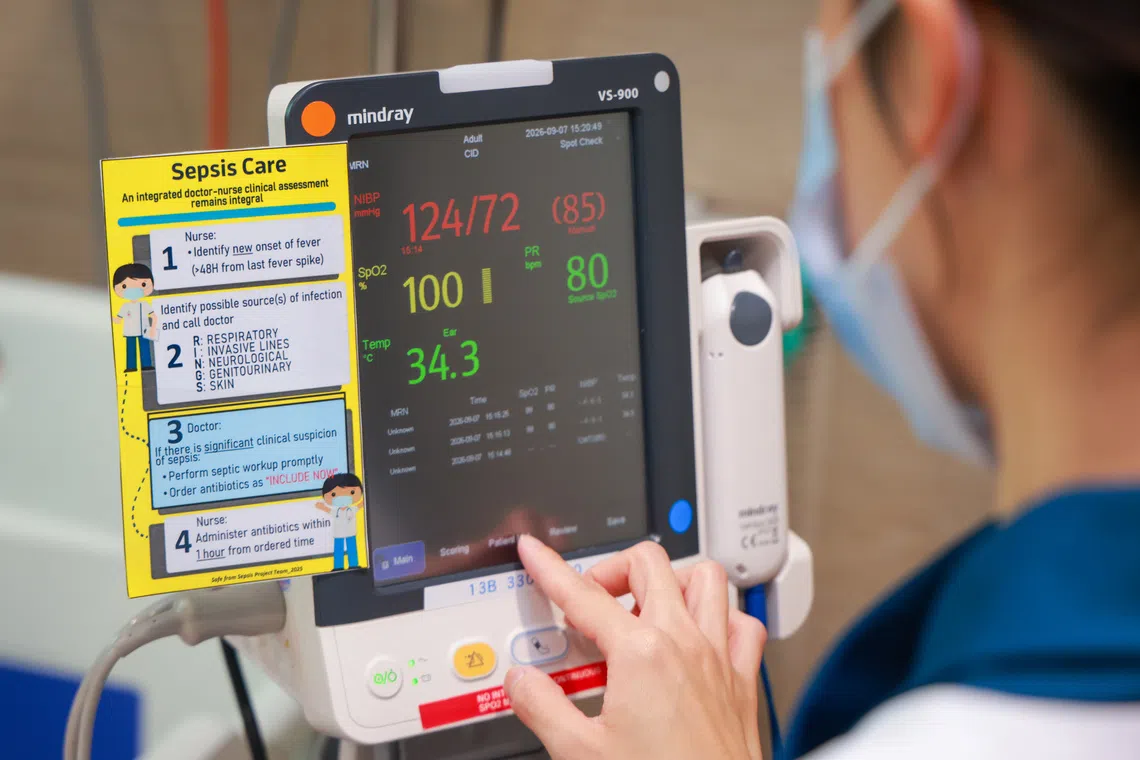
Sepsis is an extreme reaction by the human body to an infection.
ST PHOTO: JASON QUAH
Published Sep 07, 2026, 07:45 PM
Updated Sep 07, 2026, 07:45 PM
Tan Tock Seng Hospital launched Safe from Sepsis to detect sepsis early and administer antibiotics within 180 minutes, improving patient survival rates significantly.
The initiative trained 1,763 nurses and reduced median antibiotic administration time from 220 to 114 minutes across multiple hospital wards.
Safe from Sepsis won a Gold Award for Clinical Effectiveness and plans to expand to other healthcare institutions in Singapore's NHG cluster.
SINGAPORE - A team from Tan Tock Seng Hospital has developed a process to allow for the earlier detection and management of sepsis – a life-threatening condition that accounts for more than 20 per cent of all deaths worldwide.
Sepsis is an extreme reaction by the human body to an infection. It occurs when chemicals released by the body to combat pathogens cause inflammatory responses, impairing blood flow to vital organs in severe cases.
This in turn can lead to tissue damage, organ failure or death if not treated in time.
According to a study published in October 2025 in the Lancet Global Health, there were an estimated 166 million sepsis cases worldwide in 2021, with 21.4 million deaths from the condition that year.
To better manage sepsis and prevent it from progressing to septic shock – whose symptoms include extremely low blood pressure and organ failure – an eight-member team from Tan Tock Seng Hospital (TTSH) developed an initiative called Safe from Sepsis.
Led by nurses, the initiative aims to allow for the earlier identification of patients at risk of sepsis, as well as providing such patients with accelerated treatment.
Prior to the initiative’s launch, the median time for antibiotics to be administered for patients with sepsis was 220 minutes, said Huang Wenhui, the medical project lead for Safe from Sepsis.
Huang – a senior consultant with the TTSH general medicine department – noted that only 37 per cent of such patients received antibiotics in under 180 minutes, a timeframe which significantly improves patient survival rates.
Safe from Sepsis was introduced with the aim of ensuring at least 80 per cent of patients receive antibiotics within this critical window, he said.
“Nurses have an extremely important role because they actually know the patients very well and they’re more in tune with the patients,” Huang said, noting they would be more aware of subtle changes in patients which could point to sepsis
Under the new initiative, a structured sepsis assessment tool was introduced to help nurses recognise early symptoms of sepsis such as fever, breathlessness and altered mental status, as well as identify potential infection sources.
Should they suspect sepsis, the case will then be escalated to a suitable doctor to ensure patients get a medical review, have their blood culture collected and receive antibiotics within 180 minutes.
A year-long pilot of the initiative, which began in September 2024, proved to be successful, said TTSH senior nurse manager Caren Mok, who is also the nursing project lead for Safe from Sepsis.
Between September 2025 and May 2026, the initiative was expanded to 62 wards across the hospital and the TTSH integrated care hub, which offers rehabilitative and palliative care, as well as the National Centre for Infectious Diseases and TTSH’s sub-acute care wards at the nearby Ren Ci Community Hospital.
Across the nine-month period, there were 1,395 sepsis cases, 75 per cent of which received antibiotics within 180 minutes.
The initiative cut the median time from fever recognition to antibiotic administration by 76 minutes, from 220 minutes to 114 minutes.
Among the 1,763 nurses trained under the initiative was TTSH senior staff nurse Fan Shuwan. She said that while there were concerns about the initiative adding to the workload of nurses, tackling sepsis before it worsens is easier than handling a patient whose condition has deteriorated.
“It actually helps to lessen the workload in the long run,” said Fan, who also acts as a “nurse champion” to advocate for Safe from Sepsis among her colleagues.
(From left) Huang Wenhui, the medical project lead for Safe from Sepsis, TTSH senior staff nurse Fan Shuwan and TTSH senior nurse manager Caren Mok. ST PHOTO: JASON QUAH
(From left) Huang Wenhui, the medical project lead for Safe from Sepsis, TTSH senior staff nurse Fan Shuwan and TTSH senior nurse manager Caren Mok.
Tackling sepsis is becoming increasingly important as Singapore’s population ages and patients present with more comorbidities, said Huang.
He noted that while there were concerns about overprescribing antibiotics as a result of the initiative, the hospital’s data showed their prescription continued to be appropriate.
Safe from Sepsis has also gained international recognition. At the recent Hospital Management Asia Awards in Bangkok – held annually to recognise healthcare excellence across the region – the team received the Gold Award for Clinical Effectiveness Improvement for their work.
In the longer term TTSH hopes to be able to spread Safe from Sepsis to other institutions under the NHG Health public healthcare cluster and beyond, Mok said.
Zhaki Abdullah is a correspondent at The Straits Times. He is on the health beat, in addition to occasionally covering science, environmental, tech and Muslim affairs issues.
Tan Tock Seng Hospital
脓毒症是人体对感染的一种极端反应。
《海峡时报》摄影:JASON QUAH
发布于 2026 年 9 月 7 日晚上 7:45
更新于2026年9月7日晚上7:45
陈笃生医院推出“安全预防败血症”计划,旨在及早发现败血症并在 180 分钟内使用抗生素,从而显著提高患者的生存率。
该计划培训了 1763 名护士,并将多个医院病房的抗生素给药中位时间从 220 分钟缩短至 114 分钟。
Safe from Sepsis 荣获临床疗效金奖,并计划扩展到新加坡 NHG 集群的其他医疗机构。
新加坡——陈笃生医院的一个团队开发了一种流程,可以更早地发现和治疗败血症——败血症是一种危及生命的疾病,占全球所有死亡人数的 20% 以上。
脓毒症是人体对感染的一种极端反应。当人体释放的用于对抗病原体的化学物质引发炎症反应时,就会发生脓毒症,严重时甚至会损害重要器官的血液供应。
如果不及时治疗,这反过来会导致组织损伤、器官衰竭甚至死亡。
根据 2025 年 10 月发表在《柳叶刀全球健康》上的一项研究,2021 年全球估计有 1.66 亿例败血症病例,当年有 2140 万人死于该疾病。
为了更好地控制败血症并防止其发展为败血性休克(其症状包括极低的血压和器官衰竭),陈笃生医院 (TTSH) 的一个八人团队制定了一项名为“远离败血症”的计划。
这项由护士主导的计划旨在及早发现有败血症风险的患者,并为这些患者提供加速治疗。
“在该计划启动之前,败血症患者接受抗生素治疗的平均时间为 220 分钟,” 预防败血症医疗项目负责人黄文辉表示。
黄医生是陈笃生医院内科的高级顾问,他指出,只有 37% 的此类患者在 180 分钟内接受了抗生素治疗,而这一时间范围显著提高了患者的生存率。
他说,推出“预防败血症”计划的目的是确保至少 80% 的患者在这个关键时期内接受抗生素治疗。
黄医生说:“护士扮演着极其重要的角色,因为她们非常了解病人,也更能体会病人的感受。”她指出,护士们会更敏锐地察觉到病人身上可能预示着败血症的细微变化。
在新举措下,引入了一种结构化的脓毒症评估工具,以帮助护士识别脓毒症的早期症状,如发烧、呼吸困难和精神状态改变,以及识别潜在的感染源。
如果他们怀疑是败血症,那么病例将被上报给合适的医生,以确保患者在 180 分钟内得到医疗评估、采集血培养样本并接受抗生素治疗。
陈笃生医院高级护士经理兼“远离败血症”护理项目负责人 Caren Mok 表示,这项于 2024 年 9 月开始的为期一年的试点计划取得了成功。
从 2025 年 9 月到 2026 年 5 月,该计划扩展到医院的 62 个病房和 TTSH 综合护理中心(提供康复和姑息治疗),以及国家传染病中心和 TTSH 在附近的仁慈社区医院的亚急性护理病房。
在九个月期间,共发生 1395 例败血症病例,其中 75% 的患者在 180 分钟内接受了抗生素治疗。
该举措将从识别发烧到使用抗生素的平均时间缩短了 76 分钟,从 220 分钟缩短到 114 分钟。
在接受该计划培训的1763名护士中,陈笃生医院高级护士范淑婉位列其中。她表示,虽然有人担心该计划会增加护士的工作量,但防控败血症远比处理病情恶化的患者容易得多。
“从长远来看,这实际上有助于减轻工作量,”范说道。她同时也是一名“护士倡导者”,在同事中倡导“预防败血症”。
(从左至右)“预防败血症”医疗项目负责人黄文慧、陈笃生医院高级护士范淑婉和陈笃生医院高级护士长莫嘉琳。海峡时报摄影:JASON QUAH
(从左至右)“远离败血症”医疗项目负责人黄文辉、陈笃生医院高级护士范淑婉和陈笃生医院高级护士长莫嘉琳。
黄医生表示,随着新加坡人口老龄化,患者合并症增多,应对败血症变得越来越重要。
他指出,虽然有人担心这项举措会导致抗生素滥用,但医院的数据显示,他们的处方仍然是合理的。
“预防败血症”项目也获得了国际认可。在最近于曼谷举行的亚洲医院管理奖颁奖典礼上——该奖项每年颁发一次,旨在表彰亚洲地区的卓越医疗服务——该团队凭借其工作荣获了临床疗效改进金奖。
莫克表示,从长远来看,陈笃生希望能够将“预防败血症”推广到NHG Health公共医疗保健集群下的其他机构以及更广泛的地区。
扎基·阿卜杜拉是《海峡时报》的记者。他主要负责健康新闻报道,偶尔也报道科学、环境、科技和穆斯林事务等议题。
陈笃生医院