Singapore, Indonesia committed at highest level to resolving bilateral issues: Vivian Balakrishnan新加坡和印度尼西亚最高级别承诺解决双边问题:维文·巴拉克里希南
Both sides grappling with issues such as gas cuts, power exports and haze. Read more at straitstimes.com.
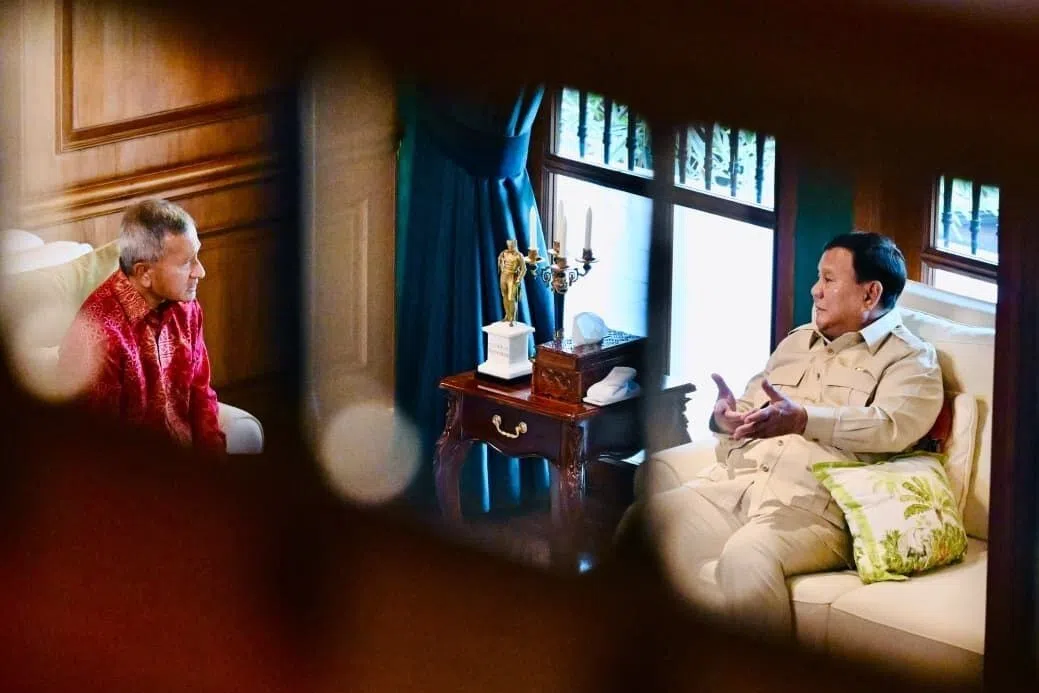
Foreign Minister Vivian Balakrishnan (left) meeting Indonesian President Prabowo Subianto in Jakarta on Oct 28.
PHOTO: INDONESIA PRESIDENTIAL PALACE
Published Oct 28, 2026, 08:33 PM
Updated Oct 28, 2026, 08:52 PM
Singapore and Indonesia said their top leaders have the political will to resolve disputes, after “good”, “honest” talks between Foreign Minister Vivian Balakrishnan and President Prabowo Subianto.
The two sides are dealing with issues such as gas cuts, possible power exports and haze. They agreed on a joint task force and a hotline to improve contact and accountability.
Balakrishnan said both countries must honour contracts and secure vital supplies. He said Singapore is prepared, and both sides will deepen ties before 2027 ASEAN plans.
JAKARTA – High-level communication between Prime Minister Lawrence Wong and Indonesian President Prabowo Subianto has set the “political commitment on both sides to do what is necessary”, Singapore Foreign Minister Vivian Balakrishnan said on Oct 28, as the two neighbours seek to manage differences over energy supplies and other bilateral issues.
Speaking to reporters in Jakarta after meeting Prabowo earlier in the day, Balakrishnan said his visit had involved “good conversations, honest conversations, sincere conversations” and produced constructive approaches, some of which were already being implemented.
“I’m not at liberty to discuss the details,” he said when asked about his meeting with Prabowo.
“But first, let me give you the assurance that communication has occurred at the highest level between my prime minister and with President Prabowo,” he said.
He added that both sides now had to implement their plans and “execute that commitment”.
The meeting came as the two neighbours grappled with questions over gas supplies and plans for cross-border electricity exports, while stepping up cooperation to tackle forest and land fires in Indonesia – which have sent thick haze across parts of the region and prompted calls for stronger action to prevent the problem from recurring .
Indonesia’s Cabinet Secretary Teddy Indra Wijaya said earlier on Oct 28 that Balakrishnan had requested an audience with Prabowo. The Presidential Secretariat also said that Prabowo remained committed to maintaining good relations and strengthening communication with neighbouring countries.
Managing differences with ‘cool heads’
Balakrishnan said Singapore and Indonesia, as permanent neighbours, would always be interdependent and face common challenges, including the haze and pandemics.
He acknowledged that differences in priorities and approaches were inevitable, sometimes accompanied by political disagreements.
“But precisely at a moment like this, it’s important for cool heads to prevail,” he said, stressing the need for direct, honest and constructive conversations.
After arriving in Jakarta on Oct 27 for a three-day visit, Balakrishnan held his first official talks with Indonesian Foreign Minister Arrmanatha Nasir , who took office on Oct 1.
Both ministers reaffirmed the strength of bilateral relations and stressed the importance of open dialogue and mutual respect.
“We want Indonesia to succeed, and we want this because our futures are intertwined. Singapore’s success also depends on a prosperous, stable, peaceful Indonesia,” he said during his Oct 27 talks.
The two ministers also agreed on Oct 27 to establish a joint task force to hold companies accountable for forest and land fires that cause transboundary haze, as well as a hotline at the ministerial and senior official levels to strengthen communication.
Balakrishnan said the haze problem had persisted in South-east Asia for almost three decades, calling it “far too long” and stressing the need to find solutions.
Energy and cooperation
Asked whether Singapore and Indonesia had reached a consensus on contractual obligations following the gas export cuts, Balakrishnan said both countries shared a commitment to honouring contracts.
“If you carefully parse the statements which have been made by Mr Wong, Minister Tan, as well as the Indonesian ministers, you will realise that in fact there is a common commitment to the sanctity of contract, and that’s good,” he said, referring to PM Wong and Minister for Energy, Trade and Industry (Energy and Industry) Tan See Leng.
He said honouring contracts was important to the credibility and competitiveness of both economies.
“Look at actions, not just at words,” he added, saying contracts were generally respected in the region.
PM Wong said on Oct 25 that Singapore expected all parties to honour their contractual commitments , while Indonesia’s Energy and Mineral Resources Minister Bahlil Lahadalia said the reductions did not breach existing agreements.
Indonesia began cutting natural gas exports to Singapore on Oct 24 by 31 million standard cubic feet per day, or about 8 per cent of its piped gas exports, to prioritise domestic electricity needs in Batam, Bintan and Sumatra.
Singapore’s Energy Market Authority said the reduction amounted to 17 billion British thermal units per day over 18 days , equivalent to less than 2 per cent of Singapore’s daily gas demand.
The authority said Singapore had sufficient supplies, with its gas importer ready to bring in more liquefied natural gas (LNG) if needed.
Existing gas import contracts with Indonesia are due to expire at the end of 2028.
Balakrishnan said Singapore was managing the disruption from a position of strength, having diversified its energy sources and developed LNG terminals.
He also pointed to plans being explored for strategic oil storage with Saudi Arabia and overseas visits by Singapore ministers to secure essential supplies.
“The pattern is about securing essential supplies to keep Singapore going, whatever happens,” he said.
Separately, Indonesia is reviewing plans to export low-carbon electricity to Singapore, with pricing negotiations yet to be resolved.
Bahlil said on Oct 26 that Jakarta was reviewing the plans to prioritise domestic needs. Singapore has granted conditional licences to six Indonesian electricity import projects with a combined capacity of 3 gigawatts.
Balakrishnan said governments had a responsibility to secure essential supplies, including energy, for their populations.
He said he was not particularly fond of the term “resource nationalism”, noting that governments had to look after their own people.
But he said domestic priorities and regional cooperation could go hand in hand, with cross-border energy contracts helping to attract investment, expand infrastructure and lower costs.
“Working together and looking after your own needs. It’s not either or. It’s not a binary,” he said.
He cited the Asean Power Grid and regional energy investment as ways to strengthen energy security, particularly as artificial intelligence and data centres drive up electricity demand.
Singapore and Indonesia will mark 60 years of diplomatic relations in 2027, when Singapore will also chair Asean .
During their Oct 27 talks, Arrmanatha pledged Indonesia’s support for Singapore’s Asean chairmanship.
Both ministers also agreed to build on the outcomes of the Singapore-Indonesia Leaders’ Retreat in July , when PM Wong and Prabowo witnessed the signing of 26 agreements spanning economic, energy, defence, digital, environmental and other areas of cooperation.
Singapore has been Indonesia’s largest source of foreign direct investment since 2014, with investments reaching US$17.4 billion (S$22.6 billion) in 2025.
Looking ahead to Singapore’s Asean chairmanship, Balakrishnan said the Republic would seek to deepen regional integration and strengthen partnerships to build resilience against disruptions to essential supplies.
“Given the state of the world, I think this has become even more urgent, more essential,” he said.
Arlina Arshad is The Straits Times’ Indonesia bureau chief. She is a Singaporean who has been living and working in Indonesia as a journalist for more than 15 years.
Hariz Baharudin is Indonesia correspondent at The Straits Times. He has an interest in Indonesia and the wider currents shaping South-east Asia.
Singapore-Indonesia ties
10月28日,外交部长维维安·巴拉克里希南(左)在雅加达会见印度尼西亚总统普拉博沃·苏比安托。
照片:印度尼西亚总统府
发布于 2026 年 10 月 28 日晚上 8:33
更新于2026年10月28日晚上8:52
新加坡和印度尼西亚表示,在外交部长维文·巴拉克里希南和总统普拉博沃·苏比安托进行了“良好”、“坦诚”的会谈后,两国最高领导人有政治意愿解决争端。
双方正在处理天然气供应中断、可能的电力出口以及雾霾等问题。他们同意成立联合工作组并设立热线,以加强联系和问责。
巴拉克里希南表示,两国必须履行合同,确保关键物资供应。他表示,新加坡已做好准备,双方将在2027年东盟计划实施前深化双边关系。
雅加达——新加坡外交部长维文·巴拉克里希南10月28日表示,总理黄循财和印尼总统普拉博沃·苏比安托之间的高层沟通,已确立了“双方采取必要措施的政治承诺”,两国正努力管控在能源供应和其他双边问题上的分歧。
巴拉克里希南在雅加达与普拉博沃会面后对记者表示,他的访问包括“良好的对话、坦诚的对话、真诚的对话”,并产生了建设性的方法,其中一些方法已经在实施中。
当被问及与普拉博沃的会面时,他说:“我不方便讨论细节。”
“但首先,我要向你们保证,我的总理和普拉博沃总统之间已经进行了最高级别的沟通,”他说。
他补充说,双方现在都必须落实各自的计划并“履行承诺”。
此次会晤正值两国邻国努力解决天然气供应和跨境电力出口计划等问题之际,同时双方也在加强合作,以应对印度尼西亚的森林和土地火灾——这些火灾已使该地区部分地区笼罩在浓烟之中,并引发了人们呼吁采取更有力的行动来防止问题再次发生。
印尼内阁秘书泰迪·因德拉·维贾亚(Teddy Indra Wijaya)10月28日早些时候表示,巴拉克里希南已请求与普拉博沃会面。总统府也表示,普拉博沃将继续致力于与邻国保持良好关系并加强沟通。
冷静处理分歧
巴拉克里希南表示,新加坡和印度尼西亚作为永久邻国,将始终相互依存,并面临共同的挑战,包括雾霾和流行病。
他承认,优先事项和方法上的差异是不可避免的,有时还会伴随着政治分歧。
“但正是在这样的时刻,保持冷静的头脑才显得尤为重要,”他说道,并强调需要进行直接、诚实和建设性的对话。
巴拉克里希南于 10 月 27 日抵达雅加达进行为期三天的访问,并与 10 月 1 日上任的印尼外交部长阿尔马纳塔·纳西尔举行了首次正式会谈。
两位部长重申了双边关系的牢固性,并强调了公开对话和相互尊重的重要性。
“我们希望印尼取得成功,因为我们的未来息息相关。新加坡的成功也取决于一个繁荣、稳定、和平的印尼,”他在10月27日的会谈中说道。
两位部长还于 10 月 27 日同意成立联合工作组,追究造成跨境烟霾的森林和土地火灾相关公司的责任,并设立部长级和高级官员级热线,以加强沟通。
巴拉克里希南表示,东南亚的雾霾问题已经持续了近三十年,他称之为“时间太长了”,并强调需要找到解决办法。
能源与合作
当被问及新加坡和印度尼西亚在天然气出口削减后是否就合同义务达成共识时,巴拉克里希南表示,两国都致力于履行合同。
“如果你仔细分析黄先生、陈部长以及印尼部长们的声明,你就会发现,实际上他们都对合同的神圣性有着共同的承诺,这很好,”他指的是黄英贤总理和能源、贸易及工业部长(能源和工业)陈世龙。
他表示,履行合同对两国经济的信誉和竞争力都至关重要。
“要看行动,而不仅仅是言辞,”他补充道,并表示该地区普遍尊重合同。
黄之锋总理于 10 月 25 日表示,新加坡希望各方履行其合同义务,而印尼能源和矿产资源部长巴赫利尔·拉哈达利亚则表示,减产并未违反现有协议。
10月24日,印尼开始削减对新加坡的天然气出口,每天减少3100万标准立方英尺,约占其管道天然气出口量的8%,以优先满足巴淡岛、民丹岛和苏门答腊岛的国内电力需求。
新加坡能源市场管理局表示,18 天内每天减少的天然气用量为 170 亿英热单位,相当于新加坡每日天然气需求的不到 2%。
该机构表示,新加坡天然气供应充足,如有需要,其天然气进口商已准备好进口更多液化天然气(LNG)。
与印度尼西亚现有的天然气进口合同将于 2028 年底到期。
巴拉克里希南表示,新加坡凭借其能源来源多元化和液化天然气接收站的发展,从自身优势地位应对了此次冲击。
他还指出,新加坡正在与沙特阿拉伯探讨战略石油储存计划,新加坡部长们也将出国访问以确保基本物资供应。
他说:“这种模式旨在确保基本物资供应,以维持新加坡的正常运转,无论发生什么。”
另外,印尼正在审查向新加坡出口低碳电力的计划,但价格谈判尚未解决。
巴利尔10月26日表示,雅加达正在重新评估相关计划,以优先满足国内需求。新加坡已向六个印尼电力进口项目发放了有条件许可证,这些项目的总装机容量为3吉瓦。
巴拉克里希南表示,各国政府有责任保障其人民的基本物资供应,包括能源。
他表示自己并不特别喜欢“资源民族主义”这个词,并指出政府必须照顾好自己的人民。
但他表示,国内优先事项和区域合作可以齐头并进,跨境能源合同有助于吸引投资、扩大基础设施和降低成本。
“既要团结协作,也要照顾好自己的需求。这不是二选一的问题,也不是非此即彼的选择。”他说道。
他指出,东盟电网和区域能源投资是加强能源安全的途径,尤其是在人工智能和数据中心推动电力需求不断增长的情况下。
2027年,新加坡和印度尼西亚将迎来建交60周年,届时新加坡还将担任东盟轮值主席国。
在10月27日的会谈中,阿曼纳塔承诺印尼将支持新加坡担任东盟轮值主席国。
两位部长还同意在7月份新加坡-印尼领导人非正式会议上取得的成果基础上继续努力。当时,黄英贤总理和普拉博沃见证了26项协议的签署,涵盖经济、能源、国防、数字、环境和其他合作领域。
自 2014 年以来,新加坡一直是印度尼西亚最大的外国直接投资来源国,预计到 2025 年,投资额将达到 174 亿美元(226 亿新元)。
展望新加坡担任东盟轮值主席国,巴拉克里希南表示,新加坡将寻求深化区域一体化,加强伙伴关系,以增强抵御基本物资供应中断的能力。
“鉴于当今世界形势,我认为这变得更加紧迫,更加重要,”他说。
阿琳娜·阿尔沙德是《海峡时报》印尼分社社长。她是一名新加坡人,在印尼生活和工作超过15年,从事新闻工作。
哈里兹·巴哈鲁丁是《海峡时报》驻印度尼西亚记者。他对印度尼西亚以及影响东南亚的更广泛趋势很感兴趣。
新加坡与印度尼西亚的关系