AI replacing certain tasks, but not entire jobs: Ong Ye Kung人工智能将取代某些任务,但不会取代整个工作:王乙康
The health minister was speaking about the job market to students and academic staff members at the annual Kent Ridge Ministerial Forum.
The health minister was speaking about the job market to students and academic staff members at the annual Kent Ridge Ministerial Forum.
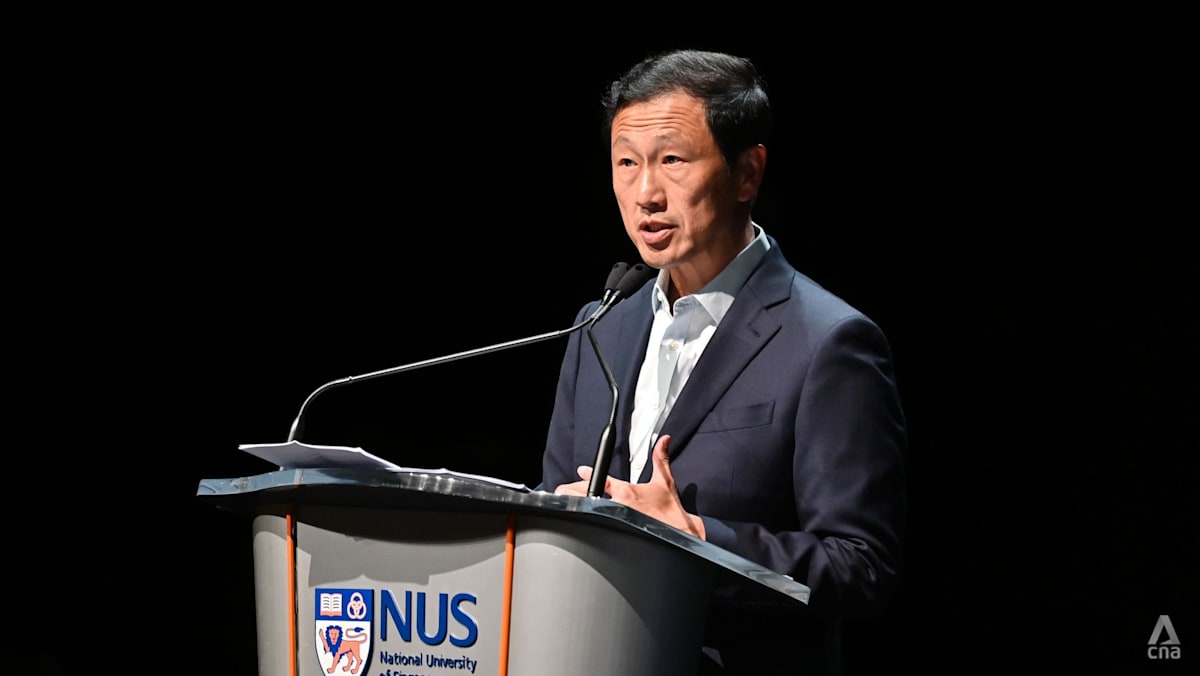
Minister for Health and Coordinating Minister for Social Policies Ong Ye Kung speaking at the Kent Ridge Ministerial Forum, held at the National University of Singapore (NUS) on Sep 7, 2026. (Photo: CNA/Alyssa Tan)
This audio is generated by an AI tool.
SINGAPORE: While artificial intelligence is replacing certain tasks, it is not replacing entire jobs most of the time, Minister for Health Ong Ye Kung said on Monday (Sep 7).
He added that AI is not resulting in mass job displacement, but it is used as a tool, which can lead to job redesign.
“As AI replaces knowledge creation, and even human connection, the impact will be even more profound. Seizing its opportunities, installing guardrails, and pushing back against its adverse impacts are parallel efforts of equal importance that we must start work now,” said Mr Ong at the annual Kent Ridge Ministerial Forum.
Held at the National University of Singapore’s (NUS) University Cultural Centre, the forum was attended by about 250 students from various tertiary institutions and members of academia.
CNA Games Guess Word Crack the word, one row at a time Buzzword Create words using the given letters Mini Sudoku Tiny puzzle, mighty brain teaser Mini Crossword Small grid, big challenge Word Search Spot as many words as you can Show More Show Less Speaking at the start of the forum, Mr Ong set out how he sees changes in the job market. He cited Graduate Employment Survey (GES) data, which showed that from 2023 to 2025, the proportion of graduates who secured employment six months after graduation declined from 92.9 per cent to 88.9 per cent . This reflects a “more competitive market”, he said. Mr Ong said employers are facing changes too, pointing to industries that have been undergoing “significant change” over the years. For example, automobiles are shifting towards electric vehicles, and ageing populations are reshaping healthcare. “And then, there is AI. In some organisations and industries, it is automating certain routine tasks. However, these tasks used to be handled by new hires ... so AI might have raised baseline expectations of what the new hires have to do,” he said. “In summary, more graduates entering the market, employers needing to differentiate job applicants and higher expectations of new hires, and these are three compounding factors resulting in a tighter graduate job market and greater job search anxiety that you are facing,” added Mr Ong, who is also coordinating minister for social policies.
Speaking at the start of the forum, Mr Ong set out how he sees changes in the job market.
He cited Graduate Employment Survey (GES) data, which showed that from 2023 to 2025, the proportion of graduates who secured employment six months after graduation declined from 92.9 per cent to 88.9 per cent .
This reflects a “more competitive market”, he said.
Mr Ong said employers are facing changes too, pointing to industries that have been undergoing “significant change” over the years.
For example, automobiles are shifting towards electric vehicles, and ageing populations are reshaping healthcare.
“And then, there is AI. In some organisations and industries, it is automating certain routine tasks. However, these tasks used to be handled by new hires ... so AI might have raised baseline expectations of what the new hires have to do,” he said.
“In summary, more graduates entering the market, employers needing to differentiate job applicants and higher expectations of new hires, and these are three compounding factors resulting in a tighter graduate job market and greater job search anxiety that you are facing,” added Mr Ong, who is also coordinating minister for social policies.
JOBS REMAIN RELEVANT
Mr Ong reassured students that Singapore is still competitive and creating jobs.
“You are not entering a declining or stagnant economy. You are entering an economy that is growing, that is attracting investments, and that is still dynamic,” he added.
Singapore remains relevant and competitive, and it has strengthened its position as a key node in global supply chains.
The country also has an open economy, a strong network of free trade agreements, tripartite cooperation, as well as stable institutions and political climate, said Mr Ong.
While some specific jobs such as programmers, editors and translators might be replaced by AI , “large swathes” of jobs remain relevant, he said.
“I know for a fact, healthcare workers remain as busy as ever. In fact, they are hoping that AI can help reduce some of their routine work, some of their tedious work, such as automating record-taking during a consultation with a patient, planning their work rosters ... and providing with an extra pair of eyes when they do diagnostic scans,” he said.
An interior designer told him that he uses AI to improve renderings for clients, but still coordinates contractors, applies for permits, liaises with clients and iterates ideas.
Mr Ong said a young executive from the MICE industry who organises road shows for government agencies also told him that AI can help with some artwork. However, the executive still has to design the overall experience, curate the themes and narratives, and work with partners and media to bring everything together.
“So the feedback by many of these conversations is quite consistent from people across many professions. Most of the time, AI is replacing certain tasks, but not entire jobs – at least not yet. So it is not resulting in mass job displacement, but it is used as a tool, which can result in some job redesign,” he said.
The minister also urged graduates to tap the support available to them, such as free access to AI tools at some universities, career guidance and career fairs.
Mr Ong added that the Singapore Business Federation and employers have a “very big part” to play.
“Employers can help prevent hiring from becoming an ever-escalating arms race. If I put it frankly, the intensity of this arms race is ultimately shaped by how employers hire.
“We are not asking employers to lower their hiring standards. But every additional signal that employers send – hiring candidates with more internships, more credentials, better grades – becomes something that students feel you must chase to curate your perfect CV,” he said.
Mr Ong said that hiring a fresh graduate is always about spotting potential and taking a chance.
Some students have spent years training and playing competitive sports, dedicated themselves to the arts, gone backpacking around the world, volunteered or taken on caregiving responsibilities at home.
While these experiences may not “fit neatly” into a conventional CV, they reflect a candidate’s resilience, initiative, discipline, empathy, character, and work ethic, he said.
“So I encourage, and hope, that employers will look at candidates more holistically, beyond GPAs and internships. Help assure applicants that this is how you hire, and cool down an arms race that is energy-sapping, and I think making the undergraduate experience less holistic for young people at a critical formative age,” he said.
Mr Ong told students that “the most important” aspect is to build mastery – or finding an area that they care about, going deep into the craft and working at it for the long haul.
“A degree may open the door, but mastery of your craft will define you as a professional and become your biggest competitive edge.
“In a world where AI takes over routine tasks and we are surrounded by AI-generated content ... mastery is what sets you apart and will be more valued than before,” he said.
Mr Ong said students should “seriously consider” accepting offers when they receive them.
“It will rarely be the perfect job; in fact, I don't think it will be the perfect job ... So if one of your shots hits the target, take the win. Every target you hit gives you confidence and brings you one step closer to mastery,” he said.
Fresh graduates sometimes turn down an offer because the salary falls short of expectations, or because of a lack of work-life balance.
While these things matter and it is understandable that graduates value them, Mr Ong said learning and laying a career foundation matter most at the start of their careers. “Your first job does not have to define your whole career. Your first job is a starting point, not a settling point. Seizing an opportunity, even an imperfect one, is giving yourself a platform to build towards your goals,” he said.
Mr Ong acknowledged that AI is a “major source of uncertainty” as it is exponentially growing.
Humanity could take steps to curb AI’s “unfettered growth”, and governments may reserve certain jobs to be done only by humans, as suggested by Bill Gates, he said.
“Maybe consumers like you and me demand the human touch, in the same way that we will frustratingly navigate an automated hotline ... in order to reach a real human being. We may demand that doctors, teachers, educators, policemen, HR personnel, service staff, and financial advisers be human.
“We want food prepared by human chefs, we want to watch live bands, we want songs written by the real Taylor Swift. We want to watch films featuring human actors and real-world imagery like Top Gun: Maverick,” he said.
While it will be an uncertain process that is “understandably worrying”, it is not new to human history, he said, pointing to the Industrial Revolution and the rise of computers.
“Further, from a personal standpoint, how does worrying help? How does getting anxious help? It doesn't change the situation. Life is not straightforward, that is a fact. Regretting the past and worrying about the future is a waste of energy, waste of mental power. It changes nothing. They are among our worst emotional enemies,” he said.
“Instead, focus on the present. That means seizing the opportunities before us, investing in your own mastery, making the best use of opportunities.”
Get our pick of top stories and thought-provoking articles in your inbox
Stay updated with notifications for breaking news and our best stories
Join our channel for the top reads for the day on your preferred chat app
卫生部长在肯特岗年度部长论坛上向学生和教职员工发表了关于就业市场的讲话。
2026年9月7日,卫生部长兼社会政策统筹部长王乙康在新加坡国立大学举行的肯特岗部长级论坛上发表讲话。(图片:CNA/Alyssa Tan)
这段音频由人工智能工具生成。
新加坡:卫生部长王乙康周一(9月7日)表示,虽然人工智能正在取代某些任务,但大多数情况下它并不会取代整个工作岗位。
他还补充说,人工智能不会导致大规模失业,而是被用作一种工具,可以带来工作岗位的重新设计。
王乙康先生在肯特岗部长级年度论坛上表示:“随着人工智能取代知识创造,甚至取代人与人之间的联系,其影响将更加深远。抓住人工智能带来的机遇、设置防护措施以及抵制其负面影响,这三项工作同等重要,我们必须立即着手开展。”
本次论坛在新加坡国立大学(NUS)大学文化中心举行,约有 250 名来自各高等院校的学生和学术界人士参加。
CNA游戏 猜词游戏 逐行破解单词 流行词游戏 用给定的字母组成单词 迷你数独 小谜题,脑力挑战 迷你填字游戏 小方格,大挑战 单词搜索 尽可能多地找出单词 显示更多 显示更少 在论坛开幕式上,翁先生阐述了他对就业市场变化的看法。他引用了毕业生就业调查(GES)的数据,数据显示,从2023年到2025年,毕业生毕业六个月后找到工作的比例从92.9%下降到88.9%。他表示,这反映了“竞争更加激烈的市场”。翁先生指出,雇主也面临着变化,并提到了一些近年来经历了“重大变革”的行业。例如,汽车行业正在向电动汽车转型,而人口老龄化正在重塑医疗保健行业。 “此外,还有人工智能。在一些机构和行业,它正在实现某些日常工作的自动化。然而,这些工作过去都是由新员工负责的……因此,人工智能可能提高了人们对新员工工作能力的预期,”他说道。“总而言之,更多毕业生进入就业市场,雇主需要区分求职者,以及对新员工更高的期望,这三个因素相互叠加,导致了毕业生就业市场竞争加剧,以及你们目前面临的求职焦虑,”王乙康先生补充道。他同时也是社会政策统筹部长。
在论坛开幕式上,翁先生阐述了他对就业市场变化的看法。
他引用了毕业生就业调查 (GES) 的数据,该数据显示,从 2023 年到 2025 年,毕业生在毕业六个月后找到工作的比例从 92.9% 下降到 88.9%。
他表示,这反映出“市场竞争更加激烈”。
王先生表示,雇主们也面临着变化,他指出,近年来一些行业经历了“重大变化”。
例如,汽车行业正在向电动汽车转型,人口老龄化正在重塑医疗保健行业。
“此外,还有人工智能。在一些组织和行业中,它正在实现某些日常工作的自动化。然而,这些工作过去都是由新员工负责的……因此,人工智能可能提高了人们对新员工工作能力的预期,”他说道。
“总而言之,更多毕业生进入就业市场,雇主需要区分求职者,以及对新员工更高的期望,这三个因素相互叠加,导致毕业生就业市场更加紧张,求职焦虑加剧,这也是你们目前面临的困境。”社会政策统筹部长王乙康补充道。
工作岗位依然重要
王先生向学生们保证,新加坡仍然具有竞争力,并且正在创造就业机会。
“你们进入的不是一个衰退或停滞的经济体,而是一个正在增长、吸引投资、依然充满活力的经济体,”他补充道。
新加坡依然保持着重要性和竞争力,并巩固了其作为全球供应链关键节点的地位。
王先生表示,该国还拥有开放的经济、强大的自由贸易协定网络、三方合作以及稳定的制度和政治环境。
他表示,虽然程序员、编辑和翻译等一些特定工作可能会被人工智能取代,但“很大一部分”工作仍然具有相关性。
“我确信,医护人员依然像以往一样忙碌。事实上,他们希望人工智能能够帮助他们减少一些日常工作和繁琐的工作,例如在与患者咨询期间自动记录病历、安排工作日程……以及在进行诊断扫描时提供额外的辅助工具,”他说。
一位室内设计师告诉他,他利用人工智能来改进客户的效果图,但仍然需要协调承包商、申请许可证、与客户联络并反复修改想法。
王先生表示,一位来自会展行业、负责为政府机构组织路演的年轻高管也告诉他,人工智能可以辅助一些美术设计工作。然而,这位高管仍然需要设计整体体验,策划主题和叙事,并与合作伙伴和媒体协作,将所有元素整合在一起。
“因此,来自各行各业人士的反馈相当一致。大多数情况下,人工智能取代的是某些任务,而不是整个工作岗位——至少目前还没有。所以它不会导致大规模的失业,而是被用作一种工具,这可能会导致一些工作岗位的重新设计,”他说道。
部长还敦促毕业生利用现有的支持资源,例如一些大学提供的免费人工智能工具、职业指导和招聘会。
王先生补充说,新加坡商业联合会和雇主们也应发挥“非常重要的作用”。
“雇主可以帮助防止招聘演变成一场不断升级的军备竞赛。坦白地说,这场军备竞赛的激烈程度最终取决于雇主的招聘方式。”
“我们并不是要求雇主降低招聘标准。但是,雇主发出的每一个额外信号——比如招聘拥有更多实习经历、更多资历、更好成绩的求职者——都会让学生们觉得,为了打造一份完美的简历,他们必须努力争取这些条件,”他说。
王先生表示,聘用应届毕业生始终关乎发现潜力并抓住机会。
有些学生花费数年时间进行训练和参加竞技体育运动,有些学生致力于艺术,有些学生背包游历世界,有些学生在家做志愿者或承担照顾家人的责任。
他表示,虽然这些经历可能无法“完美地”融入传统的简历中,但它们反映了候选人的韧性、主动性、自律性、同理心、品格和职业道德。
“所以我鼓励并希望,雇主们能够更全面地看待求职者,而不仅仅关注GPA和实习经历。帮助求职者们确信这才是你们的招聘方式,并缓和这种消耗精力的军备竞赛,我认为这会让正处于关键成长阶段的年轻人的本科学习经历变得不够全面,”他说。
Ong 先生告诉学生们,“最重要”的一点是掌握技艺——或者找到自己感兴趣的领域,深入钻研,并长期努力。
“学位或许能为你打开一扇门,但精湛的技艺才能真正定义你,让你成为一名专业人士,并成为你最大的竞争优势。”
“在人工智能接管日常任务、我们被人工智能生成的内容包围的世界里……精通技术才能让你脱颖而出,并且比以前更有价值,”他说。
王先生表示,学生们在收到录取通知书时应该“认真考虑”是否接受。
“这很少会是一份完美的工作;事实上,我认为它永远不会是一份完美的工作……所以,如果你的射击击中了目标,那就接受胜利吧。你击中的每一个目标都会增强你的信心,让你离精通更近一步,”他说。
应届毕业生有时会拒绝工作机会,因为薪资低于预期,或者因为工作与生活无法平衡。
虽然这些都很重要,毕业生重视它们也无可厚非,但翁先生表示,在职业生涯初期,学习和打好职业基础才是最重要的。“你的第一份工作不必决定你的整个职业生涯。第一份工作只是一个起点,而不是终点。抓住机会,哪怕并不完美,也能为你实现目标搭建一个平台。”他说道。
王先生承认,人工智能是一个“主要的不确定性来源”,因为它正呈指数级增长。
他说,人类可以采取措施遏制人工智能的“无限制增长”,各国政府也可以像比尔·盖茨建议的那样,将某些工作限定为只能由人类完成。
“或许像你我这样的消费者渴望人情味,就像我们会沮丧地尝试各种自动语音服务热线……只为联系到真人一样。我们或许会要求医生、教师、教育工作者、警察、人力资源人员、服务人员和财务顾问都像真人一样。”
他说:“我们想吃由真人厨师烹制的食物,我们想看现场乐队表演,我们想听泰勒·斯威夫特本人创作的歌曲。我们想看由真人演员出演、采用真实世界画面的电影,比如《壮志凌云:独行侠》。”
他表示,虽然这将是一个充满不确定性且“令人担忧”的过程,但这在人类历史上并不新鲜,并指出工业革命和计算机的兴起就是例证。
“此外,从个人角度来看,担忧有什么用?焦虑又有什么帮助?它改变不了现状。生活并非一帆风顺,这是事实。后悔过去、担忧未来都是在浪费精力,浪费心力。它什么也改变不了。它们是我们最大的情感敌人之一,”他说道。
“相反,要专注于当下。这意味着抓住眼前的机遇,投资于自身的能力提升,并充分利用各种机会。”
订阅我们的邮件,即可获取精选热门新闻和引人深思的文章。
订阅通知,第一时间获取突发新闻和精彩报道。
加入我们的频道,即可在您常用的聊天应用上获取当日热门文章。