Better balance between development and conservation with revised Maju, Gillman plans: Nature groups修订后的马朱和吉尔曼计划更好地平衡了发展与保护:自然保护组织
But they said biodiversity and habitats would still be negatively affected. Read more at straitstimes.com.
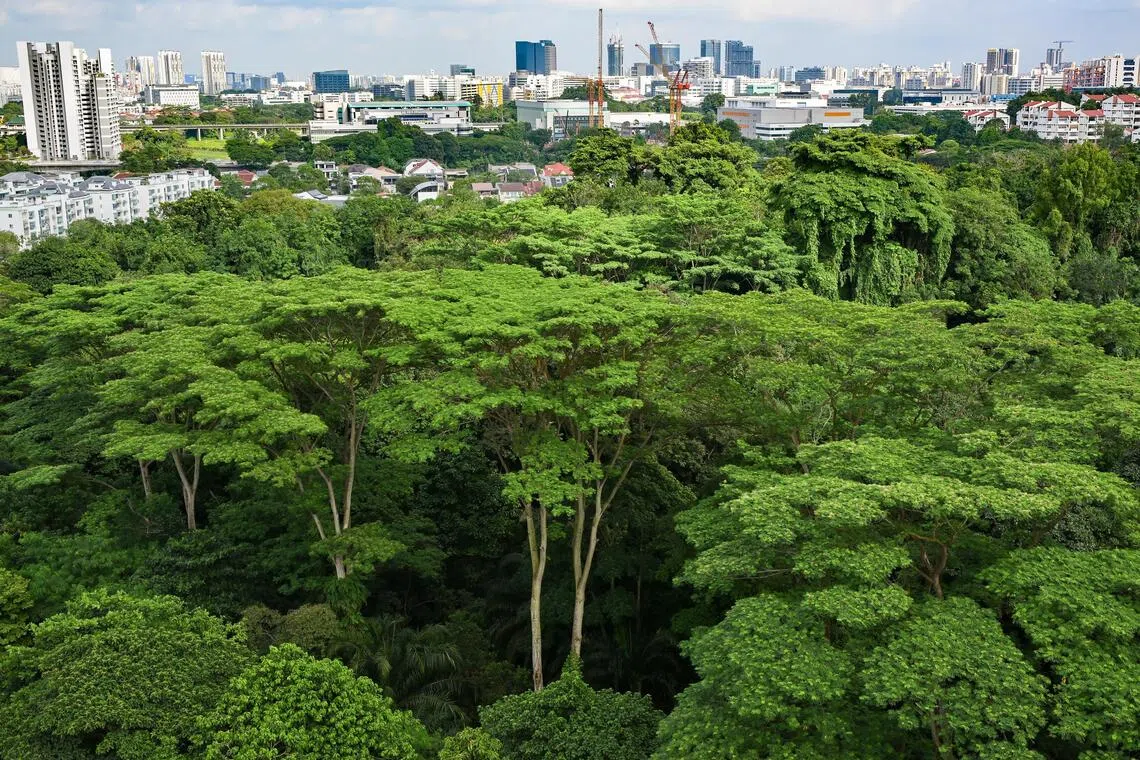
More greenery will be retained in Maju Forest (above) and Gillman Barracks under revised development plans announced by the Housing Board on Oct 28.
ST PHOTO: LIM YAOHUI
Published Oct 28, 2026, 11:44 PM
Updated Oct 28, 2026, 11:44 PM
SINGAPORE – The revised development plans for Maju Forest and Gillman Barracks are a good compromise between providing housing and preserving greenery, and also connect wildlife better than in original proposals, say nature groups here.
But redevelopment of any kind would still have an impact on biodiversity and habitats at both sites, they added.
Residents living near Maju Forest and Gillman Barracks had mixed feelings towards the updated plans. While some felt that the changes struck a better balance between redevelopment needs and their concerns, other residents said they had hoped to be consulted on the revised plans.
These comments followed the Oct 28 announcement of revised plans for the redevelopment of both sites, which will now have more greenery but fewer new homes than in the initial plans released in July.
Movin Nyanasegaran, president of Bird Society of Singapore, said the additional greenery that has been set aside is a “good compromise”.
While he felt the changes were not a massive step up for wildlife since initial plans had made allowances for fauna at both sites, he said he was glad to see more native-dominated forests retained under the revised plans.
Such forests, which are typically dominated by native fast-growing trees, are more suited to vegetation and insect communities that form the foundation of natural ecosystems here than forests filled with non-native plants, said Nyanasegaran.
He added that he appreciated the move, especially because retaining more native-dominated forest in the Gillman Barracks site was something he had specifically suggested during engagement sessions with HDB.
Under the revised plans, retained greenery at Maju Forest will also be designated as a new nature park, while green spaces in Gillman Barracks are set to be part of the upcoming Alexandra Nature Park to widen the greenery within the Labrador Nature Park Network.
Lester Tan, a member of the Nature Society Singapore conservation committee, said dedicating parts of both sites to nature parks is a good step as such parks are “more rustic than a manicured urban park”.
This means these spaces will be built more sensitively to consider different animals and birds in the area, he added.
More broadly, the revised plans will help to improve ecological connectivity compared with the earlier proposals, said Tan.
For instance, he added, a wider green area in the southern part of Maju Forest will connect wildlife better than the tiny strip of land in the previous plans.
Agreeing with this assessment, environmentalist Ho Xiang Tian said the larger and more contiguous greenery that will be retained in Maju Forest will serve as a useful stepping stone where wildlife can “rest” while moving across the ecological corridor.
This is crucial because the space available for wildlife will shrink further as Singapore clears more forested areas, and various species could be stranded when connectivity between green areas is disrupted, added the co-founder of environmental group LepakInSG.
As nature groups noted, biodiversity and habitats are, inevitably, negatively affected by redevelopment plans.
Tan pointed out that there are other forests with more conservation value than Maju Forest, like Clementi Forest and Tagore Forest.
“I would rather (have) the revised plan than shift the stress from one point to another (like Clementi or Tagore forests),” Tan added. “Keeping 10ha of Maju Forest strikes a balance – it is better than clearing two-thirds of it.”
The Government said on Sept 8 that there are currently no plans to designate the Tagore forest as a nature reserve , in response to a question in Parliament about whether the Government would consider granting the forest such protection.
Residents living near Gillman Barracks and Clementi’s Sunset Way, where Maju Forest is located, had different views of the updated redevelopment plans.
For Telok Blangah resident Anna Yap, the revised plans for Gillman Barracks achieve a better balance between building homes and conserving nature.
The 37-year-old landscape architect, who attended two engagement sessions with representatives of public agencies, also said such sessions helped people to understand the Government’s balancing act.
“It’s important to have engagements because planning can be quite top-down. Such sessions help to build ownership from the ground up. It means the planning process is longer, but it’s always helpful to hear everyone’s perspective,” she said.
Telok Blangah resident Asif Hussain, 39, said he hopes the Government will conduct public consultations at an earlier stage for future redevelopment projects.
Joanne Teoh, who has lived in Sunset Way for over three decades, said that she had hoped that residents like herself were invited to review revised plans before they were informed of the outcome.
Some residents did not think the authorities went far enough to preserve greenery.
Nature guide Mark Lin, 34, who lives in Clementi’s Sunset Way, said he was disappointed by the revised plans, which felt to him like more of a negotiation of bits of land than a genuine effort to preserve more of the forest’s biodiversity.
Photographer Seow Mun Kong, who lives in Telok Blangah, said while keeping more greenery is a step in the right direction, he would rather the forest remain untouched.
“Once you tear it down, it’s irreplaceable,” said Seow, 40, who often runs along the forest walk leading to Gillman Barracks.
Teoh, a 67-year-old media specialist, said: “Retaining more forest is welcome, but saving 45% still means losing more than half of Maju.”
Wong Yang is a journalist who covers politics and policy.
Isabelle Liew is a journalist at The Straits Times. She covers housing issues in Singapore, with a focus on public housing.
Ng Keng Gene is a correspondent at The Straits Times, reporting on issues relating to land use, urban planning and heritage.
Conservation/Preservation
Parks/Nature reserves
Environmental issues
根据建屋发展局 10 月 28 日公布的修订发展计划,马朱森林(上图)和吉尔曼军营将保留更多绿地。
ST 照片:林耀辉
发布于 2026 年 10 月 28 日晚上 11:44
更新于2026年10月28日晚上11:44
新加坡——当地自然保护组织表示,马朱森林和吉尔曼军营的修订发展计划在提供住房和保护绿地之间取得了良好的平衡,并且比最初的提案更好地将野生动物与自然连接起来。
但他们补充说,任何形式的重建都会对这两个地点的生物多样性和栖息地产生影响。
居住在马朱森林和吉尔曼军营附近的居民对更新后的规划方案褒贬不一。一些居民认为,这些修改更好地平衡了重建需求和他们的担忧,而另一些居民则表示,他们原本希望在修订方案出台前能被征询意见。
这些评论是在 10 月 28 日公布了这两个地点的重新开发修订计划之后发表的,修订后的计划将有更多的绿地,但新住宅的数量将比 7 月份公布的最初计划要少。
新加坡鸟类协会主席莫文·尼亚纳塞加兰表示,预留的额外绿地是一个“不错的折衷方案”。
虽然他认为这些变化对野生动物来说并非巨大的进步,因为最初的计划已经考虑到了两个地点的动物群,但他表示很高兴看到修订后的计划保留了更多以本地物种为主的森林。
尼亚纳塞加兰表示,这种通常以本地速生树木为主的森林,比充满非本地植物的森林更适合构成这里自然生态系统基础的植被和昆虫群落。
他还表示赞赏这一举措,尤其因为在吉尔曼军营地块保留更多以本地树种为主的森林是他曾在与建屋发展局的磋商会议上特别建议过的。
根据修订后的计划,马朱森林保留的绿地也将被指定为一个新的自然公园,而吉尔曼兵营的绿地将成为即将建成的亚历山德拉自然公园的一部分,以扩大拉布拉多自然公园网络内的绿地面积。
新加坡自然协会保育委员会成员莱斯特·谭表示,将这两个地点的部分区域划为自然公园是一个好举措,因为这样的公园“比精心修剪的城市公园更具乡村风情”。
他补充说,这意味着这些空间的建设将更加注重考虑该地区不同动物和鸟类的需求。
谭表示,从更广泛的角度来看,与之前的方案相比,修订后的方案将有助于改善生态连通性。
例如,他补充说,马朱森林南部更广阔的绿地将比之前规划中的狭长地带更好地连接野生动物。
环保人士何祥天赞同这一评估,他表示,马菊森林将保留更大、更连片的绿地,这将为野生动物穿越生态走廊提供有用的“休息”跳板。
环保组织 LepakInSG 的联合创始人补充说,这一点至关重要,因为随着新加坡砍伐更多森林,野生动物可利用的空间将进一步缩小,当绿地之间的连通性被破坏时,各种物种可能会被困住。
正如自然保护组织所指出的那样,生物多样性和栖息地不可避免地会受到重建计划的负面影响。
谭指出,还有其他一些森林比马朱森林更有保护价值,例如金文泰森林和泰戈尔森林。
“我宁愿接受修订后的方案,也不愿将压力从一个地方转移到另一个地方(比如金文泰或泰戈尔森林),”谭补充道。“保留10公顷的马朱森林能达到一种平衡——这比砍伐其中三分之二要好。”
9月8日,政府在回应议会关于政府是否会考虑给予泰戈尔森林自然保护区保护的问题时表示,目前没有计划将泰戈尔森林指定为自然保护区。
居住在吉尔曼军营和金文泰日落大道(马朱森林所在地)附近的居民对更新后的重建计划有不同的看法。
对于直落布兰雅居民叶安娜来说,吉尔曼军营的修订计划在建造房屋和保护自然环境之间实现了更好的平衡。
这位 37 岁的景观设计师曾两次与公共机构代表进行交流,他表示,此类交流有助于人们理解政府的平衡之道。
“开展沟通交流很重要,因为规划往往是自上而下的。这类会议有助于从基层建立责任感。这意味着规划过程会更长,但倾听每个人的意见总是很有帮助的,”她说道。
39岁的直落布兰雅居民阿西夫·侯赛因表示,他希望政府在未来的重建项目中能够更早地进行公众咨询。
在日落路居住了三十多年的张若安表示,她曾希望像她这样的居民在被告知结果之前,能够受邀审查修改后的计划。
一些居民认为当局在保护绿地方面做得还不够。
34 岁的自然向导 Mark Lin 住在金文泰的日落大道,他说他对修改后的计划感到失望,在他看来,这更像是对土地的讨价还价,而不是真正努力保护森林的生物多样性。
居住在直落布兰雅的摄影师萧文光表示,虽然保留更多绿地是朝着正确方向迈出的一步,但他更希望森林保持原样。
“一旦拆掉,就无法替代了,”40岁的Seow说道,他经常沿着通往吉尔曼军营的森林步道跑步。
67岁的媒体专家Teoh表示:“保留更多森林固然可喜,但即使保留45%,也意味着失去马朱一半以上的森林。”
黄阳是一位报道政治和政策的记者。
Isabelle Liew是《海峡时报》的记者,主要报道新加坡的住房问题,尤其关注公共住房。
吴庆根是《海峡时报》的记者,报道与土地利用、城市规划和遗产相关的问题。
保护/保存
公园/自然保护区
环境问题