Confessions Of An SR-71 Blackbird PilotSR-71黑鸟飞行员的自白
What it was like to sit at the controls of the Skunk Works' legendary Blackbird while hurtling over hostile territory at Mach 3.3.
新闻视频
Published Oct 28, 2026 11:44 AM EDT
(Adelbert "Buz" Carpenter)
Few humans have flown a jet as high or as fast as Adelbert “Buz” Carpenter. During his six years as an SR-71 Blackbird pilot, the now-retired Air Force Colonel flew 230 missions, frequently exceeding three times the speed of sound. Over the course of nearly 800 hours flying one of the world’s most iconic aircraft, Carpenter soared over Cuba, skirted North Korea and tracked Russian nuclear submarines in the Arctic. He also had a few close calls, in one case narrowly avoiding disaster.
With the possibility that NASA could be returning the SR-71 to its test fleet, the Blackbird is back in the news and we wanted to dive deep into what it was like to fly the jet and get some thoughts on the latest SR-71 rumors from someone who piloted it. We couldn’t think of anyone better than “Buz” Carpenter.
Before joining the Blackbird program, Carpenter flew recon missions during the Vietnam War as an RF-4C pilot among other assignments. He now serves as a docent at the Smithsonian Air & Space Museum’s Udvar Hazy Center .
U.S. Air Force Col. (ret.) Buz Carpenter, former SR-71 Blackbird instructor pilot, shares some of his memories of flying the supersonic aircraft with the audience at RAF Mildenhall, England, July 27, 2026. (U.S. Air Force photo by Karen Abeyasekere) Karen Abeyasekere
Some of the questions and answers have been lightly edited for clarity.
Q: How did you become an SR-71 pilot? Walk me through your decision to join the program. What made you want to fly it? What was the qualification process like?
A: Well, it was a multi-step process… You had to fill out all this paperwork. You had to send them your flight records, all your flight checks, your physical records. What are your professional ratings in the Air Force? Do they rate you as superior?
The home base was Beale Air Force Base in California. If they liked you, you got called back for about a week. The first two days were a modified astronaut’s physical. I mean, they checked everything. You had a series of interviews. As a pilot, I had to fly with two current SR-71 pilots, not in the SR, but in the companion trainer, the T-38 .
At any time, there were only 11 of us qualified to fly the SR-71. That’s how small a group it was for the whole program. Only 85 of us ever flew operational missions… So you can see it’s a pretty small group.
Q: Did pilots have to be invited to apply for the SR-71 program?
A: Oh, you had to apply for it. When there was a pilot in the program and he knew somebody he used to fly with that was really super, the invitation would be: ‘fill out the paperwork, and once we get the paperwork and look you over, we’ll call you back and go through the same routine that I went through.
You’ve got to go through the physical. Sometimes it was shortened because they knew the person. A couple of them were actually T-38 instructors at Beale Air Force Base, and their invitation was a lot shorter because they had all the records there. They knew who you were, and they knew how you could fly.
About a week before Christmas, 1974, I got a telegram that says ‘you’ve been selected. You will report to Beale Air Force Base July 1975 and commence training in the SR-71.’ I couldn’t have been happier.
Q: What was the training like?
A: The first thing you’re going to do is you’re going to get checked out in the T-38, even though we had all flown it earlier. You had to become [requalified] in it, because as long as you’re in a program, you’re going to continue to fly the T-38.
Once you actually started the program, you’d be paired with your navigator, who then assumed the title Reconnaissance Systems Officer [RSO]. And in my case, it was the wonderful Capt. John Murphy. We trained and flew together for four years.
Your first month or so was mostly academics, because the airplane was so different. You had to learn the systems because the airplane operates in a very hot environment – an average temperature of almost 600 degrees [Fahrenheit]. The airplane grows three to four inches in length, an inch or two in width – it’s 93% titanium to deal with the high temperatures [associated with supersonic flight]. So during flights, you are going to have to deal with systems that are now straining or starting to fail because of the heat environment they’re operating in. So it is imperative that you understand exactly how this airplane is engineered, and what kind of options you might have if you start getting failures.
Then you start getting into the simulator , and obviously it’s a kind of crawl-walk-run type of a deal. This was the first simulator I’d ever seen that was a computer simulator. Up until that point, they called them part-task trainers. It had all the switches and everything, but it didn’t fly like the airplane. Like you’d be in the trainer and they want to simulate a fire. Somebody would bang against the side of this thing, and yell ‘fire’ and turn on the fire light, but they were just watching what you were doing. The SR simulator flew exactly like you [would fly the plane].
So even before John and I started training, we would find times when the simulator wasn’t being used at night, and we would go down there, and fly this simulator. And if you did something wrong, it reacted exactly how the airplane would react. I mean, it could crash if you did something bad enough.
An SR-71 flight simulator. (NASA Photo / Tammy Gill)
There’s no visual. The simulator could move a little bit motion-wise, not severely. It would react exactly how the airplane was going to react, but you couldn’t see anything. Your first visual of what the airplane was like was going to be on your first flight in the airplane.
That’s when you’re going to see what does a takeoff look like in 20 seconds? What does it look like to get behind a tanker and refuel? And as importantly, what does it look like to come back in at 175 indicated [airspeed] and land this airplane on a runway? It was a tremendous training aid because when you came back later on when you were doing your six weeks in Japan, maybe you took some vacation, but the first thing after that they’re going to put you in the simulator for four hours and see how you react to emergencies. It was a very complex and defining. We washed people out who could not maintain the level of proficiency that we expected if you were going to fly this airplane.
Q: Could you practice refueling as well?
A: You could do takeoffs, because it was like an instrument takeoff, and you could do ‘quote’ instrument landings, but you had no visual to see how this whole thing would come together. Air refueling we didn’t mess with it because there wasn’t enough you could see. When you came to an air refueling in the simulator, they would just fill you up and say, ‘okay, you’ve been refueled.’ Because you needed the visual picture to understand what you’d be doing behind the tanker.
Q: Tell me about the first time you donned the pressure suit, which you had to wear to withstand the pressures of flying at altitudes of up to 80,000 feet or more.
A: If you were going to fly, you came in two and a half hours early. You had to pass a physical before every flight to make sure your sinuses and blood pressure and a number of other things were okay. You would then have a meal of steak and eggs, just like the astronauts, high protein, low bulk. They would brief you on the status of your airplane, and then about an hour and 15 minutes prior, you would go down where your suits were being maintained, and you’d put on cotton long johns because you’re going to perspire a little bit. Not profusely, but occasionally, if you were low on fuel. The fuel was the cooling system for the airplane, and if you’d been flying at the higher speeds, and you were low on fuel, the suit would heat up a little bit.
They’d suit you up. I’m going to stop there. The first time you ever suited up, you’re not going to the airplane. They’re just exposing you. It was a [NASA] Gemini suit that had been modified, and you put on the cotton long johns. You had two people that helped you into the suit. The suit is lying on the floor like a coverall. So you’re going to come through the back of the suit. You put your legs on like you would a coverall you’d have at home. You then put your arms through the sleeves, and at that point, the two technicians would grab that helmet ring, and they would lift it up, and then you would duck underneath and come up and stand.
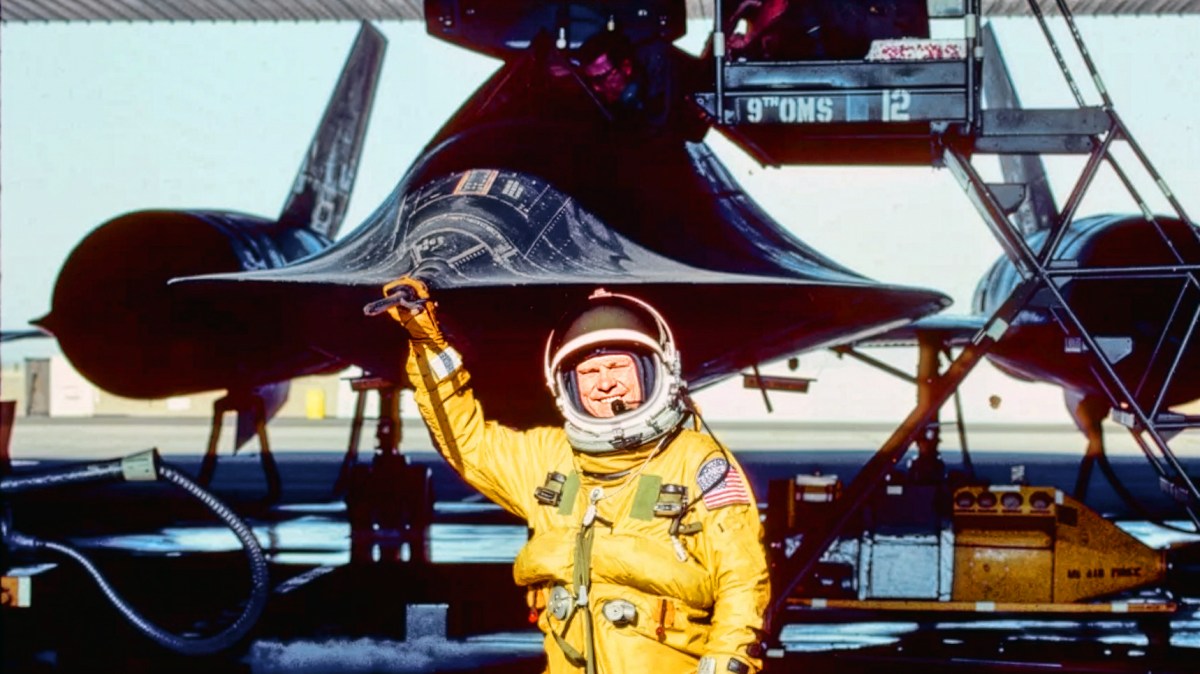
Adelbert “Buz” Carpenter in his SR-71 pressure suit. (Courtesy of Adelbert “Buz” Carpenter)
So now the suit is fully on you, and the helmet ring is sitting on your shoulder. The first time you do that, it probably takes 25 minutes, because they’re explaining to you, this is the easiest way to do it. This is where you should step. This is how you get your legs in. This is how you get your arms in. And then the next thing they’re going to do, they’re going to hand you your helmet.
The suit weighs about 40 pounds. If you’re claustrophobic, this is not a program to be in. It’s not overpowering, but it’s your work suit and something to get used to. It’s not that uncomfortable in a sitting position because that’s where you’re going to use it most of the time, sitting in the cockpit.
They’re going to hand you your helmet, and in the helmet — which most people can’t see — there’s a seal that comes around your face. So once you get the helmet on, you’re going to crank down the seal so it seals tightly, because you are going to be breathing — once the visor comes down in the aircraft — you’re going to be breathing 100% oxygen until you land. The reason for that is that the cabin is pressurized to 26,000 feet to reduce the pressure on the airplane. So they want to reduce the nitrogen in your blood. You’re just like a diver when you go from sea level to 26,000 feet. It’s like a diver who’s been diving coming back up to sea level. So by breathing 100% oxygen, you get the nitrogen out of your system, and you avoid the bends.
There were very few, and possibly no episodes like that in the SR program, but in the U-2 sister program, they maintained an altitude of 28,000 feet, and they had to pre-breathe oxygen before they ever went out to the airplane. Because once they got to the airplane, start up, they go straight to altitude. When we take off, it takes us a half hour from the time our visor comes down, breathing 100% oxygen, before you can take off, and then you’re going to go to a tanker to refuel. So by time you were through at the tanker, you’ve been breathing oxygen, pure oxygen, for over an hour. And the reason for taking off light and going to a tanker: Early in the program, the test program, I think we lost two airplanes doing tests due do heavyweight takeoffs and aborts.
An SR-71 takes gas from an KC-135Q. National Archives
So to preclude that, instead of taking off with 80,000 pounds of fuel, we would take off with 40,000 pounds of fuel. It reduced the wear and tear on the on the tires , so we could accelerate quicker, less stress.
But there was a second piece. When the Concorde crashed in Paris in 2000, it lost two engines on one side. They could never get the airplane going fast enough. The airplane stalled. The powerful engines caused the airplane to roll over.
Flames shoot from the rear of the Air France Concorde as it takes off from Roissy on July 25, 2000, just minutes before the plane crashed in the town of Gonesse, claiming 113 lives—the 109 people on board (mostly German tourists) and four people on the ground (AFP via Getty Images) –
On the SR, it had been forecast through the simulations that if you lost one of your afterburners, lost an engine right after takeoff, there wasn’t enough airflow over your flight controls because you have to keep the other afterburner going. You were going to do the same thing. You were going to roll over and crash. So if you had a full load of fuel, it would take you about maybe 20 seconds, 30 seconds to get above 350 [knots] because at 350, you had more than enough air going across the flight controls to control an engine-out condition. By reducing the takeoff weight down to 40,000 pounds, that dead zone where you didn’t have control was probably 15 seconds. Never happened, but that was part of the theory behind why we took off with half a fuel load.
We took off with heavier fuel loads, occasionally. I think I may have taken off once or twice with a full load. It was a fairly rare exception, but we would take off with 50,000 pounds. I’ve taken off with 60,000 pounds a couple times.
Q: How was your first flight? When was it?
A: You’re not going to be impressed. My first flight, I think, was the 16th of July, 1976, and your first flight in the airplane is subsonic. You’re going to be fully suited up. You’re going to take off. It’s going to be the first time you ever see a takeoff. The takeoff is 20 seconds, and in 20 seconds, you’re going to go 4,500 feet from a dead stop. You’re going to lift off doing 230 miles an hour as you bring the nose up and accelerate to 400 knots. You’re going to pass through 20,000 feet less than two minutes from the time you start your takeoff roll, and then you’ll level off at 25,000 feet and head out to the tanker.
SR-71 taking off. (Courtesy of Adelbert “Buz” Carpenter)
On your first flight, you’re going to spend almost an hour and a half on the tanker, and that’s to teach you how you refuel this airplane behind our special tankers. Almost all the guys had prior refueling experience, so you’re helping them adjust to a new type of refueling regimen per se.
Occasionally, you’d get a guy who had no refueling experience, and that was more difficult to try to teach somebody for the first time how you do refuelings. And one of the trickier things with the tankers, you’d hook up with a tanker, and they’re doing 315 [mph] to 325 [mph] at 25,000 feet. That was where we liked to refuel. So, not every time, but it was not uncommon that by the time you were passing through, having accepted 70,000 pounds of fuel, you’re starting to get power limited, and there were two things you can do.
The preferred thing was you would light the left afterburner to the min-burner [minimum afterburner], and bring the right engine back to a point it would be your modulator. But now you’re going to put the rudder in, because you’re going to be slightly cocked, because your left engine is in min-burner, and what we want you to do is not drop off the boom.
An aerial refueling between SR-71 and KC-135Q. USAF/CMSgt Don Sutherland (left) Lockheed/Tony Landis (Right)
Strategic Air Command, our parent command in the Air Force, wanted you to drop off the tanker, stabilize, light the left burner, adjust the airplane speed, pull in and refuel. The critical thing for us in refuelings is that we wanted to have full tanks at the end of the air refueling point, and if it’s a timed mission, we would need to have that all done at a certain time because maybe there are other airplanes or satellites or that they’re going to use us as a cue.
So basically, I never dropped off, and as an instructor pilot, I taught my students to be able to light the afterburner, put the rudder in, use the right throttle as a modulation, and stay there. One of the good things in our tankers that others didn’t have, we could talk to the tanker crew through the boom, and the outside world couldn’t hear us. So, particularly on operational missions, when we’re running radio silent, we could give the tanker instructions that we wanted passed on without having to break radio silence.
Adelbert “Buz” Carpenter in the cockpit of an SR-71 Blackbird. (Adelbert “Buz” Carpenter)
Q: How did you prepare for your first flight?
I probably had a 150 hours in the simulator. I felt very comfortable. Came in like I told you for the physical, and we talked with my instructor about what we were going to do that day, and got suited up. I wouldn’t say so much nervousness, but anticipation.
You’re going to have your first flight. You go up, and when you get up in the cockpit, you sit down. You put your arms on the side rails, and those same two people, men or women, that suited you up are now going to reach in and make all the critical connections. This is the first time you’re really going to see the whole process with the dual oxygen system, your comm system, hooking up your survival pack, your parachute, everything.
You go through the same thing you’ve done in a simulator, but now you’re in the aircraft. You’re gonna, for the first time, be able to taxi it and and get a feel for how sensitive are the brakes and find out what your turning radius is. Every airplane has a different radius, and how much do you anticipate when you start to make a turn as you’re heading out? You taxi on out when it’s that time. Go to the end of the runway, and they’ll do one more inspection to make sure everything looks good on the airplane, and you’ll just kind of go through, and then you’ll call the tower, and you’re cleared on the runway.
And once you’re cleared for takeoff, what you’ll do is you’ll release the brakes as you bring the power to mil [military power—full power without afterburner]. You’ll quickly check your engines. The instruments look good… You go to full afterburner, and you’re on your way. And like I said, the takeoff portion takes about 20 seconds. When you hit 180 [knots], you’re going to start bringing the nose up because you don’t have any flaps, so you’re looking for the airplane to start getting a lift because of the speed, and so you’re going to lift off with a 210 indicated, 210 translates to about 230 miles an hour, and then continue the nose up to 15 to 20 degrees because you’re going to be accelerating pretty quickly.
Like I said, you pass through 20,000 feet less than two minutes from the time you start. You just go through the routine. You’re gonna see the tanker. I’d seen many tankers before. Of course, this my first time in the SR.
One advantage to me and guys coming out of fighters is that sometimes fighters had the same behind-the-power-curve problem [when refueling], so you would end up having to light one of your afterburners and do the same process in a fighter because of the weight of the fuel. And maybe we didn’t carry bomb loads in the RF-4, but maybe I had three tanks, a center tank and two wing tanks that increased my weight up to the point that I was actually starting to slip behind the power curve.
You come back in, and the instructor is going to demonstrate the first landing, and then you’re going to go back out, and he’s going to have you do an ILS – instrument landing system – approach and touchdown, and then you go back out, and you may do a second one, or you may do a precision radar approach. And then you’re going to get into visual approaches. You’re going to come down, and into the runway, you’re going to go around with a closed pattern, so you can get more practice touch-and-goes until you get it down. If you’re in the traffic pattern, when we had about 7,000 pounds of fuel left, we would land the airplane at that point. We never wanted to get really low in case something should occur because we needed to have enough fuel to get down to McClellan or Sacramento Airport [to divert].
Q: How long did your first flight last, how fast did you go and how high?
A: That first flight was two and a half hours. I reached about 25,000 feet, and probably hit 0.9 Mach for a little while. Then you fly around. You do not go supersonic. Your first supersonic flight is going to be your second flight.
Q: Did you first fly in the two-seater (SR-71B)?
A: We all flew in the two-seater first as a pilot for our initial pilot checkout.
Q: How does the B-variant fly differently from the A?
A: The SR-71 B-model flies just like the A-model mission operational aircraft.
Q: Was there a tradition to celebrate your first flight?
A: There were some people that met you. I think my family was there, but that’s not the important flight. That’ll come two days, two flights later. You know, people, other current crew members, pilots, and RSOs and my instructor pilot will come out and say, “Hey, congratulations, Buz.” But then, the real important one: your second flight. You’re gonna take off. You’re gonna go to the tanker. You’re gonna refuel, but now you’re gonna drop off the tanker, and you’re gonna start. And you go supersonic. You would start a climb from 25,000 feet at 0.9 Mach, and you would climb up. And we typically would go up to 33,000 because they did not want you supersonic below 30,000 feet because of the shock.
So at 30,000, 33,000 feet, you push the nose over, go full afterburner, and as you’re coming down, you’re going to accelerate really fast. And this is the high drag zone of the SR-71. So as you’re coming down, you’re going to go through the speed of sound very easily. Now you’re going to see [Mach] 1.05, 1.1, and about that point, then you’re going to start bringing the nose up and pick up your climb speed and basically use that climb speed until you’re fairly high up when you’re going to pick up a Mach, and that first supersonic flight, you’re going to fly it at 2.8 Mach, and I know this may sound unique, but at 2.8 Mach, this airplane is actually quite docile.
That’s the low speed. The sensitivity of the airplane is still there, but it’s fairly low.
Your third flight is Mach 3, and you do the same practice, you do the refueling. You come back in. You shoot patterns, but when you land this time, people come out, typically the wing commander, and he’s got a Mach 3 tie tack he’s going to give you. And all kinds of people are going to be out there because this is a significant time; you’ve had your Mach 3 flight. But there’s something else significant with it. You get to buy the bar that night, and we were always glad to buy the bar because that meant we’d finally had our Mach 3 flight, and we were part of the group.
Q: What was it like when you reached Mach 3 for the first time?
A: The aircraft actually reacts quite well. The thing that surprised you, or not surprised you, but it’s the first time you get to see the curvature of the Earth, the beautiful black sky up above, and the blue below you. It’s also very quiet. You are in a spacesuit, but you’re traveling at three times the speed of sound. The sound’s behind you. You can feel vibrations in the airplane.
An Earth view from a SR-71 Blackbird at 83,000 feet. (USAF / Brian Shul)
Later on, when you’ve flown this airplane for a while, you can actually feel at certain times when boost pumps are kicking out because that particular fuel tank is going dry, and little sensitivities like that. You’re very busy monitoring the cockpit instruments to make sure the airplane is doing exactly what you want it to do, because it can deviate. And what they’re looking for is we want pilots and RSOs that are going to make sure the airplane is doing what the mission calls for and the way it’s supposed to be flown.
So there’s adjustment as you change temperatures aloft. The airplane’s going to fly a little differently, so you’re going to make adjustments. If you’re going from warm air to colder air because of a frontal passage, as soon as the engines get that colder air, the airplane wants to accelerate because now the air is denser, and the engines are producing more thrust. It’s a dynamic environment. This is not the kind of airplane that you sit back and put the autopilot on and let it do its thing.
You have an autopilot on, but the only thing the autopilot does is keep it on that track that the mission was planned for.
We don’t put any altitude hold on, because we allow the airplane – as it burns off fuel – to continue to climb. So you’re in a constant climb as the airplane becomes lighter and lighter, and with that, your fuel flow continues to go down. The higher you go, you’re carrying less weight. The amount of fuel you’re burning per mile or per minute is dropping, because the engines are becoming more and more efficient. It’s the only airplane in the world – because the way our engine inlets and nozzles are engineered – that the faster we go, the less fuel we burn. You talk about any other airplane you can think of. If you’re going to go faster, it’s going to cost you on fuel. It’s not the case with the SR.
AN SR-71 in flight. (Photo by Getty Images)
Q: What altitude did you reach on that first Mach 3 flight?
A: 81,000 — 80,000 feet, something like that.
Q: How difficult was it to get used to the SR-71’s cockpit and all its additional gauges?
A: The core part of the cockpit were the attitude indicators, and it was very much like the F-4-type airplanes, the RF-4 that I came out of. You just had a lot more round dials and gauges because of the supersonic flight that was going to be involved with this airplane. In the RF-4 during test flights, I needed to bring the airplane, I think to 2.1 Mach. And you only did it momentarily because you were burning a tremendous amount of fuel, so you didn’t have all the different things that you were you were monitoring.
In the SR, you developed a way to cross-check so that you were constantly making sure that the engines and everything were performing correctly. That’s part of what you’d learned already in the simulator, and now you had it in the airplane. And now, you could see how some of the conditions – like actual operating engines and changing weather environment – affected you when you’re flying the airplane.
Q: Weather and atmospheric conditions play a big role in how the SR-71 flew, right?
A: That’s correct. Early on, when they were flying – we never overflew Russia or Red China — but we’d fly right on their border, and some of the early flights off the north coast of Russia. It may sound kind of strange to you, but there was some really warm air. You study in school that at 80,000 feet, the outside air should be about minus 50 degrees, 55 degrees, somewhere in there. The pressure is about 0.4 pounds per square inch. I’ve seen air as warm as minus 40. Now you’ll say, ‘But gee, that doesn’t seem like a big deal.’ It’s a huge difference on the engine because now the air is a lot thinner. But I’ve also seen the other scale off the north coast of Russia. I’ve seen minus 90 degrees. Now, when you’re starting pumping minus 90 degree air into the engine, it really wants to race because now the air is that much denser, and the engines are producing more thrust.
Q: How difficult was Blackbird to fly? How did it compare to other aircraft? What was the biggest challenge to learning to fly at speed and altitude?
A: One of the biggest challenges, if you came out of a fighter airplane, is that we could pull seven Gs. That’s what they were built for. The SR-71, because it expands in flight with heating, the G limit is 1.7 Gs. You’ve had that in a sharp turn in the car, clearly on a roller coaster, and that’s why we were limited to 45 degrees of bank because that’s 1.7 Gs being pulled. Now, if the airplane is cold, has not expanded, we can pull 3 Gs, but you can see it’s a much, much more limiting. Like if you’re cruising at Mach 3 and you want to make a turn, the radius is going to be around 75 degrees, around 75 miles. So you’re looking at 150 miles from where you are until you get over to do a complete 180 degree turn heading the other direction. So there’s a lot more of a planning factor on how much because you can’t yank and bang this airplane because when it’s expanded, you could bend it and titanium is really hard to repair.
Q: Did that ever happen to you?
A: I didn’t. But at an air show in England, one of the guys pulled more Gs than he should have, and the airplane flew once or twice more. And everybody said there was something wrong with this airplane. It was grounded. I don’t know how they got it back to the States, but it never flew again.
Q: How did the chine surfaces, those sloped surfaces at the edge of the fuselage, affect flight?
A: They gave you more lift. Other than that, it obviously limited your visibility somewhat because they’re flared out.
Q: Give me a sense of your visibility in the SR-71 cockpit. What can you see and what can’t you see?
A: Well, one thing, you’re in a spacesuit. So, think about from the middle of your body, you can’t see aft of where your arms are. That’s all by feel. So everything you do in the cockpit, your sense of feel is considerably reduced. As you look forward, the two side windows are great for looking around. Many times we have multiple tankers because of how far the tankers had to go to be in our refueling position.
For our refueling track off the north coast of Norway, those tankers had to fly five hours to get there. So we would typically have three tankers to make sure that they could give us the fuel we needed. The windows you used most were those two pie [-shaped] windows in the front, because that’s what you’re going to be looking through when you take off. That’s what you’re looking through when you’re refueling, and that’s what you’re looking through when you come into land. Now the side window you might browse a little bit when you come into land to see, particularly in the trainer [SR-71B], how am I aligned with things that I know are along the runway to make sure I’m in the center per se. Because once you bring that nose up in the trainer you can’t see forward. The runway disappears.
Q: Did you have any close calls during training?
A: Not during training. Later flying operationally, I did. I took off from a runway where the wind was exceeding 50 knots, and the airfield was closed. This was in Okinawa, but Washington, D.C., wanted the flight off because it was critical that the SR show up in an area at a certain time.
I came back from another flight to Kadena where water had gotten into some of the systems. One of the afterburners didn’t light. I couldn’t get it to light, so I came back in. It’s a dual runway. The weather was about 200 feet [ceiling], half a mile visibility, and the radar controller put me on the wrong runway. And as I was breaking out [of the clouds], there was a a DC-10 full of passengers, so I had to go around, and I’m starting to lose instruments. Doing a circling approach in an SR-71 is really hard, but fortunately I had been stationed there before, so I kind of knew the ground track I needed to maintain, so I could come around and successfully find the runway and put it down, which I did.
About the same time period, around 1979, 1980, coming back from a night mission to RAF Mildenhall, there had been some thunderstorms through England, and the weather in England was terrible. There was not an air base that was above minimums, so I was told that there was a tanker airborne waiting to give us fuel so we could fly to Madrid to Torrejón Air Base, the U.S. Air Force base there. But we were going to have a special mission in two days. The White House or the national security advisor had directed it, and I knew if I flew to Torrejón, by the time you got all the support equipment down there, there was no way we could make that mission.
As SR pilots, we had different rules than the rest of the pilots in the Air Force. If you’re a regular pilot in the Air Force and the airfield goes below minimums, you mandatorily have to go to the alternate location. You can’t shoot an approach. That was not the case in the SR-71. We had the option to shoot the approach to see if we could land, and if we couldn’t land, then you went to the alternate.
One of the things in the back seat, the RSO had a periscope. He could look straight down, and he could also adjust the periscope so it could look, I think, 35 degrees forward. So that particular night, I mean, it is pea soup fog. I mean, it is terrible. I’m coming in. Oh, and the ILS had been hit by lightning, so there was no ILS. I’m using a British radar controller, who is good.
As we’re coming in, my back-seater John said, ‘Okay, I’m looking down, and I can see you’re on center line because I can see through the periscope the lights passing underneath the airplane.’ So we landed the airplane successfully. I brought it to a stop. The controller had forgotten to tell Mildenhall that I was coming in to land. They thought the airfield was closed, so when I called them and said, ‘Mildenhall Tower, this is so-and-so. Send out progressive [taxi instructions]. I can’t find the taxiway to be led back to the hangar where I have to put this airplane.’ And the controller came back and said, ‘You can’t be here. We’re closed.’ I said, ‘We’re here, sitting on the runway. Just get me a follow-me [truck] to get me back to where I need to park.’
Q: Tell me about the RSO relationship during flights. What was the RSO’s role and how did you communicate?
A: If you flew an operational mission, it had to be with your formed RSO. Couldn’t be with anybody else. The RSO ran the navigation system, the star tracker, did any updates required there. The RSO turned on and ran the cameras. Radar nose if it was going. The RSO ran the checklists. The defensive systems were all in the back. All the indicators about whether we were being tracked or being shot at – that was all in the back. He did the radio calls on training missions over the United States. I would do them in the traffic pattern, taking off and landing, but the rest of the radio calls were done from the back seat as we went from center to center.
He was the orchestrator back there. The pilot flew the airplane, took care of the refueling, made sure that it’s on track, and we’re doing what we’re doing. But the guy in the back is the one that’s the synthesizer.
The cockpit is really small . It would have been really tough to have carried a map and folding it and trying to move it. So the [the map was on 35 millimeter film], and it moved at your ground speed, and would show you, ‘okay, you got a turn coming up. This is the fuel you should have. RSO, you need to turn on this camera. You need to check that your defensive systems are on and working before you enter denied airspace.’ So the RSO was a very critical function. We trained and flew together for four years.
Adelbert “Buz” Carpenter (left) and John Murphy (right). (Courtesy of Adelbert “Buz” Carpenter)
Q: Walk me through your first operational mission. When was it? How was your preparation process different from others, and and what did you do? What was the mission?
A: Um, I won’t say it was a vanilla mission, but it was the one where you’re going to go to Kadena because we can keep track of you the best there, and the missions are more controlled. So your first operational mission, you would have flown a local mission where you’re mostly flying around the island and doing stuff and just landing at Kadena. That would have been March of ’77, and your first mission. The thing that makes it different, is you go through the same preparation, but the day before, you’re going to go in and do more of a mission planning. What does the mission look like? Where are the turns? Where are the things I need to be concerned about? And then the day of the mission, they’re going to come in and say, ‘Okay, this is what the weather is. This is what any intelligence activity you need to know of. These are special instructions from the State Department that might provide additional limiting factors on you that you have to take into consideration.’
That’s all around the time you’re having your breakfast, getting ready to go. You go down, you suit up like you normally would. There’s no difference in starting the airplane up. It’s a little more critical this time to make sure your tankers are where they’re supposed to be, and typically your first mission is probably going to be along the Korean DMZ. It’s going to be a two-and-a-half-hour sortie. You’re going to take off. You’re going to refuel at 25,000 feet. Head up the west coast of Korea. You’re going to see the Yellow Sea. Make a big sweeping right turn, and you’ll come north of Seoul. You go very close to the DMZ all the way across. Do a big turn over the Sea of Japan. Come back the same direction along the DMZ. Then turn south and come back and land, and this will probably be your first operational mission.
Q: What were you collecting? What kind of sensors did you have?
A: Oh, we would have the side cameras that could look out about 30 miles in. We might have the nose camera. The electronic sensors could pick up any radio, radar, other type of electronic signals out to about 350 miles anywhere around us. So you’d be sensing what the North Koreans have that was active at that time to better understand what their defense posture is, where missile sites were located, and things along those lines.
The side camera was a camera controlled by the computer. All you did was turn it on because of the astro tracker . We navigated directly off the stars, we didn’t navigate off the ground. We guaranteed the president 300 feet anywhere in the world traveling at 2,200 miles an hour. This is long before GPS, and so the president and the people around him had great — six presidents used us — comfort knowing that we would go where they wanted us to go, and in all likelihood we’d come back.
We weren’t going to get shot down, which never happened, so they wouldn’t have to deal with some kind of a hostage situation or some kind of a diplomatic problem. That was just part of it.
The SR-71 plethora of optional sensors. (Public Domain)
Later on, when I flew a flight for President Carter when the Saudis and the Yemenis were at war over their border, the nose camera was in there. The nose camera took a picture 72 miles wide, 36 miles either side of center, and in the center your resolution was two to four inches. You can see people, you can see tanks, cars, all kinds of things. You cannot recognize faces.
There’s another nose that came in while I was flying, probably in 1977, a ground-mapping radar, because there’s parts of the world where the sun rarely shines. So if you’re waiting for that picture, you may never get it. So you can’t see people with that. Cars are hard to identify. It’s more of an electronic blob, but a ship, an airplane, things like that, that would be on the ground or at sea, there’s enough radar return that most of the time they may not be able to give it the exact airplane or ship, but they know what kind it was, so that day or night, in any weather, when an enemy is trying to move things around that you can’t see, you could actually pick up what their activities are.
One of the SR-71’s interchangeable noses. Pacific Coast Air Museum
Q: You talked about working with other assets for collection missions and a lot of coordination. What did those include?
A: Other assets in our coordinated collection missions included other aircraft, ships at sea, land sites collecting and satellites overhead. Timing was important on these operations. I had as many as 28 sensors I was stimulating the Russian’s for.
Q: Give me an overall sense of your operational missions. What were the goals and what permissions did you need?
A: There’s something that’s still done today called the ‘Beige Book,’ and they go through, and it’s all the services, including submarines, and all that. Okay, what are we interested in? What are we going to plan? How important is the target? How much risk do these targets pose to the collectors, but also politically? If we do this, are there political consequences? And this goes to the whole government, including the State Department, CIA. So they publish this.
Now, when something occurs like the battle with Yemen that just pops up, then things are reprioritized.
Overflights are typically approved by the president, but sometimes by the National Security Adviser. Not below that level per se. The missions where you’re flying peripherally around Russia, around China, other places in the world, those would be approved as part of the monthly schedule. Places we overflew. I mean, we overflew Cuba every 45 days. We did work in Central America. After I left, I think there were some that went down to Colombia. I am one of the only two pilots that ever took the airplane to Diego Garcia . Originally, we were looking at that as a possible base to use to go image Iran and come from a different direction than we had in the past because they were much like today, harassing ships with their missiles and other stuff. We flew over North Korea a couple times.
Q: Did you ever fly over North Korea?
A: I didn’t, but the airplane did.
Q: How did you navigate?
A: We used the star catalog. We had 58 stars that were the northern stars that we used for tracking. To give you an idea. Took them an hour and 45 minutes to load our mission in the tracker, and we called it after the fact R2-D2 because it always knew where we were. It was told exactly where it was on the face of the earth to start. After we started the engines and we’re ready to taxi, when you came out of the hangar, if it was a clear day or clear night, within two minutes, the RSO in the back seat would get a starlight, and what that told you is we’re now automatically tracking the stars day or night, and it was a really accurate system.
SR-71 Astroinertial Navigation System (ANS) (National Air and Space Museum)
It was a wonderful system to fly with, but it also gave the planners and our leaders [the confidence] that if we can fly within 300 feet, like let’s say the north coast of Russia, well, most airplanes are going to have to put you a couple miles off just because we’re not sure exactly where you are. In our case, we could fly maybe 500 feet off their international border because we knew we would be exactly where we were supposed to be, and that was one of the great advantages.
Another great advantage was we had great range. There was a special mission that I flew. The Navy had lost track of a couple boomers [Russian nuclear ballistic missile submarines]. They’d come out of Murmansk, up there in northern Russia, and had slipped through what we call the Greenland-Iceland-U.K. gap , and so we were tasked for a quick reaction. And in this particular case, there was a a second SR that took off after me. To show you the importance of the mission, if I was not mission-capable at Goose Bay, the second SR, one hour behind me, was going to pick up the mission.
I was fully ready, so we proceeded across the Atlantic north of Norway. We refueled again. We did the double pass past Murmansk. I saw [the Russian submarines] once or twice making their way to the Arctic Ocean on the surface as the inland waters were too shallow to dive.
Russian submariners near Severmorosk. (Satellite image courtesty of the U.S. Geological Survey)
We refueled again off the north coast, crossed the Atlantic, refueled over Goose Bay, Labrador, came across Canada, and at 8:20 in the morning, Saturday morning, I landed back at Beale Air Force Base.
Q: What other countries have you flown over?
A: I’ve flown over Cuba. Obviously, flown in the Middle East, over Egypt, down to Yemen. Over West Germany. In the Pacific, we did more peripheral flights, and peripheral were sometimes actually more sensitive because they put you close to the border, and there were a lot of potential political issues.
For instance, around 1978 or 1979, I had a major emergency on the DMZ, and to follow what I needed to do to clear the problem – which had to do with the inlets – I needed to roll the airplane out, but I was already in a turn. If I’d rolled the airplane out, I would have overflown North Korea, which would have possibly been a political violation. So I had to keep the airplane in a turn. The airplane was damaged. I had to land at one of our U.S. Air Force bases in South Korea and have maintenance come up and work on the airplane, just to avoid a possible incident.
I’ll show you the difference between presidents. When President Ford’s term was coming to an end, he knew that President Carter felt it was immoral to overfly other countries and unethical. So we were flying over Cuba every 45 days to keep track of the Russians and the Cubans per se. So, on his last day in office, President Ford had tasked us: you were to take off, you’re to overfly Cuba, you have to land back in California. This was on the 20th of January, 1977. Not later than 10 minutes before Carter takes the oath of office, I was in the wing commander’s office when we called the White House and said, ‘Mission complete, aircraft on the ground.’
For a year, we didn’t overfly anybody because Carter thought it was immoral, and then he realized the Russians were doing stuff in Cuba we weren’t seeing. There were, you know, parts of the world that the SR had unique capabilities that he was foregoing because of his political view. So that changed.
A: It changed because we were having intelligence failures, because we were being surprised with things that were taking place that our collection systems, had they been used like they were designed, would have probably picked up.
Q: Was the SR-71 used as a psychological weapon against adversaries?
A: Sort of. We sometimes flew over heads of state greeting each other and they would be covered with an excellent sonic shock wave to remind them they were doing things counter to U.S. and/or NATO policies. In the three days before Noriega decided to leave Panama, SR-71 aircraft overflew his home with the sonic boom to advise him it was time to go.
Q: Did you ever fly over China?
A: We did not overfly China. U-2s did, but the SR never overflew China. Now this will surprise you. Sometimes I’ve flown missions that the Russians knew ahead of time that I was going to be right on their border at a certain time, and the reason for that was that they really wanted to shoot down and get their hands on an SR. So when we would be into an area like other reconnaissance airplanes, they would hardly pay attention to it. We would go in the area, and a lot of their radars and other stuff would come up very closely, monitoring what we were doing.
So I landed in Okinawa, Japan, and the head of NSA for the Far East had been there and asked me, ‘Was there any unusual activity today?’ And I said, ‘No, about the same number of fighters tried to come up to intercept me, and I never had a missile fired at me.’ And he said, ‘Well, that’s unexpected. We told the Russians yesterday where you were going to be today, hoping that we’d get some greater fidelity on the collection.’ So they had great confidence we were going to come back.
Q: How close did the Russian fighters get to you?
A: Not that close. We were really a tough target. They would try to make a head-on [interception] with a conversion [turn]. Well, by the time they made a conversion, they had the same problem. They had to be above Mach 2 to come after us. By the time they made the turn, we were 100 miles down the road.
Q: The SR-71 had a reduced radar signature. Did this help in its survivability, or was it the speed and the electronic warfare capabilities that largely kept SR-71 crews safe?
A: It was a combination of capabilities that gave it such a remarkable survival capability. To start with, the stealthiness made it hard to find until it was very close to you, significantly compressing an enemie’s reaction timelines. Extremely high speed, Mach 3.2, and incredible altitude, up to 85,000 feet, put its operations in a difficult area to attack. If they did get contact and decided to engage you – all the missiles of our era had to be guided to the high-speed maneuvering target as they did not have onboard guidance capability. When the electronic jamming system became active, the adversary lost their ability to communicate with their missile, so basically it followed its last command and went stupid.
Q: I have seen reports that Blackbirds evaded about 4,000 missiles fired by the Soviet Union, North Vietnam, North Korea and India. Is that accurate?
Q: How many would you say?
A: The number of missile wasn’t well-tracked. I flew a mission on the Korean DMZ, and they were playing with me. When I say playing, they were using their long-range [radar]. Then the acquisition radar came up that was trying to ready for the missile, but the missile was never armed.
Six weeks later, my buddy had three missiles fired at him. So there were probably no more than 100. Part of the thing was they gave up. I mean, particularly over Vietnam, that’s where most of the missiles were fired, and they were just not working. And how many missiles do you want to fire to try to get an airplane?
Q: What were the orders if things went terribly wrong? Were there places you absolutely could not land at and had to destroy the aircraft instead of letting it fall into enemy hands? What about if the crew was captured after ejecting?
A: The aircraft was not to go into enemy hands. And in some cases not even allies’ hands. If the aircraft was impossible to control and out of control – ejection might be your only option. It was the safest USAF aircraft I ever flew. There were a total of 12 ejections in the test program and in operations. None were ever caused by enemy actions. There was never a USAF SR-71 crew member ever killed flying this aircraft – an incredible record! We all went to a special survival school to understand what we might expect if captured by an enemy which never happened or came even close to happening.
Q: What was the closest interception threat?
A: Probably the closest the Russians ever got to a successful intercept had nothing to do with their initial work. There’s a crew; they’re flying the Baltic, so they’re Mach 2.8. They head up past Lithuania, Latvia, and as they beam Estonia, the right engine explodes. The turbines come apart. So now you’re a single-engine airplane. You’re not going to be at Mach. You’re going to be probably around 12,000 feet subsonic. So the crew announces Mayday, starts a turn. They probably overflew some Soviet airspace. They start this big turn. The Swedes pick up the fact that they hear a Mayday call, and they have a pair of [ Saab] Viggens that are airborne that are actually armed.
So as they make the turn, they descend. Get the airplane under control. The Russians send five flights of MiGs to come out. They’ll also send out a rescue helicopter with the idea maybe they can capture the SR crew. Some of those MiGs that were coming out we were sure were directed to shoot down the SR if it wouldn’t follow their signals.
But when they got there, all of a sudden they find there’s a Swedish Viggen on either wing. So the Russians decided this is not a good idea. Halfway down, the two Viggens were low on fuel. The Swedes sent two more Viggens up that replaced them, sat on the wings, continued their mission, and when they got to a certain point, United States Air Force F-15s came out of Germany, intercepted, joined with the SR-71, and led it to a safe landing on an air base in northern Germany.
The mission was classified for years and years. The Swedes wouldn’t even acknowledge it took place because they were a neutral country per se. One of my classmates from the academy, who was a lieutenant general, found out about it and said, ‘We’ve got to do something.’ So, in a very rare occasion, they put through the paperwork, and those four Swedish pilots at a ceremony in Stockholm, were given United States Air Force Air Medals for what they did that day to save the airplane. That’s the closest that we ever came to actually losing an SR-71 that would have been related to combat. (You can read more about that award ceremony in our story about the event here .)
From left to right, Col. Lars-Erik Blad, Maj. Roger Moller, Maj. Krister Sjober, and Retired U.S. Air Force Lt. Col. Tom Veltri stand beside the official photo which depicts the event that earned the Swedish pilots their U.S. Air Medals in Stockholm, Sweden, Nov. 28, 2018. The Swedish Airmen risked their lives to save an SR-71 and the aircrew, Tom Veltri and Duane Noll, on June 29, 1987. (U.S. Air Force Photo by Senior Airman Kelly O’Connor) Senior Airman Kelly OConnor
Q: What’s the highest you’ve flown? What’s the fastest?
A: My top speed is 3.35 Mach before I slowed it back down to 3.2 Mach because we got into cold air and the airplane really wanted to accelerate. My highest altitude is a little over 85,000 feet. Those were in the late ’70s, early ’80s. I don’t remember the specifics.
The high-speed one was off the north coast of Russia when I got into really cold air. You can’t just come out afterburner to try to slow the airplane down because you risk then having a compressor stall. So what you had to do was force the airplane into a climb, and as it was climbing, break its ability to maintain that speed. So once you got it back to the speed you wanted, you’d kind of lower the nose to where you wanted to cruise and go from there.
The faster you went in this airplane, the more dangerous it was, and the more sensitive it became, and that was part of the reason why 3.2 Mach – that’s where the inlets and the engines and the nozzles and everything was optimized for, because they were really afraid you had what we call an “unstart.” That’s when you lose a shock out of one of the inlets, and now the other engine is producing 100%. This engine is still running, but it’s only producing 30%. The airplane goes into a violent yaw and can pitch up on you. They were afraid there wasn’t enough flight control to be able to control the airplane.
Q: Was it harder to fly at that speed?
A: It’s just more sensitive. As you made inputs, the airplane was more reactive, and you had to be on your toes because if you had an unstart at that point, you needed to make sure that you prevented the airplane from doing a yaw slice and particularly pitching up.
One time off the coast of China around 1978 or 1979, I had an unstart and the nose started up. Of course John [the RSO] knew that we had an unstart, because you can’t miss it. You get banged up in the cockpit. I had to stick full forward, and I told John, I said, ‘we’ve got about three or four potatoes.’ That means in three or four seconds, if that nose doesn’t stop climbing, we’re going to have to leave this airplane because it’s going to disintegrate.
Q: You flew over Area 51 and later oversaw its funding when you were at the Pentagon. What is it like?
A: When I did the test flights in Area 51, I had to go through and do some briefings and sign off on stuff. I’m an Area 51 guy. I mean, I’ve been on the ground there. I was responsible for their funding for a couple years, and I used to take guests out there on certain occasions who needed to see something or understand something. It’s great. It looks like the movie The Martian . It’s God forbidden, but it’s a great place to do classified testing because it’s the only place in the country we can do that pretty much successfully.
Before I left the Pentagon, I completed the paperwork to withdraw 75,000 more acres of land that sat on a hillside. So now your closest point to have a direct view of the complexes is from 26 miles away at [Tikaboo Peak].
A satellite view of Area 51, Southern Nevada, United States. (Photo by Gallo Images/Orbital Horizon/Copernicus Sentinel Data 2024) Gallo Images
Q: Let’s talk about the present. Obviously, the Blackbirds are big news with rampant speculation about the future of Tail 844. What do you know about this, and what do you think that NASA is planning for it?
A: I think we know a number of things. The airplane’s been outside for what 30 years, so it may need some repair. NASA is trying to inspire the current and future generations about X planes.
One right now that’s got everybody’s attention is the X-59 that will start flying over the United States here pretty soon, and it’s to measure whether we have successfully come up with a shape that reduces the intensity of the Mach shock wave? Because where this will lead to is there’s a couple companies… that want to create a supersonic transport. One of the limitations on the Concorde, no European country would ever allow it to overfly. Nor did we, because that tremendous wing space created a really significant shock wave on the ground.
NASA’s X-59. Lockheed Martin
In the SR-71, we broke windows. I can remember a particular Cuban overflight. I came around, I did a descent over Mississippi. My tanker was over Mississippi. I refueled. Gave me enough fuel to get back to California. When I landed, the director of operations for the wing had left a message that when I got out of my spacesuit, give him a call. So I called him. I said, ‘Colonel Lawson, what can I do?’ And he goes, ‘Oh, Buz, how’d the mission go?’ And I said, ‘You don’t ask me how the mission goes, unless there’s something you’re particularly. What is it?’ He says, ‘Well, Hattiesburg, Mississippi. There’s 30 houses that have fewer windows, and we’re pretty sure it was you.’
We couldn’t predict where the shock would go. Now we know from some of the tests is, that when you’re in a turn, a turning descent like I was, sometimes the shock wave actually concentrates and becomes more violent than it would if you’d passed over straight and level. So what the X-59 is trying to do is see if they can successfully get a shape and controls, so they can build this supersonic transport that, in fact, can fly over normal airspace.
Q: Former NASA Blackbird engineer Tim Connors told us that he thinks that they’re going to use Tail 844 as a high-speed engine testbed. What’s your assessment of that?
A: It doesn’t make sense. It is high speed, but we’ve done all that. All that data is there. I mean, we’ve got hundreds of hours at Mach 3 and above that they don’t need to, and we’ve got air chambers now that can run the air at those Mach speeds to take a look at. I mean, they’re looking at the hypersonic. They’d like to have an engine like the J-58 that you could take off at a normal speed, and somewhere around Mach 3, you could open valves or do something that you could then accelerate to Mach 5 or Mach 6, and then when you were through with what you wanted to do, come back, and then go down through the Mach 3…2…1, and recover safely back at wherever you want.
Author’s note: Being able to test this exact transition area between Mach 3 and Mach 4, approaching hypersonic, potentially for a combined cycle engine like Buz describes, is what some think NASA will use the SR-71 for.
SR-71 Blackbird. (Courtesy photo via USAF)
I mean, basically that’s what the SR did. Except we went to Mach 3. The big transition in the SR-71 took place in Mach 2. Because when you hit Mach 2 or thereabouts, that’s when those bypass tubes, the six of them around the engine, started bypassing air around the engine, and the air, the engine inlet, everything became a pseudo-ramjet. Because the faster you went, the more thrust you were creating by the ram thrust, not by the thrust being created by the engine itself. The engine had to run; it was critical to the whole process, but the vast majority of the larger part of the thrust was being created by the bypass.
Q: Do you think other aircraft came after Blackbird, even experimentally, that broke its speed records? If so, why haven’t we seen them all these years later?
A: No operational jet-powered manned aircraft has come along to break the significant records we set 50 years ago.
Q: So what is NASA going to use Tail 844 for?
A: I think they’re going to try to see how useful is it. Something that’s sat outside with blowing sand and everything else – it’s really hard to know.
Q: How how difficult will be for modern test pilots to fly Tail 844 or whatever aircraft is created from this project?
A: It would be challenging because there’s no simulator that works, and the simulator helps you go through all the things that you might face to successfully save the airplane. I mean, we consider the SR a national asset, so the last thing we were going to do was eject from the airplane. If you don’t have that simulator, it’s going to be much more difficult.
Q: And the simulators don’t exist anymore?
A: The simulator sits down in a museum in Texas. It’s not operable.
Q: Was boosting the speed of the SR-71 ever discussed during your career, and if so, what were the options considered to make that happen?
A: It was. The idea was that they were going – I can’t remember where it was a water injection or something – that they could take the SR up to 3.5 and beyond. I may have this wrong, but the SR shape and the materials that make up the body of the airplane, I think are good up to [Mach] 3.8, maybe even 4, and this was going to be a water injection that for 10 minutes you could take the airplane up to a faster speed. I think it was [Mach] 3.5, but it may have been [Mach] 3.6. But when they looked at the weight and all the different things, it was the Lockheed proposal. The decision was made. You didn’t gain that much by raising the speed because we were fully authorized to go to [Mach] 3.3.
I’ll tell you a number of my contemporaries never went there. When I was an instructor pilot, I made sure my student went there because if you needed to go there, I wanted you to feel the sensitivity of the airplane when you’re at those speeds.
Q: So was the idea to flow liquid to cool the air going into the inlets?
A: I think that’s where it was. It was in that area, but it’s been so long. I don’t remember. But that never went anywhere, and it only gave you 10 minutes. Because the critical temperature on the airplane was not the airplane. In the cockpit, the CIT – compressor inlet temperature – we were not to exceed 427 centigrade, which is about 800 degrees [Fahrenheit]. Pratt & Whitney said beyond that point, our modeling says that you’re at a higher risk of the engine failing.
Q: Conners told us that during his time in the SR-71 program, he investigated whether it was possible to get the Blackbird close to Mach 4. Do you think a Blackbird could approach Mach 4 with the proper modifications?
A: The question is, what will Mach 4 give you? And I think the focus is more on unmanned vehicles that are Mach 5, Mach 6.
A: You look at the weight that’s in an airplane to keep a man alive — that’s quite a penalty you’re paying. And when you get up to Mach 5 and Mach 6, the temperatures you’re dealing with are — it’s on a curve that is accelerating up, and the materials you have to use and try to put a person in there – it doesn’t make sense.
Q: How would the shock waves affect the ability to exceed Mach 3.3?
A: Obviously, they’re going to become steeper. At Mach 3.2, the shock sits just on the outer lip of the inlet. That is dealing with part of the shape of the airplane. Again, this is what was designed as your optimum speed.
Schlieren flow visualization of shock waves for started and unstarted inlet at Mach 2. NASA Glenn Research Center
Q: If you were a betting man, what would you say the odds are of the Blackbird flying again?
A: I could see it if they wanted to fly it for inspiration, particularly subsonic. The airplanes I’ve flown a couple times subsonic because we had some maintenance problems. 0.9 Mach. It’s a sweet airplane.
Q: Do you see it flying again?
A: I think part of the problem is engines that haven’t been used in those numbers of years. How difficult is it going to be for you to put them back in service? Because there’s no spare engines. When the program was taken apart finally in 2007, a number of those engines were ground up. Foolishly, they were ground up. So there’s not a lot of spares out there.
Q: So what’s NASA’s goal for Tail 844?
A: I think the goal is inspirational. I give tours regularly at the Air and Space Museum, and you’ve got multi generations that still love the SR. I just came back from organizing an SR-71 weekend down at the Museum of Aviation at Robins Air Force Base, and people come from all over to talk to us and see the airplane. When you look at it, young people can’t believe this airplane — like the one in the Smithsonian — came off the production line in 1966. It came off the production line before their parents were born. Yet you look at it, and partly because of the Star Wars influence, you think, ‘Oh, is it a space plane? Is it an airplane?’ I mean, it is something that creates visions and dreams, and I think that’s what NASA is trying to get back to: use it as a a dream generator to fly again. I don’t know. A number of people have already said that they can’t believe it’s going to fly. So it could fly, but I would say that the odds are against it.
Adelbert “Buz” Carpenter being inducted into the Virginia Aviation Hall of Fame. (Courtesy Adelbert “Buz” Carpenter.
Q: You’re at docent at the Udvar Hazy Center. What’s the scuttlebutt there about the plan for Tail 844?
A: They’re as clueless as everybody else.
Contact the author: howard@twz.com
Comments couldn’t be loaded. Please refresh the page.
发布于美国东部时间2026年10月28日上午11:44
(阿德尔伯特·“巴兹”·卡彭特)
很少有人能像阿德尔伯特·“巴兹”·卡彭特那样驾驶喷气式飞机飞得那么高、那么快。这位现已退役的空军上校在担任SR-71“黑鸟”侦察机飞行员的六年间,执行了230次任务,飞行速度经常超过三倍音速。在近800小时的飞行中,卡彭特驾驶着世界上最具标志性的飞机之一,飞越古巴上空,绕过朝鲜半岛,并在北极追踪俄罗斯核潜艇。他也曾几次与死神擦肩而过,其中一次险些酿成灾难。
鉴于NASA有可能将SR-71重新投入测试机队,黑鸟侦察机再次成为新闻焦点。我们想深入了解驾驶这架飞机的体验,并听听一位曾驾驶过SR-71的飞行员对最新传闻的看法。我们认为,没有比“巴兹”·卡彭特更合适的人选了。
在加入黑鸟计划之前,卡彭特曾在越南战争期间驾驶RF-4C侦察机执行侦察任务,此外还执行过其他任务。他现在是史密森尼国家航空航天博物馆乌德瓦尔·哈齐中心的讲解员。
2026年7月27日,美国空军上校(退役)巴兹·卡彭特(Buz Carpenter)——前SR-71“黑鸟”超音速侦察机教官飞行员——在英国米尔登霍尔皇家空军基地与听众分享了他驾驶这架超音速飞机的难忘经历。(美国空军照片,摄影:凯伦·阿贝亚塞克雷)
为了清晰起见,部分问答内容已略作编辑。
问:你是如何成为一名SR-71飞行员的?请你谈谈你决定加入这个项目的原因。是什么让你想驾驶它?资格认证过程是怎样的?
答:嗯,这过程很复杂……你得填写各种各样的表格。你得把你的飞行记录、所有飞行检查记录、体检记录都寄给他们。你在空军的专业等级是什么?他们把你评为优秀吗?
大本营是加利福尼亚州的比尔空军基地。如果他们觉得你不错,就会召你回去待一周左右。头两天是简化版的宇航员体检。我的意思是,他们什么都检查一遍。你还要接受一系列面试。作为一名飞行员,我必须和两名现役SR-71飞行员一起飞行,不是驾驶SR-71,而是驾驶配套的教练机T-38。
任何时候,只有我们11个人有资格驾驶SR-71。整个项目团队的规模就这么小。只有85个人执行过作战任务……所以你可以看出,这是一个非常小的团队。
问:飞行员是否必须受邀才能申请SR-71计划?
A:哦,你得申请才行。当这个项目里有个飞行员,他认识一个以前一起飞过、特别厉害的人,邀请的方式就是:“填好表格,我们收到表格审核之后,会给你回电话,然后走一遍我当初走过的流程。”
你必须通过体检。有时候体检会缩短,因为他们认识你。其中有几位实际上是比尔空军基地的T-38教练,他们的体检时间要短得多,因为他们那里有你所有的记录。他们知道你是谁,也知道你的飞行技术如何。
1974 年圣诞节前一周左右,我收到一封电报,上面写着“你已被选中。你将于 1975 年 7 月到比尔空军基地报到,开始 SR-71 的训练。”我简直高兴极了。
问:培训情况如何?
答:你首先要做的是接受T-38的飞行资格考核,尽管我们之前都飞过。你必须重新取得资格,因为只要你还在这个项目里,你就得继续驾驶T-38。
一旦你正式开始这个项目,你就会和你的导航员搭档,他/她会担任侦察系统官(RSO)。我的搭档是出色的约翰·墨菲上尉。我们一起训练、一起飞行了四年。
头一个月左右主要是学习理论知识,因为这架飞机和以往的飞机截然不同。你必须熟悉各种系统,因为这架飞机在极高的环境下运行——平均温度接近华氏600度(约摄氏315度)。飞机长度会增加三到四英寸,宽度会增加一到两英寸——机身93%的材料都是钛合金,以应对超音速飞行带来的高温。因此,在飞行过程中,你必须处理那些由于高温环境而承受压力甚至开始出现故障的系统。所以,你必须彻底了解这架飞机的工程设计,以及如果出现故障你可以采取哪些措施。
然后你开始进入模拟器,显然这是一个循序渐进的过程。这是我见过的第一个电脑模拟器。在此之前,他们称之为部分任务训练器。它有所有的开关和其他设备,但它的飞行方式与真正的飞机截然不同。比如,你坐在训练器里,他们想模拟一场火灾。有人会敲打模拟器的侧面,大喊“着火了”,然后打开灭火灯,但他们只是在观察你的操作。而SR模拟器的飞行方式与你实际驾驶飞机的方式完全一样。
所以,甚至在我和约翰开始训练之前,我们就会找机会在晚上模拟器不被使用的时候去那里练习飞行。如果你操作失误,模拟器的反应会和真飞机一模一样。我的意思是,如果你操作失误严重到一定程度,它甚至可能会坠毁。
SR-71飞行模拟器。(NASA照片/塔米·吉尔摄)
没有视觉效果。模拟器可以进行一些轻微的运动,但幅度不大。它会完全模拟飞机的实际飞行反应,但你什么也看不到。你第一次真正体验飞机的感觉,要等到你第一次乘坐这架飞机的时候。
那时你就能亲眼看到20秒内起飞是什么样子?跟在加油机后面加油是什么样子?同样重要的是,以175节的指示空速返回跑道并安全着陆是什么样子?这真是一次绝佳的训练机会,因为当你之后在日本进行为期六周的训练时,或许你会休假,但之后的第一件事就是让你在模拟器里待上四个小时,看看你如何应对紧急情况。这是一次非常复杂且意义重大的训练。我们会淘汰那些无法达到我们预期驾驶水平的人。
问:您能否也练习一下加油?
答:你可以进行起飞练习,因为它类似于仪表起飞,你也可以进行所谓的“仪表着陆”,但你无法通过视觉了解整个过程。空中加油我们没有做任何尝试,因为视觉信息不足。在模拟器中进行空中加油时,他们会直接给你加满油,然后说:“好了,加油完毕。”因为你需要视觉图像来理解在加油机后面该做什么。
问:请您谈谈您第一次穿上压力服的经历,当时您必须穿着压力服来承受在高达 80,000 英尺或更高高度飞行时的压力。
答:如果你要坐飞机,就得提前两个半小时到。每次飞行前都要体检,确保鼻窦、血压以及其他一些指标都正常。然后你会吃一顿牛排鸡蛋的餐食,就像宇航员一样,高蛋白、低热量。他们会向你简要介绍飞机的状况,然后在起飞前大约一个小时十五分钟,你会去维护宇航服的地方,穿上棉质保暖内衣,因为你会出汗。不会大量出汗,但如果燃料不足,偶尔会出汗。燃料是飞机的冷却系统,如果你高速飞行,燃料又不足,宇航服就会有点热。
他们会给你穿上宇航服。我就说到这儿吧。你第一次穿上宇航服的时候,不是要上飞机。他们只是让你脱掉衣服。那是一套经过改装的[NASA]双子座宇航服,你还要穿上棉质保暖内衣。有两个人会帮你穿好宇航服。宇航服像连体服一样铺在地上。你要从宇航服的后部钻进去。先把腿套进去,就像穿家里的连体服一样。然后把胳膊伸进袖子里,这时,两个技术人员会抓住头盔的环,把它提起来,然后你弯腰钻进去,再站起来。
阿德尔伯特·“巴兹”·卡彭特身穿SR-71压力服。(图片由阿德尔伯特·“巴兹”·卡彭特提供)
现在,你的宇航服已经完全穿戴好了,头盔环也扣在了肩膀上。第一次穿戴的话,大概需要25分钟,因为他们会一步步教你,告诉你最简单的穿戴方法是什么,脚应该踩在这里,腿应该这样放进去,胳膊应该这样放进去。接下来,他们会把头盔递给你。
这套宇航服重约40磅。如果你有幽闭恐惧症,这个项目可能不太适合你。它不会让你感到难以承受,但毕竟是你的工作服,需要一段时间适应。坐着的时候感觉还不错,因为大部分时间你都会坐在驾驶舱里。
他们会把头盔递给你,头盔里——大多数人看不到——有一个密封圈,可以贴合你的脸部。戴上头盔后,你要把密封圈拧紧,确保它完全密封,因为一旦飞机上的面罩放下,你就会一直呼吸100%的氧气,直到着陆。这是因为机舱在26000英尺的高度会加压,以降低飞机内部的压力。所以他们想降低你血液中的氮气含量。这就像潜水员从海平面上升到26000英尺一样。就像潜水员潜水后返回海平面一样。通过呼吸100%的氧气,你可以排出体内的氮气,避免减压病。
在SR项目中,这种情况非常少见,甚至可能根本没有发生过。但在U-2姊妹项目中,他们保持着28000英尺的飞行高度,而且在登上飞机之前必须预先吸氧。因为一旦登上飞机,启动发动机,飞机就会直接爬升到预定高度。而我们起飞时,从放下氧气面罩、吸完100%纯氧到起飞,需要半个小时,之后还要去加油机加油。所以,从加油机加油完毕到起飞,你已经吸了一个多小时的纯氧了。之所以要轻载起飞并去加油机加油,是因为在项目早期,也就是测试阶段,我们好像损失了两架飞机,都是因为进行重载起飞和中止飞行测试时发生的。
一架SR-71侦察机从一架KC-135Q加油机获取燃料。(美国国家档案馆)
为了避免这种情况,我们不再携带 8 万磅燃料起飞,而是只携带 4 万磅燃料。这样可以减少轮胎的磨损,从而让我们能够更快、更轻松地加速。
但还有第二个因素。2000年协和式飞机在巴黎坠毁时,一侧的两个引擎失效。飞机始终无法达到足够的速度,最终失速。强大的引擎导致飞机翻滚。
2000年7月25日,一架法国航空公司的协和式飞机从鲁瓦西机场起飞,机尾喷出火焰。几分钟后,这架飞机在戈内斯镇坠毁,造成113人死亡——机上109人(大部分是德国游客)和地面4人遇难。(法新社/盖蒂图片社)
在SR测试中,模拟预测表明,如果起飞后不久失去一个加力燃烧室,也就是失去一台发动机,由于必须维持另一个加力燃烧室的运转,流经飞行控制系统的气流不足。飞机将会发生翻滚并坠毁。因此,如果满载燃油,大约需要20到30秒才能达到350节以上的速度,因为在350节时,流经飞行控制系统的气流足以应对单发失效的情况。通过将起飞重量减少到40000磅,失控的“死亡区”可能只有15秒。这种情况从未发生过,但这正是我们选择半载燃油起飞的理论依据之一。
我们偶尔会携带较重的燃料起飞。我想我可能有一两次满载起飞的经历。这种情况相当罕见,但我们确实会携带5万磅的燃料起飞。我也曾几次携带6万磅的燃料起飞。
问:你的第一次飞行体验如何?是什么时候?
答:你不会觉得很神奇的。我的第一次飞行,我记得是1976年7月16日,而你的第一次飞行是亚音速飞行。你会穿戴好全套飞行服,然后起飞。这将是你第一次亲眼目睹飞机起飞。起飞过程只有20秒,在这20秒内,你将从静止状态爬升到4500英尺。你会以230英里/小时的速度离地,同时拉起机头并加速到400节。从开始滑跑到飞越20000英尺的高度,不到两分钟,然后你会保持在25000英尺的高度,飞往加油机。
SR-71 起飞。(图片由 Adelbert “Buz” Carpenter 提供)
你的第一次飞行,将在加油机上待上近一个半小时,目的是教你如何使用我们专用的加油机为这架飞机加油。几乎所有机组人员之前都有加油经验,所以你主要是帮助他们适应这种新的加油方式。
偶尔会遇到一些完全没有加油经验的人,第一次教他们如何加油就比较困难。加油机最棘手的地方之一就是,当你和一架油轮对接时,它们在25000英尺的高空以315到325英里的时速飞行。我们喜欢在这个高度加油。所以,虽然不是每次都这样,但当你加满70000磅燃油后,在空中飞行时,动力开始下降,这种情况并不少见。这时有两种办法。
理想情况下,你应该将左侧发动机的加力燃烧室调到最小加力燃烧室状态,然后将右侧发动机的转速调回调节器位置。但现在你要打舵,因为飞机有点倾斜,左侧发动机处于最小加力燃烧室状态,我们希望你不要脱离控制杆。
SR-71侦察机与KC-135Q加油机进行空中加油。美国空军/首席军士长唐·萨瑟兰(左)洛克希德/托尼·兰迪斯(右)
空军战略司令部(我们的上级司令部)要求我们放下加油机,稳定飞机,点燃左侧加力燃烧室,调整飞机速度,然后拉起加油。对我们来说,空中加油的关键在于抵达加油点时油箱必须加满。如果是限时任务,我们需要在特定时间完成所有操作,因为可能还有其他飞机或卫星需要加油,或者他们会以我们为信号。
所以基本上,我从未掉队。作为一名教官飞行员,我教我的学生们如何打开加力燃烧室、踩下方向舵、用右油门进行调节,并保持这个姿势。我们加油机的一大优势是其他飞机没有的:我们可以通过加油管与加油机组人员通话,而外界听不到我们的声音。因此,尤其是在执行作战任务时,当我们保持无线电静默时,我们可以在不打破无线电静默的情况下向加油机组传达我们想要传递的指令。
阿德尔伯特·“巴兹”·卡彭特在SR-71黑鸟侦察机的驾驶舱内。(阿德尔伯特·“巴兹”·卡彭特)
问:你是如何准备你的第一次飞行的?
我大概在模拟器上练了150个小时,感觉很自在。就像我之前跟你说的那样,我按时来参加体检,然后和我的教官聊了聊当天的训练内容,之后就穿戴好了装备。与其说是紧张,不如说是期待。
你即将进行第一次飞行。升空后,进入驾驶舱,坐下。将手臂放在两侧的扶手上,之前为你穿戴飞行装备的那两个人(无论男女)会伸手帮你连接所有关键部件。这将是你第一次真正了解双氧系统、通讯系统、救生包、降落伞等所有设备的连接过程。
你会经历和模拟器里一样的操作,只不过这次你是在真正的飞机上。你将第一次有机会滑行,感受刹车的灵敏度,并了解飞机的转弯半径。每架飞机的转弯半径都不同,当你开始转弯时,你预估的转弯半径是多少?到了滑行时间,你就滑行出去。滑到跑道尽头,他们会再做一次检查,确保飞机一切正常,然后你就可以顺利通过,之后联系塔台,获得跑道起飞许可。
一旦获得起飞许可,你就要松开刹车,同时将油门推到军用功率(不使用加力燃烧室时的全功率)。快速检查一下发动机。仪表显示正常……然后开启加力燃烧室,就可以起飞了。就像我刚才说的,起飞过程大约需要20秒。当速度达到180节时,由于没有襟翼,你需要开始拉起机头,观察飞机如何利用速度获得升力。当指示空速达到210节时(大约相当于230英里/小时),飞机就会起飞,然后继续拉起机头15到20度,因为飞机的加速度会非常快。
就像我说的,从起飞到飞越两万英尺高空,不到两分钟时间。你只需要按部就班地走完流程。你会看到油罐车。我以前见过很多油罐车。当然,这是我第一次乘坐SR飞机。
对我以及从战斗机飞行员转飞的飞行员来说,一个优势是,战斗机有时也会遇到加油时动力不足的问题,所以由于燃油重量,你最终不得不启动加力燃烧室,在战斗机上重复同样的加油过程。也许我们驾驶的RF-4没有携带炸弹,但我可能挂载了三个副油箱——一个中央副油箱和两个翼下副油箱——这些油箱的重量增加到一定程度,导致我的动力开始跟不上。
你返回跑道后,教员会演示第一次着陆,然后你再次起飞,他会让你进行仪表着陆系统(ILS)进近和着陆,之后你再次起飞,可能会进行第二次进近,或者进行精密雷达进近。接下来你将进入目视进近阶段。你会下降到跑道上,然后进行闭合航线复飞,这样你就可以进行更多触地复飞练习,直到你能够熟练着陆。如果你在航线飞行中,当飞机剩余燃油约7000磅时,我们会选择在那个位置着陆。我们从不想飞得太低,以防万一发生意外,因为我们需要足够的燃油才能降落到麦克莱伦机场或萨克拉门托机场(备降)。
问:你的第一次飞行持续了多长时间?速度有多快?高度有多高?
答:第一次飞行持续了两个半小时。我飞到了大约25000英尺的高度,可能短暂地达到了0.9马赫。之后你只是绕着飞,并没有超音速飞行。你的第一次超音速飞行应该是你的第二次飞行。
问:您第一次乘坐的是双座飞机(SR-71B)吗?
A:我们所有人第一次作为飞行员进行飞行考核时,都是乘坐双座飞机。
问:B型飞机与A型飞机在飞行方面有何不同?
A:SR-71 B 型的飞行性能与 A 型任务作战飞机完全相同。
问:你们第一次飞行时有什么庆祝的传统吗?
答:当时有些人来接你。我想我的家人也在,但这并不是最重要的飞行。最重要的飞行会在两天后,也就是两次飞行之后到来。你知道,其他机组人员、飞行员、区域安全官,还有我的教官飞行员都会出来跟我说:“嘿,恭喜你,巴兹。” 但真正重要的飞行是你的第二次飞行。你要起飞,飞到加油机那里加油,然后卸下加油机,开始超音速飞行。你会从25000英尺的高度以0.9马赫的速度爬升,然后不断向上爬升。我们通常会爬升到33000英尺,因为他们不希望你在30000英尺以下进行超音速飞行,以免产生冲击波。
所以在30000到33000英尺的高度,你把机头压低,开启加力燃烧室,然后下降,你会迅速加速。这是SR-71的高阻力区。所以下降过程中,你会很容易地突破音速。你会看到马赫数达到1.05到1.1左右,然后开始抬头爬升,并保持这个爬升速度,直到你爬升到相当高的高度,再次达到一个马赫数。第一次超音速飞行,你的速度是2.8马赫。我知道这听起来可能很特别,但实际上,在2.8马赫的速度下,这架飞机非常温顺。
这是低速飞行的情况。飞机的灵敏度依然存在,但相当低。
你的第三次飞行是3马赫,你做同样的练习,进行空中加油。你返回基地,进行飞行特技飞行,但这次着陆时,会有人出来,通常是联队长,他会给你一个3马赫的领带夹。各种各样的人都会出来,因为这是个重要的时刻;你完成了你的3马赫飞行。但还有另一层意义。那天晚上你可以请客,我们总是很乐意请客,因为这意味着我们终于完成了3马赫飞行,我们也是这个群体的一份子。
问:你第一次达到3马赫时是什么感觉?
答:这架飞机的反应其实相当不错。让你感到惊讶(或者说并不惊讶)的是,你第一次亲眼目睹了地球的弧度,头顶是美丽的黑色夜空,脚下是蔚蓝的天空。而且飞机上非常安静。你穿着宇航服,却以三倍音速飞行。声音是从你身后传来的。你能感觉到飞机的震动。
从83000英尺高空的SR-71黑鸟侦察机上拍摄的地球照片。(美国空军/布莱恩·舒尔摄)
之后,当你驾驶这架飞机一段时间后,你就能感觉到某些时候增压泵会因为某个油箱快空了而停止工作,诸如此类的细微差别。你会非常忙于监控驾驶舱仪表,确保飞机完全按照你的预期运行,因为它可能会偏离航线。他们想要的是能够确保飞机按照任务要求和规范飞行的飞行员和区域安全官。
所以,随着高空温度的变化,需要进行相应的调整。飞机的飞行特性也会略有不同,因此需要做出相应的调整。例如,如果因为锋面过境而从暖空气进入冷空气区,一旦发动机吸入冷空气,飞机就会加速,因为此时空气密度更大,发动机产生的推力也更大。这是一个动态的环境。驾驶这种飞机,你不能只是坐在那里,打开自动驾驶仪,让它自动运行。
你开启了自动驾驶功能,但自动驾驶功能唯一的作用就是让飞机沿着预定的任务路线飞行。
我们不设置高度限制,因为我们允许飞机在燃烧燃油的同时继续爬升。所以飞机一直在爬升,重量越来越轻,燃油消耗量也随之减少。高度越高,飞机的载重越轻。每英里或每分钟的燃油消耗量都在下降,因为发动机的效率越来越高。这是世界上唯一一款——因为我们发动机进气口和喷嘴的设计方式——速度越快,燃油消耗量越低的飞机。想想你能想到的任何其他飞机。如果速度更快,燃油消耗量就会增加。但SR飞机并非如此。
一架SR-71侦察机正在飞行中。(图片来源:Getty Images)
问:你第一次进行3马赫飞行时达到了多高的高度?
A:81,000 到 80,000 英尺,差不多是这个高度。
问:适应 SR-71 的驾驶舱及其所有附加仪表有多难?
答:驾驶舱的核心部分是姿态指示器,它很像F-4型飞机,也就是我之前驾驶的RF-4。只是因为这架飞机要进行超音速飞行,所以仪表盘上有很多圆形的刻度盘和仪表。在RF-4的试飞中,我需要把飞机加速到2.1马赫。但你只能短暂地达到这个速度,因为会消耗大量的燃料,所以你不可能同时监控那么多不同的参数。
在模拟飞行中,你摸索出了一套交叉检查的方法,确保发动机和其他所有部件都能正常运转。这部分内容你已经在模拟器中学习过了,现在你把它运用到了实际飞机上。而且,现在你还能观察到一些因素——比如实际运转的发动机和不断变化的天气环境——在你驾驶飞机时会对你产生怎样的影响。
问:天气和大气条件对SR-71的飞行性能有很大影响,对吗?
答:没错。早期,我们飞行的时候——我们从未飞越俄罗斯或红色中国——但我们会沿着他们的边境飞行,还有一些早期的飞行是在俄罗斯北部沿海进行的。这听起来可能有点奇怪,但那里的空气非常温暖。你在学校里学到,在8万英尺的高空,外界空气温度应该在零下50到55度之间。气压大约是每平方英寸0.4磅。我见过零下40度的空气。你可能会说,“哎呀,这看起来没什么大不了的。”但这对发动机来说影响巨大,因为空气密度大大降低。但我也在俄罗斯北部沿海见过另一种极端情况。我见过零下90度的空气。当你开始向发动机输送零下90度的空气时,发动机的转速会非常高,因为空气密度大大增加,发动机产生的推力也更大。
问:驾驶黑鸟有多难?它与其他飞机相比如何?学习高速高空飞行最大的挑战是什么?
答:如果你是从战斗机飞行员转过来的,你会发现最大的挑战之一就是我们可以承受7G的过载。战斗机就是为此而设计的。而SR-71由于飞行中受热膨胀,其过载极限只有1.7G。你在汽车急转弯或者过山车上肯定体验过1.7G,这就是为什么SR-71的倾斜角度被限制在45度,因为45度就相当于1.7G的过载。如果飞机是冷的,没有膨胀,我们可以承受3G的过载,但你可以看到,这限制了它的性能。比如,如果你以3马赫的速度巡航,想要转弯,转弯半径大约是75度,也就是大约75英里。也就是说,你需要在150英里的范围内才能完成180度转弯。所以,在建造过程中需要考虑更多规划因素,因为你不能粗暴地拉扯和敲打这架飞机,因为当它展开时,你可能会把它弄弯,而钛合金真的很难修复。
问:你遇到过这种情况吗?
答:我没有。但在英国的一次航展上,有个飞行员做了个超负荷的飞行,结果飞机又飞了一两趟。大家都说这架飞机有问题,就停飞了。我不知道他们是怎么把它弄回美国的,反正它再也没飞过。
问:机身边缘的斜面(机翼棱面)对飞行有何影响?
答:它们能提供更大的升力。除此之外,由于它们向外张开,显然也在一定程度上限制了你的视野。
问:请描述一下您在SR-71驾驶舱内的视野。您能看到什么,看不到什么?
答:嗯,首先,你穿着宇航服。想想看,从你身体中部往后看,你根本看不到手臂后面的东西。一切都只能靠感觉。所以你在驾驶舱里做的每一件事,你的触觉都会大大降低。向前看的时候,两侧的舷窗很适合环顾四周。很多时候,我们需要多架加油机,因为加油机要飞很远才能到达我们的加油位置。
我们在挪威北海岸的加油航线,加油机需要飞行五个小时才能到达。所以我们通常会安排三架加油机,以确保能够提供所需的燃料。你最常使用的窗户是前面那两个扇形窗,因为起飞时你要透过它们观察,加油时也要透过它们观察,降落时也要透过它们观察。降落时,你可能会稍微瞥一眼侧窗,尤其是在教练机(SR-71B)上,看看我与跑道上已知物体的对准情况,确保我位于跑道中心。因为一旦教练机的机头抬起,你就看不到前方了。跑道就消失了。
问:训练期间有没有遇到什么险情?
答:训练期间没有。后来执行作战任务时遇到过。当时我从一条风速超过50节的跑道起飞,而且机场已经关闭。那是在冲绳,但华盛顿特区要求取消这次飞行,因为安全侦察机必须在特定时间抵达某个区域。
我刚从嘉手纳基地飞回来,那里的飞机系统进水了。其中一个加力燃烧室没点火。我怎么也点不着,只好返航。那是个双跑道机场。当时云底高度大约200英尺,能见度半英里,雷达管制员把我导向了错误的跑道。当我冲出云层时,发现有一架满载乘客的DC-10,所以我不得不复飞,而且仪表读数开始下降。驾驶SR-71进行盘旋进近非常困难,但幸运的是我之前在那里驻扎过,所以大致知道需要保持的地面航迹,因此我能够成功复飞并找到跑道降落,最终也确实做到了。
大约在1979年或1980年,我们从米尔登霍尔皇家空军基地执行夜间任务返回时,英国遭遇了雷暴天气,天气极其恶劣。所有空军基地的油量都低于最低标准,所以我被告知有一架空中加油机在空中待命,可以给我们加油,这样我们就可以飞往马德里的托雷洪空军基地——那里的美国空军基地。但两天后我们将执行一项特殊任务。这是白宫或国家安全顾问的指示,我知道如果我飞到托雷洪,等所有支援设备都运到那里,我们就无法完成这项任务了。
作为SR飞行员,我们的规则与其他空军飞行员不同。如果你是空军的普通飞行员,一旦机场低于最低标准,你就必须飞往备降机场。你不能尝试进近。但SR-71的情况并非如此。我们可以选择先尝试进近,看看能否着陆;如果无法着陆,则飞往备降机场。
后座上,雷达站操作员(RSO)的座位上有一个潜望镜。他可以向下直视,也可以调整潜望镜的角度,大概可以向前看35度。那天晚上,雾气非常浓,简直像豌豆汤一样。我当时正在进近。哦,对了,仪表着陆系统(ILS)被闪电击中了,所以ILS无法使用。我当时和一个英国雷达管制员通话,他很专业。
飞机进场时,我的后座乘客约翰说:“好了,我往下看,我能看出你们在跑道中心线上,因为我能透过潜望镜看到飞机下方的灯光。”于是我们成功着陆。我把飞机停稳了。管制员忘了通知米尔登霍尔机场我正在进场降落。他们以为机场已经关闭了,所以我打电话给他们说:“米尔登霍尔塔台,我是某某。请发出逐步滑行指令。我找不到滑行道,无法返回停放飞机的机库。”管制员回复说:“你们不能在这里。我们关闭了。”我说:“我们就在这里,停在跑道上。请给我一辆引导车,把我送到我需要停放的地方。”
问:请谈谈飞行期间与安全保障官员(RSO)的关系。RSO 的职责是什么?你们是如何沟通的?
答:如果你执行作战任务,必须和你的指定雷达站长(RSO)一起。不能和其他人一起。RSO负责操作导航系统、星敏感器,并进行必要的更新。RSO还负责启动和操作摄像头。如果需要的话,还要启动雷达鼻锥。RSO负责执行检查清单。防御系统都在后部。所有关于我们是否被跟踪或被攻击的指示器——都在后部。在美国上空的训练任务中,他负责无线电通话。我会在起降航线上进行无线电通话,但其余的无线电通话都是在我们从一个中心飞到另一个中心时,从后座完成的。
他才是幕后的指挥者。飞行员负责驾驶飞机、加油、确保航线正确,以及我们所做的一切。但坐在后面的那个人才是真正的统筹者。
驾驶舱非常小。携带地图、折叠地图并移动地图会非常困难。所以地图是用35毫米胶片显示的,它会以你的地速移动,并显示“好的,你即将转弯。这是你应该携带的燃油量。雷达站长,你需要打开这个摄像头。在进入禁飞区之前,你需要检查你的防御系统是否已开启并正常工作。”因此,雷达站长的工作至关重要。我们一起训练和飞行了四年。
阿德尔伯特·“巴兹”·卡彭特(左)和约翰·墨菲(右)。(图片由阿德尔伯特·“巴兹”·卡彭特提供)
问:请您详细介绍一下您的第一次作战任务。那是什么时候?您的准备工作与其他任务有何不同?您具体做了哪些准备?任务内容是什么?
答:嗯,我不会说那是个普通的任务,但你要去嘉手纳基地是因为在那里我们能更好地监视你,而且任务也更受控制。所以你的第一次作战任务,应该是执行一次本地任务,主要是在岛上飞行,做一些任务,然后降落在嘉手纳基地。那是1977年3月,你的第一次任务。不同之处在于,准备工作虽然一样,但在前一天,你要进行更详细的任务规划。任务是什么样的?转弯在哪里?有哪些需要注意的地方?然后在任务当天,他们会告诉你:“好的,天气情况是这样的。你需要了解的情报活动是这样的。这些是国务院的特殊指示,可能会对你施加一些额外的限制因素,你必须考虑这些因素。”
那段时间差不多就是你吃早餐、准备出发的时候。你下飞机,像往常一样穿戴好飞行服。启动飞机没什么区别。这次更需要确保加油机各就各位,而且你的第一次任务很可能是在朝鲜半岛非军事区附近。这将是一次两个半小时的飞行。你会起飞,在25000英尺的高度加油。然后沿着朝鲜半岛西海岸飞行。你会看到黄海。做一个大幅度的右转弯,你会飞到首尔以北。一路沿着非军事区飞行,非常靠近非军事区。在日本海上空做一个大转弯。沿着非军事区原路返回。然后转向南,返回并降落,这很可能就是你的第一次作战任务。
问:你们当时在收集什么数据?你们使用了哪些类型的传感器?
答:哦,我们会有侧视摄像头,可以探测到大约30英里外的情况。我们可能还会有机头摄像头。电子传感器可以接收到周围大约350英里范围内的任何无线电、雷达或其他类型的电子信号。这样我们就能感知到朝鲜当时正在使用的武器,从而更好地了解他们的防御态势、导弹发射场的位置等等。
侧置摄像头是由电脑控制的。你只需要打开它,因为它配备了天文追踪器。我们直接利用星空进行导航,而不是利用地面。我们保证总统在全球任何地点都能以每小时2200英里的速度飞行,误差不超过300英尺。这远在GPS出现之前,因此总统及其身边的人都非常放心——共有六位总统使用过我们的服务——他们知道我们会去他们想去的地方,而且很有可能会安全返回。
我们不会被击落,而这种情况也从未发生,所以他们不必处理人质危机或外交难题。这只是其中的一部分。
SR-71 的众多可选传感器。(公共领域)
后来,我为卡特总统执行任务时,正值沙特阿拉伯和也门边境交战,飞机上装了机头摄像头。这摄像头拍摄的范围是中心点两侧各36英里宽,宽72英里,中心区域的分辨率只有两到四英寸。你可以看到人、坦克、汽车,各种各样的东西。但你无法辨认人脸。
在我飞行期间,大概是1977年,还出现了另一种雷达——地面测绘雷达。因为世界上有些地方阳光很少照射到,所以如果你指望它拍到图像,可能永远也拍不到。因此,用它看不到人,也很难识别汽车。它更像是一个电子信号,但对于舰船、飞机之类的东西,无论是在地面还是海上,雷达回波信号都足够强,虽然大多数情况下可能无法确定具体的飞机或舰船型号,但可以知道是什么类型的。所以,无论白天黑夜,无论什么天气,当敌人试图在你看不见的地方移动目标时,你都能掌握他们的动向。
SR-71侦察机可互换机头之一。太平洋海岸航空博物馆
问:您提到过与其他资源合作执行收集任务,以及大量的协调工作。这些工作都包括哪些方面?
答:我们协同情报收集任务中的其他资源还包括其他飞机、海上舰艇、陆地收集点和高空卫星。这些行动的时机至关重要。我当时调动了多达28个传感器,以刺激俄方进行情报收集。
问:请您概括一下您的作战任务。任务目标是什么?您需要获得哪些许可?
答:现在仍然有一种叫做“褐皮书”的做法,他们会审查所有部门,包括潜艇部队等等。他们会问:我们感兴趣的是什么?我们要制定什么计划?目标有多重要?这些目标对情报收集者以及政治方面构成多大的风险?如果我们这样做,会产生什么政治后果?这份报告会提交给整个政府部门,包括国务院和中央情报局。然后他们会公布这份报告。
现在,当像也门战争这样突然爆发的事件发生时,事情的优先顺序就会重新调整。
飞越任务通常由总统批准,有时也由国家安全顾问批准。但不能低于这个级别。那些在俄罗斯、中国以及世界其他地方进行周边飞行的任务,都会被列入月度计划并获得批准。我们飞越过的地方有很多。比如,我们每45天就会飞越古巴。我们也在中美洲执行过任务。我离开后,我想还有一些人飞到了哥伦比亚。我是仅有的两名驾驶飞机飞往迪戈加西亚岛的飞行员之一。最初,我们考虑过把那里作为基地,用来监视伊朗,并从与以往不同的方向进行攻击,因为当时伊朗的情况和现在很像,用导弹和其他武器骚扰船只。我们还飞越过朝鲜几次。
问:你飞越过朝鲜吗?
A:我没有,但飞机有。
问:你是如何导航的?
答:我们用了星表。我们用了58颗北极星进行追踪。举个例子,他们花了1小时45分钟把任务信息加载到追踪器里,事后我们管它叫R2-D2,因为它总能找到我们的位置。它被精确地告知了在地球上的位置。启动引擎,准备滑行后,当飞机驶出机库,如果是晴朗的白天或夜晚,两分钟之内,后座的无线电信号官就能接收到星光信号。这表示我们现在正在自动追踪星空,无论白天还是夜晚。这套系统非常精准。
SR-71 天体惯性导航系统(ANS)(国家航空航天博物馆)
这套系统飞行起来非常棒,同时也让规划人员和我们的领导人信心倍增。如果我们能在距离目标300英尺的范围内飞行,比如在俄罗斯北部沿海地区,大多数飞机都会因为无法准确定位而不得不偏离目标几英里。而我们则可以在距离国际边界500英尺的范围内飞行,因为我们知道自己会精准地到达预定位置,这正是它的一大优势。
另一个巨大的优势是我们的航程很远。我执行过一次特殊任务。海军失去了对几艘“弹道导弹潜艇”(俄罗斯核动力弹道导弹潜艇)的追踪。它们从俄罗斯北部的摩尔曼斯克出发,穿过了我们所说的格陵兰-冰岛-英国空域,所以我们的任务是迅速做出反应。在这个特殊的案例中,还有第二架SR飞机在我之后起飞。为了让你们明白这次任务的重要性,如果我在鹅湾机场无法执行任务,那么比我晚一个小时起飞的第二架SR飞机将接替我执行任务。
我做好了万全准备,于是我们继续向北横渡大西洋,途经挪威北部。我们再次补充了燃料。我们两次飞越摩尔曼斯克。我看到(俄罗斯潜艇)一两次浮出水面,驶向北冰洋,因为内陆水域太浅,无法潜水。
俄罗斯潜艇兵在北莫罗斯克附近活动。(卫星图像由美国地质调查局提供)
我们在北海岸附近再次加油,飞越大西洋,在拉布拉多鹅湾上空加油,穿过加拿大,星期六早上 8 点 20 分,我降落在比尔空军基地。
问:您还飞越过哪些其他国家?
答:我飞越过古巴。当然,也飞越过中东,飞越埃及,一直到也门。飞越过西德。在太平洋地区,我们执行的是一些外围飞行任务,而这些外围任务有时实际上更加敏感,因为它们会让我们靠近边境,存在很多潜在的政治问题。
例如,大约在1978年或1979年,我在非军事区遇到了一次重大紧急情况。为了排除故障——问题与进气口有关——我需要让飞机滑行出去,但我当时已经在转弯了。如果我让飞机滑行出去,就会飞越朝鲜领空,这可能构成政治违规。所以我必须保持飞机转弯。飞机受损了。我不得不降落在韩国的一个美国空军基地,让维修人员过来修理飞机,以避免可能发生的事故。
我来给你们展示一下两位总统的区别。福特总统任期即将结束时,他知道卡特总统认为飞越他国领空是不道德的,也是不合伦理的。所以我们每隔45天就要飞越古巴,监视苏联和古巴的动向。因此,在福特总统任期的最后一天,他给我们布置了一个任务:你们起飞,飞越古巴,然后降落在加利福尼亚。那是1977年1月20日。卡特宣誓就职前不到10分钟,我还在联队指挥官的办公室里,我们打电话给白宫说:“任务完成,飞机已着陆。”
整整一年,我们都没飞越任何人的领空,因为卡特认为这样做不道德。后来他意识到,苏联人在古巴的活动我们却一无所知。你知道,苏联的战机在某些地区拥有独特的作战能力,但他却因为政治立场而放弃了这些能力。所以情况发生了改变。
答:情况发生了变化,因为我们的情报工作出现了失误,因为我们对一些事情的发生感到惊讶,而如果我们的情报收集系统按照设计的方式使用,这些事情很可能早就被发现了。
问:SR-71是否曾被用作对抗敌人的心理武器?
答:算是吧。我们有时会飞越正在互致问候的国家元首领领空,用强烈的音爆冲击他们,提醒他们正在做与美国和/或北约政策相悖的事情。在诺列加决定离开巴拿马的前三天,SR-71侦察机带着音爆飞越他的住所,以此警告他该走了。
问:你飞越过中国吗?
答:我们没有飞越中国领空。U-2侦察机飞越过,但SR从未飞越过中国领空。接下来我要说的可能会让你感到惊讶。有时候,我执行的任务中,俄罗斯人事先就知道我会在某个时间飞到他们的边境附近,原因在于他们非常想击落一架SR,并缴获它。所以,当我们像其他侦察机一样进入某个区域时,他们几乎不会注意到我们。我们进入该区域后,他们的许多雷达和其他设备就会非常密切地监视我们的一举一动。
于是我降落在日本冲绳,美国国家安全局远东地区负责人也在那里,他问我:“今天有什么异常活动吗?”我说:“没有,拦截我的战斗机数量和往常差不多,但我没有遭到导弹袭击。”他说:“这真是出乎意料。我们昨天已经把您今天的行程告诉了俄罗斯人,希望他们能更准确地收集到情报。”所以他们非常确信我们会再次返回。
问:俄罗斯战斗机离你们有多近?
答:没那么近。我们确实是个难缠的目标。他们会尝试正面拦截,然后转向。结果,等他们转向成功后,他们也遇到了同样的问题。他们必须达到2马赫以上的速度才能追上我们。等他们转向成功时,我们已经领先100英里了。
问:SR-71的雷达反射截面积小。这是否提高了它的生存能力?还是说,是它的速度和电子战能力才是保障SR-71机组人员安全的主要因素?
答:正是多种能力的结合赋予了它如此卓越的生存能力。首先,它的隐蔽性使其难以被发现,直到非常接近目标,从而大大缩短了敌人的反应时间。其次,它拥有极高的速度(3.2马赫)和惊人的高度(高达85000英尺),使其作战区域难以被攻击。即使敌人最终发现并决定攻击,由于当时的导弹不具备机载制导能力,所有导弹都必须通过远程制导才能击中这种高速机动的目标。当电子干扰系统启动时,敌方导弹便失去了与其通信的能力,基本上只能按照之前的指令执行,最终失效。
问:我看到有报道称,黑鸟侦察机躲过了苏联、北越、朝鲜和印度发射的约4000枚导弹。这个说法准确吗?
问:您觉得有多少个?
答:导弹数量没有得到准确追踪。我执行了一次在朝鲜非军事区上空的任务,他们当时在戏耍我。我说戏耍,是指他们使用了远程雷达。然后目标探测雷达启动,试图锁定导弹,但导弹根本没有装弹。
六周后,我的朋友遭到了三枚导弹袭击。所以导弹总数可能不超过一百枚。部分原因是他们放弃了。我的意思是,尤其是在越南上空,那里发射的导弹最多,但那些导弹根本不起作用。你愿意发射多少枚导弹去击落一架飞机呢?
问:如果情况变得极其糟糕,命令是什么?是否存在绝对不能降落的地方,必须摧毁飞机而不是让它落入敌手?如果机组人员弹射后被俘,又该怎么办?
答:这架飞机绝不能落入敌手。在某些情况下,甚至不能落入盟军手中。如果飞机完全失控,弹射可能是你唯一的选择。这是我驾驶过的最安全的美国空军飞机。在测试和作战行动中,总共发生了12次弹射。没有一次是由敌方行动造成的。驾驶这架飞机时,美国空军SR-71机组人员从未丧生——这是一个令人难以置信的记录!我们都接受过专门的生存训练,了解如果被敌方俘虏可能面临的情况,但这种情况从未发生过,甚至连接近发生的概率都没有。
问:最接近拦截的威胁是什么?
答:或许俄国人最接近成功拦截的一次,与他们最初的计划毫无关系。当时有一架飞机在波罗的海上空飞行,速度大约是2.8马赫。他们飞越立陶宛和拉脱维亚,正准备向爱沙尼亚发射信号时,右侧发动机突然爆炸,涡轮机解体。飞机变成了单引擎飞机,速度肯定达不到2.8马赫,大概会在12000英尺左右的亚音速高度飞行。于是机组发出求救信号,开始转弯。他们可能飞越了苏联领空。他们开始大幅度转弯。瑞典人接收到了求救信号,他们有两架萨博维根战斗机在空中待命,而且都已携带武器。
所以当他们转弯时,他们开始下降,控制住飞机。俄国人派出了五队米格战机前来支援。他们还会派出一架救援直升机,希望能抓获SR的机组人员。我们确信,那些前来支援的米格战机中,有些是奉命将SR击落的,如果SR不听从他们的信号的话。
但当他们到达目的地时,突然发现机翼两侧各有一架瑞典维根战斗机。于是俄国人意识到这并非明智之举。飞行到一半时,两架维根战斗机的燃料告罄。瑞典人又派出两架维根战斗机接替它们,继续执行任务。当它们飞到某个特定位置时,美国空军的F-15战斗机从德国起飞,拦截了SR-71,并将其引导至德国北部的一个空军基地安全降落。
这项任务多年来一直被列为机密。瑞典方面甚至不愿承认此事,因为他们本身就是一个中立国。我的一位军校同学,当时是位中将,得知此事后说:“我们必须做点什么。”于是,在极其特殊的情况下,他们提交了相关文件,并在斯德哥尔摩举行的仪式上,为那四位瑞典飞行员颁发了美国空军航空勋章,以表彰他们当天为拯救飞机所做的贡献。这是我们最接近在战斗中损失一架SR-71的一次。(您可以在我们关于此事的报道中阅读更多关于颁奖仪式的内容。)
从左至右,拉尔斯-埃里克·布拉德上校、罗杰·莫勒少校、克里斯特·肖伯少校和退役美国空军中校汤姆·维尔特里站在一张官方照片旁。这张照片记录了2018年11月28日在瑞典斯德哥尔摩,瑞典飞行员因英勇事迹荣获美国空军勋章的场景。1987年6月29日,这些瑞典飞行员冒着生命危险,成功营救了一架SR-71侦察机及其机组人员汤姆·维尔特里和杜安·诺尔。(美国空军高级飞行员凯利·奥康纳摄)
问:你飞过的最高高度是多少?最快的速度是多少?
答:我的最高速度是3.35马赫,后来因为进入冷空气,飞机加速很猛,所以我把速度降到了3.2马赫。我的最高飞行高度略高于85000英尺。那是在70年代末80年代初。具体细节我记不清了。
那次高速飞行是在俄罗斯北部沿海,当时我遇到了极寒气流。你不能直接关闭加力燃烧室来减速,因为那样可能会导致压气机失速。所以你必须让飞机爬升,并在爬升过程中破坏它维持高速的能力。一旦速度恢复到你想要的水平,你就可以降低机头,调整到你想要的巡航高度,然后继续飞行。
这架飞机速度越快,就越危险,也越敏感。这也是为什么进气道、发动机、喷嘴等等所有部件都针对3.2马赫进行了优化的原因之一,因为他们非常担心会出现我们所说的“失速启动”。失速启动是指其中一个进气道失去冲击力,此时另一个发动机开始输出100%的功率。而失去动力的发动机仍在运转,但功率只有原来的30%。飞机会发生剧烈的偏航,甚至可能突然抬头。他们担心此时飞机的飞行控制系统不足以控制这种状况。
问:以那种速度飞行是不是更难?
答:它只是更灵敏而已。当你做出操作时,飞机的反应更灵敏,你必须时刻保持警惕,因为如果此时出现失误,你需要确保防止飞机发生偏航,尤其是防止飞机抬头。
大约在1978年或1979年,有一次在中国沿海飞行时,飞机起步失败,机头开始上翘。当然,约翰(区域安全官)知道我们起步失败了,因为这种情况不可能看不出来。驾驶舱里的人都会被撞得鼻青脸肿。我不得不把操纵杆推到最前,然后告诉约翰:“我们大概有三四个土豆了。” 这意味着如果机头在三四秒钟内不停止上翘,我们就得弃机,因为飞机就要解体了。
问:您曾飞越51区,后来在五角大楼任职期间负责监督其资金筹措。那里是什么样的?
答:我在51区进行试飞的时候,必须参加一些简报会,并在一些文件上签字。我是51区的人。我的意思是,我去过那里。我负责过他们几年的资金,而且我以前还会带一些需要了解或了解某些情况的客人去那里。那里很棒。看起来就像电影《火星救援》里的场景。虽然那里是禁地,但却是进行机密测试的绝佳场所,因为那是美国唯一一个我们可以几乎成功地进行这类测试的地方。
在我离开五角大楼之前,我完成了收回位于山坡上的75000英亩土地的手续。所以现在,你能直接看到这些建筑群的最近地点是26英里外的[蒂卡布峰]。
这是美国内华达州南部51区的卫星图像。(图片由Gallo Images/Orbital Horizon/Copernicus Sentinel 2024年数据提供)
问:我们来谈谈现在的情况。显然,黑鸟侦察机是热门新闻,关于844号机尾的未来也众说纷纭。您对此了解多少?您认为NASA对此有何计划?
答:我想我们了解一些情况。这架飞机已经在户外停放了30年,所以可能需要一些维修。NASA正试图激发当代和后代对X系列飞机的兴趣。
目前最引人关注的项目之一是即将在美国上空进行试飞的X-59,其目的是测试我们是否成功研发出一种能够降低马赫冲击波强度的机体形状。因为这项测试的意义在于,有几家公司希望研发超音速运输机。协和式飞机的一大局限在于,没有哪个欧洲国家允许它飞越其领空。我们自己也不允许,因为其巨大的机翼面积会在地面产生非常强烈的冲击波。
NASA的X-59。洛克希德·马丁公司
在SR-71上,我们砸碎过窗户。我记得有一次飞越古巴上空的经历。我绕了一圈,然后下降到密西西比州上空。我的加油机也在密西西比州上空。我加满了油,足够飞回加利福尼亚。我降落后,联队的作战主管留言说,等我脱下宇航服后给他打电话。于是我打了电话。我说:“劳森上校,有什么事吗?” 他说:“哦,巴兹,任务怎么样?” 我说:“除非有什么特别的事,否则你不会问我任务怎么样。什么事?” 他说:“嗯,哈蒂斯堡,密西西比州。有30栋房子的窗户比你的少,我们几乎可以肯定是你干的。”
我们无法预测冲击波的传播方向。现在我们从一些测试中得知,当飞机转弯下降时(就像我当时那样),冲击波有时会集中起来,变得比平飞时更加剧烈。因此,X-59 项目的目标是测试他们能否成功设计出合适的外形和操控系统,从而制造出能够在正常空域飞行的超音速运输机。
问:前NASA黑鸟侦察机工程师蒂姆·康纳斯告诉我们,他认为他们将把844号尾翼用作高速发动机试验平台。您对此有何看法?
答:这说不通。速度确实很快,但我们已经完成了所有相关工作。所有数据都在那里。我的意思是,我们已经积累了数百小时3马赫及以上速度的飞行数据,而他们根本不需要这些数据。我们现在也有气室,可以在这些马赫速度下运行空气进行测试。我的意思是,他们正在研究高超音速飞行。他们想要一种像J-58那样的发动机,可以以正常速度起飞,在3马赫左右的速度下,打开阀门或进行其他操作,然后加速到5马赫或6马赫,完成所需操作后,返回,然后以3马赫、2马赫、1马赫的速度下降,最后安全返回到任何想要的位置。
作者注:能够测试马赫 3 到马赫 4 之间的精确过渡区域,接近高超音速,对于像 Buz 所描述的那种组合循环发动机来说,一些人认为 NASA 将使用 SR-71 来做这件事。
SR-71“黑鸟”侦察机。(图片由美国空军提供)
我的意思是,SR-71基本上就是这么做的。只不过我们达到了3马赫。SR-71的重大转变发生在2马赫左右。因为当速度达到2马赫左右时,发动机周围的六根旁通管就开始绕过发动机,空气、发动机进气口等等都变成了类似冲压发动机的推力。因为速度越快,冲压推力产生的推力就越多,而不是发动机本身产生的推力。发动机当然也必须运转;它对整个过程至关重要,但绝大部分推力都是由旁通管产生的。
问:您认为在“黑鸟”之后,是否有其他飞机(即使是实验性的)打破了它的速度纪录?如果有,为什么这么多年过去了我们都没有看到它们?
答:目前还没有出现任何可投入使用的喷气式载人飞机来打破我们 50 年前创造的重大纪录。
问:那么,NASA打算用844号尾翼做什么?
A:我觉得他们会试着看看它到底有多实用。东西放在室外,风吹沙砾什么的——真的很难说它到底有多好。
问:对于现代试飞员来说,驾驶 Tail 844 或该项目制造的任何飞机有多困难?
答:这会非常困难,因为没有合适的模拟器,而模拟器可以帮助你演练所有可能遇到的情况,从而成功挽救飞机。我的意思是,我们把SR视为国家资产,所以我们最不想做的就是弹射逃生。如果没有模拟器,情况会困难得多。
问:模拟器已经不存在了吗?
答:这台模拟器现在放在德克萨斯州的一家博物馆里,已经无法使用了。
问:在您的职业生涯中,是否曾讨论过提高 SR-71 的速度?如果讨论过,为了实现这一目标,考虑过哪些方案?
答:确实如此。他们的想法是——我记不清具体是什么了,好像是注水之类的——他们想把SR的速度提升到3.5马赫甚至更高。我可能记错了,但SR的外形和机身材料,我认为可以承受3.8马赫,甚至4马赫,而他们计划通过注水,在10分钟内将飞机的速度提升到更高的水平。我记得是3.5马赫,但也可能是3.6马赫。但当他们考虑重量和其他各种因素后,最终选择了洛克希德公司的方案。决定就此做出。因为我们已经被完全授权达到3.3马赫,所以提高速度并没有带来太大的收益。
我可以告诉你,我的很多同龄人从未去过那里。当我担任飞行教官时,我会确保我的学生去那里,因为如果你需要去那里,我希望你能够感受到飞机在那种速度下的灵敏度。
问:所以,当时的想法是用液体冷却进入进气口的空气吗?
答:我想应该是在那儿。就在那个区域,但时间太久了,我记不清了。不过那件事最终也没成,只给了你十分钟时间。因为飞机上的临界温度并非指飞机本身。在驾驶舱内,压气机入口温度(CIT)——也就是压气机入口温度——不能超过427摄氏度,大约是800华氏度。普惠公司表示,根据他们的模型,超过这个温度,发动机发生故障的风险就会更高。
问:康纳斯告诉我们,在SR-71项目期间,他曾研究过黑鸟是否有可能接近4马赫。您认为经过适当的改装,黑鸟有可能接近4马赫吗?
答:问题是,4马赫能给你带来什么?我认为重点更多地放在5马赫、6马赫的无人飞行器上。
答:你看看飞机上为了维持一个人的生命而增加的重量——这代价相当大。当速度达到5马赫和6马赫时,你所面对的温度——它呈加速上升的曲线——以及你必须使用的材料,还要试图把人放进去——这根本不合理。
问:冲击波会对超过马赫 3.3 的能力产生什么影响?
答:显然,它们的坡度会变得更陡。在3.2马赫时,激波刚好位于进气口的外缘。这涉及到飞机形状的一部分。再次强调,这正是设计的最佳速度。
马赫数2时启动和未启动进气道冲击波的纹影流动可视化。NASA格伦研究中心
问:如果你喜欢打赌,你认为黑鸟战机再次翱翔蓝天的几率有多大?
答:如果他们想体验一下飞行乐趣,尤其是亚音速飞行,我觉得完全可以。我之前也因为一些维护问题,驾驶过几次亚音速飞机,速度是0.9马赫。这飞机真不错。
问:你认为它还能再次翱翔蓝天吗?
答:我认为部分问题在于这些发动机已经闲置多年。让它们重新投入使用对您来说有多难?因为没有备用发动机。2007年该项目最终终止时,很多发动机都被拆解报废了。真是愚蠢,竟然把它们拆解了。所以市面上几乎没有备用发动机。
问:那么,NASA 对 844 号尾翼飞机的目标是什么?
答:我认为这个目标鼓舞人心。我经常在航空航天博物馆带团,那里好几代人都依然热爱SR-71。我刚从罗宾斯空军基地的航空博物馆组织完一个SR-71周末活动回来,人们从四面八方赶来和我们交流,参观这架飞机。年轻人看到它时,简直难以置信——就像史密森尼博物馆里的那架一样——这架飞机竟然是1966年下线的。它下线的时候,他们的父母都还没出生呢。但你看着它,部分原因是受《星球大战》的影响,你会想,“哦,它是太空飞机吗?还是飞机?”我的意思是,它能激发人们的想象和梦想,我认为这正是NASA想要重拾的:把它当作梦想的源泉,让飞机再次翱翔蓝天。我不知道。很多人已经说过他们不敢相信它真的能飞起来。所以它有可能飞起来,但我认为可能性不大。
阿德尔伯特·“巴兹”·卡彭特入选弗吉尼亚航空名人堂。(图片由阿德尔伯特·“巴兹”·卡彭特提供)
问:您是乌德瓦尔·哈齐中心的讲解员。关于844号机尾的计划,那里有什么传言吗?
A:他们和其他人一样一无所知。
联系作者:howard@twz.com
评论加载失败,请刷新页面。