AUKUS partners test autonomous systems as Europe weighs maritime surveillance needsAUKUS合作伙伴测试自主系统,欧洲正在权衡海上监视需求
The UK headed up the anti-submarine warfare component of Maritime Big Play exercise, which took place off the coast of San Diego in October.
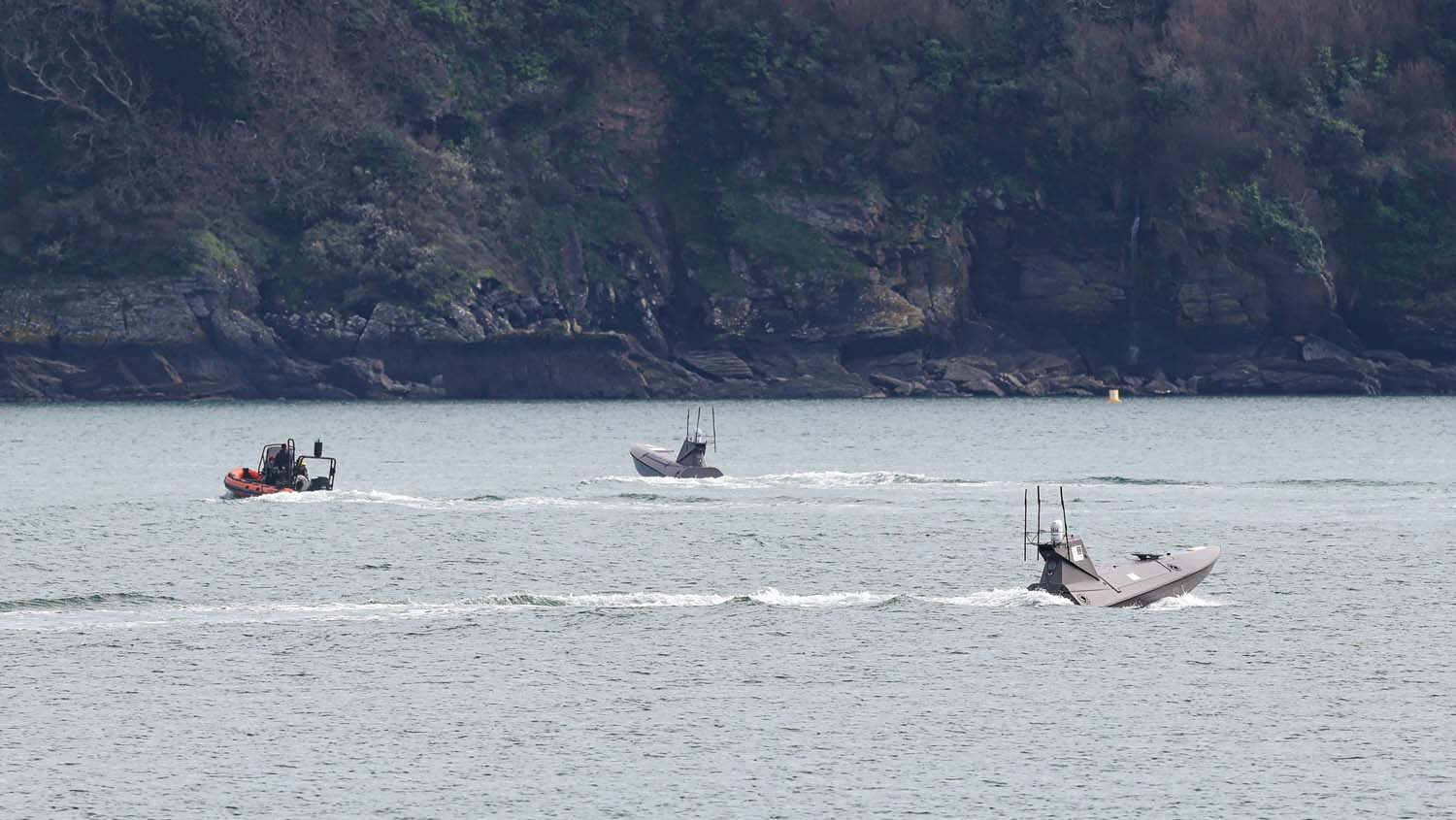
Building on the success of trials and tests in 2025, Exercise Spring Sabre landed in Plymouth in early March, to develop and manage the diversity of uncrewed maritime and airborne available to a Hybrid Navy construct. (Royal Navy)
WASHINGTON — The US, United Kingdom and Australia wrapped up a naval exercise this month that the Royal Navy billed as the three countries’ “largest ever demonstration of uncrewed and autonomous technology” in support of AUKUS Pillar II .
During the Maritime Big Play exercise, the AUKUS partners tested autonomous systems off the coast of San Diego, California, and integrated them into maritime operations — including tracking underwater threats and sharing data across platforms. The exercise comes as the UK and other European countries look to expand their maritime surveillance capabilities with autonomous systems amid growing security concerns in the region.
The UK headed up the anti-submarine warfare (ASW) portion of the exercise, using “a range of uncrewed surface vessels, underwater gliders, drones and subsea vehicles” during the exercise, according to a Royal Navy news release. Specifically, the ASW component focused on using both manned and unmanned systems for tracking and surveillance missions.
Altogether, the exercise was designed to showcase more than 40 technologies from the three AUKUS countries — including manned, unmanned and “multi-domain autonomous” systems, the release said.
The Royal Navy did not respond to a request for comment regarding how many and which types of unmanned systems were used in the exercise. The US Navy said in a news release that the drill’s ultimate goal was to “achieve milestones in integrating mature robotics and autonomous systems within AUKUS coalition maritime operations.”
The three countries established the AUKUS framework in 2021, with Pillar I focused on providing Australia with Virginia-class nuclear-powered submarines by 2032. Under Pillar II of the deal, the nations are working together to jointly develop and field advanced military capabilities.
“Maritime Big Play demonstrates the real, tangible progress we are making with our AUKUS partners to deliver cutting-edge autonomous capability at sea,” Second Sea Lord Vice Adm. Paul Beattie said in a statement this month. “This is about more than technology on display, it’s about proving that our forces can operate together seamlessly, sharing data and combining assets to stay ahead of future threats.”
European nations are broadly pursuing maritime surveillance capabilities, with different priorities depending on each country’s geographic location and security concerns — from monitoring Russia’s activity in northern waters to tracking the flow of people through the Mediterranean in the south.
““As a result, countries are buying small numbers of manned patrol platforms and combining them with uncrewed aircraft,” Bryan Clark, director of the Hudson Institute’s Center for Defense Concepts and Technologies, told Breaking Defense . “In the south, they tend to want uncrewed aircraft plus manned patrol ships to intercept migrants. In the north, countries are buying manned ASW patrol aircraft like the P-8A [Poseidon] or Atlantique, plus uncrewed aircraft like the MQ-9B [SkyGuardian] .”
Zak Schneider, a visiting fellow at the Casimir Pulaski Foundation in Warsaw, also noted that maritime surveillance platforms have become critical capabilities for monitoring Russia’s escalation in the European theater.
“Sensors, ISR, intel and other data feeds are vital to being able to act on/forecast in advance new attacks in the maritime domain,” Schneider told Breaking Defense. “So, surveillance is also about the proliferation of sensors, detectors and reconnaissance that can feed data into these big systems. “
As European allies look for better ways to detect and track underwater threats, the AUKUS partners are also pursuing new sensor technologies for uncrewed systems. To cap off the Maritime Big Play exercise, the UK’s Ministry of Defence announced Tuesday that the country would spearhead d evelopment of three advanced undersea sensor payloads for unmanned systems, which the ministry said would become “available” to the UK, Australia and the US in 2027, in support of the AUKUS agreement.
The sensor payloads consist of a synthetic aperture sonar, a deployable anti-submarine warfare sensor and a deployable non-kinetic effector. The systems will be designed to conduct surveillance, collect underwater information and dispatch sensors that can track and identify underwater threats, according to the Ministry of Defence.
“The UK is all in on AUKUS, and this cutting-edge technology shows why,” UK Minister for Defence Readiness and Industry Luke Pollard said Tuesday in a statement. “By leading development of these sensor payloads, we’re putting British innovation at the heart of AUKUS and strengthening our collective undersea capability.”
Breaking Defense Video
How General Atomics views Europe’s unmanned future
A more flexible way to defend maneuver forces from drones that doesn’t tie them down [Sponsored]
What’s haunting the Pentagon this Halloween?
The new must-have capabilities for drones [Sponsored]
Army’s tech chief talks autonomy, acquisition and the future of drones
Drones take over AUSA, plus the Army’s plan to bring in new vendors
Hegseth talks autonomy at AUSA, a key show focus
Army doubles down on autonomy, stakes out Indo-Pacific role: AUSA Day 2
Telle talks ‘manufacturing rodeo,’ supply chain ‘weak links’: AUSA Day 1
New leaders, new drone command: What we expect from AUSA 2026
继2025年试验和测试取得成功之后,“春之军刀”演习于3月初在普利茅斯举行,旨在开发和管理混合海军架构中可用的各种无人海上和空中作战力量。(英国皇家海军)
华盛顿——本月,美国、英国和澳大利亚结束了一次海军演习,英国皇家海军称这是三国为支持 AUKUS Pillar II 而进行的“有史以来规模最大的无人和自主技术演示”。
在“海上大演习”中,AUKUS合作伙伴在加利福尼亚州圣地亚哥海岸附近测试了自主系统,并将其整合到海上行动中,包括追踪水下威胁和跨平台共享数据。此次演习正值英国和其他欧洲国家寻求利用自主系统增强其海上监视能力之际,以应对该地区日益增长的安全担忧。
据英国皇家海军新闻稿称,英国主导了此次演习的反潜作战(ASW)部分,演习中使用了“一系列无人水面舰艇、水下滑翔机、无人机和水下航行器”。具体而言,反潜作战部分侧重于使用有人和无人系统执行跟踪和监视任务。
新闻稿称,此次演习旨在展示来自 AUKUS 三个国家的 40 多项技术,包括有人驾驶、无人驾驶和“多域自主”系统。
英国皇家海军未回应有关此次演习中使用了多少以及哪些类型的无人系统的信息。美国海军在一份新闻稿中表示,此次演习的最终目标是“在AUKUS联盟海上行动中整合成熟的机器人和自主系统方面取得里程碑式的进展”。
三国于 2021 年建立了 AUKUS 框架,第一支柱的重点是到 2032 年向澳大利亚提供弗吉尼亚级核动力潜艇。根据该协议的第二支柱,三国正在共同努力,联合开发和部署先进的军事能力。
“‘海上大型演习’展现了我们与AUKUS合作伙伴在海上交付尖端自主能力方面取得的切实进展,”第二海务大臣保罗·比蒂海军中将本月在一份声明中表示。“这不仅仅是技术展示,更是为了证明我们的部队能够无缝协作,共享数据,整合资源,从而在未来的威胁面前保持领先地位。”
欧洲各国都在大力发展海上监视能力,但各国的优先事项各不相同,这取决于各国的地理位置和安全顾虑——从监测俄罗斯在北部水域的活动到追踪南部地中海的人口流动。
“因此,各国都在少量采购有人巡逻平台,并将其与无人机结合使用,”哈德逊研究所国防概念与技术中心主任布莱恩·克拉克告诉《防务新闻》。“在南方国家,他们倾向于使用无人机和有人巡逻舰来拦截移民。在北方国家,他们则采购像P-8A(海神)或大西洋这样的有人反潜巡逻机,以及像MQ-9B(天空卫士)这样的无人机。”
华沙卡西米尔·普拉斯基基金会的访问学者扎克·施耐德也指出,海上监视平台已成为监测俄罗斯在欧洲地区升级行动的关键能力。
施耐德告诉《防务新闻》:“传感器、情报监视侦察、情报和其他数据馈送对于提前应对/预测海上领域的新攻击至关重要。因此,监视也关乎传感器、探测器和侦察设备的扩散,这些设备可以将数据传输到这些大型系统中。”
随着欧洲盟国寻求更有效的水下威胁探测和追踪方法,AUKUS 合作协议的伙伴国也在积极研发用于无人系统的新型传感器技术。为配合“海上大演习”,英国国防部周二宣布,英国将牵头研发三种先进的水下传感器有效载荷,用于无人系统。国防部表示,这些有效载荷将于 2027 年向英国、澳大利亚和美国“开放”,以支持 AUKUS 协议的实施。
据英国国防部称,该传感器有效载荷包括合成孔径声呐、可部署反潜作战传感器和可部署非动能效应器。这些系统旨在执行监视任务、收集水下信息,并部署能够跟踪和识别水下威胁的传感器。
英国国防战备与工业大臣卢克·波拉德周二在一份声明中表示:“英国全力投入AUKUS项目,这项尖端技术充分展现了这一点。通过主导这些传感器有效载荷的研发,我们将英国的创新置于AUKUS项目的核心,并增强我们集体的水下作战能力。”
突破性防御视频
通用原子公司如何看待欧洲的无人化未来
一种更灵活的防御机动部队免受无人机攻击的方式,不会限制其行动[赞助]
今年万圣节,五角大楼究竟闹鬼?
无人机必备的新功能 [赞助内容]
陆军技术主管谈无人机的自主性、采购和未来
无人机主导了美国陆军协会(AUSA)的会议,此外,陆军还计划引入新的供应商。
Hegseth 在 AUSA 大会上谈到了自主性,这是本次大会的一个重点议题。
陆军加倍强调自主性,明确印太地区角色:AUSA第二天
特勒谈“制造业乱象”、供应链“薄弱环节”:AUSA 第一天
新领导人,新无人机指挥部:我们对 AUSA 2026 的期待