China’s CE-25A Electric Commuter Airliner Demonstrator Emerges In Photos中国CE-25A电动通勤客机验证机照片曝光
The 19-seat aircraft features an unusual array of ducted fans, and the technology behind it could have implications beyond civilian aviation. The 19-seat aircraft features an unusual array of ducted fans, and the technology behind it could have implications beyond civilian aviation.
新闻视频
Published Oct 28, 2026 2:26 PM EDT
via Chinese internet
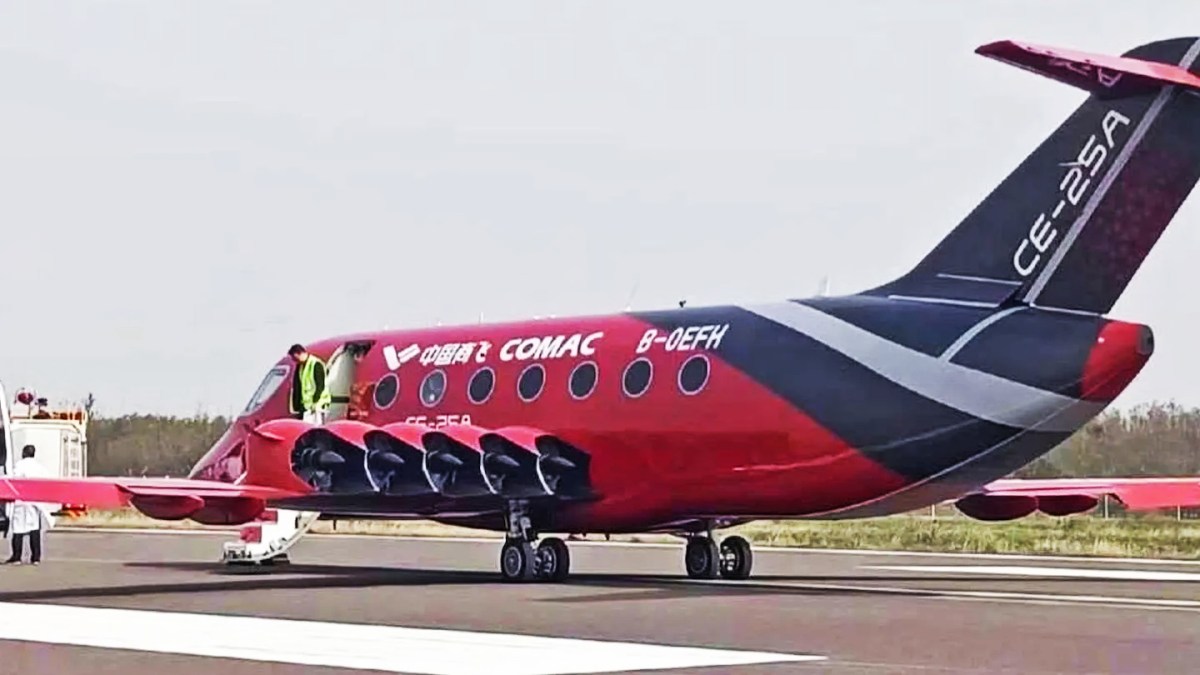
New images appear to show a full-sized demonstrator of China’s CE-25A, an unorthodox 19-seat all-electric aircraft being developed by the state-owned Commercial Aircraft Corporation of China (COMAC). The photographs offer a fresh look at a program the company publicly outlined in 2023, although the aircraft’s current testing status remains unclear.
The images appear to have first been shared by Chinese automotive blogger Han Lu (韩路) on October 28 and show a red and black colored aircraft with a silver cheatline bearing COMAC and CE-25A markings. Its Chinese civilian registration is B-0EFH.
One of the first images showing the apparent COMAC CE-25A. via Chinese internet
At this point, it should be noted that we cannot establish with certainty that the imagery is legitimate, but our own examination using multiple AI image-analysis models has found no major indications that they were artificially generated.
Regardless, the program overall reflects COMAC’s interest in distributed electric propulsion, an approach that could help inform future aircraft development even if the CE-25A itself never enters commercial service.
The appearance of what seems to be a full-sized demonstrator certainly raises questions about how far the program has progressed. At this stage, there is no clear public confirmation that this particular aircraft has flown, and its precise role in the development effort remains uncertain.
A rear three-quarter view provides a good look at the distributed electric propulsion system used in the CE-25A. via Chinese internet
COMAC first presented the CE-25A concept at the China International Import Expo in Shanghai in November 2023. The company described it as a 19-seat, all-electric commuter aircraft intended for short- and medium-distance passenger transportation, as well as business aviation.
Published design specifications called for a cruising speed of approximately 400 kilometers per hour (248 miles per hour) and a range of around 400 to 500 kilometers (250 to 310 miles).
The 19-seat capacity and its general configuration are somewhat similar to the Beechcraft 1900 twin-turboprop regional airliner. With a 19-passenger payload, the Beechcraft 1900 has a range of around 700 kilometers (440 miles) and a cruising speed of approximately 520 kilometers per hour (320 miles per hour).
Stock photo of a Beechcraft 1900D taking off. Photo by Fabrizio Gandolfo/SOPA Images/LightRocket via Getty Images SOPA Images
The Chinese aircraft’s most distinctive feature is its distributed electric propulsion system. Instead of relying on a small number of conventional turboprop engines, the design uses 10 electrically driven ducted fans integrated into its wing structure.
Distributed propulsion can give designers greater flexibility in how thrust is generated and integrated with the airframe. Depending on the configuration, it can offer aerodynamic benefits and potentially improve performance in particular flight regimes. Electric motors can also simplify some aspects of propulsion-system design compared with conventional turbine engines.
Those advantages come with very considerable engineering challenges. Batteries remain far less energy-dense than aviation fuel, placing constraints on range, payload, and endurance. High-power electrical systems also require careful thermal management, while integrating multiple propulsion units introduces additional questions involving reliability, maintenance, and flight control.
There is also some confusion about how the demonstrator shown in the new images fits in with previously announced plans for the program. In 2023, COMAC referred to experimental aircraft verification flight work, which was to involve a scaled demonstrator. Meanwhile, the aircraft in the new photos is full-sized. Potentially, there is an unseen ‘missing link’ subscale demonstrator that has already flown.
A model of the CE-25A is displayed alongside a placard with its key features and specifications. via Chinese internet
China is not alone in exploring distributed electric propulsion for regional aircraft. Several Western projects are also underway.
The European UNIFIER-19 research effort has examined 19-seat, zero-emission regional aircraft concepts using alternative propulsion systems, including distributed electric ducted fans. Some variants explored hydrogen fuel cells rather than relying exclusively on batteries. Compared to the CE-25A, it is strictly a research effort rather than a proposed production aircraft.
In the United States, NASA’s X-57A Maxwell experimental aircraft investigated distributed electric propulsion using 14 electric motors and propellers integrated into a specially designed wing. The X-57 was much smaller than the CE-25A and used open propellers rather than ducted fans. The project was intended to demonstrate potential aerodynamic and efficiency benefits but did not progress to its planned piloted flight configuration.
The X-57 program was canceled in 2023 after safety issues with its propulsion system proved impossible to resolve within the available budget and schedule. It had been launched on the assumption that existing electric propulsion technology was sufficiently mature for safe flight, but this ultimately proved premature. The experience underscores the very significant engineering and safety challenges that remain in developing viable electric aircraft. Meanwhile, France’s AURA AERO is developing ERA , a 16- to 19-seat regional aircraft planned around eight electric motors and two turbogenerators. The hybrid-electric design is intended to offer substantially greater range than the CE-25A’s published target, with the company advertising a range of approximately 1,500 kilometers (930 miles). ERA is a more direct comparison in terms of intended passenger capacity and commercial role, but it uses a different propulsion architecture and is not an all-electric aircraft.
Swedish company Heart Aerospace also pursued a 19-seat battery-powered commuter aircraft, the ES-19 , with a proposed range of approximately 400 kilometers (250 miles). Its original design was more conventional, with a high wing and T-tail, and the company subsequently moved away from the ES-19 concept toward larger hybrid-electric aircraft.
The CE-25A has been presented as a civilian aircraft, and there is no public evidence that COMAC intends to develop it for military service. Nevertheless, the technologies being explored could have relevance to future military aviation .
This would be in line with China’s pursuit of other unconventional aircraft programs with more direct potential military applications.
A mature electric aircraft in this general class could potentially support short-range utility missions, liaison duties, or personnel transport where payload and endurance requirements are modest and suitable charging infrastructure is available. At this stage, there is no indication that the CE-25A has been designed for autonomous operations, austere-field use, or military payloads.
At the same time, its utility in military environments would depend heavily on battery performance, ground support, operating conditions, and the ability to maintain the aircraft away from established infrastructure.
Perhaps more likely is that research into distributed electric propulsion, including the CE-25A, could inform other Chinese aircraft designs. Advances in electric motors, power distribution, flight controls, thermal management, and the integration of multiple propulsion units could eventually benefit crewed and uncrewed aircraft or specialized platforms with different operational requirements.
The CE-25A sits within China’s broader effort to expand its domestic aerospace capabilities and explore new aircraft technologies. COMAC is best known internationally for its C919 narrowbody airliner and ARJ21 regional jet, but its research interests extend beyond conventional commercial aircraft.
An ARJ21 sits on the tarmac at Yangzhou Taizhou International Airport, Jiangsu Province of China. Photo by Visual China Group via Getty Images VCG
China’s substantial battery-manufacturing industry provides a potential advantage in electric aviation, although adapting batteries developed for road vehicles to the demands of flight remains a significant engineering challenge.
In 2023, COMAC announced cooperation with battery manufacturer CATL and Shanghai Jiao Tong University on research related to battery-powered aircraft concepts. The precise relationship between that work and the CE-25A, including whether they share specific battery technologies or propulsion systems, is not immediately clear.
For now, the newly surfaced photographs provide a compelling look at a COMAC project that has been publicly acknowledged but remains opaque in several important respects.
Whether the CE-25A ultimately becomes a viable civilian aircraft or contributes to other aerospace developments, including in the military realm, its emergence offers more evidence of China’s continued push into unconventional aircraft design.
Contact the author: thomas@thewarzone.com
Comments couldn’t be loaded. Please refresh the page.
发布于美国东部时间2026年10月28日下午2:26
通过中国互联网
最新曝光的图片似乎展示了中国商用飞机有限责任公司(COMAC)正在研发的CE-25A全尺寸验证机。这款非传统的19座全电动飞机由中国商用飞机有限责任公司研制。这些照片让人们得以一窥该公司于2023年公开提出的该项目,但目前该飞机的测试状态仍不明朗。
这些图片似乎最早由中国汽车博主韩路于10月28日分享,图片显示一架红黑相间的飞机,机身侧面有银色饰带,并印有COMAC和CE-25A的标志。其中国民用注册号为B-0EFH。
这是最早一批疑似中国商飞CE-25A飞机的图片之一。图片来自中国互联网。
需要指出的是,我们目前还不能确定这些图像是否真实,但我们使用多个 AI 图像分析模型进行的检查并未发现任何重大迹象表明这些图像是人工生成的。
无论如何,该计划总体上反映了中国商飞对分布式电力推进的兴趣,即使 CE-25A 本身从未投入商业运营,这种方法也可能有助于指导未来的飞机开发。
一架疑似全尺寸验证机的出现,无疑引发了人们对该项目进展程度的疑问。目前,尚无公开消息证实这架飞机已经试飞,其在研发工作中的具体作用也仍不明朗。
从后四分之三视角可以清楚地看到CE-25A所使用的分布式电力推进系统。(图片来自中国互联网)
中国商飞于 2023 年 11 月在上海举行的中国国际进口博览会上首次展示了 CE-25A 概念机。该公司将其描述为一款 19 座全电动通勤飞机,旨在用于短途和中程客运以及公务航空。
已公布的设计规范要求巡航速度约为每小时 400 公里(每小时 248 英里),续航里程约为 400 至 500 公里(250 至 310 英里)。
这款19座飞机的载客量和总体布局与比奇1900双涡轮螺旋桨支线客机有些相似。比奇1900在搭载19名乘客的情况下,航程约为700公里(440英里),巡航速度约为每小时520公里(320英里)。
一张比奇1900D飞机起飞的库存照片。照片由Fabrizio Gandolfo/SOPA Images/LightRocket通过Getty Images提供。
中国这款飞机最显著的特点是其分布式电力推进系统。它没有依赖少量传统的涡轮螺旋桨发动机,而是采用了10台集成在机翼结构中的电动涵道风扇。
分布式推进系统能够为设计人员提供更大的灵活性,让他们能够更灵活地产生推力并将其与机身结构集成。根据不同的配置,它可以带来空气动力学优势,并有可能在特定飞行状态下提升性能。与传统的涡轮发动机相比,电动机还可以简化推进系统设计的某些方面。
这些优势也带来了相当大的工程挑战。电池的能量密度远低于航空燃料,这限制了航程、有效载荷和续航时间。高功率电气系统还需要精细的热管理,而集成多个推进单元则会带来可靠性、维护和飞行控制方面的额外问题。
关于新图片中展示的验证机与此前公布的项目计划之间的联系,目前仍存在一些疑问。中国商飞曾在2023年提及实验飞机验证飞行工作,其中就包括一架缩比验证机。然而,新照片中的飞机却是全尺寸的。或许,存在一架尚未亮相的、已完成试飞的缩比验证机,填补了这一“缺失环节”。
CE-25A 的模型机旁边展示着一块标牌,上面列出了它的主要特点和规格。(图片来自中国互联网)
中国并非唯一探索支线飞机分布式电力推进技术的国家。西方也有多个相关项目正在进行中。
欧洲的UNIFIER-19研究项目探索了采用替代推进系统的19座零排放支线飞机概念,其中包括分布式电动涵道风扇。部分方案探索了氢燃料电池,而非完全依赖电池。与CE-25A相比,UNIFIER-19严格意义上仍是一项研究项目,而非拟投产的飞机。
在美国,NASA的X-57A“麦克斯韦”实验飞机利用集成在特制机翼中的14台电动机和螺旋桨,研究了分布式电力推进技术。X-57比CE-25A小得多,并且使用开放式螺旋桨而非涵道风扇。该项目旨在展示潜在的空气动力学和效率优势,但最终未能实现计划中的载人飞行配置。
X-57项目于2023年被取消,原因是其推进系统的安全问题在现有预算和时间限制内无法解决。该项目启动时基于现有电力推进技术已足够成熟,能够安全飞行的假设,但最终证明这一假设过于仓促。这一经历凸显了开发可行的电动飞机在工程和安全方面仍然面临的巨大挑战。与此同时,法国AURA AERO公司正在开发ERA,这是一款16至19座的支线飞机,计划采用八台电动机和两台涡轮发电机。这款混合动力飞机旨在提供比CE-25A公布的目标航程更远的航程,该公司宣称其航程约为1500公里(930英里)。ERA在预期载客量和商业用途方面与CE-25A更为直接,但它采用了不同的推进系统架构,并且并非纯电动飞机。
瑞典公司Heart Aerospace也曾研发过一款名为ES-19的19座电池动力通勤飞机,其预计航程约为400公里(250英里)。该公司最初的设计较为传统,采用高翼和T型尾翼,但后来该公司放弃了ES-19的概念,转而研发更大的混合动力电动飞机。
CE-25A一直被定位为民用飞机,目前尚无公开证据表明中国商飞计划将其开发用于军事用途。然而,其正在探索的技术可能对未来的军事航空具有重要意义。
这与中国追求其他具有更直接潜在军事用途的非常规飞机项目是一致的。
该级别成熟的电动飞机有望支持短程通用任务、联络任务或人员运输,尤其适用于有效载荷和续航时间要求不高且充电基础设施完善的场景。目前尚无迹象表明CE-25A的设计用途是自主运行、野外作业或军事载荷。
同时,它在军事环境中的实用性将很大程度上取决于电池性能、地面支持、运行条件以及在远离现有基础设施的情况下维护飞机的能力。
或许更有可能的是,对分布式电力推进系统(包括CE-25A)的研究可以为其他中国飞机设计提供借鉴。电动机、电力分配、飞行控制、热管理以及多推进单元集成等方面的进步,最终可能使有人驾驶和无人驾驶飞机,或具有不同作战需求的专用平台受益。
CE-25A是中国拓展国内航空航天能力、探索新型飞机技术的大战略的一部分。中国商飞(COMAC)以其C919窄体客机和ARJ21支线客机在国际上享有盛誉,但其研究兴趣远不止于传统的商用飞机。
一架ARJ21飞机停放在中国江苏省扬州台州国际机场的停机坪上。图片由视觉中国集团(Visual China Group)通过Getty Images VCG提供。
中国庞大的电池制造产业为电动航空提供了潜在优势,尽管将为公路车辆开发的电池改造以满足飞行需求仍然是一项重大的工程挑战。
2023年,中国商飞宣布与电池制造商宁德时代(CATL)和上海交通大学合作,开展电池动力飞机概念相关的研究。这项研究与CE-25A之间的具体联系,包括它们是否共享特定的电池技术或推进系统,目前尚不明确。
目前,新曝光的照片让我们得以一窥 COMAC 的一个项目,该项目虽然已被公开承认,但在几个重要方面仍然不透明。
无论 CE-25A 最终能否成为一款可行的民用飞机,或者能否为其他航空航天发展(包括军事领域)做出贡献,它的出现都进一步证明了中国在非常规飞机设计领域持续推进的决心。
联系作者:thomas@thewarzone.com
评论加载失败,请刷新页面。