AI-powered hearing aids: How they help you follow conversations in noisy places人工智能助听器:它们如何帮助您在嘈杂的环境中听清对话
AI-powered hearing aids help improve speech clarity in noisy places, with personalised fitting and follow-up care boosting results. Read more at straitstimes.com.
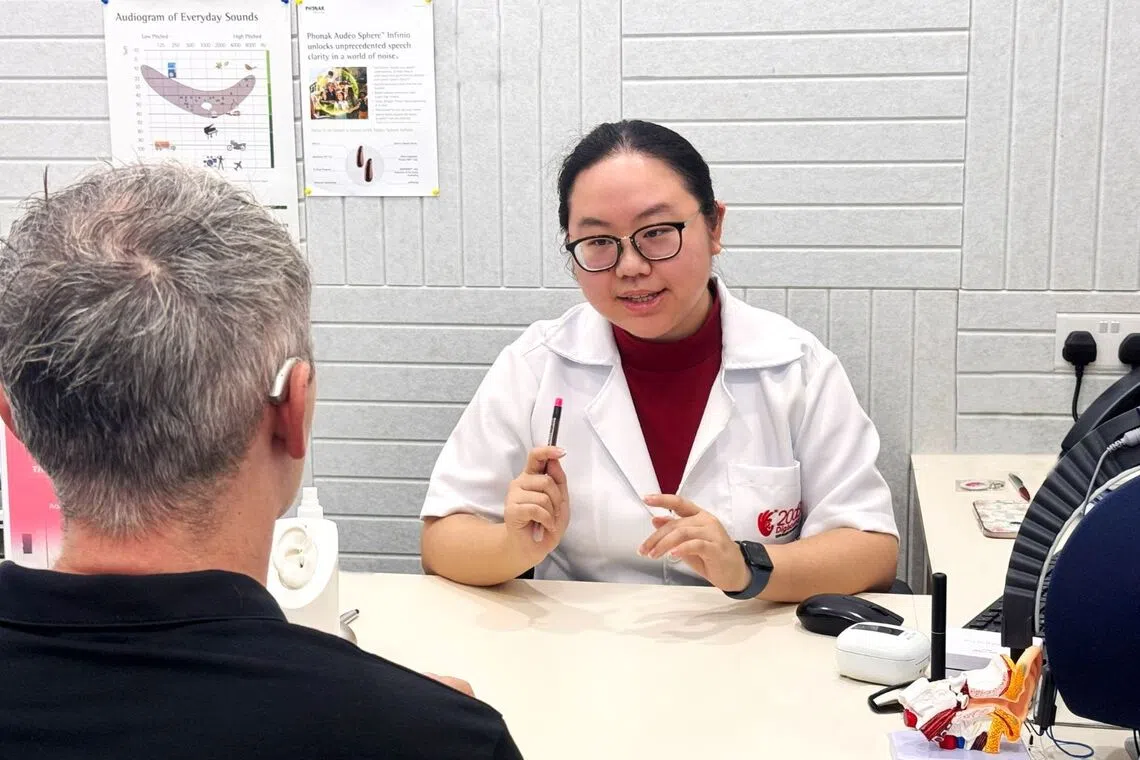
Today’s hearing aids can adapt automatically as environments change and be tuned to the sounds wearers miss, while personalised fitting and follow-up care help get the most out of them
Audiologist Grace Wong discusses a patient’s daily listening challenges to help identify a suitable hearing solution.
Published Oct 29, 2026, 04:00 AM
The ticking of a clock. The hum of the air-conditioning. Even the sound of his own footsteps. These were some of the everyday sounds that suddenly stood out to Lim Chee Keong when he tried on his new hearing aids.
“I could hear the birds in the morning again, which I hadn’t realised I’d missed,” recalls the 58-year-old retired bank manager.
But the biggest difference was being able to follow conversations without guessing what had been said or simply smiling and nodding along.
Lim first noticed changes in his hearing in his early 50s, but dismissed them as people mumbling. The turning point came during dinner with old friends at a noisy restaurant, when he answered a question with something completely unrelated.
“I realised I was putting too much effort into simply keeping up with conversations. I booked a hearing test the following week.”
An online hearing test conducted by 20dB Hearing found that he had moderate to severe age-related hearing loss in both ears, affecting his ability to understand speech, particularly amid background noise.
The Phonak Audeo Eon is designed to adapt to different listening environments, helping wearers follow conversations more easily. PHOTO: 20DB HEARING
The Phonak Audeo Eon is designed to adapt to different listening environments, helping wearers follow conversations more easily.
How do AI-powered hearing aids make speech clearer in noisy places?
Lim was fitted with the Phonak Audeo Eon Sphere (prelaunched exclusively at 20dB Hearing), which uses AI-powered technology, including Spheric Speech Clarity 3.0 and the Hypersonic chip, designed to help separate speech from background noise.
“I heard the chip helps tell the difference between someone talking and all the background clatter, which was exactly my problem in restaurants,” he says.
His experience highlights a common misconception: that hearing aids simply make everything louder.
Grace Wong, an audiologist at 20dB Hearing, explains that hearing loss often affects higher-pitched sounds first. Someone may hear a person speaking but struggle to make out certain words, especially in noisy places.
“Most people with hearing loss don’t need everything louder. They need extra help with certain pitches, usually the high-pitched consonants that make words clear,” she says.
Hearing aids can be programmed to provide more support for sounds a person struggles to hear. Newer AI-powered devices such as the Eon can also automatically adjust as listening environments change.
For example, someone may need different sound settings while travelling on a bus than when stepping into a noisy restaurant, says Kausellya Subramaniam, senior audiologist at 20dB Hearing.
The Eon is designed to recognise such changes and adjust how sounds are processed, reducing the need for wearers to change settings manually.
“Earlier generations already helped people hear better; the Eon takes another step towards helping the hearing aid understand the listening situation and respond accordingly,” she adds.
Wearers need not be tech-savvy, as many adjustments happen automatically. Those who want more control can use the myPhonak app to personalise their settings.
The Eon is also 25 per cent smaller and 20 per cent lighter than the previous Sphere model , and offers around 22 hours of battery life on a single charge, even under demanding conditions such as Bluetooth streaming and noisy environments.
For Lim, these improvements mean a less noticeable device and less frequent charging.
Senior audiologist Kausellya Subramaniam examines a patient’s ear as part of assessing their hearing needs. PHOTO: 20DB HEARING
Senior audiologist Kausellya Subramaniam examines a patient’s ear as part of assessing their hearing needs.
Why personalised fitting matters for better hearing
Even with advanced technology, finding the right hearing solution involves more than a hearing test.
Audiologists at 20dB Hearing also ask about patients’ routines, communication needs and situations they find challenging – from family dinners to workplace meetings.
“Test results show what a person can hear, but conversations show what they need to hear and how they live with their hearing loss,” says Wong.
Two people with similar hearing-test results may therefore need different solutions. Someone who spends most of their time at home, for example, has different listening needs from someone who frequently attends meetings or travels.
Personalisation continues during fitting and adjustment.
Lim recalls his audiologist programming his hearing aids and asking him to flag sounds that seemed too loud or unnatural.
“When I first put it on, the room suddenly sounded so sharp. It was a bit much for a day or two, but then my brain got used to it,” he says.
Kausellya compares the experience to entering a brightly lit room after being in the dark: the light is immediately there, but the eyes need time to adjust.
Similarly, while some wearers notice clearer speech quickly, others may need longer to get used to sounds they have not heard clearly for years.
She advises patients to wear their hearing aids for at least eight hours daily during the adjustment period. Follow-up appointments allow audiologists to fine-tune settings based on real-life experiences, with 20dB Hearing’s Product Lifetime of Aftercare Promise providing continued support throughout the lifespan of the device.
“The aid can process the sound adequately, but the user is the one who can give feedback to us about what feels too loud, too soft or not natural,” she says.
While AI can automate more of the listening experience, professional fitting and ongoing support remain important in helping wearers adapt.
For Lim, the difference is evident in everyday life.
“Day to day, things are just easier,” he says. “I’m not straining to follow conversations anymore, so I finish the evening with energy left over.”
Recently, he returned to a restaurant with the same group of old friends. This time, he could join in without guessing what others were saying.
“What matters most is that I’m back in the conversation.”
Book a hearing test for yourself or a loved one at 20dB Hearing.
如今的助听器能够随着环境变化自动调节,并能针对佩戴者听不到的声音进行调谐,而个性化的验配和后续护理则有助于最大限度地发挥其作用。
听力学家 Grace Wong 与患者讨论其日常听力挑战,以帮助确定合适的听力解决方案。
发布于 2026 年 10 月 29 日 上午 4:00
时钟的滴答声,空调的嗡嗡声,甚至自己的脚步声——这些日常的声音,在林志强试戴新助听器后,突然变得格外清晰。
“早上我又能听到鸟鸣了,我之前都没意识到自己错过了这些声音,”这位 58 岁的退休银行经理回忆道。
但最大的不同在于能够理解对话内容,而无需猜测别人说了什么,或者只是微笑点头附和。
林先生五十岁出头时第一次注意到听力有所变化,但他当时只当是别人说话含糊不清。转折点发生在一次与老朋友在一家嘈杂的餐厅吃饭时,他回答了一个与问题完全无关的内容。
“我意识到自己花了太多精力仅仅是为了跟上对话。于是我预约了下周的听力测试。”
20dB Hearing 进行的在线听力测试发现,他双耳患有中度至重度与年龄相关的听力损失,影响了他理解言语的能力,尤其是在背景噪音中。
Phonak Audeo Eon 助听器旨在适应不同的聆听环境,帮助佩戴者更轻松地跟上对话。图片:20DB HEARING
Phonak Audeo Eon 耳机旨在适应不同的聆听环境,帮助佩戴者更轻松地跟上对话。
人工智能助听器如何使嘈杂环境中的语音更清晰?
林先生佩戴了 Phonak Audeo Eon Sphere(20dB Hearing 独家预售),该助听器采用人工智能技术,包括 Spheric Speech Clarity 3.0 和 Hypersonic 芯片,旨在帮助将语音与背景噪音分离。
“我听说这个芯片有助于区分说话的人和所有背景噪音,这正是我在餐厅里遇到的问题,”他说。
他的经历凸显了一个常见的误解:助听器只是让所有声音都变大。
20dB听力中心的听力学家格蕾丝·王解释说,听力损失通常首先影响高音调的声音。患者可能听到别人说话,但难以听清某些词语,尤其是在嘈杂的环境中。
“大多数听力受损的人并不需要所有声音都更大。他们需要的是某些特定音调的额外帮助,通常是那些使单词清晰的高音辅音,”她说。
助听器可以进行编程,为听力障碍人士提供更多声音支持。像Eon这样的新型人工智能设备还可以根据聆听环境的变化自动调节。
例如,20dB Hearing 的高级听力学家 Kausellya Subramaniam 表示,人们在乘坐公共汽车时可能需要不同的声音设置,而在走进嘈杂的餐厅时则可能需要不同的声音设置。
Eon 的设计旨在识别此类变化并调整声音的处理方式,从而减少佩戴者手动更改设置的需要。
她补充说:“早期的几代助听器已经帮助人们听得更清楚了;Eon 助听器更进一步,帮助助听器理解聆听环境并做出相应的反应。”
佩戴者无需精通技术,因为许多调节功能都会自动完成。如果想要更多控制权,可以使用 myPhonak 应用程序进行个性化设置。
Eon 比之前的 Sphere 型号小 25%,轻 20%,单次充电即可提供约 22 小时的电池续航时间,即使在蓝牙流媒体播放和嘈杂环境等苛刻条件下也是如此。
对于林来说,这些改进意味着设备更不显眼,充电频率也更低。
资深听力学家考塞利亚·苏布拉马尼亚姆正在检查患者的耳朵,以评估其听力需求。(图片:20DB听力中心)
资深听力学家考塞利亚·苏布拉马尼亚姆正在检查患者的耳朵,以评估他们的听力需求。
为什么个性化验配对改善听力至关重要
即使拥有先进的技术,找到合适的助听解决方案也不仅仅是进行听力测试那么简单。
20dB 听力中心的听力学家还会询问患者的日常作息、沟通需求以及他们遇到的挑战性情况——从家庭聚餐到工作场所会议。
“测试结果显示一个人能听到什么,但对话显示他们需要听到什么以及他们如何应对听力损失,”黄说。
因此,听力测试结果相似的两个人可能需要不同的解决方案。例如,大部分时间待在家里的人与经常参加会议或出差的人的聆听需求就截然不同。
在试穿和调整过程中,我们会继续进行个性化调整。
林回忆说,他的听力学家在为他的助听器编程时,要求他标记出那些听起来太响或不自然的声音。
“我第一次戴上它的时候,房间里的声音突然变得非常尖锐。一两天感觉有点难以忍受,但之后我的大脑就适应了,”他说。
考塞利亚将这种体验比作从黑暗中进入一个明亮的房间:光线立刻出现,但眼睛需要时间来适应。
同样,虽然有些佩戴者很快就能注意到语音更清晰了,但其他人可能需要更长的时间来适应他们多年来都没能听清楚的声音。
她建议患者在适应期内每天至少佩戴助听器八小时。后续复诊可以让听力专家根据实际使用情况微调设置,而20dB Hearing的终身售后服务承诺则可在助听器的整个使用寿命期间提供持续支持。
“助听器可以充分处理声音,但用户才能向我们反馈声音是否过大、过小或不自然,”她说。
虽然人工智能可以自动化更多聆听体验,但专业的适配和持续的支持对于帮助佩戴者适应仍然非常重要。
对林来说,这种差异在日常生活中显而易见。
“现在每天都轻松多了,”他说。“我不再需要费力去跟上谈话,所以晚上结束时还有余力。”
最近,他和一群老朋友重聚一家餐厅。这一次,他可以不用猜测就能加入大家的谈话了。
“最重要的是,我又重新回到了对话中。”
在 20dB Hearing 为自己或亲人预约听力测试。