Commentary: Why staying indoors may not be enough when haze hits评论:为什么雾霾来袭时,待在室内可能还不够
When sheltering from haze in indoor spaces, air filtration, cooling and ventilation need to be considered together, says SUSS’ Zuraimi Mohamed Sultan.
新闻视频
When sheltering from haze in indoor spaces, air filtration, cooling and ventilation need to be considered together, says SUSS’ Zuraimi Mohamed Sultan.
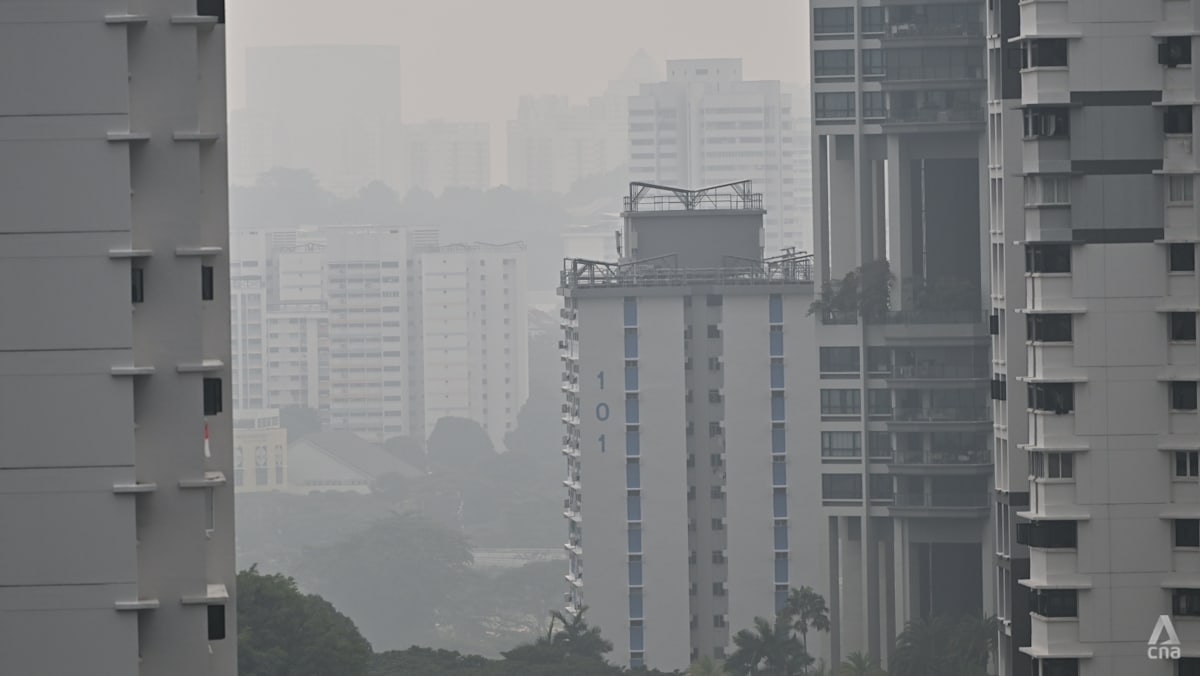
Haze situation from Tanjong Pagar Plaza overlooking Spottiswoode Park HDB on Sep 14, 2026. (Photo: CNA/Raydza Rahman)
This audio is generated by an AI tool.
SINGAPORE: Singapore recently saw its worst haze episode since 2015 , logging 18 consecutive days of unhealthy air from Oct 5 to 22.
The National Environment Agency (NEA) expects that wet conditions should suppress hazy conditions until Thursday (Oct 29) . What have we learnt from coping with the past few smoke-filled weeks, and are we prepared for another haze episode?
To reduce exposure to haze particles, the NEA recommends that individuals stay indoors and close windows and doors. However, doing so can sometimes involve trade-offs between health and comfort.
Consider an older person living in a flat without air-conditioning. Closing windows can make the home warmer and stuffier, while reopening them during haze allows particles back inside.
CNA Games Guess Word Crack the word, one row at a time Buzzword Create words using the given letters Mini Sudoku Tiny puzzle, mighty brain teaser Mini Crossword Small grid, big challenge Word Search Spot as many words as you can Show More Show Less Singapore has set up community haze shelters which are available to the public when the 24-hour Pollutant Standards Index (PSI) exceeds 200. Healthcare institutions are prepared to close windows and use air purifiers and portable air coolers where appropriate. These efforts help protect vulnerable groups. However, the ability to maintain a comfortable indoor environment with reduced haze exposure still depends on housing circumstances, financial resources, mobility and available support. Advice to stay indoors must therefore be accompanied by practical measures that enable them to do so comfortably and with reduced haze exposure.
Singapore has set up community haze shelters which are available to the public when the 24-hour Pollutant Standards Index (PSI) exceeds 200. Healthcare institutions are prepared to close windows and use air purifiers and portable air coolers where appropriate.
These efforts help protect vulnerable groups. However, the ability to maintain a comfortable indoor environment with reduced haze exposure still depends on housing circumstances, financial resources, mobility and available support. Advice to stay indoors must therefore be accompanied by practical measures that enable them to do so comfortably and with reduced haze exposure.
CLOSING WINDOWS CHANGES THE INDOOR ENVIRONMENT
Heat, carbon dioxide and other pollutants may accumulate in enclosed rooms, particularly when occupancy is high. Reopening windows when outdoor air quality improves can help restore ventilation.
The challenge arises when haze persists, especially in spaces that rely on natural ventilation to maintain acceptable indoor conditions.
Indoor protection depends on ventilation arrangements, available equipment and occupants’ needs within each home. Residents with limited mobility may have difficulty adjusting windows, operating equipment or moving to a more suitable space.
Similar considerations apply to naturally ventilated nursing homes and hospital wards, as well as schools and childcare centres. Existing haze preparedness measures provide important protection, but their effectiveness should be assessed under actual occupancy and operating conditions to ensure that particle exposure, ventilation and thermal comfort are adequately managed.
COOLING, FILTRATION AND VENTILATION SERVE DIFFERENT PURPOSES
Fans can improve thermal comfort by increasing air movement across occupants, particularly in closed indoor spaces without air-conditioning. However, ordinary fans do not reduce room temperature, remove haze particles or introduce fresh air when they simply recirculate indoor air.
Similarly, while air-conditioning provides cooling, its presence alone does not ensure adequate particle filtration or ventilation.
Air purifiers can reduce indoor particle concentrations, provided their capacity is appropriate for the room. Effective performance also requires suitable placement, correct operation and regular maintenance.
Cooling, ventilation and air filtration need to be considered together. A comfortably cooled room may still have inadequate ventilation, while a room with effective particle filtration may become excessively warm. Haze preparedness should therefore address particle exposure, ventilation and thermal comfort as complementary aspects of indoor protection.
In shared buildings, facilities managers can assess existing systems and establish procedures for responding to changing conditions. Monitoring indoor particles, temperature and carbon dioxide – the latter as one indicator of ventilation adequacy – can support decisions alongside information on occupancy and occupants’ needs.
In healthcare facilities, these arrangements must also be coordinated with clinical and infection-control requirements.
Households may lack the equipment or expertise available to institutions. Purchasing an air purifier involves an initial expense, followed by the costs of electricity and replacing filters. For residents with limited income, these can compete with essential spending.
Targeted equipment loans or subsidies could help vulnerable households establish one room with reduced particle exposure and adequate comfort. Support should extend beyond equipment provision to include maintenance.
Practical assistance matters as much as equipment. Volunteers or community partners could help older residents operate devices and position them appropriately.
Community haze shelters provide another avenue for protection. Their accessibility depends on residents knowing their locations and opening hours, being able to travel there, and having arrangements that allow them to remain for the required period.
OUTDOOR WORKERS NEED SOMEWHERE SUITABLE TO RECOVER
The built environment also has an important role in protecting people who work outdoors, such as construction workers and delivery riders.
Depending on the air quality, the Ministry of Manpower’s (MOM) guidelines advise employers to reduce, minimise or avoid strenuous outdoor work, and mitigate risks through measures like scheduling indoor rest breaks and deferring non-essential tasks.
More could be done to ensure outdoor workers have suitable places to rest. Employers could ensure there are designated indoor spaces where workers can shelter during periods of poor air quality. This would require arrangements to pause or reschedule outdoor tasks, together with access to spaces with particle filtration, ventilation and thermal comfort.
For delivery riders, platforms could work with building owners and businesses to identify accessible indoor rest spaces. Delivery schedules and incentive arrangements should enable riders to take protective breaks without undue pressure to return outdoors.
N95 masks remain important where respiratory protection is indicated. However, their use may increase breathing effort and cause discomfort for some workers. Suitable indoor spaces could support breaks from outdoor exposure and allow temporary mask removal.
Employers and platforms should therefore coordinate work schedules, rest facilities and operational expectations to make sheltering during haze peaks a feasible protective measure.
Singapore’s advisories and institutional measures provide essential support. Building on them means examining whether the places where people shelter are appropriate .
For an older resident, that may mean assistance with filtration and comfort at home. For a school or care facility, it may mean checking how equipment performs in an occupied room. For an outdoor worker, it may mean access to an indoor rest space.
Advice to stay indoors becomes more effective when people can access an environment that reduces haze exposure without compromising comfort or ventilation.
Dr Zuraimi Mohamed Sultan is Head of Programme, Facilities Management at the School of Science and Technology, Singapore University of Social Sciences.
Get our pick of top stories and thought-provoking articles in your inbox
Stay updated with notifications for breaking news and our best stories
Join our channel for the top reads for the day on your preferred chat app
新跃社科大学 (SUSS) 的 Zuraimi Mohamed Sultan 表示,在室内空间躲避雾霾时,需要同时考虑空气过滤、冷却和通风。
2026年9月14日,从丹戎巴葛广场俯瞰斯波蒂斯伍德公园组屋,可见雾霾情况。(图片:CNA/Raydza Rahman)
这段音频由人工智能工具生成。
新加坡:新加坡最近遭遇了自 2015 年以来最严重的雾霾事件,从 10 月 5 日至 22 日连续 18 天空气质量不健康。
国家环境局预计,潮湿天气将抑制雾霾天气直至周四(10月29日)。我们从过去几周应对烟雾弥漫的天气中学到了什么?我们是否已做好应对下一次雾霾天气的准备?
为了减少吸入雾霾颗粒,新加坡国家环境局建议民众待在室内,并关闭门窗。然而,这样做有时需要在健康和舒适之间做出取舍。
想象一下,一位老年人住在没有空调的公寓里。关上窗户会让屋里更热更闷,而雾霾天气打开窗户又会让颗粒物重新进入室内。
CNA游戏 猜词游戏 逐行破解单词 流行词游戏 用给定的字母组成单词 迷你数独 小谜题,脑力挑战 迷你填字游戏 小方格,大挑战 单词搜索 尽可能多地找出单词 显示更多 显示更少 新加坡已设立社区雾霾避难所,当24小时空气污染指数(PSI)超过200时,公众即可使用。医疗机构已做好准备,在适当情况下关闭窗户并使用空气净化器和便携式空调。这些措施有助于保护弱势群体。然而,能否在减少雾霾暴露的情况下维持舒适的室内环境,仍然取决于住房条件、经济资源、行动能力和可获得的帮助。因此,建议人们待在室内的同时,必须采取切实可行的措施,使他们能够舒适地待在室内,并减少雾霾暴露。
新加坡已设立社区雾霾避难所,当 24 小时污染物标准指数 (PSI) 超过 200 时,公众即可使用。医疗机构也已做好准备,在适当情况下关闭窗户并使用空气净化器和便携式空气冷却器。
这些措施有助于保护弱势群体。然而,能否在室内保持舒适的环境并减少雾霾暴露,仍然取决于住房条件、经济资源、行动能力和可获得的援助。因此,建议人们待在室内的同时,必须采取切实可行的措施,使他们能够舒适地待在室内并减少雾霾暴露。
关闭窗户会改变室内环境
热量、二氧化碳和其他污染物可能会在封闭的房间内积聚,尤其是在人员密集的情况下。当室外空气质量改善时,重新打开窗户有助于恢复室内通风。
当雾霾持续存在时,尤其是在依靠自然通风来维持室内环境的场所,就会出现挑战。
室内防护取决于每户住宅的通风情况、可用设备以及居住者的需求。行动不便的住户可能难以调节窗户、操作设备或移动到更合适的空间。
类似的考虑也适用于自然通风的养老院和医院病房,以及学校和托儿中心。现有的雾霾防范措施提供了重要的保护,但其有效性应在实际使用和运行条件下进行评估,以确保颗粒物暴露、通风和热舒适度得到充分控制。
冷却、过滤和通风各有不同的用途
风扇可以通过增加室内空气流动来改善室内热舒适度,尤其是在没有空调的封闭室内空间。然而,普通风扇只是循环室内空气,并不能降低室温、去除雾霾颗粒或引入新鲜空气。
同样,虽然空调可以提供制冷,但仅靠空调本身并不能保证足够的颗粒物过滤或通风。
空气净化器可以降低室内颗粒物浓度,前提是其净化能力与房间大小相匹配。有效的净化效果还需要合适的摆放位置、正确的操作和定期的维护。
制冷、通风和空气过滤需要综合考虑。即使房间温度适宜,通风也可能不足;而即使房间配备了有效的颗粒物过滤装置,温度也可能过高。因此,雾霾防控措施应将颗粒物暴露、通风和热舒适度作为室内防护的互补要素。
在共享建筑中,设施管理人员可以评估现有系统并制定应对不断变化的情况的程序。监测室内颗粒物、温度和二氧化碳(后者是通风是否充足的指标之一)可以结合入住率和住户需求等信息,为决策提供支持。
在医疗机构中,这些安排还必须与临床和感染控制要求相协调。
家庭可能缺乏机构所拥有的设备或专业知识。购买空气净化器需要一笔初始费用,之后还有电费和更换滤芯的费用。对于收入有限的居民来说,这些费用可能会挤占其他必需开支。
有针对性的设备贷款或补贴可以帮助弱势家庭打造一个颗粒物暴露量低且舒适度足够的房间。支持范围不仅限于提供设备,还应包括维护保养。
实际帮助与设备同样重要。志愿者或社区伙伴可以帮助老年居民操作设备并正确摆放。
社区烟雾避难所提供了另一种防护途径。居民能否方便地前往避难所取决于他们是否了解避难所的位置和开放时间,是否能够前往,以及是否已做好安排,确保能够停留所需的时间。
户外工作者需要一个合适的休息场所
建筑环境在保护户外工作者(如建筑工人、送货骑手等)方面也发挥着重要作用。
根据空气质量,人力部 (MOM) 的指导方针建议雇主减少、尽量减少或避免剧烈的户外工作,并通过安排室内休息时间和推迟非必要任务等措施来降低风险。
可以采取更多措施,确保户外工作者有合适的休息场所。雇主可以确保设有指定的室内空间,供工人在空气质量不佳时躲避。这需要安排暂停或重新安排户外作业,并提供配备颗粒物过滤、通风和温度舒适的室内空间。
对于外卖骑手,平台可以与楼宇业主和商家合作,寻找方便的室内休息场所。配送时间和激励机制应确保骑手能够在没有被迫返回户外工作的情况下,获得必要的休息。
在需要呼吸防护的情况下,N95口罩仍然非常重要。然而,使用N95口罩可能会增加呼吸阻力,并给一些工人带来不适。合适的室内空间可以提供休息场所,使工人能够暂时摆脱户外暴露,并摘下口罩。
因此,雇主和平台应协调工作安排、休息设施和运营预期,使在雾霾高峰期提供避难场所成为一项可行的防护措施。
新加坡的建议和制度措施提供了至关重要的支持。在此基础上,需要审查人们避难的场所是否合适。
对于老年居民而言,这可能意味着需要协助解决家中的过滤和舒适问题。对于学校或护理机构而言,这可能意味着需要检查设备在有人居住的房间内的运行情况。对于户外工作者而言,这可能意味着需要使用室内休息场所。
当人们能够获得既能减少雾霾暴露又不影响舒适度和通风的环境时,待在室内的建议就会更加有效。
Zuraimi Mohamed Sultan 博士是新加坡社会科学大学科学与技术学院设施管理项目负责人。
订阅我们的邮件,即可获取精选热点新闻和引人深思的文章。
订阅通知,第一时间获取突发新闻和精彩报道。
加入我们的频道,即可在您常用的聊天应用上获取当日热门文章。