Graduates can stay confident that S’pore is still creating jobs amid tighter job market: Ong Ye Kung王乙康:毕业生们可以放心,即使就业市场趋紧,新加坡仍在创造就业机会。
Read more at straitstimes.com.
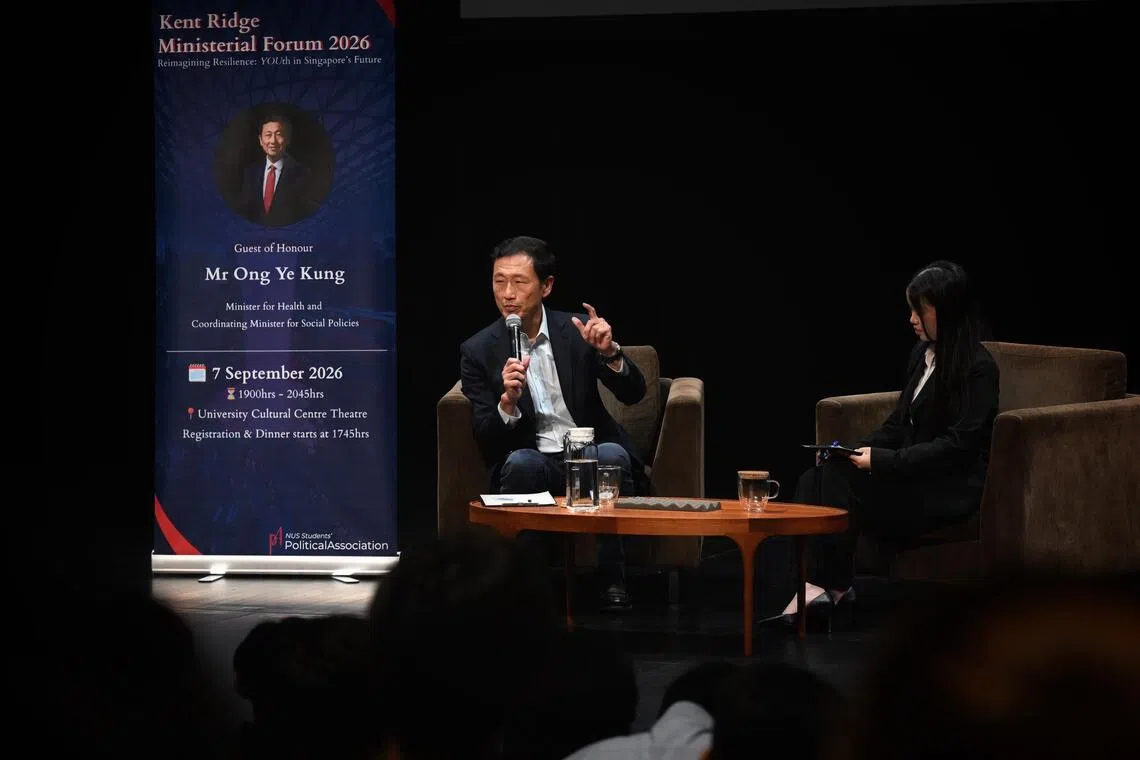
Minister for Health and Coordinating Minister for Social Policies Ong Ye Kung speaking during the dialogue session at the Kent Ridge Ministerial Forum on Sept 7, 2026.
ST PHOTO: CHONG JUN LIANG
Published Sep 07, 2026, 09:00 PM
Updated Sep 07, 2026, 09:00 PM
SINGAPORE — Graduates can remain confident that Singapore is still competitive and creating jobs, Coordinating Minister for Social Policies Ong Ye Kung said on Sept 7.
Addressing an audience of about 250 students, he also acknowledged a tighter graduate job market and greater job-search anxiety.
He said: “You are not entering a declining or stagnant economy. You are entering one that is growing, that’s attracting investments, and that’s still dynamic.
“So you are not cooked. You’re still raw.”
He was speaking at the Kent Ridge Ministerial Forum at NUS’ University Cultural Centre, where he laid out his assessment of the changes to the job market and advised students on how to maximise their chances of succeeding in their careers.
He also called on employers to cool an “arms race” over grades and internships and prevent hiring from becoming an ever-escalating competition.
Pointing out that the way they hire ultimately shapes the arms race’s intensity, he said: “We are not asking employers to lower their hiring standards.
“But every additional signal that employers send – hiring candidates with more internships, more credentials, better grades – becomes something that students feel you must chase to curate the perfect CV.”
Ong urged employers to look beyond GPAs and internships when assessing fresh graduates, whose experiences may not fit neatly into a conventional CV, but can demonstrate their resilience, initiative, discipline, empathy, character and work ethic.
Hiring a fresh graduate is “always about spotting potential and taking a chance in a young person”, he said.
“Help assure applicants that this is how you hire, and cool down an arms race that is energy-sapping, and I think making the undergraduate experience less holistic for young people at a critical formative age,” he added.
Ong’s remarks come as the proportion of graduates who secured employment six months after graduation declined from 92.9 per cent in 2023 to 88.9 per cent in 2025, according to Graduate Employment Survey data.
He attributed the tighter graduate job market to three factors: more graduates entering the market, employers needing to differentiate between applicants, and higher expectations of new hires.
Pointing out that about one in two students in a cohort today is a university graduate, compared with about one in five when he graduated in the early 1990s, Ong said with more graduates, a degree remains valuable but distinguishes candidates less than before.
Employers have therefore also been selecting applicants through internships, alongside academic results.
This has created a “self-reinforcing loop” in which employers tighten their hiring criteria, graduates do more to meet those criteria, and employers then need to further differentiate between applicants, he said.
‘Broken career ladder’ affecting some new hires
AI is another change affecting the job market. Ong said some organisations and industries are using AI to automate routine tasks that used to be handled by new hires, potentially raising the baseline expectations of them.
He described this as the “broken ladder syndrome”, where the career ladder remains but the first few rungs are missing and a new hire has to take a bigger step to start off at the third rung.
However, AI was not resulting in mass job displacement, said Ong. In most cases, he said, AI was replacing certain tasks rather than entire jobs, and was instead being used as a tool that could result in job redesign.
While it is natural for people to feel uncertain about a technology that is growing exponentially, AI could also compress the time taken for inventions and discoveries, potentially creating new economic activity and opportunities, said Ong.
Governments could also put in place guardrails, including reserving certain jobs for humans, while consumers may continue to demand a human touch in areas such as healthcare, education and services, he added.
“We want food prepared by human chefs. We want to watch live bands. We want songs written by the real Taylor Swift,” he said. “We want to watch films featuring human actors and real-world imagery like Top Gun: Maverick – that one has no AI at all.”
Ong said graduates can nevertheless remain confident about their prospects, pointing to Singapore’s continued economic growth, investments and job creation.
Investments by firms like Micron, Roche, GSK, Sanofi and Google, as well as the expansion of financial institutions and both integrated resorts are signs that companies continue to base important functions in Singapore, he added.
Major local companies including DBS, Keppel, Sembcorp and ST Engineering are also expanding their businesses and hiring new graduates, he said.
But he said graduates should not rely solely on the strength of the economy to navigate a tougher job market. Instead, they should focus on building mastery in an area they care about.
“A degree may open the door, but mastery of your craft will define you as a professional and become your biggest competitive edge,” he said.
In a world where AI takes over routine tasks and people are surrounded by AI-generated content, mastery is what sets people apart and will be more valuable than before, he added.
Ong then urged graduates to demonstrate their interest, passion and desire to pursue mastery when applying for jobs, rather than simply casting a wide net.
“There is a saying that you miss 100 per cent of the shots you do not take, so it is better to send out more CVs to increase your chances of hitting something,” he said. “There’s a certain logic I can understand, but remember this: employers are moving targets that can move faster than your shots.”
He added that employers can tell when a CV is mass-produced, even when it contains customised tweaks, and urged graduates to instead zero in on the industry, type of work and organisation that suits and interests them.
He also encouraged graduates to seriously consider accepting offers when they come along.
Learning and laying a career foundation matter most at the start of a career, he said.
“Your first job is a starting point, not a settling point.”
卫生部长兼社会政策统筹部长王乙康于2026年9月7日在肯特岗部长级论坛对话会上发表讲话。
《海峡时报》照片:梁崇俊
发布于2026年9月7日晚上9点
更新于2026年9月7日晚上9点
新加坡——社会政策统筹部长王乙康9月7日表示,毕业生们可以继续相信新加坡仍然具有竞争力,并且正在创造就业机会。
在对大约 250 名学生发表讲话时,他还承认毕业生就业市场更加紧张,求职焦虑情绪也更加严重。
他说:“你们进入的不是一个衰退或停滞的经济体,而是一个正在增长、吸引投资、仍然充满活力的经济体。”
“所以你还没熟,你还是生的。”
他在新加坡国立大学文化中心举行的肯特岗部长级论坛上发表讲话,阐述了他对就业市场变化的评估,并就如何最大限度地提高职业生涯的成功机会向学生提出了建议。
他还呼吁用人单位冷静下来,不要在成绩和实习经历方面展开“军备竞赛”,防止招聘变成一场不断升级的竞争。
他指出,他们的招聘方式最终决定了军备竞赛的激烈程度,并表示:“我们并不是要求雇主降低招聘标准。
“但是,雇主发出的每一个额外信号——例如,招聘拥有更多实习经历、更多资历、更好成绩的候选人——都会让学生们觉得,为了打造一份完美的简历,他们必须努力争取这些条件。”
Ong敦促雇主在评估应届毕业生时,不要只看GPA和实习经历,因为他们的经历可能无法完全体现在传统的简历中,但可以展现他们的韧性、主动性、自律性、同理心、品格和职业道德。
他说,雇用应届毕业生“始终关乎发现潜力,并给年轻人一个机会”。
“帮助应聘者确信这就是你们的招聘方式,并缓和这场消耗精力的军备竞赛,我认为这会让处于关键成长阶段的年轻人的本科学习经历变得不那么全面,”他补充道。
Ong发表上述言论之际,根据毕业生就业调查数据,毕业生在毕业六个月后找到工作的比例从2023年的92.9%下降到2025年的88.9%。
他将毕业生就业市场趋紧归因于三个因素:更多毕业生进入就业市场、雇主需要区分求职者以及对新员工的期望更高。
Ong指出,如今同届学生中约有二分之一拥有大学学历,而他上世纪90年代初毕业时,这一比例约为五分之一。他表示,虽然毕业生人数增多,但学位仍然很有价值,但对求职者的影响不如以前那么显著了。
因此,除了学术成绩外,雇主们也开始通过实习经历来选拔申请人。
他说,这就形成了一个“自我强化的循环”,雇主收紧招聘标准,毕业生更加努力地满足这些标准,而雇主又需要进一步区分申请人。
“职业发展阶梯断裂”影响部分新员工
人工智能是影响就业市场的另一项变革。翁表示,一些机构和行业正在利用人工智能来自动化处理过去由新员工负责的日常工作,这可能会提高人们对新员工的基本期望。
他将此描述为“断梯综合症”,即职业阶梯仍然存在,但最初的几级台阶缺失,新员工必须迈出更大的一步才能从第三级台阶开始。
翁表示,人工智能并没有导致大规模失业。他说,在大多数情况下,人工智能取代的是某些特定任务,而不是整个工作岗位,而是被用作一种可以促成工作岗位重新设计的工具。
Ong表示,虽然人们对呈指数级增长的技术感到不确定是很自然的,但人工智能也可以缩短发明和发现所需的时间,从而有可能创造新的经济活动和机会。
他还补充说,政府还可以制定一些保障措施,例如为人类保留某些工作岗位,而消费者可能继续要求在医疗保健、教育和服务等领域体现人性化关怀。
“我们想吃由真人厨师烹制的食物。我们想看现场乐队表演。我们想听泰勒·斯威夫特本人创作的歌曲,”他说。“我们想看由真人演员出演、采用真实世界画面的电影,比如《壮志凌云:独行侠》——这部电影完全没有人工智能。”
王先生表示,毕业生们仍然可以对自己的前景充满信心,他指出新加坡经济持续增长,投资不断,就业机会不断增加。
他补充说,美光、罗氏、葛兰素史克、赛诺菲和谷歌等公司的投资,以及金融机构和综合度假村的扩张,都表明企业继续在新加坡设立重要职能部门。
他还表示,包括星展银行、吉宝集团、胜科集团和新科工程在内的多家本地大型企业也在拓展业务并招聘应届毕业生。
但他表示,毕业生不应仅仅依靠经济的强劲势头来应对日益严峻的就业市场。相反,他们应该专注于在自己感兴趣的领域精益求精。
“学位或许能为你打开一扇门,但精湛的技艺才能真正定义你,让你成为一名专业人士,并成为你最大的竞争优势,”他说。
他补充说,在人工智能接管日常任务、人们被人工智能生成的内容包围的世界里,精通技术才能使人脱颖而出,并且比以往更有价值。
Ong 随后敦促毕业生在申请工作时要展现出他们的兴趣、热情和追求精通的愿望,而不是简单地广撒网。
“俗话说,不尝试就永远不会成功,所以多投简历才能增加成功的几率,”他说。“这其中的道理我能理解,但记住一点:雇主就像移动的靶子,他们的移动速度比你的投篮速度快得多。”
他还补充说,即使简历中包含个性化的修改,雇主也能分辨出哪些是批量生产的,并敦促毕业生们应该专注于适合自己和自己感兴趣的行业、工作类型和组织。
他还鼓励毕业生认真考虑接受工作机会。
他表示,在职业生涯的初期,学习和打好职业基础最为重要。
“你的第一份工作是一个起点,而不是终点。”