A new identity for a changing world适应变化的世界的新身份
AS THE world confronts accelerating technological change, environmental challenges and increasingly complex global uncertainties, higher education must evolve to prepare graduates not only for today's opportunities, but also for the challenges and possibilities of tomorrow.
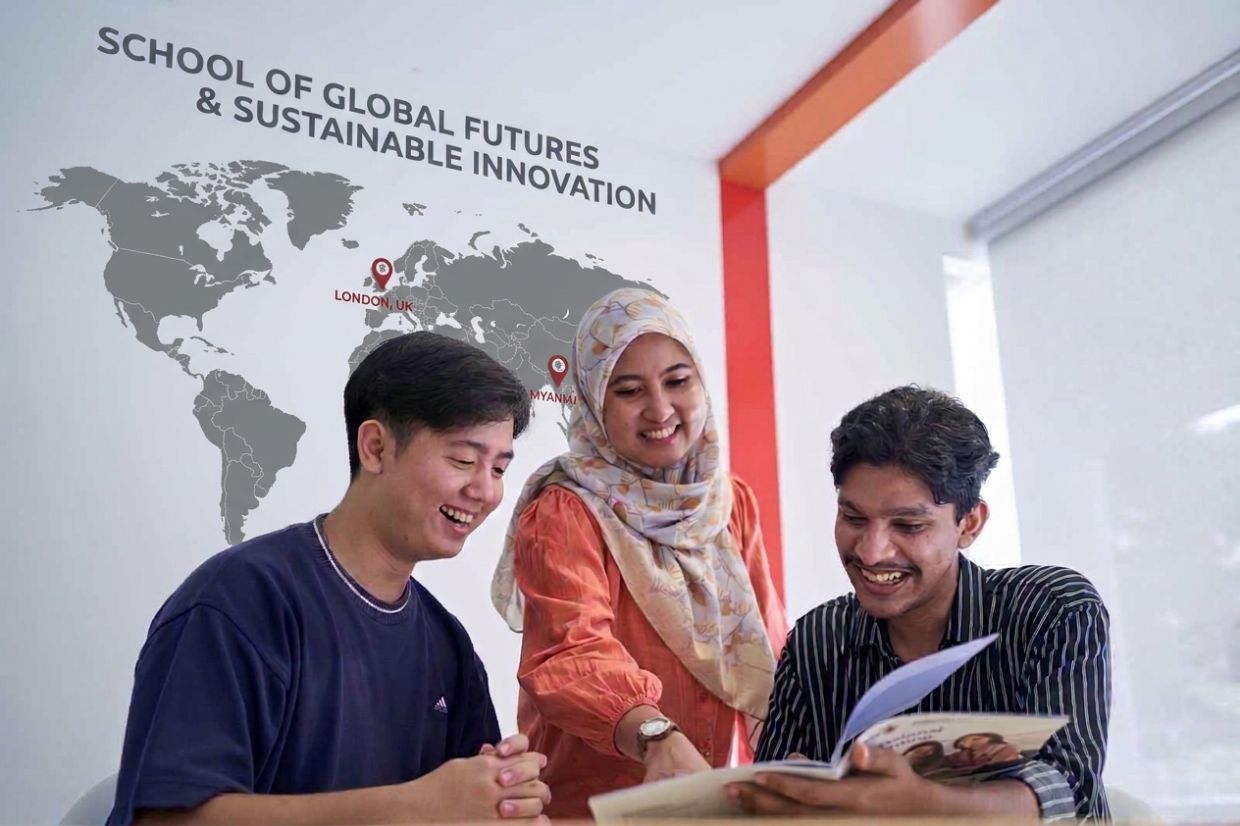
Sunway University’s School of Global Futures and Sustainable Innovation trains graduates to solve complex challenges through cross-disciplinary thinking.
AS THE world confronts accelerating technological change, environmental challenges and increasingly complex global uncertainties, higher education must evolve to prepare graduates not only for today's opportunities, but also for the challenges and possibilities of tomorrow.
Reflecting this imperative, Sunway University's School of American Education has been renamed the School of Global Futures and Sustainable Innovation, marking an evolution in its educational vision and ambitions.
Building on its established strengths in liberal arts education, interdisciplinary learning and international academic pathways, the newly renamed school seeks to place greater emphasis on future-focused thinking, sustainability, responsible innovation and global engagement.
The new identity reflects a commitment to developing graduates who can think across disciplinary boundaries, understand the interconnected nature of global challenges and contribute to creating more sustainable and inclusive futures.
School of Global Futures and Sustainable Innovation acting dean Assoc Prof Dr Woo Pei Jun
said the evolving nature of global challenges calls for an educational approach that moves beyond traditional disciplinary boundaries.
“The problems our graduates will face, from climate change to artificial intelligence (AI), do not sit within a single discipline.
“They involve technology, people, business and society all at once. We want students to be grounded in their own field but able to draw on others, work with different kinds of people and see the bigger picture,” she said.
Woo emphasised that the priority is to equip students with the confidence and practical skills to make a positive impact.
From the first year, students encounter areas such as sociology, intercultural communication, psychology, environmental studies and economics.
This approach helps students develop a deeper understanding of people, cultures and the wider world, regardless of their chosen field of study.
Through this learning experience, she explained, computer science students learn to consider how people use technology, business students become more aware of social and environmental issues, while communication students gain a better understanding of how economic and psychological factors influence people’s decisions.
True to its name, the school provides students with various opportunities to gain global exposure and broaden their international perspectives.
Through its partnership with Arizona State University (ASU), for example, students get access to free certification opportunities in areas such as innovation, sustainability and leadership, curated by the university.
These additional learning opportunities allow students to expand their knowledge, develop relevant skills and earn credentials alongside their degrees.
Students can also choose flexible study pathways, either completing their degrees at Sunway University in Malaysia or transferring to leading universities in the United States, Canada, Australia, New Zealand and other destinations worldwide.
The school offers students diverse opportunities to gain global exposure and broaden their international perspectives.
“Ultimately, we want our students to graduate not only with a degree, but with broader perspectives, practical experiences and the confidence to contribute meaningfully wherever their careers take them,” she said.
This educational philosophy is reflected in the range of programmes offered at the school, such as the Bachelor of Arts (Honors) Global Management, Bachelor of Science (Honors) Computer Science (Artificial Intelligence) and the American Degree Transfer Program.
Beyond these programmes, students also benefit from the university’s wider academic and research ecosystem, such as the Jeffrey Sachs Center on Sustainable Development, the Sunway Centre for Planetary Health and the Future Cities Research Institute.
Woo emphasised the importance of producing graduates who possess strong subject knowledge without being confined by disciplinary boundaries.
“We want students to get used to looking at an issue from several angles and working with people who bring different expertise to the table.”
Looking ahead, the school aims to build on its existing approach to education to introduce more opportunities for international learning, sustainability initiatives, future-focused electives, microcredentials and closer industry collaboration.
It is exploring areas such as AI, digital society, future cities, systems thinking, environment, social and governance (ESG), leadership and sustainable business innovation.
“We want students to have more opportunities to combine different interests and shape a learning journey that makes sense for them.”
Woo hopes that students leave curious, resilient and willing to work with people from different backgrounds and disciplines.
“They should feel confident asking questions, listening carefully and making responsible decisions, especially when there isn't one obvious answer,” she said.
“Above all, we want them to have the confidence and the practical ability to make a positive difference.”
For more information, visit the school’s website .
Thank you for your report!
Bridging dreams through digital chalkboards
Taking the fuss out of wash day
The vision that made space for Malaysian art
双威大学全球未来与可持续创新学院培养毕业生运用跨学科思维解决复杂挑战。
随着世界面临加速的技术变革、环境挑战和日益复杂的全球不确定性,高等教育必须与时俱进,不仅要让毕业生为当今的机遇做好准备,还要为未来的挑战和可能性做好准备。
为了体现这一迫切需求,双威大学美国教育学院更名为全球未来与可持续创新学院,标志着其教育愿景和抱负的演变。
更名后的这所学校以其在博雅教育、跨学科学习和国际学术途径方面的既有优势为基础,力求更加注重面向未来的思维、可持续性、负责任的创新和全球参与。
新形象体现了学校致力于培养能够跨越学科界限思考、理解全球挑战相互关联性并为创造更可持续、更包容的未来做出贡献的毕业生的承诺。
全球未来与可持续创新学院代理院长胡培俊副教授
他表示,全球挑战的不断演变要求教育方法超越传统的学科界限。
“从气候变化到人工智能(AI),我们的毕业生将面临的问题并不局限于单一学科。
“它们同时涉及技术、人、商业和社会。我们希望学生不仅精通自己的领域,还能借鉴其他领域的知识,与不同类型的人合作,并能看到更广阔的图景,”她说。
伍强调,首要任务是让学生拥有自信和实用技能,从而产生积极的影响。
从大一开始,学生们就会接触到社会学、跨文化交流、心理学、环境研究和经济学等领域。
无论学生选择哪个学习领域,这种方法都能帮助他们更深入地了解人、文化和更广阔的世界。
她解释说,通过这种学习经历,计算机科学专业的学生学会思考人们如何使用技术,商科学生更加意识到社会和环境问题,而传播学专业的学生则更好地理解经济和心理因素如何影响人们的决策。
正如其名,这所学校为学生提供了各种机会,让他们接触全球事务,拓宽国际视野。
例如,通过与亚利桑那州立大学 (ASU) 的合作,学生可以获得由该大学策划的创新、可持续发展和领导力等领域的免费认证机会。
这些额外的学习机会使学生能够拓展知识、培养相关技能,并在获得学位的同时获得证书。
学生还可以选择灵活的学习途径,既可以在马来西亚双威大学完成学位,也可以转学到美国、加拿大、澳大利亚、新西兰和世界其他地区的顶尖大学。
学校为学生提供各种机会,让他们接触全球事务,拓宽国际视野。
“最终,我们希望我们的学生毕业时不仅能获得学位,还能拥有更广阔的视野、实践经验以及自信,无论他们的职业生涯将他们带向何方,都能做出有意义的贡献,”她说。
这种教育理念体现在该校提供的各种课程中,例如文学学士(荣誉)全球管理、理学学士(荣誉)计算机科学(人工智能)和美国学位转学课程。
除了这些课程之外,学生们还可以受益于大学更广泛的学术和研究生态系统,例如杰弗里·萨克斯可持续发展中心、双威行星健康中心和未来城市研究所。
伍强调,培养具备扎实学科知识而不受学科界限限制的毕业生至关重要。
“我们希望学生们习惯于从多个角度看待问题,并与拥有不同专业知识的人合作。”
展望未来,该校计划在其现有教育方法的基础上,引入更多国际学习机会、可持续发展举措、面向未来的选修课、微证书以及更紧密的行业合作。
它正在探索人工智能、数字社会、未来城市、系统思维、环境、社会和治理 (ESG)、领导力和可持续商业创新等领域。
“我们希望学生有更多机会将不同的兴趣结合起来,并塑造适合自己的学习历程。”
伍老师希望学生们毕业后能保持好奇心、韧性,并乐于与来自不同背景和学科的人们合作。
“他们应该有信心提出问题、认真倾听并做出负责任的决定,尤其是在没有一个显而易见的答案时,”她说。
“最重要的是,我们希望他们有信心和实际能力去做出积极的改变。”
欲了解更多信息,请访问学校网站。
感谢您的报告!
通过数字黑板连接梦想
让洗衣日不再繁琐
为马来西亚艺术开辟空间的愿景