The Navy’s Secretive And Revolutionary Program To Project False Fleets From Drone Swarms海军秘密而革命性的无人机集群伪装舰队计划
The advanced electronic warfare program uses swarms in the air and sea to cooperatively fool a wide variety of sensors dispersed over a large area.
Updated Dec 1, 2019 6:05 AM EST
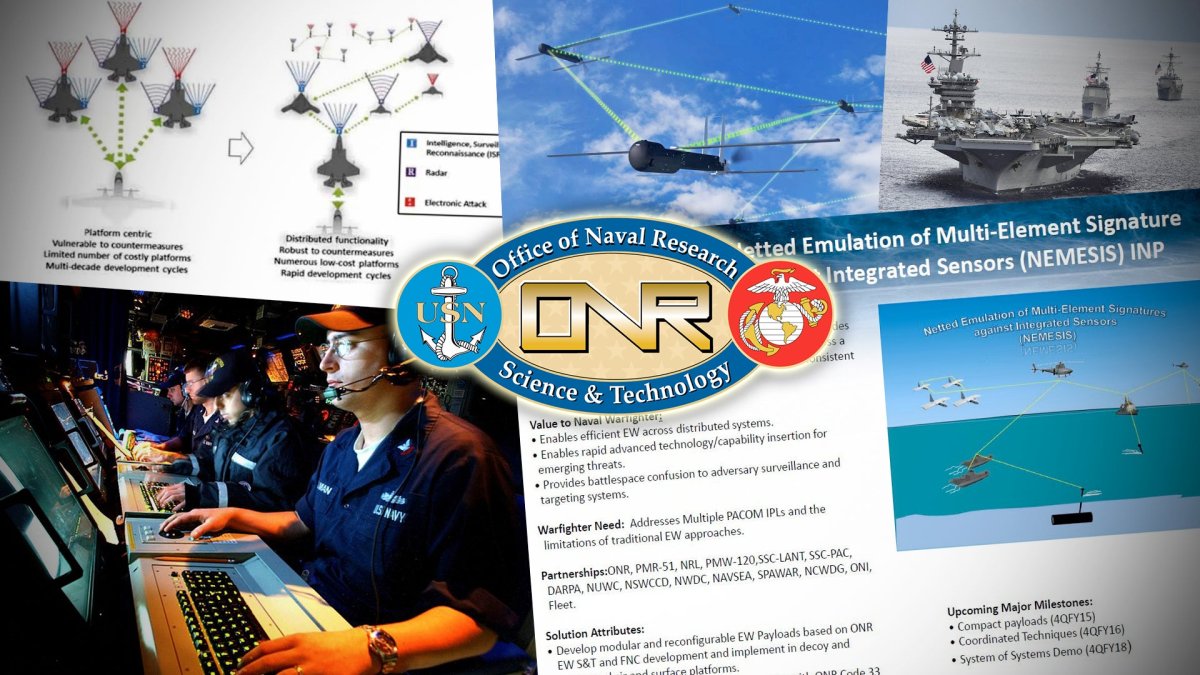
The U.S. Navy has been quietly developing what could be one of the most important, transformative, and fascinating advances in naval combat, and warfare in general, in years. This new electronic warfare “system of systems” has been clandestinely refined over the last five years and judging from the Navy’s own budgetary documents, it may be operational soon, if it isn’t already. This secretive new electronic warfare “ecosystem” is known as Netted Emulation of Multi-Element Signature against Integrated Sensors, or NEMESIS.
NEMESIS is not just some ‘paper program.’ From publicly available, but obscure documents we’ve collected, it’s clear that, for years, the Navy has been developing and integrating multiple types of unmanned vehicles, shipboard and submarine systems, countermeasures and electronic warfare payloads, and communication technologies to give it the ability to project what is, in essence, phantom fleets of aircraft, ships, and submarines. These realistic-looking false signatures and decoys have the ability to appear seamlessly across disparate and geographically separated enemy sensor systems located both above and below the ocean’s surface. As a result, this networked and cooperative electronic warfare concept brings an unprecedented level of guileful fidelity to the fight. It’s not just about disrupting the enemy’s capabilities or confusing them at a command and control level, but also about making their sensors tell them the same falsehoods across large swathes of the battlespace.
Another way of looking at it is NEMESIS shifts from traditional electronic warfare tactics, in which multiple electronic warfare systems execute individual electronic attacks on multiple enemy sensors to achieve largely individual or localized effects, to a very diverse set of networked electronic warfare systems cooperatively making electronic attacks on huge portions of an enemy’s sensor network. That network may stretch across large distances and multiple warfighting domains. In doing so, it achieves a cohesive set of far more unified, powerful, and convincing effects.
It sounds like science fiction, but it is anything but—it’s the next quantum leap in the quiet, but ferocious struggle to control the invisible domain of electronic warfare.
Electronic warfare (EW) has become an essential part of military strategy over the better part of the last century. This has only become more pronounced in recent decades as military systems have increasingly migrated into the digital age.
NATO’s simplest definition of electronic warfare is as follows:
The purpose of EW is to deny the opponent the advantage of, and ensure friendly unimpeded access to the electromagnetic spectrum. EW can be applied from air, sea, land, and space, and target communication and radar systems. It involves the use of electromagnetic energy to provide improved understanding of the operational environment as well as to achieve specific effects on the modern battlefield.
Electronic warfare encompasses a huge variety of operations and tactics, such as disrupting enemy communications and preventing your own from being disrupted. Maybe the most well-known form of EW has to do with jamming enemy radar systems, but there are many forms of electronic warfare that don’t involve traditional jamming. These include detecting, spoofing, and distracting enemy sensor systems and denying them the opportunity to successfully target friendly forces to varying degrees.
Cyberwarfare tactics and the ability to actually disrupt enemy sensors, networks, and command and control systems at the software level are a highly critical emerging realm of warfare that in some cases can cross over and become blended with electronic warfare tactics. Even the use of directed energy weapons can be part of a force’s electronic warfare bag of tricks.
Although it is the least visible component of a present-day military’s order of battle and overall capabilities, and much of the details of exactly what capabilities exist and how they are realized remains in the shadows, electronic warfare is becoming one of the most important facets of modern warfare . As a result, future combat will occur just as much in this invisible spectrum as the visible one.
The Cold War Gave Birth To Modern Electronic Warfare
Electronic warfare, as we understand it today, is not new. The U.S. military has been deploying EW technologies that go beyond simple jamming since at least the mid-20th Century. Stealth technology would never have been so successful without electronic warfare backstopping it during combat operations. In fact, the only engagement in which an F-117 was ever shot down occurred on the only night of the aircraft’s use during Operation Allied Force when electronic warfare support was not available.
EW, at least how we understand it in modern, advanced terms, dates back much farther, to the height of the Cold War when the CIA launched the PALLADIUM project, which deployed radar spoofing systems and submarine-launched balloons carrying metallic radar reflectors in order to stimulate and probe Cuba’s Soviet-made air defenses. The effort was part of a grander objective to understand how vulnerable the A-12 Oxcart —the CIA’s progenitor of the SR-71 Blackbird and the first aircraft to integrate stealthy attributes as a driving factor in its design —would be to enemy air defenses. You can read all about this fascinating bit of history in this past piece of ours.
An A-12 Oxcart., Lockheed Martin
Considering that the CIA possessed the capability 65 years ago to clandestinely launch airborne radar reflectors from submarines and combine them with electronic warfare capabilities that could simulate or spoof the presence of American fighter aircraft on the most advanced Soviet radar systems of the era, it isn’t hard to use one’s imagination to ponder what is possible today. We know that EW capabilities have evolved drastically in step with advances in sensor, emitter, and computer processing technologies and the increasingly potent data networks that integrate and fuse their capabilities with other systems and platforms. NEMESIS is the next evolutionary leap in this regard, and a particularly huge one at that.
The U.S. Navy’s leadership has stated repeatedly that developing a major leap in EW capabilities has been a vital area of research over the last decade. On Oct. 29, 2013, then-Chief of Naval Operations (CNO) Admiral Jonathan Greenert, the service’s top officer, said as much when he spoke at a convention of the Association of Old Crows (AOC) .
At the conference, Greenert told attendees that the Navy was looking for ways to move away from traditional weaponry and turn instead more heavily towards electronic warfare and information warfare . “We’ve got to evolve this paradigm,” he said, adding that electronic warfare could essentially replace kinetic warfare in many situations:
“We’re using the electromagnetic spectrum as a domain and as a means, and we understand and grasp it. We have to figure out how we can beat things electronically first. Why do we spend all this money kinetically if we can jam, spoof, or do otherwise? We need to prepare the fleet to enact an electronic warfare plan the same way they think of a communications or surface warfare plan.”
In 2015, the National Interest published an op-ed titled “Winning the Airwaves: Sustaining America’s Advantage in the Electromagnetic Spectrum,” in which authors Bryan Clark and Mark Gunzinger wrote that America had failed to maintain its electromagnetic spectrum (EMS) superiority since the end of the Cold War. This failure had allowed “China, Russia and other rivals with an opportunity to field systems that target vulnerabilities in sensor and communication networks the U.S. military has come to depend on. As a result, America’s once significant military advantage in the EMS is eroding, and may in fact no longer exist,” they said.
The same authors produced a 2015 white paper for the Center for Strategic and Budgetary Assessments (CSBA) think tank detailing how America could regain EMS superiority , writing that the Department of Defense “now has the opportunity to develop new operational concepts and technologies that will allow it to ‘leap ahead’ of its competitors and create enduring advantages in EMS warfare.” The document lists NEMESIS as one such technology, but does not disclose any further details about the program.
Two years earlier, however, budget documents show that the Navy was beginning to develop a highly integrated constellation of next-generation systems for spoofing or fooling distributed sensors and the platforms that host them.
An electronic warfare development program known as Netted Emulation of Multi-Element Signature against Integrated Sensors or “NEMESIS” first emerged in Navy Research, Development, Test & Evaluation Budget Item Justification documents in the service’s budget proposal for the 2014 Fiscal Year, which it published in April 2013. In that and subsequent budget requests, NEMSIS appeared under the program elements “PE 0602271N / Electromagnetic Systems Applied Research” and “PE 0603271N / Electromagnetic Systems Advanced Technology.”
In these budget documents, the Navy describes NEMESIS as a “System of Systems (SoS) able to coordinate distributed EW resources against many adversary surveillance and targeting sensors simultaneously” which “will benefit the warfighter by providing platform protection across the battlespace against many sensors, creating seamless cross-domain countermeasure coordination, and enabling rapid advanced technology/capability insertion to counter emerging threats.”
More specifically, the Fiscal Year 2014 Electromagnetic Systems Applied Research RDT&E Budget Item Justification states that NEMESIS “addresses the need to generate the appearance of a realistic naval force to multiple adversarial surveillance and targeting sensors simultaneously.”
Later in that same document, a more detailed description of the program states that NEMESIS consists of “reconfigurable and modular EW payloads, Distributed Decoy and Jammer Swarms (DDJS), effective acoustic countermeasures (CM), and Multiple Input/Multiple Output Sensor/CM (MIMO S/CM) for false force generation to both above and below water sensors.”
The 2018 and 2019 budget justifications state that “Nemesis expendable decoys and prototype system hardware will be completed and delivered for field testing” and that demonstrations of these expendable decoys “will be conducted during fleet experimentation, as well as during focused field and laboratory tests.”
There is little publicly available information surrounding NEMESIS aside from these unclassified budgetary documents and a few publications and presentations that mention the program, usually to a very limited degree. Many specifics about the NEMESIS system remain unknown, but the documents help add context to the budget line item justifications we’ve presented above.
On April 9, 2014, Bob Smith, Director of Disruptive Technologies at the Office of Naval Research (ONR) gave a presentation at the National Defense Industrial Association’s 15th Annual Science and Engineering Technology Conference that described several innovative Navy prototype research programs, or INPs. A slide from the presentation offered a basic, but absolutely impressive overview of the NEMESIS program while of course stating “Additional details classified.”
The presentation stated that NEMESIS worked against distributed sensor systems in order to confuse or spoof an enemy force’s surveillance and targeting systems. That document also said that the NEMESIS system “enables rapid advanced technology/capability insertion for emerging threats”, meaning that NEMESIS could be quickly modified and upgraded to counter the latest capabilities that are still under development.
At the time, ONR said that NEMESIS addressed current limitations of traditional EW systems and multiple items on the United States Pacific Command (PACOM) Integrated Priority List (IPL), a list of the Pacific Command’s highest priorities for ensuring its forces are capable of accomplishing their missions.
According to the same ONR presentation, NEMESIS consisted of “modular and reconfigurable EW payloads” including “decoy and unmanned air and surface platforms” based on the ONR’s Science & Technology and Future Naval Capabilities programs. NEMESIS combined functionality and capabilities from Code 31 : Information, Cyber and Spectrum Superiority; Code 33 : Mission Capable, Persistent and Survivable Naval Platforms; and Code 35 : Aviation, Force Projection and Integrated Defense.
Shortly after that ONR presentation, the publicly available 2015 Navy Program Guide offered a definition of NEMESIS in its appendix, stating that NEMESIS could “synchronize electronic warfare (EW) affects across a variety of distributed platforms to create coherent and consistent EW effects” and that “NEMESIS emphasis is on the coordination and synchronization of EW capabilities and tactics against sensors in many scenarios.”
That same guide also stated that development of NEMESIS began in 2014 and was an interdisciplinary project involving well-known research centers, such as the Defense Advanced Research Projects Agency (DARPA) and ONR:
In 2013 the Navy approved NEMESIS as a FY 2014 INP New Start. Initial NEMESIS activity involved planning discussions among the Office of Naval Research, the Office of the Chief of Naval Operations, fleet commands and analysts, acquisition programs of record, government laboratories and warfare centers, the Defense Advanced Research Programs Agency, and federally funded research and development centers and university affiliated research centers. To ensure NEMESIS is addressing current and future threats to naval battle group operations, threat assessments were initiated with the Intelligence Community, and a Navy Warfare Development Command NEMESIS war game will be conducted in 2015.
In 2013 the Navy approved NEMESIS as a FY 2014 INP New Start. Initial NEMESIS activity involved planning discussions among the Office of Naval Research, the Office of the Chief of Naval Operations, fleet commands and analysts, acquisition programs of record, government laboratories and warfare centers, the Defense Advanced Research Programs Agency, and federally funded research and development centers and university affiliated research centers.
To ensure NEMESIS is addressing current and future threats to naval battle group operations, threat assessments were initiated with the Intelligence Community, and a Navy Warfare Development Command NEMESIS war game will be conducted in 2015.
On Feb. 4, 2015, Dr. Thomas Killion, then-Director of Technology at the Office of Naval Research, gave a presentation at the ONR Naval Future Force Science and Technology Expo. In that presentation, NEMESIS is listed as a current Innovative Naval Prototype (INP) program alongside some of the Navy’s most important leading-edge weapons development initiatives, including the Electromagnetic Railgun , the Large Displacement Unmanned Underwater Vehicle , the Integrated Topside information operations and communications suite, and the Autonomous Aerial Cargo Unmanned System .
The Navy’s 2015 Program Guide also mentions that the Navy conducted a war game in 2015 to test the NEMESIS system. Another budget document, the 2017 RDT&E Project Justification document for the Navy’s “Space and Electronic Warfare (SEW) Architecture/Engineering Support” program, states that this war game took place in late February 2015:
NEMESIS War Game : This Office of Naval Research (ONR) sponsored war game was conducted by NWDC and completed 23-26 Feb 2015. The primary purpose of the war game was to obtain fleet stakeholder input into the requirements for and design of a classified ONR Innovative Naval Prototype. The results of this effort will be used to design prototypes that could eventually be fielded as a Navy program of record.
That document also states that the NEMESIS war game which took place in 2015 “consisted of multiple events designed to explore innovative concepts and technologies associated with EMW”, or electromagnetic warfare, and “obtain fleet stakeholder input into the requirements for and design of a classified ONR Innovative Naval Prototype.” The descriptions of this war game appear to describe a seminar or “tabletop” exercise designed to formulate initial ideas for developing such a system, but exact details of the war game remain unknown.
The 2017 Navy Program Guide states that dedicated hardware for NEMESIS was developed in 2016 and that NEMESIS was expected to be demonstrated at full capability in late 2018:
NEMESIS has been in development since 2014, including close collaboration with the Office of Naval Research, the Office of the Chief of Naval Operations, fleet commands and analysts, acquisition programs of record, government laboratories and warfare centers, the Defense Advanced Research Programs Agency, and federally funded research and development centers and university-affiliated research centers. During 2016, NEMESIS capabilities began hardware development, technique and software migration and field testing at the sub-system level. In FY 2017-2018 flight and at-sea testing will be conducted on integrated system level capabilities in preparation for graduation demonstrations in late FY 2018.
The guide goes on to list the NEMESIS system’s developers: Georgia Tech Research Institute, Johns Hopkins’ Applied Physics Lab, Massachusetts Institute of Technology’s (MIT) Lincoln Lab, the Naval Undersea Warfare Center, the Office of Naval Research, and the Space and Naval Warfare Systems Command. The Navy just recently rebranded Space and Naval Warfare Systems Command as the Naval Information Warfare Systems Command.
While the exact components of the NEMESIS system remain unknown, there are some hints about what types of decoys and swarms could make up such a system. In a 2017 Center for Strategic and Budgetary Assessments (CSBA) white paper titled “ Winning in the Gray Zone : Using Electromagnetic Warfare to Regain Escalation Dominance,” authors Bryan Clark, Mark Gunzinger, and Jesse Sloman described the various elements that made up EW ecosystems then in development, such as NEMESIS and DARPA’s System of System Integration Technology and Experimentation (SoSITE).
The document described swarms of expendable unmanned aerial systems that “incorporate cognitive processing and coordinate their actions through communication networks,” meaning they can share data in real-time and operate semi-autonomously to jam an adversary’s sensors, act as or release decoys, gather targeting information, and detect and map air defense networks.
A DARPA SoSITE concept graphic of networked expendables, showing what appear to be small unmanned systems similar to the Nomad rotor-propelled drone , larger unmanned combat air vehicles reminiscent of the Northrop Grumman X-47B , and another unknown small UAV flying in concert with an F-35 Joint Strike Fighter and an E-2 Hawkeye ., DARPA/CSBA
Launching waves of these UAVs could extend U.S. forces’ sensor networks, confuse or obscure enemy defenses, provide a resilient communications network, coordinate and assign targets for weapons salvos, and even “provide targets to hypersonic weapons that have a very short time-of-flight,” the paper explained.
Aside from providing fire and communications support, the NEMESIS system was said to be capable of creating viable false targets that would “increase the number of potential targets” an adversary would have to engage. These false targets would “mimic the RF emissions and radar returns of real platforms” and include infrared decoys and “concepts and capabilities to simulate the computer network activity of deployed forces.” The NEMESIS system even included underwater “high-fidelity acoustic decoys” which can generate “additional targets for the enemy to investigate or attack,” according to the CSBA white paper. These acoustic decoys could include radio emulators and simulate propeller noise or other propulsion systems, as well as specific equipment on surface ships and submarines.
The CSBA said these decoys could increase the size of the forces or amount of munitions an enemy force would have to respond with, ideally making that adversary less willing to risk a larger use of its assets. What that means is that this EW system can not only disrupt an adversary’s tactics, but to some extent also dictate his battlefield decision-making.
The CSBA report described how these effects could be achieved using small unmanned EW systems launched from either high altitude balloons or undersea platforms, such as submarines or unmanned underwater vehicles (UUVs) to create these electronic warfare effects:
Launching EMW expendables at higher altitudes is another approach to extending their ranges and endurance. Launching small EMW UAVs, missiles, or munitions from very high altitude (60,000 to 120,000 feet) balloons could be a less expensive option than using a missile. High altitude balloon technologies are very mature and may cost significantly less than other delivery methods. Furthermore, defeating balloon-delivered EMW expendables would likely require SAMs that can reach very high altitudes. Using these expensive SAMs to defeat large numbers of balloons—some which might be decoys—could be costly and operationally impractical for aggressors. Another innovative delivery method for EMW expendables could be from undersea platforms, which may be the best use of undersea payload capacity in general. […] Undersea platforms could be one of the most effective methods to deliver EMW expendables because they can closely approach enemy coastlines and targets. This allows shorter-range expendables to be employed, which are less expensive, smaller, and can be carried in higher numbers than larger payloads like cruise missiles.
Launching EMW expendables at higher altitudes is another approach to extending their ranges and endurance. Launching small EMW UAVs, missiles, or munitions from very high altitude (60,000 to 120,000 feet) balloons could be a less expensive option than using a missile. High altitude balloon technologies are very mature and may cost significantly less than other delivery methods. Furthermore, defeating balloon-delivered EMW expendables would likely require SAMs that can reach very high altitudes. Using these expensive SAMs to defeat large numbers of balloons—some which might be decoys—could be costly and operationally impractical for aggressors.
Another innovative delivery method for EMW expendables could be from undersea platforms, which may be the best use of undersea payload capacity in general. […] Undersea platforms could be one of the most effective methods to deliver EMW expendables because they can closely approach enemy coastlines and targets. This allows shorter-range expendables to be employed, which are less expensive, smaller, and can be carried in higher numbers than larger payloads like cruise missiles.
Numerous sea and submarine-launched UAVs and autonomous swarm systems have already been developed or are in development. Small drone swarms can also be launched from virtually any type of ship and from shore, and even aircraft, as well. In fact, the Navy already has a swarming electronic warfare capability in the form of the ever-evolving Miniature Air Launched Decoy (MALD) . But pairing various platforms, from radar reflector and electronic warfare payload-carrying balloons and swarms of drones of different sizes and performance capabilities, and networking them together to work cooperatively to confuse, spoof, and/or blind enemy sensors dispersed over a wide area is clearly what this system is all about.
The Office of Naval Research has been testing a small, low-cost rotary-wing drone known as Nomad , described as “a highly affordable expendable design” that can be deployed without the need to ensure it returns to its parent vessel. The Nomad can be launched from tubes using a CO2 ejection system that can fit on a variety of platforms and tests of this compact UAV have found that “multiple Nomads can safely operate in the same airspace and fly in a coordinated fashion.”
Nomad undergoing testing., USN
One of the only non-Navy mentions of the NEMESIS program found online is in a NavalDrones.com article from 2017, which describes the Nomad specifically as being part of the NEMESIS system. While that claim is unconfirmed on an official level, the Naval Research Laboratory has publicly disclosed tests of the Nomad system without mentioning NEMESIS. Still, given that many of the NEMESIS documents state that “Distributed Decoy and Jammer Swarms (DDJS)” are an integral part of the system, it’s possible, if not probable, that Nomad and swarms of other small drones are part of this highly sophisticated and networked electronic warfare capability.
The 2017 CSBA paper also cites a wide range of other unmanned systems that could hypothetically be integrated into the NEMESIS system, although it remains unknown which specific expendables are used:
Small expendables in development or use today include the Switchblade precision missile, which is in use with Special Operations Forces; small UAVs such as the Coyote UAV, used in the Navy’s Low-Cost UAV Swarming Technology (LOCUST) program; and loitering munitions like the Lockheed Martin Fire Shadow. Expendables have also been integrated with launch platforms. The Navy is developing a submarine-launched version of the Blackwing UAV, which is similar to the Switchblade. Furthermore, the U.S. Air Force has deployed the Miniature Air-Launched Decoy (MALD) since the 1990s.
The aforementioned LOCUST would be one of the most obvious platforms to execute major parts of the NEMESIS concept. The Navy has been experimenting with this highly deployable swarming drone capability for years and the airframes are highly adaptable and can be launched from almost anywhere.
Lockheed Martin has been also developing small unmanned aerial vehicles such as the tiny Outrider micro-aircraft , which can be launched from canisters that fit inside submarine missile tubes. The Naval Research Laboratory has tested all-electric folding wing drones designed to launch from torpedo tubes using existing launch systems. Glimpses of other similar systems in development have been offered over the last few years, including ones designed to carry infrared and electro-optical payloads .
Northrop Grumman has tested electronic warfare drones dropped from EA-18G Growlers inside canister deployment systems and air-launched electronic warfare enabled swarming munitions are set to become a major staple of aerial warfare.
Earlier this year, the Office of Naval Research issued a special notice for a research opportunity to develop a “Long Endurance Advanced Off-board Electronic Warfare Platform,” or LEAP. This program was listed under two of the same codes as NEMESIS, ONR Code 35: Aerodynamics, Autonomy, Flight Dynamics & Control, as well as Code 31: Electronic Warfare. The proposed vehicle design to be researched was for a ship-launched, long-range expendable decoy that can carry modular EW payloads.
Swarms of small unmanned surface vessels and even undersea vessels seem to fulfill aspects of NEMESIS’ cross-domain capability as well. But leveraging swarms of smaller and somewhat expendable aerial drones and munitions that can work in conjunction with larger, less numerous, and more advanced platforms allows the NEMESIS concept to cover large geographical areas associated with modern naval combat and to distribute EW capabilities in a more resilient and decentralized manner than in the past. In doing so, it also allows for these swarms and the various dissimilar nodes that can make up the NEMESIS system at any given time to create fleets of ships and aircraft that aren’t really there across a huge area as well as execute more mundane tasks, such as jamming individual enemy emitters or working as sacrificial decoys for enemy weapons themselves.
All of this could, and eventually will, also be networked with existing, more traditional electronic warfare systems such as those mounted on the Navy’s surface combatants. In particular, this could be networked with the SLQ-32 SEWIP and the new and shadowy SLQ-59 that has recently arrived on some of the Navy’s vessels. The Navy’s EA-18G Growler could also act as a major component in this EW ecosystem and as a forward command and control node.
It’s also worth remembering that NEMESIS, or at least parts of it, would also be an incredible and obvious intelligence collecting tool when it comes to probing and evaluating an enemy’s defenses and recording its electronic order of battle. This could be done even in peacetime, very much in the same vein of PALLADIUM so many years ago, but on a much larger and more elaborate scale.
Evolution Of A Revolution
In Fiscal Year 2015, the NEMESIS program expanded beyond the Navy’s PE 0602271N / Electromagnetic Systems Applied Research program and began appearing in the budget line justification documents of several additional programs in subsequent fiscal years. During the next fiscal cycle, the Navy’s Electromagnetic Systems Applied Research program continued to work on NEMESIS as it had in prior years. Then, in Fiscal Year 2017, the program’s budget increased significantly “due to hardware procurement and conducting field experiments of NEMESIS technologies.”
The Fiscal Year 2017 RDT&E Project Justification for the NEMESIS work conducted by Navy program PE 0603271N / Electromagnetic Systems Advanced Technology states that Fiscal Years 2017 and 2018 are dedicated to “the integration and demonstration of these new technologies”.
In Fiscal Year 2018, NEMESIS appeared on two new Navy research program elements titled “PE 0602792N / (U)Innovative Naval Prototypes(INP) Applied Research” and “PE 0603801N / (U) Innovative Naval Prototypes (INP) Advanced Technology Development.” Those programs’ goals for that fiscal cycle, respectively, were:
PE 0602792N / (U)Innovative Naval Prototypes(INP) Applied Research : Complete the Nemesis project by finishing research efforts to develop and mature technologies in multiple areas that will be used to assess the feasibility of Nemesis to coordinate Electronic Warfare (EW) operations across distributed EW systems. Technologies being matured include swarming vehicle operations, distributed resource mission control, multi-domain coordinated operations and advanced RF component and subsystems technologies. These emerging technologies are being designed and developed for prototype Nemesis systems which will be capable of performing coordinated EW operations across distributed EW systems. PE 0603801N / (U) Innovative Naval Prototypes (INP) Advanced Technology Development : Complete the Nemesis project, previously funded in 0603271N Electromagnetic Systems Advanced Technology Development, by designing and building prototype Nemesis payloads that implement industry standards for software, hardware, and firmware interfaces. Nemesis expendable decoys and prototype system hardware will be completed and delivered for field testing. Demonstrations of Nemesis platforms and payload will be conducted during fleet experimentation, as well as during focused field and laboratory tests.
PE 0602792N / (U)Innovative Naval Prototypes(INP) Applied Research : Complete the Nemesis project by finishing research efforts to develop and mature technologies in multiple areas that will be used to assess the feasibility of Nemesis to coordinate Electronic Warfare (EW) operations across distributed EW systems. Technologies being matured include swarming vehicle operations, distributed resource mission control, multi-domain coordinated operations and advanced RF component and subsystems technologies. These emerging technologies are being designed and developed for prototype Nemesis systems which will be capable of performing coordinated EW operations across distributed EW systems.
PE 0603801N / (U) Innovative Naval Prototypes (INP) Advanced Technology Development : Complete the Nemesis project, previously funded in 0603271N Electromagnetic Systems Advanced Technology Development, by designing and building prototype Nemesis payloads that implement industry standards for software, hardware, and firmware interfaces. Nemesis expendable decoys and prototype system hardware will be completed and delivered for field testing. Demonstrations of Nemesis platforms and payload will be conducted during fleet experimentation, as well as during focused field and laboratory tests.
These budgetary documents state that the Innovative Naval Prototype programs “represent game-changing technologies with the potential to revolutionize operational concepts. They are disruptive in nature as they would dramatically change the way naval forces fight. INPs push the imagination of our nation’s technical talent to deliver transformational warfighting capabilities.”
In Fiscal Year 2019, funding continued to decrease in both the PE 0603271N / Electromagnetic Systems Advanced Technology and PE 0602271N / Electromagnetic Systems Applied Research programs due to the fact that the NEMESIS program was now being developed under the Innovative Naval Prototypes programs, suggesting it has advanced beyond research and development and is now working towards an operational state.
Electronic Warfare: The Next Generation
The very existence of NEMESIS proves that a revolution in electronic warfare is well underway. If the capabilities we’ve described can be gleaned from scant publicly available information, there are no doubts that more advanced NEMESIS components and capabilities remain classified. It is also likely that some components of the system have existed long before they began to be integrated with other platforms under the NEMESIS program. Above all else, that is what NEMESIS does: it pulls together various leading-edge EW concepts and networks them together for a combined electronic warfare fight the likes of which we have never seen before.
As more nations develop and refine their advanced integrated sensor networks, next-generation EW “systems of systems” such as NEMESIS will become more vital to protecting the U.S. and allied assets and for giving them a leg up by being able to directly manipulate what the enemy believes is occurring on the battlespace based on their own sensors’ data. As such, NEMESIS can help level the playing field against increasingly capable sensor networks, whether by blinding certain parts of those networks while spoofing others or by having the enemy fire its treasured weaponry at ghosts in the sea and in the air. Even a formation of what appears to be an incoming bomber force on radar and a puzzling group of bright signatures on infrared sensors could draw the enemy’s attention away from critical parts on a real offensive.
Yes, much of this sounds almost like magic, and it is probably the closest thing the military has to it, but going by even the limited information we were able to uncover about NEMESIS, it really does represent the evolutionary next great leap in electronic warfare—one that will elevate this murky art from a supporting aspect of military operations to a primary offensive and defensive one.
Tyler Rogoway contributed extensively to this feature.
Contact the editor: Tyler@thedrive.com
Comments couldn’t be loaded. Please refresh the page.
更新于美国东部时间2019年12月1日上午6:05
美国海军一直在悄悄研发一项可能成为近年来海军作战乃至整个战争领域最重要、最具变革性和最引人入胜的进步之一的技术。这套全新的电子战“系统之系统”在过去五年中经过秘密完善,根据海军自身的预算文件来看,它可能很快就会投入使用,甚至可能已经投入使用。这套神秘的新型电子战“生态系统”被称为“针对集成传感器的多元素特征网络化仿真”(Netted Emulation of Multi-Element Signature against Integrated Sensors,简称NEMESIS)。
“复仇女神”(NEMESIS)并非纸上谈兵。从我们收集到的公开但鲜为人知的文件来看,多年来,美国海军一直在研发和整合多种类型的无人飞行器、舰载和潜艇系统、对抗措施和电子战载荷以及通信技术,使其能够投射出本质上是“幽灵”的飞机、舰艇和潜艇舰队。这些逼真的虚假信号和诱饵能够无缝地出现在位于海面之上和海面之下、地理位置分散的敌方传感器系统中。因此,这种网络化和协同的电子战概念为战斗带来了前所未有的欺骗性逼真度。它不仅旨在干扰敌方作战能力或在指挥控制层面迷惑敌方,而且还旨在使敌方传感器在广阔的战场范围内发出相同的虚假信号。
换个角度来看,NEMESIS系统从传统的电子战战术——即多个电子战系统对敌方多个传感器进行单独的电子攻击,以达到局部或单一的效果——转变为由多个联网的电子战系统协同攻击敌方传感器网络的庞大部分。该网络可能跨越广阔的距离和多个作战区域。如此一来,NEMESIS系统便能实现更加统一、强大且更具说服力的协同作战效果。
这听起来像是科幻小说,但实际上却并非如此——这是在悄无声息却又异常激烈的电子战领域控制权争夺战中的又一次量子飞跃。
在过去近一个世纪的大部分时间里,电子战已成为军事战略的重要组成部分。随着军事系统日益向数字化时代转型,近几十年来,这一趋势愈发明显。
北约对电子战最简单的定义如下:
电子战的目的是剥夺敌方对电磁频谱的优势,并确保己方畅通无阻地使用电磁频谱。电子战可应用于空中、海上、陆地和太空,并可针对通信和雷达系统实施。它利用电磁能来增强对作战环境的了解,并在现代战场上取得特定效果。
电子战涵盖了种类繁多的作战行动和战术,例如干扰敌方通信以及防止己方通信受到干扰。或许最广为人知的电子战形式是干扰敌方雷达系统,但还有许多电子战形式并不涉及传统的干扰手段。这些形式包括探测、欺骗和干扰敌方传感器系统,从而在不同程度上阻止其成功攻击友军。
网络战战术以及在软件层面实际破坏敌方传感器、网络和指挥控制系统的能力,是战争领域一个至关重要的新兴领域,在某些情况下,它会与电子战战术交叉融合。甚至定向能武器的使用也可以成为部队电子战战术的一部分。
尽管电子战是现代军队作战序列和整体能力中最不显眼的组成部分,而且其具体能力及其实现方式的许多细节仍处于隐秘状态,但它正成为现代战争最重要的方面之一。因此,未来的战争不仅会在可见的领域发生,也会在不可见的领域发生。
冷战催生了现代电子战
我们今天所理解的电子战并非新生事物。早在20世纪中期,美军就开始部署超越简单干扰的电子战技术。如果没有电子战在作战行动中的支援,隐形技术绝不可能取得如此巨大的成功。事实上,F-117战斗机唯一一次被击落的战斗,就发生在“盟军行动”期间该机唯一一次出击的夜晚,而那晚电子战支援却无法使用。
电子战,至少就我们现代先进的理解而言,其历史可以追溯到更久远的冷战高峰时期。当时,中央情报局启动了“钯计划”(PALLADIUM project),部署了雷达欺骗系统和潜射气球,这些气球携带金属雷达反射器,旨在干扰和探测古巴的苏联制造的防空系统。这项行动是更宏大目标的一部分,旨在了解A-12“牛车”(Oxcart)——中央情报局SR-71“黑鸟”的原型机,也是第一款将隐身性能作为设计核心的飞机——在敌方防空系统面前的脆弱程度。您可以在我们之前的文章中了解这段引人入胜的历史。
一架A-12“牛车”攻击机,洛克希德·马丁公司
考虑到65年前中央情报局就具备从潜艇上秘密发射机载雷达反射器并将其与电子战能力相结合的能力,从而能够模拟或欺骗当时最先进的苏联雷达系统,我们不难想象如今的可能性。我们知道,随着传感器、发射器和计算机处理技术的进步,以及日益强大的数据网络将这些能力与其他系统和平台整合融合,电子战能力也得到了飞速发展。“复仇女神”(NEMESIS)系统正是这方面的又一次飞跃,而且是一次意义非凡的飞跃。
美国海军领导层曾多次表示,在过去十年中,大幅提升电子战能力一直是重要的研究领域。2013年10月29日,时任海军作战部长乔纳森·格林纳特海军上将(海军最高指挥官)在老乌鸦协会(AOC)的一次大会上发表讲话时也表达了同样的观点。
在会议上,格林纳特告诉与会者,海军正在寻求摆脱传统武器,转而更加重视电子战和信息战的方法。“我们必须改变这种模式,”他说道,并补充说,在许多情况下,电子战基本上可以取代动能战:
“我们正在将电磁频谱作为一个领域和一种手段来运用,我们理解并掌握了它。我们必须首先弄清楚如何用电子手段战胜对手。如果我们能够干扰、欺骗或其他手段,为什么还要在动能方面投入这么多资金呢?我们需要让舰队做好执行电子战计划的准备,就像他们制定通信或水面作战计划一样。”
2015年,《国家利益》杂志发表了一篇题为《赢得无线电波:维持美国在电磁频谱领域的优势》的评论文章。文章作者布莱恩·克拉克和马克·冈辛格指出,自冷战结束以来,美国未能维持其在电磁频谱(EMS)领域的优势。这一失误使得“中国、俄罗斯和其他竞争对手有机会部署针对美国军方赖以生存的传感器和通信网络漏洞的系统。因此,美国曾经在电磁频谱领域拥有的显著军事优势正在逐渐丧失,甚至可能已经不复存在。”
同一批作者于2015年为战略与预算评估中心(CSBA)智库撰写了一份白皮书,详细阐述了美国如何重获电磁场优势。白皮书指出,国防部“现在有机会开发新的作战理念和技术,使其能够‘超越’竞争对手,并在电磁场战争中创造持久优势”。该文件将NEMESIS列为其中一项技术,但并未披露该项目的任何其他细节。
然而,两年前的预算文件显示,海军已经开始开发高度集成的下一代系统星座,用于欺骗或愚弄分布式传感器及其搭载平台。
一项名为“针对集成传感器的多元素特征网络仿真”(Netted Emulation of Multi-Element Signature against Integrated Sensors,简称“NEMESIS”)的电子战开发计划,最早出现在海军2014财年预算提案的“海军研究、开发、测试和评估预算项目说明”文件中,该提案于2013年4月发布。在该预算提案及后续预算申请中,NEMESIS出现在“PE 0602271N / 电磁系统应用研究”和“PE 0603271N / 电磁系统先进技术”这两个项目项下。
在这些预算文件中,海军将 NEMESIS 描述为“能够协调分布式电子战资源,同时对抗众多敌方监视和目标传感器的系统”,它“将通过提供跨战场平台保护,对抗众多传感器,创建无缝的跨域对抗措施协调,以及实现快速先进技术/能力的插入,以应对新出现的威胁,从而使作战人员受益”。
更具体地说,2014 财年电磁系统应用研究 RDT&E 预算项目说明指出,NEMESIS“满足了同时向多个敌对监视和目标传感器生成逼真海军力量外观的需求”。
在同一份文件中,稍后对该计划进行了更详细的描述,指出 NEMESIS 由“可重构和模块化的电子战有效载荷、分布式诱饵和干扰器群 (DDJS)、有效的声学对抗措施 (CM) 以及用于向水上和水下传感器生成虚假力的多输入/多输出传感器/CM (MIMO S/CM)”组成。
2018 年和 2019 年的预算说明指出,“复仇女神一次性诱饵和原型系统硬件将完成并交付进行实地测试”,并且这些一次性诱饵的演示“将在舰队试验期间以及重点实地和实验室测试期间进行”。
除了这些非机密预算文件以及少数提及NEMESIS项目的出版物和演示文稿(通常内容非常有限)之外,关于NEMESIS项目的公开信息很少。NEMESIS系统的许多细节仍然未知,但这些文件有助于为我们上面列出的预算项目说明提供背景信息。
2014年4月9日,美国海军研究办公室(ONR)颠覆性技术主管鲍勃·史密斯在国防工业协会第15届年度科学与工程技术大会上发表了演讲,介绍了海军的几项创新原型研究项目(INP)。演讲中的一张幻灯片对NEMESIS项目进行了简要但令人印象深刻的概述,当然,幻灯片上也注明了“更多细节属于机密”。
演示文稿指出,NEMESIS系统能够对抗分布式传感器系统,从而干扰或欺骗敌方的监视和目标定位系统。该文件还指出,NEMESIS系统“能够快速部署先进技术/能力以应对新兴威胁”,这意味着NEMESIS系统可以快速进行修改和升级,以应对仍在研发中的最新技术能力。
当时,ONR 表示,NEMESIS 解决了传统电子战系统的当前局限性,并解决了美国太平洋司令部 (PACOM) 综合优先清单 (IPL) 中的多项问题。该清单列出了太平洋司令部为确保其部队能够完成任务而制定的最高优先事项。
根据美国海军研究办公室(ONR)的同一份演示文稿,NEMESIS系统由“模块化和可重构的电子战有效载荷”组成,其中包括基于ONR的“科学技术”和“未来海军能力”项目的“诱饵和无人空中及水面平台”。NEMESIS系统融合了以下三个项目的功能和能力:第31类:信息、网络和频谱优势;第33类:任务执行能力强、持久且生存能力高的海军平台;以及第35类:航空、兵力投送和综合防御。
在 ONR 的那次演示之后不久,公开的 2015 年海军项目指南在其附录中对 NEMESIS 进行了定义,指出 NEMESIS 可以“协调各种分布式平台上的电子战 (EW) 影响,以产生连贯一致的电子战效果”,并且“NEMESIS 的重点是在许多场景中协调和同步针对传感器的电子战能力和战术”。
该指南还指出,NEMESIS 的开发始于 2014 年,是一个跨学科项目,涉及国防高级研究计划局 (DARPA) 和海军研究办公室 (ONR) 等知名研究中心:
2013年,海军批准了NEMESIS项目,并将其列为2014财年海军创新计划(INP)新启动项目。NEMESIS项目的初期活动包括海军研究办公室、海军作战部长办公室、舰队司令部和分析人员、备案采购项目、政府实验室和作战中心、国防高级研究计划局以及联邦资助的研究开发中心和大学附属研究中心之间的规划讨论。为确保NEMESIS项目能够应对当前和未来对海军战斗群作战的威胁,海军与情报界启动了威胁评估,并将于2015年举行海军作战发展司令部NEMESIS战争演习。
2013年,海军批准NEMESIS项目作为2014财年INP新启动项目。NEMESIS项目的初期活动包括海军研究办公室、海军作战部长办公室、舰队司令部和分析人员、备案采购项目、政府实验室和作战中心、国防高级研究计划局以及联邦资助的研究和开发中心和大学附属研究中心之间的规划讨论。
为确保 NEMESIS 能够应对当前和未来对海军战斗群作战的威胁,已与情报界启动了威胁评估,海军作战发展司令部将于 2015 年进行 NEMESIS 战争游戏。
2015年2月4日,时任海军研究办公室技术主任的托马斯·基利恩博士在海军研究办公室未来部队科技博览会上发表了演讲。在演讲中,NEMESIS被列为当前的创新海军原型(INP)项目,与海军一些最重要的尖端武器研发计划并列,其中包括电磁轨道炮、大排水量无人水下航行器、集成水面信息作战和通信套件以及自主空中货物无人系统。
海军2015年项目指南也提到,海军在2015年进行了一次兵棋推演,以测试NEMESIS系统。另一份预算文件,即海军“太空与电子战(SEW)架构/工程支持”项目的2017年研发测试与评估项目论证文件,指出此次兵棋推演于2015年2月下旬举行:
“复仇女神”战争推演:本次由美国海军研究办公室 (ONR) 赞助的战争推演由海军武器发展中心 (NWDC) 执行,于 2015 年 2 月 23 日至 26 日完成。推演的主要目的是收集舰队利益相关者对 ONR 一项机密创新型海军原型机的需求和设计的意见。此次推演的结果将用于设计原型机,这些原型机最终可能作为海军正式项目投入使用。
该文件还指出,2015年举行的NEMESIS战争演习“包含多个旨在探索与电磁战相关的创新概念和技术的活动”,并“收集舰队利益相关者对海军研究办公室(ONR)一项机密创新海军原型系统的需求和设计的意见”。对此次战争演习的描述似乎是一场研讨会或“桌面演练”,旨在为开发此类系统提出初步构想,但演习的具体细节仍不清楚。
2017 年海军项目指南指出,NEMESIS 的专用硬件于 2016 年开发完成,预计 NEMESIS 将于 2018 年底全面展示其能力:
NEMESIS系统自2014年开始研发,其研发工作与海军研究办公室、海军作战部长办公室、舰队司令部和分析人员、相关采购项目、政府实验室和作战中心、国防高级研究计划局以及联邦政府资助的研究开发中心和大学附属研究中心密切合作。2016年,NEMESIS系统的硬件开发、技术和软件迁移以及子系统层面的实地测试工作正式启动。在2017-2018财年,将对集成系统级功能进行飞行和海上测试,为2018财年末的毕业演示做准备。
该指南还列出了NEMESIS系统的研发机构:佐治亚理工学院研究所、约翰·霍普金斯大学应用物理实验室、麻省理工学院林肯实验室、海军水下作战中心、海军研究办公室以及太空与海战系统司令部。海军最近将太空与海战系统司令部更名为海军信息战系统司令部。
尽管NEMESIS系统的具体组成部分仍然未知,但有一些线索表明,此类系统可能由哪些类型的诱饵和集群构成。在2017年战略与预算评估中心(CSBA)题为《在灰色地带取胜:利用电磁战重获升级优势》的白皮书中,作者布莱恩·克拉克、马克·冈辛格和杰西·斯洛曼描述了当时正在开发的电子战生态系统的各种要素,例如NEMESIS和DARPA的系统集成技术与实验系统(SoSITE)。
该文件描述了成群的一次性无人机系统,“它们融合了认知处理能力,并通过通信网络协调行动”,这意味着它们可以实时共享数据,并以半自主的方式运行,以干扰敌方的传感器、充当或释放诱饵、收集目标信息以及探测和绘制防空网络。
DARPA SoSITE 的一张网络化消耗品概念图,展示了类似 Nomad 旋翼无人机的小型无人系统、类似诺斯罗普·格鲁曼 X-47B 的大型无人作战飞行器,以及另一架未知的小型无人机与 F-35 联合攻击战斗机和 E-2 鹰眼预警机协同飞行的场景。(DARPA/CSBA)
该论文解释说,发射多架无人机可以扩展美军的传感器网络,迷惑或掩盖敌方防御,提供有弹性的通信网络,协调和分配武器齐射的目标,甚至“为飞行时间非常短的高超音速武器提供目标”。
除了提供火力支援和通信支持外,据称NEMESIS系统还能制造逼真的虚假目标,从而“增加”敌方需要交战的潜在目标数量。这些虚假目标能够“模拟真实平台的射频辐射和雷达回波”,包括红外诱饵以及“模拟部署部队计算机网络活动的概念和能力”。根据CSBA的白皮书,NEMESIS系统甚至还包括水下“高保真声学诱饵”,可以生成“供敌方调查或攻击的额外目标”。这些声学诱饵可能包含无线电模拟器,并能模拟螺旋桨噪声或其他推进系统,以及水面舰艇和潜艇上的特定设备。
CSBA表示,这些诱饵可以增加敌军应对所需的兵力或弹药数量,理想情况下,这将使敌方更不愿意冒险投入更多资源。这意味着,这套电子战系统不仅可以扰乱敌方的战术,还能在一定程度上左右其战场决策。
CSBA 的报告描述了如何使用从高空气球或水下平台(如潜艇或无人水下航行器 (UUV))发射的小型无人电子战系统来实现这些电子战效果:
在高空发射电磁波消耗品是延长其射程和续航时间的另一种方法。从高空(60,000 至 120,000 英尺)气球发射小型电磁波无人机、导弹或弹药可能比使用导弹更经济。高空气球技术非常成熟,成本可能远低于其他投放方式。此外,拦截气球投放的电磁波消耗品可能需要能够到达极高高度的防空导弹系统。使用这些昂贵的防空导弹系统来拦截大量气球(其中一些可能是诱饵)可能成本高昂,而且对敌方而言在作战上也不切实际。另一种创新的电磁波消耗品投放方式是从水下平台投放,这可能是水下有效载荷能力的最佳利用方式。[…] 水下平台可能是投放电磁波消耗品最有效的方法之一,因为它们可以近距离接近敌方海岸线和目标。这样就可以使用射程更短的消耗性武器,这些武器比巡航导弹等大型有效载荷更便宜、更小,而且可以携带更多数量。
在高空发射电磁波消耗品是延长其射程和续航时间的另一种方法。从高空(60,000 至 120,000 英尺)气球上发射小型电磁波无人机、导弹或弹药可能比使用导弹更经济。高空气球技术非常成熟,成本可能远低于其他投放方式。此外,拦截气球投放的电磁波消耗品可能需要能够到达极高高度的防空导弹。使用这些昂贵的防空导弹来拦截大量气球(其中一些可能是诱饵)对侵略者而言成本高昂且在作战上不切实际。
另一种创新的电磁波弹药投放方式是利用水下平台,这或许是对水下有效载荷能力的最佳利用。[…] 水下平台可能是投放电磁波弹药最有效的方法之一,因为它们可以近距离接近敌方海岸线和目标。这使得可以使用射程更短的弹药,这类弹药比巡航导弹等大型有效载荷成本更低、体积更小,而且可以携带更多数量。
许多海基和潜射无人机以及自主集群系统已经研发成功或正在研发中。小型无人机集群几乎可以从任何类型的舰船、岸基甚至飞机上发射。事实上,海军已经拥有集群电子战能力,即不断发展的微型空射诱饵(MALD)。但显然,该系统的核心在于将各种平台——从携带雷达反射器和电子战有效载荷的气球到不同尺寸和性能的无人机集群——组合起来,联网协同工作,从而干扰、欺骗和/或蒙蔽分散在广阔区域的敌方传感器。
美国海军研究办公室一直在测试一种名为“游牧者”(Nomad)的小型低成本旋翼无人机,该无人机被描述为“一种价格极其低廉的消耗性设计”,无需确保其返回母舰即可部署。“游牧者”无人机可使用二氧化碳喷射系统从发射管发射,该系统可适配多种平台。对这种紧凑型无人机的测试表明,“多架‘游牧者’无人机可以在同一空域安全运行,并协同飞行”。
“游牧者”号正在进行测试。(美国海军)
网上能找到的关于NEMESIS计划的非海军官方提及寥寥无几,其中一篇发表于2017年的NavalDrones.com文章特别指出Nomad无人机是NEMESIS系统的一部分。虽然这一说法尚未得到官方证实,但海军研究实验室曾公开披露过Nomad系统的测试结果,而并未提及NEMESIS计划。不过,鉴于NEMESIS的许多文件都指出“分布式诱饵和干扰机群(DDJS)”是该系统的组成部分,因此,Nomad无人机以及其他小型无人机群很可能(甚至极有可能)是这一高度复杂且联网的电子战能力的一部分。
2017 年 CSBA 的论文还引用了许多其他无人系统,这些系统理论上可以集成到 NEMESIS 系统中,尽管目前还不清楚具体使用了哪些消耗品:
目前正在研发或使用的小型消耗品包括特种作战部队使用的“弹簧刀”(Switchblade)精确制导导弹;海军低成本无人机集群技术(LOCUST)项目中使用的“郊狼”(Coyote)无人机等小型无人机;以及洛克希德·马丁公司“火影”(Fire Shadow)等巡飞弹。这些消耗品也已集成到发射平台中。海军正在研发“黑翼”(Blackwing)无人机的潜射版本,该无人机与“弹簧刀”类似。此外,美国空军自20世纪90年代以来一直在部署微型空射诱饵(MALD)。
前文提到的“蝗虫”(LOCUST)无人机显然是执行“复仇女神”(NEMESIS)概念主要部分的平台之一。海军多年来一直在试验这种高度可部署的集群无人机能力,其机身具有很强的适应性,几乎可以从任何地方发射。
洛克希德·马丁公司一直在研发小型无人机,例如微型“Outrider”无人机,它可以从可装入潜艇导弹发射管的发射筒中发射。海军研究实验室测试了全电动折叠翼无人机,该无人机设计用于使用现有发射系统从鱼雷发射管发射。过去几年中,其他类似系统的研发进展也已初见端倪,其中包括一些旨在携带红外和光电有效载荷的系统。
诺斯罗普·格鲁曼公司测试了从 EA-18G“咆哮者”电子战飞机上投放的电子战无人机,这些无人机装在罐式部署系统中,空射电子战集群弹药有望成为空中战争的主要武器。
今年早些时候,美国海军研究办公室发布了一份特别通知,寻求开发“长航时先进舰外电子战平台”(LEAP)。该项目与NEMESIS项目使用了相同的两个代码:ONR代码35(空气动力学、自主性、飞行动力学与控制)和代码31(电子战)。拟研究的飞行器设计方案是一种舰载远程消耗型诱饵,可携带模块化电子战有效载荷。
小型无人水面舰艇乃至水下舰艇集群似乎也能满足NEMESIS跨域作战能力的部分需求。但NEMESIS概念利用小型且消耗性较强的无人机和弹药集群,使其能够与更大、数量更少但更先进的平台协同作战,从而覆盖现代海战中广阔的地理区域,并以比以往更具韧性和分散性的方式部署电子战能力。如此一来,这些集群以及构成NEMESIS系统的各种不同节点,便可随时在广阔区域内构建出实际上并不存在的舰船和飞机舰队,并执行诸如干扰敌方单个发射器或作为诱饵引诱敌方武器攻击等更为常规的任务。
所有这些最终都可能与现有的、更传统的电子战系统联网,例如海军水面作战舰艇上安装的系统。特别是,它可以与SLQ-32 SEWIP以及最近已交付部分海军舰艇的新型SLQ-59联网。海军的EA-18G“咆哮者”电子战飞机也可以作为这一电子战生态系统的重要组成部分,并作为前沿指挥控制节点。
值得注意的是,NEMESIS(或者至少是其部分组件)在探测和评估敌方防御系统以及记录其电子作战序列方面,也是一个极其强大且显而易见的情报收集工具。即使在和平时期,它也能做到这一点,其原理与多年前的PALLADIUM系统非常相似,但规模更大、更复杂。
一场革命的演变
2015财年,NEMESIS项目的范围扩大到海军PE 0602271N/电磁系统应用研究项目之外,并在随后几个财年的多个其他项目的预算说明文件中出现。在接下来的财年中,海军电磁系统应用研究项目继续像往年一样开展NEMESIS项目。随后,在2017财年,由于“硬件采购和NEMESIS技术的现场试验”,该项目的预算大幅增加。
海军项目 PE 0603271N / 电磁系统先进技术开展的 NEMESIS 工作的 2017 财年 RDT&E 项目理由指出,2017 财年和 2018 财年致力于“这些新技术的集成和演示”。
在2018财年,NEMESIS出现在两项新的海军研究项目要素中,分别是“PE 0602792N / (U)创新型海军原型(INP)应用研究”和“PE 0603801N / (U)创新型海军原型(INP)先进技术开发”。这两个项目在该财年的目标分别是:
PE 0602792N / (U)创新海军原型(INP)应用研究:完成“复仇女神”(Nemesis)项目,具体工作包括:在多个领域开发和完善相关技术,以评估“复仇女神”系统在分布式电子战(EW)系统中协调电子战行动的可行性。正在完善的技术包括:集群车辆操作、分布式资源任务控制、多域协同作战以及先进的射频组件和子系统技术。这些新兴技术正被设计和开发用于“复仇女神”原型系统,该系统将能够在分布式电子战系统中执行协调的电子战行动。PE 0603801N / (U)创新海军原型(INP)先进技术开发:完成此前由0603271N“电磁系统先进技术开发”项目资助的“复仇女神”项目,具体工作包括:设计和构建符合行业标准的软件、硬件和固件接口原型“复仇女神”有效载荷。 “复仇女神”一次性诱饵和原型系统硬件将完成制作并交付进行实地测试。“复仇女神”平台和有效载荷的演示将在舰队试验以及专项实地和实验室测试中进行。
PE 0602792N / (U)创新型海军原型(INP)应用研究:完成“复仇女神”(Nemesis)项目,具体工作包括:在多个领域开发和完善相关技术,以评估“复仇女神”系统在分布式电子战(EW)系统中协调电子战行动的可行性。正在完善的技术包括:集群车辆作战、分布式资源任务控制、多域协同作战以及先进的射频组件和子系统技术。这些新兴技术正被设计和开发用于“复仇女神”原型系统,该系统将能够在分布式电子战系统中执行协调的电子战行动。
PE 0603801N / (U) 创新型海军原型 (INP) 先进技术开发:完成此前由 0603271N 电磁系统先进技术开发项目资助的“复仇女神”项目,具体工作包括设计和制造符合行业标准的软件、硬件和固件接口的“复仇女神”有效载荷原型。“复仇女神”一次性诱饵和原型系统硬件将完成并交付用于实地测试。将在舰队试验以及专项实地和实验室测试期间对“复仇女神”平台和有效载荷进行演示。
这些预算文件指出,创新海军原型计划“代表着具有颠覆性意义的技术,有可能彻底改变作战理念。它们本质上具有颠覆性,因为它们将极大地改变海军的作战方式。创新海军原型计划激发了我国技术人才的想象力,以提供变革性的作战能力。”
2019 财年,由于 NEMESIS 计划现在在创新海军原型计划下进行开发,表明其已超越研发阶段,正在朝着投入使用的方向发展,因此 PE 0603271N / 电磁系统先进技术计划和 PE 0602271N / 电磁系统应用研究计划的资金继续减少。
电子战:下一代
NEMESIS系统的存在本身就证明,一场电子战革命正在如火如荼地进行。如果我们仅能从有限的公开信息中推断出NEMESIS系统的部分功能,那么毫无疑问,更先进的NEMESIS组件和功能仍然属于机密。此外,该系统的某些组件很可能早在NEMESIS项目与其他平台集成之前就已经存在。NEMESIS系统的核心在于:它将各种前沿的电子战概念整合在一起,并将它们联网,从而形成前所未有的联合电子战。
随着越来越多的国家发展和完善其先进的集成传感器网络,诸如NEMESIS之类的下一代电子战“系统之系统”对于保护美国及其盟国的资产至关重要,并能通过直接操纵敌方基于自身传感器数据所感知的战场态势,为盟国赢得优势。因此,NEMESIS能够帮助对抗日益强大的传感器网络,无论是通过干扰敌方网络的某些部分并欺骗其他部分,还是让敌方将宝贵的武器火力倾泻到海空“幽灵”目标上,都能起到平衡作用。即使雷达上看似来袭的轰炸机编队,以及红外传感器上令人费解的明亮信号,也能将敌方的注意力从真正的进攻目标上转移开来。
是的,这听起来几乎就像魔法一样,而且这可能是军方最接近魔法的东西,但即使根据我们能够发现的关于 NEMESIS 的有限信息来看,它确实代表了电子战的下一个重大飞跃——它将把这门晦涩的艺术从军事行动的辅助方面提升为主要的进攻和防御手段。
泰勒·罗戈威为本文做出了重要贡献。
联系编辑:Tyler@thedrive.com
评论加载失败,请刷新页面。