How Poland straddles a trans-Atlantic defense divide波兰如何跨越跨大西洋防务鸿沟
"Every country, including Poland, has the right and obligation to very honestly and precisely evaluate what is in our interest," said Prime Minister Tusk.
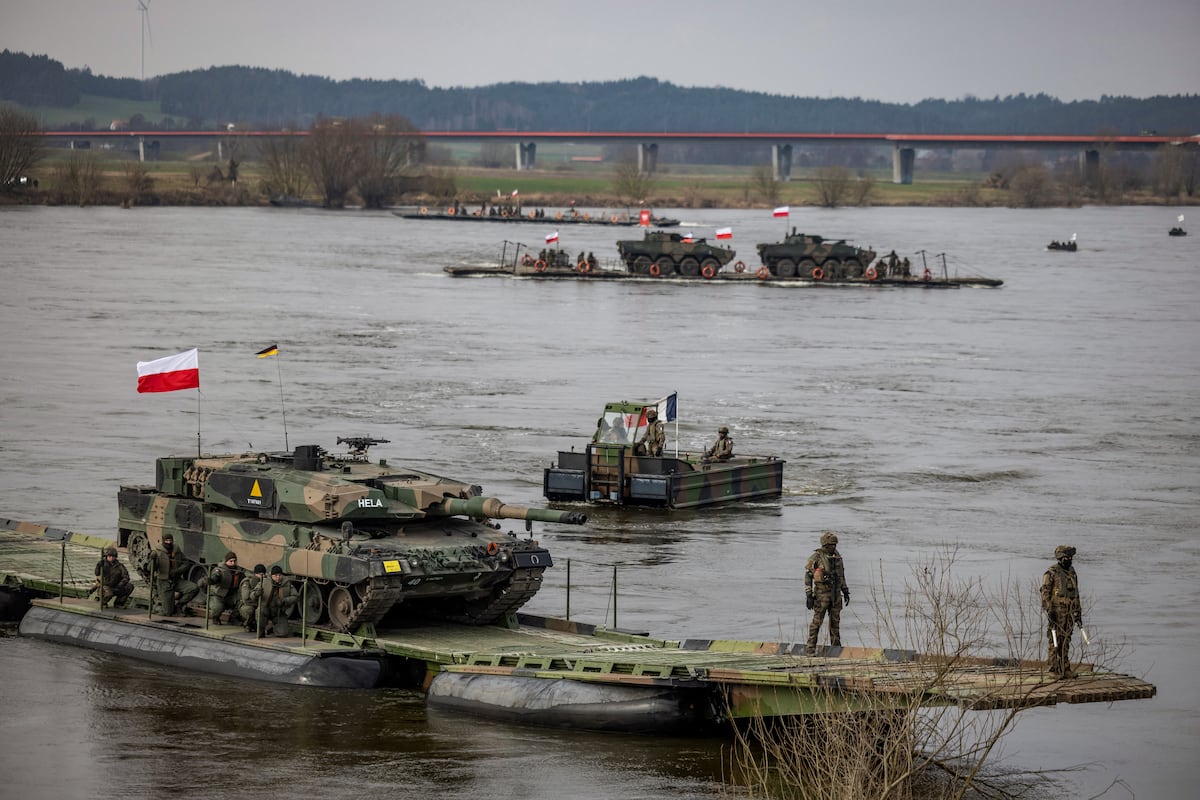
WARSAW, Poland — The Polish government has reacted to the new foreign policy course in Washington by doubling down on its commitment to more defense cooperation with the United States.
But while nods to Washington play an important role in Warsaw’s discourse, Poland’s authorities are also increasingly demonstrating willingness to tighten defense connections to key European allies.
During his official visit to Poland in February, U.S. Defense Secretary Pete Hegseth praised the nation for its efforts to allocate 4.7% of GDP to its military, an unprecedented level in the nation’s history. Hegseth called on other countries across the region to follow suit and bolster their defense budgets.
Władysław Kosiniak-Kamysz, Poland’s deputy prime minister and defense minister, reciprocated by vowing his nation is readying “further acquisitions in the United States” for its armed forces, and discussing investments in joint ventures between the Polish and American defense industries that could involve ammunition production, among others.
Alongside these declarations, however, Warsaw is hedging its options by deepening defense ties closer to home.
Tomasz Smura, program director at the Warsaw-based Casimir Pulaski Foundation, told Defense News that the coming years are likely to bring more joint projects between Polish and European partners in the field of defense.
“Poland’s relations with the United States are very close and good, and this is a constant trait of Warsaw’s foreign policy that has remained unchanged for decades,” he said. “However, Prime Minister Tusk signaled in his speech that, while making efforts to maintain these strong relations, Poland will also invest to reinforce the second pillar of the country’s security which relies on cooperation with European partners.”
Speaking at the Sejm, the parliament’s lower chamber, on March 7, Polish Prime Minister Donald Tusk said his government recognizes the new administration in Washington is aligning its foreign policy towards Russia with new priorities.
“We are dealing with a deep adjustment of the American policy in the context of the Russian-Ukrainian war. We cannot get upset with the reality. Every country, and in particular a great power such as the United States, has the right and obligation to shape its foreign policy and its strategy,” Tusk said.
“But every country, including Poland … has the right and obligation to very honestly and precisely evaluate what is in our interest, what is in the interest of our security, and what can create a problem.”
The prime minister said, “Poland does not change its opinion on the necessity, which is absolutely fundamental, to maintain the tightest relations with the United States and the North Atlantic Pact.” At the same time, Tusk cited Warsaw’s ongoing talks with Paris on involving Poland in France’s nuclear deterrent program as an example of how a further defense rapprochement with key European partners can increase the nation’s security.
“We are holding serious talks with the French on the idea of a nuclear umbrella over Europe. It is high time for Poland, using the resources that it has and also its own experiences … to look with more courage at the most modern weapons,” the prime minister said. “Purchases of conventional weapons, the traditional weapons, will not suffice.”
Tusk’s comment came in response to French President Emmanuel Macron’s recent statement that his country is considering to extend its nuclear arsenal’s coverage over European allies. Alongside these discussions, Polish President Andrzej Duda has called on the US to deploy nuclear weapons to his country as a deterrent to Russia.
Since Russia’s invasion of Ukraine in February 2022, Poland has boosted efforts to expand and modernize its military. This year, the Polish cabinet aims to allocate a total of PLN 186.6 billion ($48.5 billion) to defense. A large share of the country’s defense expenditure finances major purchases of weapons from the US, including the ongoing programs to acquire F-35 fighters jets , Boeing AH-64D copters , M1A2 Abrams SEPv3 tanks , and Patriot air defense batteries , among others.
At the same time, the Polish government has declared its willingness to participate in the German-led European Sky Shield Initiative , a continent-wide project to coordinate countries’ air defense-related purchases and procedures. Last year, Poland’s state-run defense group, PGZ, expressed interest in joining a program supported by the European Defence Fund (EDF) to create a new main battle tank .
Concerned that Moscow’s talks with Washington could impact on US military presence in Poland, Warsaw is also seeking stronger defense ties with European allies such as Germany, France and the U.K.
Poland’s authorities are aware that, as the U.S. is gradually withdrawing from supporting Ukraine militarily, Europe will need to largely take over the effort, according to Smura.
“As the Polish government accepts that Ukraine’s accession to NATO is no longer viable, this topic will be shelved, and Poland will shift its dialog with the United States to an approach anchored in more realism,” he said.
Jaroslaw Adamowski is the Poland correspondent for Defense News.
波兰华沙——波兰政府对华盛顿新的外交政策路线做出了回应,加倍致力于与美国加强防务合作。
虽然向华盛顿示好在华沙的论述中扮演着重要角色,但波兰当局也越来越表现出加强与主要欧洲盟友防务联系的意愿。
今年2月,美国国防部长皮特·赫格塞斯对波兰进行正式访问,期间他赞扬波兰将国内生产总值的4.7%用于军事开支,这一比例在波兰历史上前所未有。赫格塞斯呼吁该地区其他国家效仿波兰,增加国防预算。
波兰副总理兼国防部长瓦迪斯瓦夫·科西尼亚克-卡梅什回应称,波兰正在准备“进一步从美国采购”其武装部队的装备,并正在讨论波兰和美国国防工业之间的合资投资,其中可能包括弹药生产等领域。
然而,在发表这些声明的同时,华沙也在通过深化与国内更近地区的防务联系来对冲风险。
华沙卡西米尔·普拉斯基基金会的项目主管托马斯·斯穆拉告诉《防务新闻》,未来几年波兰和欧洲伙伴在国防领域可能会有更多联合项目。
“波兰与美国的关系非常密切良好,这是华沙外交政策的一个一贯特点,几十年来始终未变,”他说。“然而,图斯克总理在讲话中表明,波兰在努力维持这些牢固关系的同时,也将加大投入,加强国家安全的第二支柱——与欧洲伙伴的合作。”
3月7日,波兰总理唐纳德·图斯克在议会下院瑟姆发表讲话时表示,波兰政府认识到华盛顿新政府正在调整其对俄外交政策,使其具有新的优先事项。
“我们正面临着美国在俄乌战争背景下的政策深度调整。我们不能对现实感到沮丧。每个国家,特别是像美国这样的大国,都有权利和义务制定自己的外交政策和战略,”图斯克说。
“但是,包括波兰在内的每个国家……都有权利和义务非常诚实和准确地评估什么符合我们的利益,什么符合我们的安全利益,以及什么可能会造成问题。”
总理表示:“波兰在维持与美国和北大西洋公约组织最紧密的关系这一根本性问题上立场坚定不移。”与此同时,图斯克以华沙正与巴黎就波兰参与法国核威慑计划进行的磋商为例,说明进一步加强与关键欧洲伙伴的防务合作如何能够提升国家安全。
“我们正在与法国就欧洲核保护伞的构想进行严肃的磋商。波兰是时候利用自身资源和经验,更加勇敢地审视最先进的武器了,”总理说。“购买常规武器,也就是传统武器,是远远不够的。”
图斯克的评论是对法国总统马克龙近期表态的回应。马克龙表示,法国正在考虑将其核武库的覆盖范围扩大到欧洲盟国。与此同时,波兰总统杜达呼吁美国在其国家部署核武器,以威慑俄罗斯。
自2022年2月俄罗斯入侵乌克兰以来,波兰加大了扩充和现代化军力的力度。今年,波兰内阁计划拨款1866亿兹罗提(约合485亿美元)用于国防。该国国防开支的很大一部分用于从美国采购大量武器,包括正在进行的F-35战斗机、波音AH-64D直升机、M1A2艾布拉姆斯SEPv3主战坦克和爱国者防空导弹系统等项目的采购。
与此同时,波兰政府已宣布愿意参与由德国主导的“欧洲天空之盾”倡议,这是一项旨在协调各国防空相关采购和流程的欧洲大陆项目。去年,波兰国有国防集团PGZ表示有意加入由欧洲防务基金(EDF)支持的新型主战坦克研发项目。
由于担心莫斯科与华盛顿的会谈可能会影响美国在波兰的军事存在,华沙也在寻求与德国、法国和英国等欧洲盟友加强防务关系。
斯穆拉表示,波兰当局意识到,随着美国逐步停止对乌克兰的军事支持,欧洲将需要在很大程度上接管这项工作。
他说:“既然波兰政府已经接受了乌克兰加入北约不再可行的事实,那么这个话题将被搁置,波兰与美国的对话也将转向更加务实的态度。”
Jaroslaw Adamowski 是《防务新闻》驻波兰记者。