Strong El Nino in coming years can cut crop yields by up to 10%, says study on ASEAN agriculture一项针对东盟农业的研究表明,未来几年强烈的厄尔尼诺现象可能导致农作物减产高达10%。
Read more at straitstimes.com.
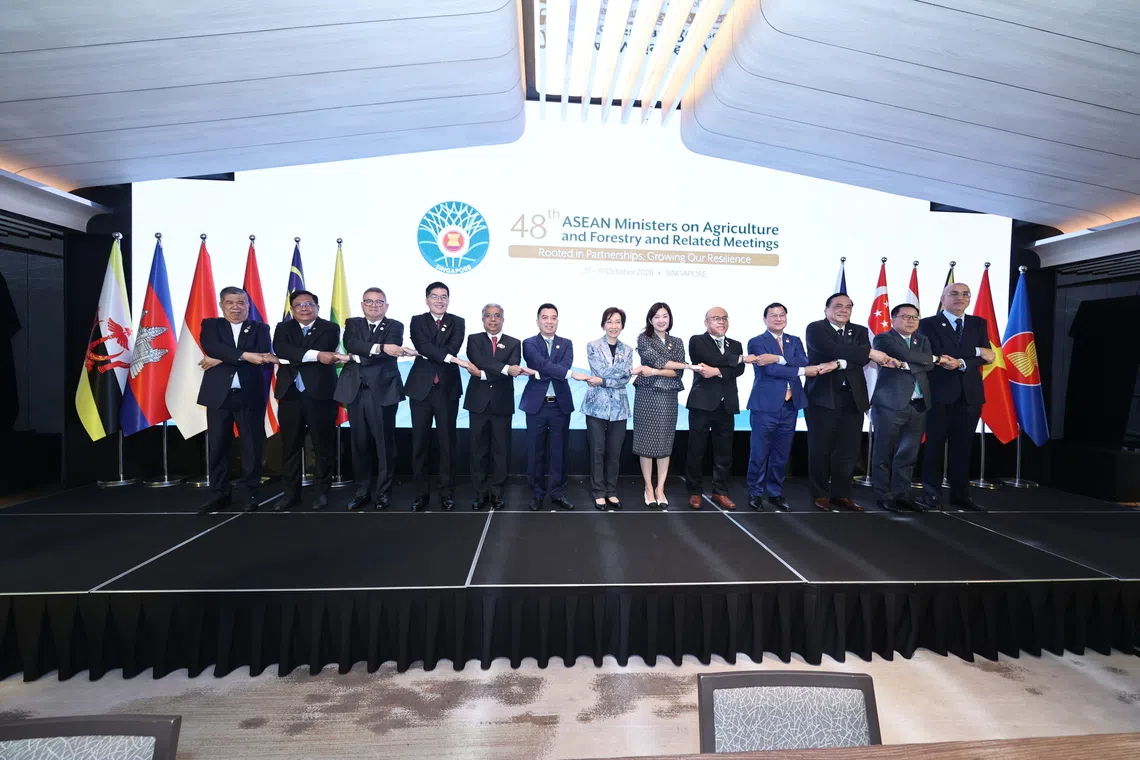
Minister for Sustainability and the Environment Grace Fu (centre) with her counterparts at the 48th meeting of the ASEAN Ministers on Agriculture and Forestry held at the Parkroyal Collection Marina Bay On Oct 29, 2026.
Published Oct 29, 2026, 06:50 PM
Updated Oct 29, 2026, 06:50 PM
Strong El Nino events could cut Southeast Asia’s crop production by up to 10%, with rice hit hardest. The study covers 2025 to 2044 and warns of more heatwaves and uneven rainfall.
Rice, maize and sugarcane may fall, while cassava and soybean could rise. But all crops still face risks from heat, floods and drought, and yields may swing sharply year to year.
Singapore said ASEAN must act together on food security. It will table a “Food Security Resilience Pact 2045” to boost climate adaptation, supply chains, emergency planning and financing.
SINGAPORE - Average crop production in Southeast Asia could fall by up to 10 per cent in years with very strong El Nino events, according to a new study.
Drier and hotter weather caused by the climate phenomenon is likely to affect rice production the most out of the five major crops assessed, according to the ASEAN Agri Climate Impact Twenty (AACIT) study.
The study, jointly conducted by the Singapore Food Agency (SFA) and the National University of Singapore’s (NUS) Tropical Marine Science Institute, was presented as part of the 48th Meeting of the ASEAN Ministers on Agriculture and Forestry (AMAF) and related meetings on Oct 29.
Among its key findings are that Southeast Asia is projected to have more frequent and longer heatwaves in the coming years, though rainfall patterns are likely to vary across locations and time.
This means climate change will not affect all parts of ASEAN in the same way, with some areas experiencing heavier rainfall and flooding while others may face prolonged dry spells or greater drought stress.
Adaptation measures will therefore need to consider local conditions, crop types and planting seasons, said a factsheet on the AACIT study released by SFA and NUS.
The study, which was started in 2024, combined climate information with crop modelling to project changes in the region’s crop production from 2025 to 2044.
It found that rice, maize and sugarcane are projected to see a drop in average crop production in the next two decades, while the yields for cassava and soybean could rise.
However, even the crops with more favourable projected yields are not free from climate-related risks, as their production could still be affected by variation in climate conditions in a particular year, such as extreme heat, heavy rainfall, or drought.
It also found that ASEAN’s crop yields could vary widely between years, depending on the weather.
For instance, rice production could rise by 4% in years with good weather, and fall by 15% in bad years. Meanwhile, soybean yields could increase by as much as 30% in favourable years, and decline by 5% in unfavourable years.
Southeast Asia is responsible for over a quarter of global rice production and 40% of international rice exports, according to the UN Food and Agriculture Organization. The Straits Times has asked SFA for more information on the full study.
Minister for Sustainability and the Environment Grace Fu said on Oct 29 that the study will strengthen ASEAN member states’ collective understanding of the climate risks facing its food systems, and highlight pathways to enhance adaptation and resilience.
Speaking at the opening of the 48th AMAF meeting, Fu said climate change, geopolitical developments, supply chain disruptions, and emerging pests and animal diseases underscore the need for countries to strengthen their food systems.
“Our challenges are interconnected and addressing them requires collective action,” she said. “For example, supporting farmers to reduce reliance on slash and burn practices and adopt more sustainable and productive agricultural practices, can yield benefits for both our environmental sustainability and food security.”
This year’s AMAF meeting saw Singapore take over as chair from the Philippines. The city-state will take on chairmanship of ASEAN in 2027.
Fu said that as AMAF chair, Singapore will table a concept note on the Food Security Resilience Pact 2045. This will provide a long-term framework to strengthen the grouping in areas such as food availability, climate adaptation, technology, supply chains, emergency preparedness and financing.
“By working together and taking a holistic approach, ASEAN can build more sustainable and resilient food systems,” she said.
Expressing a similar sentiment, Philippines Secretary of Agriculture Francisco Laurel noted at the meeting that climate change, disruptions in global supply chains and rising uncertainties in international markets continue to put pressure on ASEAN’s food systems and the livelihoods of farmers, fishermen, and rural communities
“These challenges have reinforced one important lesson: food security cannot be pursued by individual countries alone,” said the outgoing AMAF chairman. “It requires stronger regional board cooperation, collective action, and sustained commitment.”
Prior to the meeting, Fu and Japan State Minister of Agriculture, Forestry and Fisheries Fujiki Shinya exchanged a renewed memorandum of cooperation in the agriculture and food sector between Singapore and Japan,
The agreement provides a framework for both countries to work more closely on agriculture and food technologies, food security and emergency preparedness, and the international commerce of food, said a statement from the Ministry of Sustainability and the Environment.
Addressing a roundtable discussion on ASEAN’s food system transformation in the afternoon, Fu said the global agrifood landscape is rapidly changing due to climate change, supply chain vulnerabilities and increasing pressure on resources such as land and water.
At the same time, technological developments are creating new opportunities to improve productivity, she noted.
“We have an opportunity to focus on what comes next. For example, how can we mobilise investment into projects that strengthen food systems,” she said. “And how can we bring solutions to more farmers, businesses and communities across the region.”
2026年10月29日,可持续发展与环境部长傅海燕(中)与东盟各国农业和林业部长在滨海湾柏悦酒店举行的第48届东盟农业和林业部长会议上合影。
发布于2026年10月29日下午6:50
更新于2026年10月29日下午6:50
强厄尔尼诺现象可能导致东南亚农作物减产高达10%,其中水稻受影响最大。该研究涵盖2025年至2044年,并警告称未来将出现更多热浪和降雨不均的情况。
水稻、玉米和甘蔗产量可能下降,而木薯和大豆产量可能上升。但所有作物仍然面临高温、洪水和干旱的风险,产量可能逐年大幅波动。
新加坡表示,东盟必须在粮食安全问题上采取共同行动。新加坡将提出一项“2045年粮食安全韧性公约”,以加强气候适应、供应链、应急计划和融资。
新加坡——一项新的研究表明,在厄尔尼诺现象非常强烈的年份,东南亚的平均农作物产量可能会下降高达 10%。
根据东盟农业气候影响二十国集团(AACIT)的研究,气候现象导致的更加干燥炎热的天气可能会对所评估的五种主要作物中的水稻生产造成最大的影响。
这项研究由新加坡食品局 (SFA) 和新加坡国立大学 (NUS) 热带海洋科学研究所联合开展,并于 10 月 29 日在第 48 届东盟农业和林业部长会议 (AMAF) 及相关会议上进行了展示。
该研究的主要发现之一是,预计未来几年东南亚将出现更频繁、持续时间更长的热浪,尽管降雨模式可能会因地点和时间而异。
这意味着气候变化对东盟各地区的影响并不相同,一些地区可能会经历更严重的降雨和洪水,而另一些地区则可能面临更长时间的干旱或更大的干旱压力。
新加坡食品局 (SFA) 和新加坡国立大学 (NUS) 联合发布的 AACIT 研究情况说明书指出,因此,适应措施需要考虑当地条件、作物类型和种植季节。
这项研究始于 2024 年,它将气候信息与作物模型相结合,预测该地区 2025 年至 2044 年的作物产量变化。
调查发现,未来二十年水稻、玉米和甘蔗的平均作物产量预计将会下降,而木薯和大豆的产量可能会上升。
然而,即使是那些预计产量较为可观的作物,也并非没有气候相关的风险,因为它们的产量仍然可能受到特定年份气候条件变化的影响,例如极端高温、暴雨或干旱。
研究还发现,东盟的作物产量会因天气情况而出现较大年份间的差异。
例如,水稻产量在气候良好的年份可增长4%,在气候恶劣的年份则可能下降15%。同时,大豆产量在气候有利的年份可增长高达30%,在气候不利的年份则可能下降5%。
根据联合国粮食及农业组织的统计,东南亚地区的大米产量占全球总产量的四分之一以上,国际大米出口量占全球总出口量的40%。《海峡时报》已向新加坡食品局(SFA)索取该研究报告的完整信息。
可持续发展与环境部长傅海燕于10月29日表示,这项研究将加强东盟成员国对其粮食系统面临的气候风险的集体认识,并突出增强适应性和韧性的途径。
傅先生在第 48 届 AMAF 会议开幕式上发表讲话时表示,气候变化、地缘政治发展、供应链中断以及新出现的害虫和动物疾病凸显了各国加强粮食系统的必要性。
她表示:“我们面临的挑战是相互关联的,应对这些挑战需要集体行动。例如,支持农民减少对刀耕火种的依赖,并采用更可持续、更高效的农业耕作方式,既有利于环境的可持续发展,也有利于粮食安全。”
在今年的东盟与中日联大会议上,新加坡接替菲律宾担任轮值主席国。这个城邦国家将于2027年担任东盟轮值主席国。
傅先生表示,作为亚洲地中海农业论坛(AMAF)主席国,新加坡将提交一份关于《2045年粮食安全韧性公约》的概念文件。这将为加强该组织在粮食供应、气候适应、技术、供应链、应急准备和融资等领域的合作提供一个长期框架。
她表示:“通过共同努力和采取整体方法,东盟可以建立更可持续、更有韧性的粮食系统。”
菲律宾农业部长弗朗西斯科·劳雷尔在会上表达了类似的观点,他指出,气候变化、全球供应链中断以及国际市场日益加剧的不确定性,持续给东盟的粮食系统以及农民、渔民和农村社区的生计带来压力。
即将卸任的非洲粮食安全联盟(AMAF)主席表示:“这些挑战再次印证了一个重要的教训:粮食安全不能仅靠单个国家单打独斗来实现,它需要更强有力的区域理事会合作、集体行动和持续的承诺。”
会晤前,傅海燕与日本农林水产国务大臣藤木真也交换了新加坡和日本在农业和食品领域合作的新备忘录。
可持续发展与环境部在一份声明中表示,该协议为两国在农业和食品技术、粮食安全和应急准备以及国际食品贸易方面更紧密地合作提供了框架。
傅先生在当天下午举行的东盟粮食系统转型圆桌会议上表示,由于气候变化、供应链脆弱性以及土地和水等资源面临的压力不断增加,全球农业食品格局正在迅速变化。
她指出,与此同时,技术发展也为提高生产力创造了新的机遇。
“我们有机会将注意力集中在下一步上。例如,我们如何调动投资,开展能够加强粮食系统的项目,”她说道。“以及我们如何为该地区的更多农民、企业和社区带来解决方案。”