Thales Australia whips together armed UGV in just 6 weeks泰雷兹澳大利亚公司仅用6周时间就组装出了武装无人地面车辆
Thales Australia has turned a drawing board concept into a fully functioning, armed unmanned ground vehicle, or UGV, in just six weeks.
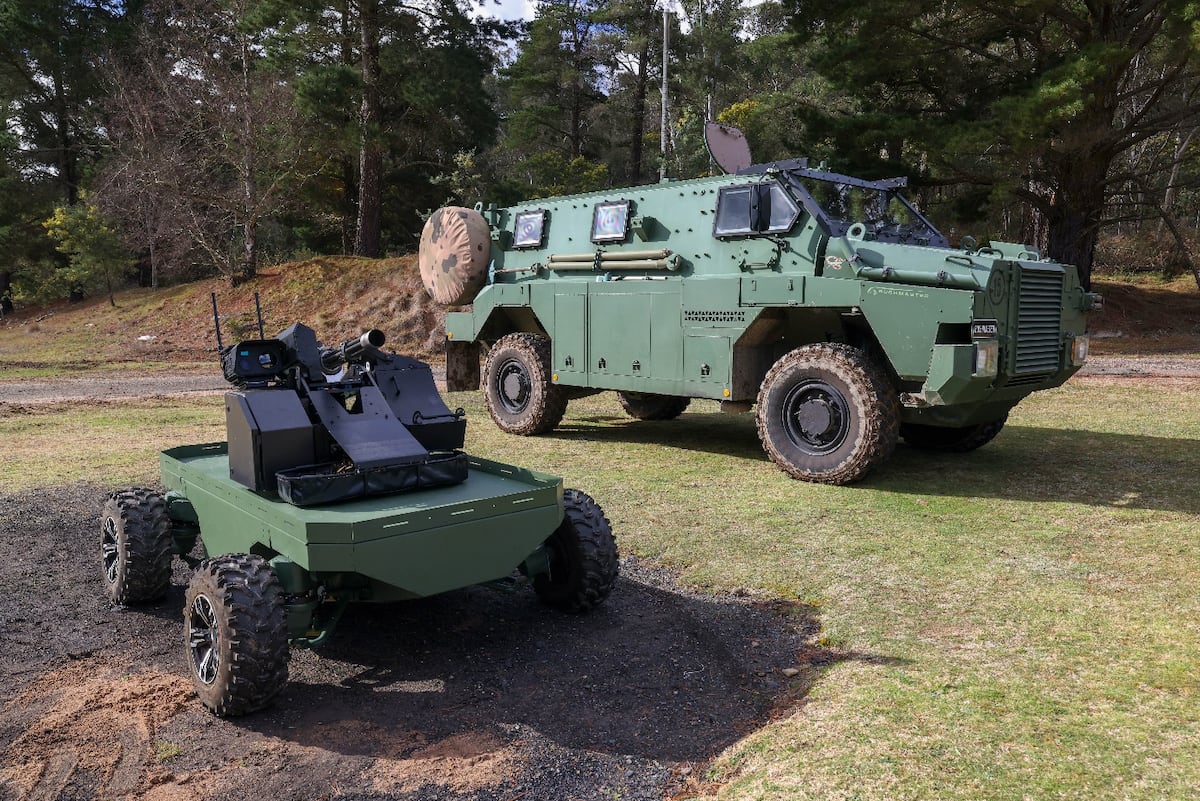
To demonstrate speed to capability, Thales Australia has turned a drawing board concept into a fully functioning, armed unmanned ground vehicle, or UGV, in just six weeks.
Called the Guardian Angel, the four-wheeled UGV has already completed live-fire testing.
Thales Australia worked with two other Australian firms to create the new system. One was Chaos 1, which specializes in rapid assessments, prototyping and autonomous-system experimentation.
The second company was W&E Platt, which makes weapon mounts. Indeed, the Guardian Angel features its low-cost Remote Operated Weapon PLATTform, with an image showing the ROWP mounting a Dillon M134D Minigun.
Thales Australia said in a statement that this project showcases its “sovereign industrial strength, ability to meet the nation’s defense and security needs, and capacity to deliver and manufacture autonomous systems and solutions”.
The company said the project was driven by one aim: to keep Australian troops safe.
However, a spokesperson explained to Defense News, “The Guardian Angel is a prototype and wasn’t specifically built for market. It’s part of a program to test and strengthen our capability in autonomous systems and solutions.”
Nonetheless, its completion paves the way for future platforms, in which a containerized mission system could offer capabilities such as medical evacuation, troop support, cargo transport and fire support.
“UGVs can preserve soldiers by operating in high-risk environments while providing a clear tactical advantage, assisting operations on the battlefield,” Andrew Downes, vice president of Land Thales Australia, commented. “They offer scalable, agile, cost-effective capability that can increase operational reach without increasing risk to personnel.”
Meanwhile, Benny Johanson, Founder and CEO of Chaos 1, described the process as “rapid prototyping in true form — little time, extremely chaotic and high risk.“
“In just six weeks we moved from a concept graphic to live-fire demonstration, and many said it couldn’t be done,” Johanson said, adding that the Guardian Angel “proved the sheer horsepower industry can generate for the warfighter at speed.”
Australian industry has developed a number of UGV designs, and the army is actively experimenting with some of them. For instance, it is trialing M113AS4 armored personnel carriers converted into modular robotic vehicles by BAE Systems Australia.
BAE Systems Australia’s largest platform is the ATLAS 8x8, fitted with an unmanned turret and 25mm Bushmaster cannon. It is currently in a prototype demonstrator status.
The Australian Army has also tested the tracked Warfighter UGV from Cyborg Dynamics Engineering. The army is already using the Ground Uncrewed System, affectionately known as GUS and produced by Outlook Industries, for remote coastal surveillance.
A couple of attritable UGV platforms also being tested are GaardTech’s Jaegar-C and DefendTex’s Banshee, small vehicles that can carry kinetic payloads.
“We’re about to bring into the next exercise UGVs. We can practice breaching minefields, for example, with sacrificial UGVs that might drag a tube full of explosives across a minefield — and we can detonate that,” Brigadier Ben McLennan, commander of the Australian Army’s 3rd Brigade, recently told Defense News. “That’s just one application. There’s a raft of other applications we’re making.”
Gordon Arthur is an Asia correspondent for Defense News. After a 20-year stint working in Hong Kong, he now resides in New Zealand. He has attended military exercises and defense exhibitions in about 20 countries around the Asia-Pacific region.
为了展示其从图纸到实际能力的快速转化,泰雷兹澳大利亚公司仅用了六周时间就将图纸上的概念变成了一辆功能齐全的武装无人地面车辆(UGV)。
这款名为“守护天使”的四轮无人地面车辆已经完成了实弹测试。
泰雷兹澳大利亚公司与另外两家澳大利亚公司合作开发了这套新系统。其中一家是 Chaos 1,该公司专门从事快速评估、原型设计和自主系统实验。
第二家公司是W&E Platt,该公司生产武器支架。事实上,“守护天使”无人机就采用了该公司低成本的遥控武器平台(ROWP),图片显示该平台安装了一挺迪龙M134D迷你机枪。
泰雷兹澳大利亚公司在一份声明中表示,该项目展现了其“自主工业实力、满足国家国防和安全需求的能力,以及交付和制造自主系统和解决方案的能力”。
该公司表示,该项目的驱动力只有一个目标:保障澳大利亚军队的安全。
然而,一位发言人向《防务新闻》解释说:“守护天使是一款原型机,并非专门为市场打造。它是我们测试和加强自主系统和解决方案能力项目的一部分。”
尽管如此,它的建成为未来的平台铺平了道路,未来的平台可以采用集装箱式任务系统,提供医疗后送、部队支援、货物运输和火力支援等能力。
“无人地面车辆能够在危险环境中作业,从而保护士兵,同时提供明显的战术优势,协助战场作战,”泰雷兹澳大利亚陆地业务副总裁安德鲁·唐斯评论道。“它们具有可扩展、灵活、经济高效的能力,能够在不增加人员风险的情况下扩大作战范围。”
与此同时,Chaos 1 的创始人兼首席执行官 Benny Johanson 将这一过程描述为“真正的快速原型制作——时间短、极其混乱且风险高”。
约翰逊说:“我们仅用了六周时间就从概念图过渡到了实弹演示,很多人都说这不可能做到。”他还补充说,“守护天使”证明了工业界能够迅速为作战人员提供强大的动力。
澳大利亚工业界已开发出多种无人地面车辆(UGV)设计方案,陆军正在积极试验其中一些方案。例如,陆军正在试用由BAE系统澳大利亚公司改装的M113AS4装甲运兵车,该车被改造成模块化机器人车辆。
BAE系统澳大利亚公司最大的平台是ATLAS 8x8,配备无人炮塔和25毫米“大毒蛇”机炮。目前它仍处于原型演示阶段。
澳大利亚陆军也测试了赛博格动力工程公司(Cyborg Dynamics Engineering)生产的履带式无人地面车辆(UGV)。陆军目前已在使用Outlook Industries公司生产的地面无人系统(GUS,昵称GUS)进行远程海岸监视。
目前正在测试的还有 GaardTech 的 Jaegar-C 和 DefendTex 的 Banshee,这两种小型无人地面车辆可以携带动能有效载荷。
“我们即将把无人地面车辆(UGV)引入下一次演习。例如,我们可以练习用牺牲型无人地面车辆拖着装满炸药的管子穿越雷区——然后引爆,”澳大利亚陆军第三旅旅长本·麦克伦南准将最近告诉《防务新闻》。“这只是其中一种应用。我们还在开发一系列其他应用。”
戈登·阿瑟是《防务新闻》的亚洲特派记者。在香港工作20年后,他现居新西兰。他曾到访亚太地区约20个国家,参加过军事演习和防务展览。