Make room for next generation while tapping elders’ experience: PM Wong to Chinese business leaders黄之锋总理呼吁中国商界领袖:在汲取长辈经验的同时,也要为下一代腾出空间。
Companies should also transform before circumstances force them to, and broaden their overseas networks, PM Wong said. Read more at straitstimes.com.
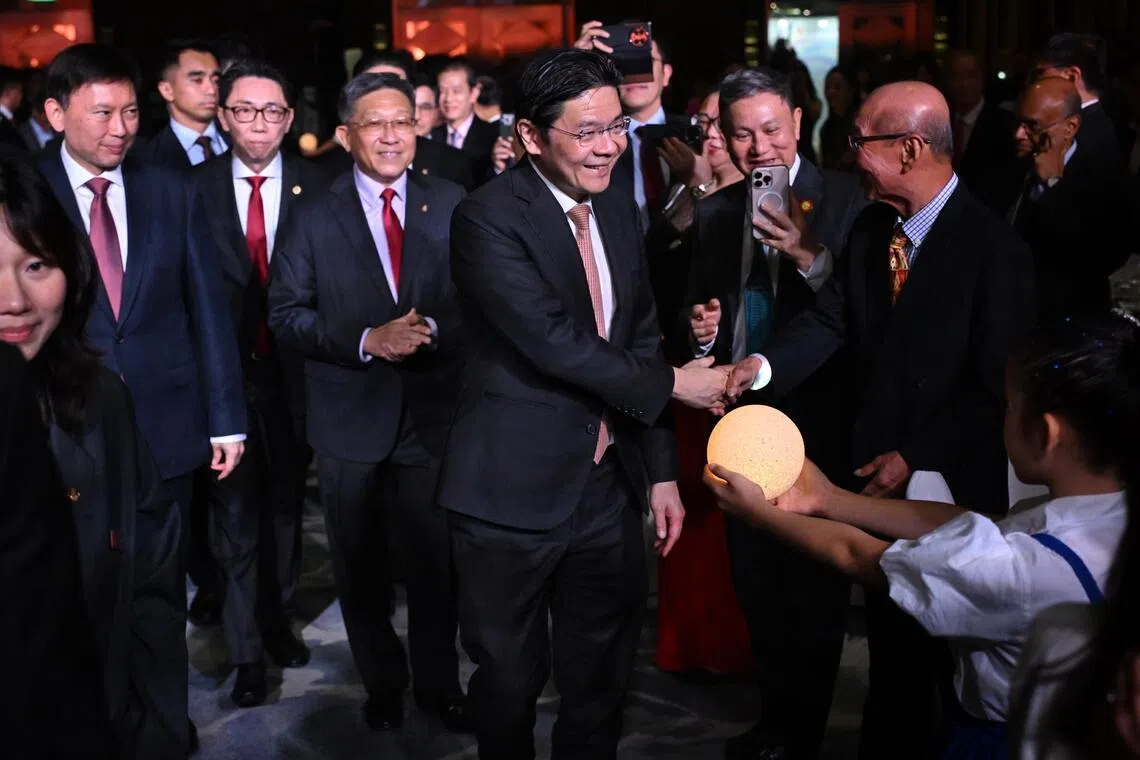
Prime Minister Lawrence Wong (centre), SCCCI president Kho Choon Keng (3rd from left) and National Development Minister Chee Hong Tat (left) arriving for the SCCCI 120th anniversary gala dinner on Oct 30.
ST PHOTO: CHONG JUN LIANG
Published Oct 30, 2026, 08:50 PM
Updated Oct 30, 2026, 08:50 PM
Prime Minister Lawrence Wong said companies must plan leadership renewal early. He warned that holding on too long risks weaker future growth, and urged older and younger leaders to learn from each other.
He said firms must transform before change forces them, especially with AI, shifting supply chains and new worker needs. Real change means redesigning jobs, processes and business models, not just using new tools.
Wong also urged Singapore firms to look beyond China and diversify into ASEAN, India, the Middle East and other markets. He backed SCCCI’s new International Advisory Panel and its role in helping businesses expand abroad.
SINGAPORE - Companies must plan ahead for leadership renewal and ensure that every generation has the opportunity to contribute, Prime Minister Lawrence Wong told an audience of Chinese business leaders on Oct 30.
While handing over the reins is not always easy, holding on for too long carries its own risks, he said at the 120th anniversary gala dinner of the Singapore Chinese Chamber of Commerce and Industry (SCCCI), the apex body of the Chinese business community here.
“Renewal cannot be left to chance,” he said. “It must be planned for, and nurtured deliberately.”
He made these points on leadership renewal in both English and Mandarin to an audience of more than 1,000, which included representatives from the Government, business community and trade associations, at the Fairmont Singapore.
“Friction may at times arise between different generations of leaders. Therefore, we should not just focus on passing the baton. More importantly, we must find ways for different generations to work together and build on one another’s strengths,” he said in Mandarin at the start of his speech, where he also acknowledged SCCCI’s contributions to Singapore’s progress.
He quoted a Chinese saying: “New waves rise and carry the ones before them forward”, stressing that the next generation must step up for society to continue progressing.
Switching to English, he noted that succession is one of the toughest challenges faced by many businesses, particularly family-owned enterprises.
“Actually, succession is the biggest challenge everywhere, including in politics. But it is a challenge in business too,” he said.
Founders would have spent decades building their companies, which often reflect their judgment , relationships and often, their personal identity, he added.
“But holding on for too long carries its own risks. Younger leaders may not have the chance to develop their capabilities. New ideas may struggle to take root. And the business may find itself less prepared for the future,” he said.
PM Wong said s enior leaders should prepare their successors by sharing their experience and networks, and gradually giving them greater responsibilities.
“Give them the space to exercise their own judgment, make their own decisions, and sometimes even make mistakes.”
Younger leaders must earn that trust by bringing fresh ideas and new capabilities. While technology and artificial intelligence (AI) may give them access to knowledge at their fingertips, they should not assume they know better than their elders, he said.
Instead, they should be willing to listen and learn about what made the business successful.
PM Wong said this principle of renewal extends beyond individual companies to institutions such as SCCCI, as he urged the chamber to connect younger and older business leaders, facilitate mentorship and create opportunities for the next generation to step forward.
“Because the true test of successful leadership is not what we achieve during our lifetime,” he said. “It is whether we leave behind an organisation that is stronger, and a new generation of leaders who are ready to take it forward. ”
PM Wong also highlighted two other areas the companies have to work at - transforming before circumstances for them to and building new connections outside of Singapore.
He noted that firms today face new technologies such as AI, which are changing how companies operate and compete.
These changes cannot be stopped, he said, and the task is to get ahead of them.
He noted that SCCCI has been helping small and medium-sized enterprises adopt AI and digital solutions, as well as sustainable practices. It is also helping workers acquire new skills.
He encouraged the chamber to continue its efforts, adding that the Government will keep supporting businesses and workers through these changes.
But real transformation goes beyond adopting the latest AI tool, he cautioned.
A company can introduce AI and still operate in much the same way as before, he said. The bigger gains come when firms rethink their processes, redesign jobs and even change their business models, all of which require a mindset change.
“We must be prepared to question assumptions that have served us well in the past,” he said, adding that this is often hardest when things are going well , because success breeds comfort and eventually complacency.
On building new connections, PM Wong called on companies to broaden networks and diversify markets.
Singapore’s small domestic market means its companies have always had to look abroad for customers, partners, ideas and opportunities.
SCCCI understood this from the start, he said, and has built extensive networks overseas, particularly in China, which should continue to be deepened.
With the global economy becoming more fragmented and trade and investment flows shifting, companies must seize new opportunities that are opening up, he said.
China remains an important market, but Singapore companies must venture out early, take calculated risks and establish presnce for the long term across ASEAN, India, the Middle East, Africa and Latin America, he added.
This is another area that the Government will support companies in, he added.
PM Wong also welcomed SCCCI’s new International Advisory Panel (IAP), with Minister Chee Hong Tat as patron, which aims to support companies in going abroad.
He said that the spirit of enterprise, the willingness to look beyond immediate interests and the commitment to contribute to Singapore’s progress have sustained SCCCI for 120 years, and will carry it foward.
Likewise, Singapore must keep adapting to a changing world, finding new opportunities, and preparing for the future, he said.
In his speech, SCCCI president Kho Choon Keng said in Mandarin that the newly-established panel will bring together the insights and expertise of international business leaders, provide its members with forward-looking insights into global markets and help to create new opportunities for all.
He added: “As Singapore assumes the ASEAN Chairmanship next year, we look forward to seizing this opportunity to work hand in hand with all to build a more prosperous, stable and sustainable region.”
Chin Soo Fang is senior correspondent at The Straits Times, covering a wide range of topics including community, politics, social issues, consumer, culture and heritage.
10月30日,总理黄循财(中)、新加坡工商会主席许俊庆(左三)和国家发展部长徐芳达(左一)抵达新加坡工商会120周年庆典晚宴现场。
《海峡时报》照片:梁崇俊
发布于2026年10月30日晚上8:50
更新于2026年10月30日晚上8:50
黄循财总理表示,企业必须尽早规划领导层更迭。他警告说,领导层留任时间过长会削弱未来的增长,并敦促资深和年轻领导者互相学习。
他表示,企业必须在变革迫使其变革之前进行转型,尤其是在人工智能、供应链转移和新的员工需求等背景下。真正的变革意味着重新设计工作岗位、流程和商业模式,而不仅仅是使用新的工具。
黄先生还敦促新加坡企业将目光投向中国以外的市场,拓展东盟、印度、中东及其他市场。他支持新加坡工商会新成立的国际顾问委员会及其在帮助企业拓展海外市场方面发挥的作用。
新加坡——10月30日,总理黄循财在对一群中国商界领袖发表讲话时表示,企业必须提前规划领导层更新,并确保每一代人都有机会做出贡献。
他在新加坡中华总商会(新加坡华人商界的最高机构)成立120周年庆典晚宴上表示,虽然交出领导权并不总是容易的,但长期把持权力也会带来风险。
“复兴不能听天由命,”他说。“它必须经过规划,并精心培育。”
他在新加坡费尔蒙酒店用英语和普通话向 1000 多名听众发表了关于领导力更新的演讲,听众包括政府、商界和行业协会的代表。
“不同世代的领导人之间有时难免会产生摩擦。因此,我们不应仅仅关注权力的交接。更重要的是,我们必须找到让不同世代的领导人携手合作、取长补短的方法,”他在演讲开始时用普通话说道,并肯定了新加坡工商会为新加坡发展所做出的贡献。
他引用了一句中国谚语:“新浪潮兴起,带动前人前进”,强调下一代必须挺身而出,社会才能继续进步。
他转而用英语指出,继承是许多企业,特别是家族企业面临的最严峻挑战之一。
“事实上,继承问题是各行各业面临的最大挑战,包括政界。在商界,继承问题同样是一个挑战,”他说道。
他补充说,创始人往往花费数十年时间打造自己的公司,这些公司通常反映了他们的判断力、人际关系,以及他们的个人身份。
“但长期把持权力也会带来风险。年轻的领导者可能没有机会发展自身能力。新想法可能难以生根发芽。企业也可能发现自己对未来准备不足,”他说道。
黄总理表示,资深领导人应该通过分享经验和人脉来培养继任者,并逐步赋予他们更大的责任。
“给他们空间去运用自己的判断力,做出自己的决定,甚至允许他们犯错。”
他表示,年轻的领导者必须通过带来新思路和新能力来赢得信任。虽然科技和人工智能(AI)让他们能够轻松获取知识,但他们不应自以为比长辈更懂行。
相反,他们应该愿意倾听和学习企业成功的秘诀。
黄总理表示,这种更新换代的原则不仅适用于单个公司,也适用于像新加坡工商会这样的机构。他敦促工商会联系年轻一代和年长一代的商业领袖,促进指导,并为下一代创造机会,让他们能够脱颖而出。
“因为衡量领导力是否成功的真正标准,不在于我们一生取得了什么成就,”他说,“而在于我们能否留下一个更强大的组织,以及培养出一批能够带领组织继续前进的新一代领导者。”
黄总理还强调了这些公司需要努力的另外两个领域——在形势允许之前进行转型,以及在新加坡以外建立新的联系。
他指出,如今企业面临着人工智能等新技术,这些技术正在改变公司的运营和竞争方式。
他说,这些变化无法阻止,我们的任务是抢在它们前面。
他指出,SCCCI一直在帮助中小企业采用人工智能和数字化解决方案以及可持续发展实践,同时也在帮助员工掌握新技能。
他鼓励商会继续努力,并补充说,政府将继续支持企业和工人度过这些变化。
但他警告说,真正的变革不仅仅是采用最新的人工智能工具。
他表示,公司可以引入人工智能,但运营方式仍与之前基本相同。只有当企业重新思考流程、重新设计岗位,甚至改变商业模式时,才能获得更大的收益,而所有这些都需要转变思维方式。
“我们必须准备好质疑过去对我们有益的假设,”他说,并补充说,当一切进展顺利时,这往往是最难的,因为成功会带来舒适感,最终导致自满。
黄循财总理呼吁企业拓展人脉网络、实现市场多元化,以建立新的联系。
新加坡国内市场规模较小,这意味着新加坡企业一直以来都必须向海外寻求客户、合作伙伴、创意和机遇。
他表示,中国工商会从一开始就明白这一点,并在海外,尤其是在中国,建立了广泛的人脉网络,这些网络应该继续深化。
他表示,随着全球经济日益分散,贸易和投资流动发生转变,企业必须抓住正在出现的新机遇。
他补充说,中国仍然是一个重要的市场,但新加坡企业必须尽早走出去,承担经过深思熟虑的风险,并在东盟、印度、中东、非洲和拉丁美洲建立长期的业务基础。
他还补充说,这是政府将支持企业发展的另一个领域。
黄总理也对新加坡工商会新成立的国际咨询小组(IAP)表示欢迎,该小组由徐芳达部长担任赞助人,旨在支持企业走向海外。
他表示,进取精神、不计前嫌的魄力以及为新加坡发展做出贡献的承诺,使新加坡工商会走过了120年,并将继续推动其向前发展。
他表示,同样地,新加坡也必须不断适应不断变化的世界,寻找新的机遇,并为未来做好准备。
新加坡工商会会长许春庆在讲话中用普通话表示,新成立的委员会将汇集国际商业领袖的洞察力和专业知识,为会员提供对全球市场的前瞻性见解,并帮助所有人创造新的机遇。
他补充道:“明年新加坡将担任东盟轮值主席国,我们期待抓住这个机会,与各方携手合作,建设一个更加繁荣、稳定和可持续发展的地区。”
Chin Soo Fang 是《海峡时报》的资深记者,报道范围广泛,包括社区、政治、社会问题、消费者、文化和遗产等话题。