Comfortable in her own skin: How a 12-year-old embraces her rare birthmark自在自信:一位12岁女孩如何欣然接受自己罕见的胎记
Singapore girl with rare giant congenital melanocytic nevus embraces her birthmark and confidence despite health risks Read more at straitstimes.com.
Medical Mysteries is a series that spotlights rare diseases or unusual conditions.
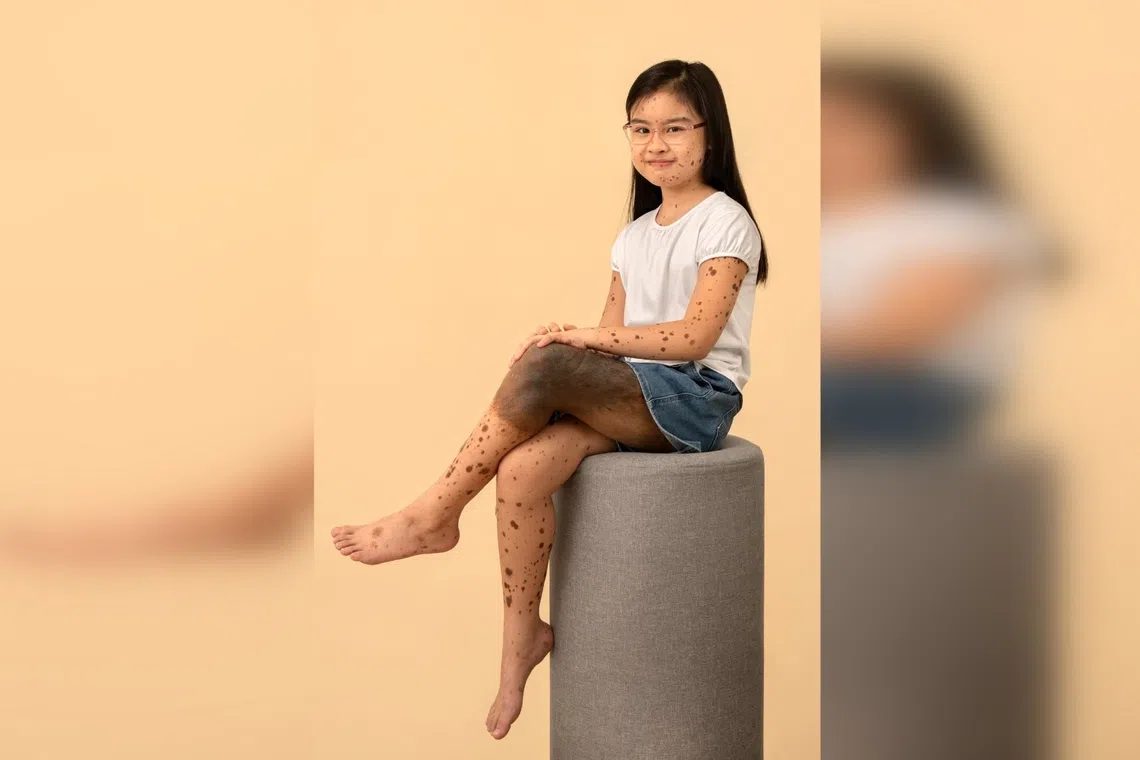
Charlotte Lim was born with giant congenital melanocytic nevus, a rare non-cancerous birthmark that covers a large portion of her body. The condition affects about 1 in 500,000 newborns.
PHOTO: RARE SKIN CONDITIONS SOCIETY (SINGAPORE) AND DEBRA (DYSTROPHIC EPIDERMOLYSIS BULLOSA RESEARCH ASSOCIATION)
Published Oct 31, 2026, 08:00 AM
Updated Oct 31, 2026, 08:00 AM
Charlotte Lim, 12, was born with giant congenital melanocytic nevus, a rare noncancerous birthmark covering about 30% of her body.
Doctors say GCMN affects one in 20,000 newborns and can bring a 3 to 11% lifetime risk of skin cancer and possible brain or spine problems.
Her mother helped her face questions and bullying with confidence, but she now worries about secondary school and possible surgery for facial spots.
SINGAPORE – “They are my birthmarks.”
That was what 12-year-old Charlotte Lim told everyone and anyone who bothered to ask her about the spots on her skin, especially the large one that covered much of her body and extended down her legs.
Charlotte was born with an enlarged birthmark that now covers about 30% of her body.
“It extended from her diaphragm to her legs, and she has smaller spots on her body and face that have grown progressively larger,” her mother Esther Zheng, 43, told The Straits Times.
Zheng, a civil servant, said she was shocked when she first saw her daughter’s extensive dark markings. “She also has over 100 smaller moles on her stomach, scalp, face, arms and legs.”
What Charlotte has is a rare, non-cancerous pigmented birthmark called a giant congenital melanocytic nevus (GCMN), which can enlarge as the child grows.
The condition affects about one in 100,000 newborns, said Mark Koh, who heads the department of dermatology at KK Women’s and Children’s Hospital (KKH).
“A congenital nevus (is a pigmented mole or birthmark) that occurs due to a mutation in the genes affecting pigment cells. It occurs while the embryo or foetus is growing in the mother’s womb,” he added.
“The size of the congenital nevus depends on how early the mutation occurs during the pregnancy, with earlier mutations causing larger lesions. The size and site of the lesion also vary.”
He said that while GCMN is a genetic condition, it is not passed down from parent to child.
Koh said some patients with GCMN may have moles in the brain and spine called neuro-melanosis, which can lead to neurological problems such as weakness or seizures.
“The GCMN could also develop into a cancerous mole or melanoma, which might also occur in the brain and spine if there is neuro-melanosis,” he said.
Hair can also grow directly from the main GCMN or from smaller, scattered satellite moles that frequently accompany large birthmarks.
The rare condition Charlotte Lim has is not inherited. She is seen here with mum Esther Zheng, brother Keefe Lim and dad Lim Wei Liang. PHOTO: RARE SKIN CONDITIONS SOCIETY (SINGAPORE) AND DEBRA (DYSTROPHIC EPIDERMOLYSIS BULLOSA RESEARCH ASSOCIATION)
The rare condition Charlotte Lim has is not inherited. She is seen here with mum Esther Zheng, brother Keefe Lim and dad Lim Wei Liang.
Koh said there is no single medical cure that permanently and completely erases a GCMN, as “it is a deep skin lesion that results from early embryonic genetic mutations”. However, there are several approaches to manage, reduce, or remove some of the lesions.
Regular dermatological monitoring is essential because there is a 3% to 11% lifetime risk of GCMN developing into skin cancer, as well as potential neurological conditions.
Other methods include surgery to completely remove the mole and laser therapy to lighten the pigmentation.
Worried about how her daughter would cope with bullying, Zheng prepared her to deal with people from a young age.
She taught Charlotte that GCMN was “nothing but a birthmark” and that if people asked about it, she should simply tell them what it was.
“And that was what she had been doing since pre-school days. Of course, before she started pre-school, we had informed the principal so that she could tell the teachers. By letting her tell her friends, classmates and teachers about her condition, we have taught her strength and confidence,” Zheng said.
Her peers and teachers came to understand her condition, and Zheng said that, surprisingly, Charlotte was never bullied, not even in primary school.
“Her friends even gave her the nickname ‘spotty leopard’, which she was fine with. They stopped calling her that as they grew older,” she added.
Charlotte loves adventure and sports, especially rock climbing, and would often cast aside her condition to immerse herself in her hobbies, but she needed to avoid sunlight as much as possible.
“We were told that because of her rare condition, there was a possibility of her developing more moles elsewhere on her body, as well as a higher risk of skin cancer,” Zheng said.
Her mother also admitted that she was worried for Charlotte, who will be starting secondary school next year, especially as spots have developed on her face.
Studies have shown that about three in 10 children with GCMN experience social isolation, bullying or exclusion by their peers.
“Charlotte met another child with GCMN at the Rare Skin Conditions Society – a little boy named Pin Hao – and they became fast friends. Pin Hao went for surgery to remove some of the spots on his face, and Charlotte made up her mind that she wanted to do likewise. I told her it would be painful, but she had her mind set on it,” Zheng said.
Surgery often requires multiple procedures and can leave scarring.
Koh said: “Smaller or ‘satellite’ moles often sprout in patients with giant congenital nevus. They can occur anywhere on the skin. These lesions may be removed if there is a cosmetic concern, like when they appear on the face. They can be removed by surgery or lasers.”
He added that surgery can remove the spots entirely, and there is a smaller chance of recurrence. Lasers are not usually recommended because of the high risk of recurrence.
“I hope Charlotte continues to be confident as she grows. After all, everyone is born to look different, and we should all feel beautiful in our own skin,” Zheng said.
ST Medical Mysteries
KK Women's and Children's Hospital
《医学谜案》是一档聚焦罕见疾病或不寻常病症的系列节目。
夏洛特·林出生时患有巨大的先天性黑色素细胞痣,这是一种罕见的非癌性胎记,覆盖了她身体的大部分区域。这种情况影响大约五十万分之一的新生儿。
照片:罕见皮肤病协会(新加坡)和 DEBRA(营养不良性大疱性表皮松解症研究协会)
发布于2026年10月31日上午8:00
更新于2026年10月31日上午8:00
12 岁的夏洛特·林出生时患有巨大的先天性黑色素细胞痣,这是一种罕见的非癌性胎记,覆盖了她身体约 30% 的面积。
医生表示,每 20,000 名新生儿中就有 1 人患有 GCMN,并且患者一生中患皮肤癌的风险为 3% 至 11%,还可能导致脑部或脊柱问题。
母亲帮助她自信地面对质疑和欺凌,但她现在担心中学生活以及可能需要做面部斑点手术。
新加坡——“那是我的胎记。”
12 岁的夏洛特·林就是这样告诉每一个问起她皮肤上斑点的人,尤其是那个覆盖了她身体大部分区域并延伸到腿部的大斑点。
夏洛特出生时身上就有一块增大的胎记,现在覆盖了她身体约 30% 的面积。
“它从她的横膈膜一直延伸到她的腿,她身上和脸上还有一些较小的斑点,这些斑点逐渐变大,”她43岁的母亲郑爱玲告诉《海峡时报》。
郑女士是一名公务员,她说当她第一次看到女儿身上大片的黑色痣时,感到非常震惊。“她肚子、头皮、脸、胳膊和腿上还有100多颗小痣。”
夏洛特患有一种罕见的非癌性色素性胎记,称为巨大先天性黑色素细胞痣(GCMN),这种胎记会随着孩子的成长而增大。
KK妇女儿童医院(KKH)皮肤科主任Mark Koh表示,这种疾病影响大约十万分之一的新生儿。
他补充说:“先天性痣(是一种色素痣或胎记)是由于影响色素细胞的基因突变而引起的。它发生在胚胎或胎儿在母体子宫内发育期间。”
“先天性痣的大小取决于妊娠期间基因突变发生的时间早晚,突变越早,病变越大。病变的大小和位置也各不相同。”
他说,虽然 GCMN 是一种遗传性疾病,但它不会从父母遗传给孩子。
Koh表示,一些患有GCMN的患者可能会在大脑和脊髓中出现痣,称为神经黑变病,这会导致神经系统问题,例如虚弱或癫痫发作。
“如果患有神经性黑变病,GCMN 也可能发展成癌性痣或黑色素瘤,这种情况也可能发生在大脑和脊髓中,”他说。
毛发也可以直接从主要的 GCMN 长出,或者从经常伴随大胎记出现的较小、分散的卫星痣长出。
夏洛特·林患有的罕见疾病并非遗传。照片中她与母亲郑怡婷、弟弟林基夫和父亲林伟良在一起。照片:新加坡罕见皮肤病学会和营养不良性大疱性表皮松解症研究协会 (DEBRA)
夏洛特·林患有的罕见疾病并非遗传。照片中她与母亲郑怡婷、弟弟林基夫和父亲林伟良在一起。
Koh表示,目前尚无任何单一的医学疗法能够永久彻底地消除巨细胞痣,因为“这是一种由早期胚胎基因突变引起的深层皮肤病变”。然而,有多种方法可以控制、减轻或去除部分病变。
定期进行皮肤科监测至关重要,因为 GCMN 患者一生中有 3% 至 11% 的风险会发展成皮肤癌,还可能出现神经系统疾病。
其他方法包括手术彻底切除痣和激光治疗淡化色素沉着。
郑女士担心女儿会如何应对校园欺凌,所以从小就教她如何与人相处。
她告诉夏洛特,GCMN“只不过是一种胎记”,如果有人问起,她应该直接告诉他们那是什么。
“她从幼儿园就开始这么做了。当然,在她上幼儿园之前,我们已经通知了校长,以便她可以告诉老师。通过让她告诉朋友、同学和老师她的情况,我们培养了她的坚强和自信,”郑女士说。
她的同学和老师们逐渐了解了她的情况,郑女士说,令人惊讶的是,夏洛特从未受到过欺凌,即使在小学也没有。
“她的朋友们甚至给她起了个绰号叫‘斑点豹’,她也并不介意。随着他们长大,就不再这么叫她了,”她补充道。
夏洛特热爱冒险和运动,尤其喜欢攀岩,她经常会暂时抛开自己的身体状况,沉浸在自己的爱好中,但她需要尽可能避免阳光照射。
郑女士说:“我们被告知,由于她患有罕见的疾病,她身体其他部位有可能长出更多痣,而且患皮肤癌的风险也更高。”
她的母亲也承认,她很担心明年就要上中学的夏洛特,尤其是因为她的脸上长出了斑点。
研究表明,大约十分之三患有 GCMN 的儿童会经历社交孤立、欺凌或被同龄人排斥。
“夏洛特在罕见皮肤病协会遇到了另一个患有巨型细胞痣的孩子——一个名叫郝品的小男孩——他们很快就成了好朋友。郝品做了手术去除脸上的一些斑点,夏洛特也决定要做同样的手术。我告诉她手术会很疼,但她心意已决,”郑医生说。
手术通常需要多次操作,并且可能会留下疤痕。
Koh表示:“患有巨大先天性痣的患者身上经常会出现较小的或‘卫星痣’。它们可以出现在皮肤的任何部位。如果出于美观考虑,例如当它们出现在面部时,这些病变可以切除。可以通过手术或激光去除。”
他还补充说,手术可以彻底去除斑点,而且复发的几率较小。由于激光治疗复发风险较高,通常不建议采用激光治疗。
“我希望夏洛特在成长过程中继续保持自信。毕竟,每个人天生长相都不同,我们都应该为自己的美丽而感到自豪,”郑女士说道。
ST 医学谜案
KK妇女儿童医院