Drones could replace large US Army units in Europe, expert suggests专家称,无人机或可取代美国在欧洲的大型陆军部队
What do you with an Army designed for Europe when Europe isn’t the focus anymore? The answer is drones, says one U.S. expert.
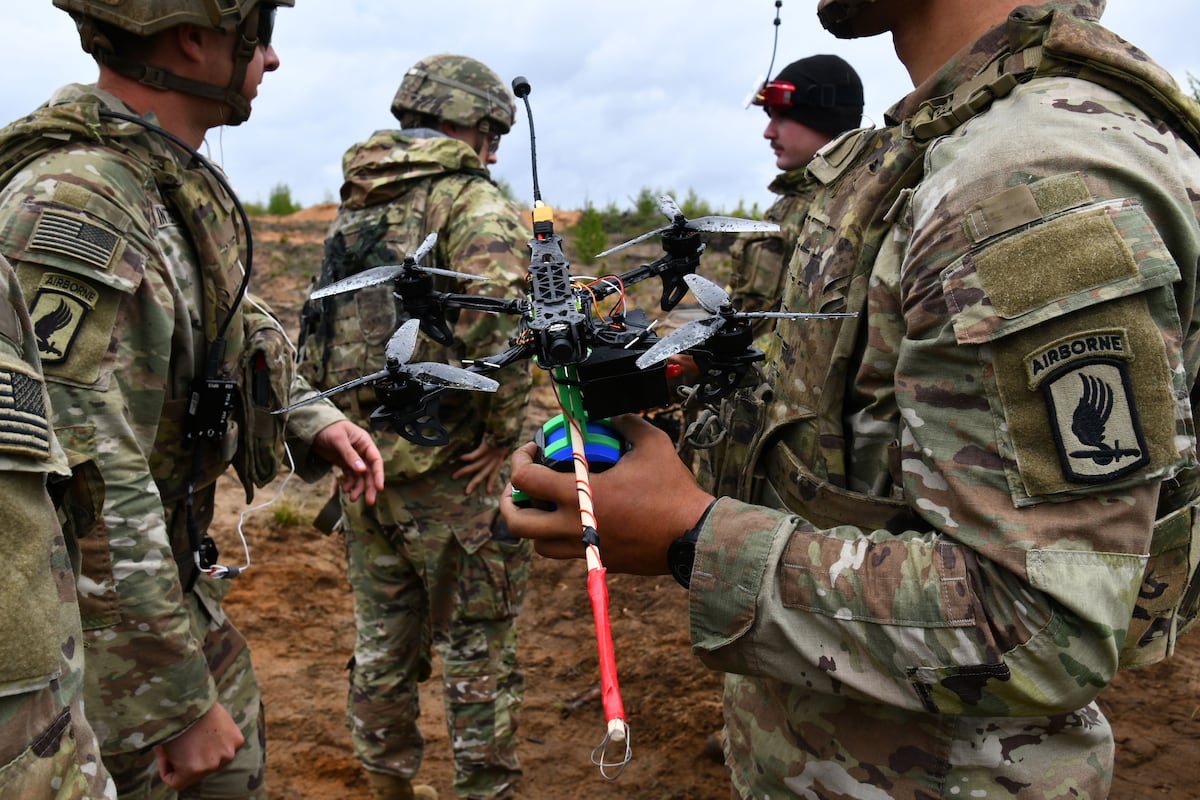
Since 1945, the U.S. Army has been designed to defend Europe. Despite detours into counterinsurgency in Southeast Asia and the Middle East, the core of the Army remains a large force of heavy mechanized brigades.
But the times are changing. The Obama administration shifted American strategic policy from Europe to Asia. Today, the Trump administration is prioritizing homeland defense , the Western Hemisphere and the Pacific . So what do you do with an Army designed for Europe when Europe isn’t the focus anymore?
The answer is drones, says one American expert. An expeditionary force of drone units — stationed in Europe or dispatched as needed — would be an economical alternative to maintaining large garrisons overseas.
“Forward-deployed forces in large garrisons and infantry and armor-centric rotational force packages need to give way to mixed drone units that can be deployed faster and better increase partner combat power,” wrote Benjamin Jensen, director of the Futures Lab at the Center for Strategic and International Studies think tank in Washington, D.C., in a recent analysis.
Jensen envisions a system where NATO’s European members provide traditional combat arms such as tanks and infantry fighting vehicles. They would be backed by American drone units that would provide a mix of strike, reconnaissance and electronic warfare unmanned aerial vehicles.
“Imagine that instead of a 1,000-person battalion, there was a 250-person rotational battalion that has a mix of 500 FPV [first-person view] drones and octocopters,” Jensen told Defense News. “And they’re running missions with those European partners, and they’re able to flow in, operate and then flow out quickly.”
The controversial notion that drones can replace boots on the ground isn’t new. But Jensen sees the key as “substitution,” a concept borrowed from economics in which one product can be replaced by another that offers equivalent value at a lower price. Just as shoppers can replace one brand of canned soup with a cheaper brand if there is a sale at the supermarket, drones can substitute for traditional ground platforms in some cases.
Substituting “more flexible and mobile drone formations can generate options to support U.S. interests in Europe,” wrote Jensen, who has previously proposed creating drone brigades . For example, an Army Launched Effects battalion, equipped with strike, surveillance and electronic warfare drones, could both patrol a wide area and deploy drone swarms to defeat a Russian invasion.
Substitution also applies to designing drones as well.
“If drones can be rapidly reconfigured across different payloads — say, intelligence collection, electronic warfare, and strike — with little friction, then one drone is nearly as good as another that was optimized for the task,” Jensen wrote.
To some extent, the Army is already on this path through the Army Transformation Initiative , which calls for rapid development and fielding of small drones. However, Jensen disagrees with plans to eliminate medium altitude, long endurance, or MALE, drones such as the MQ-1C Gray Eagle.
Critics claim MALE drones are expensive and vulnerable. Ukraine’s Turkish-made TB-2 Bayraktars were decimated by Russian air defenses, while the U.S. lost seven MQ-9 Reapers in six weeks from Houthi fire over Yemen earlier this year.
Yet Jensen counters that MALE drones offer versatility that small drones can’t match.
“I want something that generates enough power and has enough payload coverage that I can cover an area for 24 hours and carry eight-plus Hellfires if I need to,” Jensen said.
While the Army Transformation Initiative emphasizes drones, “what hasn’t received as much attention is how best to realize this vision in the reserve forces,” Jensen wrote. New drone units can be created within the Army Reserve and National Guard, while Army aviation units — some of which are slated to be eliminated — can be repurposed into unmanned aerial vehicle formations. This would minimize costs while offering the ability to quickly mobilize combat power.
And how might NATO feel about America replacing ground forces with drones?
“I think something is better than nothing,” Jensen replied.
A policy of deploying drone-centric expeditionary forces has implications beyond the battlefield. It “has the potential to alter the grammar of deterrence,” Jensen wrote. Instead of trying to deter Russia by regularly stationing an Armored Brigade Combat Team in Poland, mobile drone brigades could be sent to Eastern Europe to demonstrate American support for NATO during a crisis. Drone-based units would also be useful in the Pacific, where long distances put a premium on light, easily transportable formations.
“You can get a lot more interesting payloads, interesting performance and provide yourself a lot more flexibility than to committing to what was really 20th-century deterrence,” Jensen said.
Michael Peck is a correspondent for Defense News and a columnist for the Center for European Policy Analysis. He holds an M.A. in political science from Rutgers University. Find him at theuncommondefense.com. His email is mikedefense1@gmail.com.
自1945年以来,美国陆军的设计目标就是保卫欧洲。尽管曾参与东南亚和中东的反叛乱行动,但陆军的核心仍然是一支庞大的重型机械化旅。
但时代在变。奥巴马政府将美国的战略政策从欧洲转向亚洲。如今,特朗普政府则将国土防御、西半球和太平洋地区列为优先事项。那么,当欧洲不再是战略重点时,一支为欧洲战场设计的军队又该何去何从呢?
一位美国专家表示,答案是无人机。一支由无人机部队组成的远征军——驻扎在欧洲或根据需要派遣——将是维持海外庞大驻军的一种经济替代方案。
“大型驻军中的前沿部署部队以及以步兵和装甲兵为中心的轮换部队需要让位于混合无人机部队,这些部队可以更快部署,更好地增强伙伴的作战能力,”华盛顿特区战略与国际研究中心智库未来实验室主任本杰明·詹森在最近的一份分析报告中写道。
詹森设想的体系是,北约欧洲成员国提供坦克和步兵战车等传统作战武器,而美国无人机部队则提供打击、侦察和电子战等多种用途的无人机作为后盾。
“想象一下,与其组建一支1000人的营,不如组建一支250人的轮换营,配备500架FPV(第一人称视角)无人机和八旋翼无人机,”詹森告诉《防务新闻》。“他们与欧洲伙伴合作执行任务,能够快速部署、作战,然后迅速撤离。”
无人机可以取代地面人员这一颇具争议的观点并非新鲜事。但詹森认为关键在于“替代”,这个概念源于经济学,指的是一种产品可以用另一种价格更低、价值相当的产品来替代。正如超市打折时,消费者可以用更便宜的罐头汤品牌代替原先的品牌一样,在某些情况下,无人机也可以替代传统的地面平台。
詹森写道,用“更灵活、更机动的无人机编队来替代传统武装力量,可以为支持美国在欧洲的利益提供更多选择”。他此前曾提议组建无人机旅。例如,一个配备打击、侦察和电子战无人机的陆军发射效应营,既可以巡逻大片区域,也可以部署无人机群来击退俄罗斯的入侵。
替代法同样适用于无人机的设计。
“如果无人机能够快速重新配置以执行不同的有效载荷——例如情报收集、电子战和打击——并且几乎没有摩擦,那么一架无人机几乎和另一架针对该任务优化的无人机一样好,”詹森写道。
在某种程度上,陆军已经通过“陆军转型计划”走上了这条道路,该计划要求快速研发和部署小型无人机。然而,詹森不同意淘汰中空长航时(MALE)无人机(例如MQ-1C“灰鹰”)的计划。
批评人士称,中空长航时无人机价格昂贵且易受攻击。乌克兰的土耳其制造的TB-2“拜拉克塔尔”无人机被俄罗斯防空系统重创,而美国今年早些时候在也门胡塞武装的炮火下,六周内损失了七架MQ-9“死神”无人机。
但詹森反驳说,中空长航时无人机具有小型无人机无法比拟的多功能性。
“我想要一种能够产生足够电力并具有足够有效载荷覆盖范围的武器,这样我就可以在一个区域内持续覆盖 24 小时,并且在需要时可以携带八枚以上的地狱火导弹,”詹森说。
詹森写道,虽然陆军转型计划强调无人机,但“如何最好地在预备役部队中实现这一愿景却未得到足够的重视”。可以在陆军预备役和国民警卫队内部组建新的无人机部队,而一些即将被裁撤的陆军航空兵部队可以转型为无人机编队。这将最大限度地降低成本,同时提供快速调动作战力量的能力。
北约对美国用无人机取代地面部队会作何感想?
“我觉得总比没有强,”詹森回答说。
部署以无人机为中心的远征部队的政策影响远不止于战场。詹森写道,它“有可能改变威慑的模式”。与其像以往那样定期在波兰驻扎装甲旅战斗队来威慑俄罗斯,不如向东欧派遣机动无人机旅,以在危机时期展现美国对北约的支持。无人机部队在太平洋地区也同样有用,因为那里路途遥远,轻便易携的部队至关重要。
“你可以获得更有趣的有效载荷、更有趣的性能,并为自己提供比致力于 20 世纪威慑手段更大的灵活性,”詹森说。
迈克尔·佩克是《防务新闻》的通讯员,也是欧洲政策分析中心的专栏作家。他拥有罗格斯大学政治学硕士学位。您可以在theuncommondefense.com找到他。他的邮箱是mikedefense1@gmail.com。