This Is What the US Air Force Wants You To Think Air Combat Will Look Like in 2030这就是美国空军希望你认为2030年空战会是什么样子
A new Air Force Research Laboratory video depicts manned-unmanned teams, drone swarms, lasers and other advanced weapons, and more.
新闻视频
By Joseph Trevithick
Published Mar 26, 2018 4:40 PM EDT
As part of a broader initiative to invigorate its advanced science and technology work and promote increased partnerships with academia, the U.S. Air Force has released a short video depicting how it thinks aerial warfare might look by the end of the next decade. It’s a futuristic, but in many ways incomplete vision full of advanced stealthy manned jets , semi-autonomous unmanned combat air vehicles , lasers and other directed energy weapons , and a potentially artificial intelligence-enabled network backbone that brings it all together.
The Air Force Research Laboratory (AFRL), one of the service’s top research and development arms, put the clip online earlier in March 2018 as a “call to action” for the Air Force 2030 project. Secretary of the Air Force Heather Wilson first announced this plan at the Air Force Association’s main annual convention and exhibition in 2017, which also marked the Air Force’s 70th year in existence.
“We will listen broadly and engage those who are on the cutting edge of science so that we can focus our research efforts on the pathways that are vital to our future as a service,” she said in her keynote address on Sept. 18, 2017. “At a time when federal research funding may be uncertain we want the United States Air Force to be the sponsor of choice for research scientists.”
But it’s clear that AFRL, and the Air Force as a whole, already has some understanding of the kind of capabilities it is most interested in pursuing. After giving a brief overview of the service’s already significant history of science and technology research and development work, the Air Force 2030 video cuts to a computer generated montage of advanced air warfare concepts.
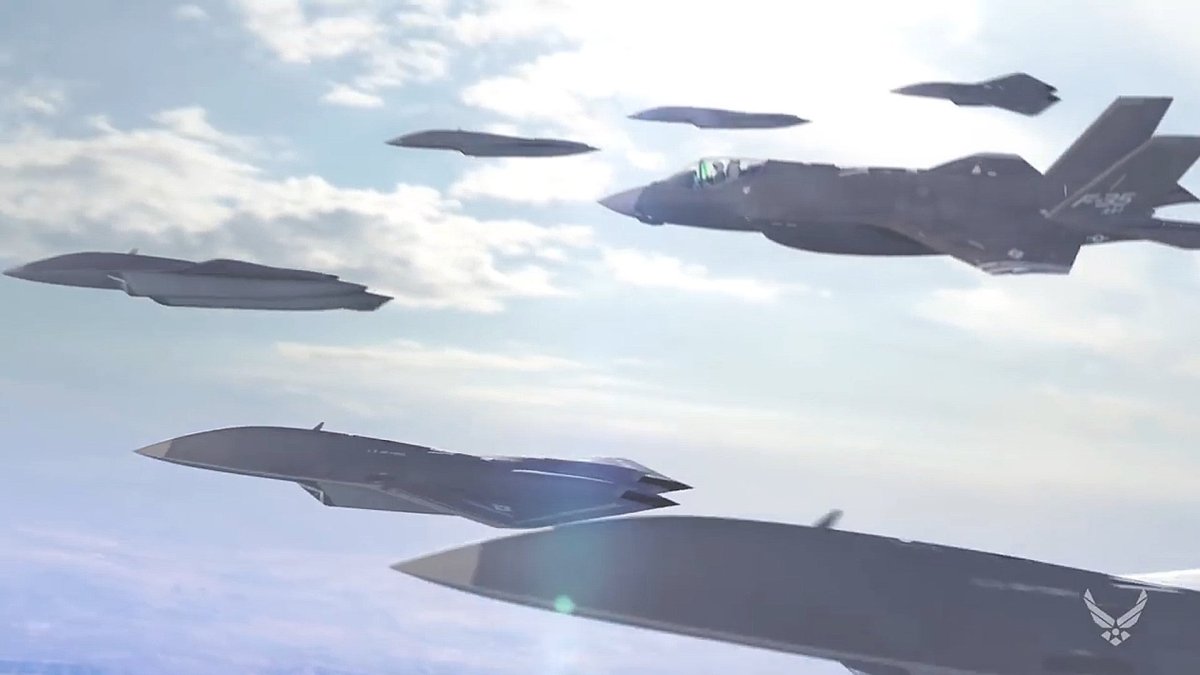
The first scene depicts an F-35A Joint Strike Fighter working together with six stealth unmanned combat air vehicles, or UCAVs. For years now, the Air Force, and AFRL in particular, has been working on this type of manned-unmanned teaming, which it has referred to as the “Loyal Wingman” concept .
In 2015, Lockheed Martin, in cooperation with the CalSpan Corporation, demonstrated the ability of a two-seat Block 50 F-16D Viper to safely fly in formation with a modified unmanned F-16 test bed, known as the Variable stability In-flight Simulator Test Aircraft, or VISTA. At times during that test, known Have Raider , the drone Viper also broke off, followed a pre-determined route independently, and then re-entered formation with the manned aircraft.
A screengrab from the Air Force 2030 video showing an F-35 and six “Loyal Wingmen” drones., USAF
Two years later, during a follow on experiment called Have Raider II , the pair of aircraft actually went through the motions of a simulated strike mission. The pilotless F-16 attacked simulated targets on the ground autonomously based on an established set of parameters, but also modified its flight pattern in response to mock threats and other changing environmental conditions.
AFRL has since released concept art of a more purpose built drone wingman under a project called Low Cost Attritable Aircraft Technology (LCAAT). That design looked very similar to the XQ-222 Valkyrie , a multi-purpose unmanned aircraft from drone maker Kratos that the U.S. Air Force also calls the XQ-58A.
Kratos recently received approval to export its less advanced UTAP-22 Mako drone , which it has tested in a loyal wingman role in the past with a U.S. Marine Corps AV-8B Harrier , which suggests that there could be more advanced designs from that company or others in a relatively mature state already available to the Air Force. With some notable exceptions , the United States is typically not inclined to make military systems available even to allies that are directly equivalent to its own top-end capabilities.
A slide from a 2017 AFRL presentation outlining the LCAAT effort., USAF
Stealthy unmanned attackers
The March 2018 video shows much more advanced loyal wingmen with completely tailless, low-observable planforms, internal weapons bays, and an in-flight refueling receptacle on top of the fuselage. Both the Air Force and the U.S. Navy have demonstrated the ability to refuel an unmanned aircraft in mid-air and the former service may have actually deployed drones with this capability.
Coupled with mid-air refueling, such a force could potentially penetrate deep into denied enemy areas full of integrated air defenses and advanced hostile fighter aircraft to destroy critical or time sensitive targets. The group would also be able to strike at those defenses, helping open up a safer path for subsequent strikes by more vulnerable non-stealthy aircraft.
In the video, the pilot in the F-35A uses the aircraft’s advance sensor suite to detect a surface-to-air missile site and orders some of his drone companions to attack it with what appears to be a GBU-39/B Small Diameter Bomb (SDB) glide bomb. This combination of a manned low-observable plane directing stealthy UCAVs to hit a target with a stand-off weapon shows just how much distance a pilot might be able to put between themselves and a threat with this operating concept.
Similar operating concepts could apply in air-to-air combat, as well, with the drones acting as missile trucks , engaging targets based on information from the controlling F-35 or another manned or unmanned asset loaded with sensors. It could also potentially help with the Air Force’s chronic pilot shortage by significantly expanding the capabilities a single manned aircraft can bring to bear across a broad area.
A screengrab showing the profile of the more advanced Loyal Wingman aircraft concept from the Air Force 2030 video., USAF
It only gets a brief and very narrow interlude in the video, but its important to note that these operations would almost certainly rely heavily on robust data links and other networked communication nodes, in the air, on the ground, and in space to rapidly relay information back and forth between manned and unmanned aircraft and other friendly forces. AFRL’s presentation shows how this might allow headquarters and air operations centers in the ground to monitor a pilots vital signs and life support systems specifically.
This is a particularly important consideration given a growing number of reported cases of hypoxia-like symptoms among aviators across the U.S. military flying a variety of fixed-wing aircraft. Hypoxia refers to a dangerous drop in oxygen getting to the brain, or an outright stop in the flow altogether, which can cause disorientation, blackouts, and even death, and is particularly dangerous for pilots. The Air Force has had to deal with these issues with regards to a wide variety of aircraft, including the F-35 , the F-22 Raptor stealth fighter , the A-10 Warthog ground attack aircraft, and the T-6 Texan II turboprop trainer. Being able to keep an eye on these issues remotely could help prevent potentially deadly accidents.
Some of the vital signs an air operations center might able to monitor remotely using data links., USAF
Beyond that, though, networked systems will also give pilots and increasingly detailed picture of the battlefield during actual operations by fuzing together different types of data from various sources. Advanced artificial intelligence may be able to help parse that information, as well, speeding up a pilot’s decision making process by weeding out low-priority data and focusing on the most significant threats.
In the video, the F-35 pilot appears to speak with a disembodied head, which could be a stand-in for an augmented reality communications system with other individuals or represent an artificial intelligence adviser of sorts explaining the situation at hand. There is the implication here that in the future a pilot may be able to issue commands to their networked wingmen using voice commands through this sort of interface, too.
An F-35 pilot engages with a computer generated head on their heads up display in the Air Force 2030 video., USAF
The AFRL video then moves on to a different drone concept, involving a canister-like module that dispenses dozens of small unmanned aircraft that work together as a swarm . The clip shows a humanoid robot pushing the entire system out the back of a C-130-type airlifter, after which a parachute deploys, suspending the system in midair, allowing the tiny planes to break off and go zipping along toward their targets.
At present, the Defense Advanced Research Projects Agency (DARPA), the Pentagon’s top advanced research and development entity, is leading this work as part of a project it calls Gremlins . Still very much in the conceptual stage, the goal for the program is to develop a system that bombers or cargo aircraft, and possibly even fighter jets, can deploy, while a C-130-sized aircraft recovers the unmanned planes after the mission if necessary.
A depiction of a parachute-retarded module deploying a drone swarm after falling from a C-130-type aircraft from the Air Force 2030 video., USAF
As we at The War Zone have written about in depth
many times before , these swarms have the potential to offer intelligence, surveillance, and reconnaissance capabilities over a broad area, as well as the ability to confuse or otherwise disrupt enemy defenses. Depending on their exact size and capabilities, they might also be able to function as munitions themselves or conduct non-kinetic attacks using electronic warfare jammers or other systems.
With that in mind, AFRL itself is working separately on a project called Gray Wolf , which aims to develop a swarming, low-cost cruise missile type weapon. the Air Force hopes it may be able to leverage the same shell to carry different, non-kentic payloads eventually.
A slide from a 2017 AFRL presentation describing the Gray Wolf program., USAF
Microwave cruise missiles
After all the drones, the video moves on to two depictions of advanced munitions and aircraft weapons. The first of these involves a B-2 Spirit stealth bomber launching a cruise missile that blacks out a city .
Together with Boeing, AFRL has actually already demonstrated the first capability in tests of a weapon known as the Counter-electronics High Power Microwave Advanced Missile Project ( CHAMP ). This system used the body of an AGM-86 Conventional Air Launched Cruise Missile (CALCM) to carry a still classified payload that uses microwave pulses to disable electronic devices.
A “blackout missile” speeds toward a power plant in the Air Force 2030., USAF
Since then, the Navy appears to have taken the lead on this project, which it refers to High-power Joint Electromagnetic Non-Kinetic Strike, or HIJENKS. The Air Force remains actively involved, though, and reportedly is responsible for the payload that will go into the prototype weapons.
The exact shell for this new system is unclear, but there were reports in the past that the stealthy AGM-158B Joint Air to Surface Standoff Missile-Extended Range (JASSM-ER) could be the basis for the new weapon. This would make sense, as this system has a number of improved features over the older AGM-86s that make it harder for an enemy to detect and potentially shoot down.
In turn, this could improve its ability to sneak into a denied area and neutralize an opponent’s key sensor networks and command and control nodes, blinding them to subsequent operations and throwing their response procedures into chaos. This gives such a weapon a powerful psychological, as well as function capability, as an enemy has no idea about the size and direction of what might be coming next. Depending on the specific platform carrying the system, it might not even be possible for them to initially determine the source of this non-kinetic strike, if at all.
A slide from a 2017 AFRL presentation taking a look at the Navy-led HIJENKS program., USAF
Laser-armed sixth generation fighters
The video ends on a clip of a notional sixth generation fighter employing a laser weapon to shoot down an enemy aircraft. This combination is also something the Air Force has expressed an interest in and maybe closer to reality than some might think.
AFRL is leading a project to develop an experimental podded solid-state laser weapon for fighter jets under the Self-protect High Energy Laser Demonstrator ( SHiELD ) program. The main goal there is to demonstrate a system that would be able to shoot down incoming missiles.
A slide from a 2017 AFRL presentation regarding the SHiELD project., USAF
But if this arrangement works, it could provide a starting place for an offensive directed energy weapon. Such a system could theoretically work in both air-to-air and air-to-ground roles and could offer a host of advantages over more traditional guns, missiles, and bombs.
The inherent ability of a laser focus its beam narrowly on a particular point could improve overall accuracy and help limit collateral damage during air strikes, especially in constrained environments such as densely populated urban areas, which is itself an increasing topic of concern across the Pentagon. Depending on the exact nature of the power source, it could also offer an effectively “bottomless magazine,” allowing an aircraft to remain on station and armed for a protracted period of time, even after engaging multiple targets.
A sixth generation fighter jet fires an offensive laser weapon in the Air Force 2030 video., USAF
And though the video shows a tailless sixth generation stealth fighter shooting down another aircraft in a stereotypical dogfight, the Air Force is still in the process of outlining what it wants from this future aircraft. In its latest budget request for the 2019 fiscal year, which it released in February 2018, the service asked for more than $500 million to continue work on this Next Generation Air Dominance (NGAD) platform, which it has also referred to in the past as Penetrating Counter Air (PCA).
This amount is nearly double what the Air Force asked for to support the NGAD program in the 2018 fiscal year. At present, there is little firm information about what this aircraft might look like beyond the service’s desire for it to be capable of flying for extended periods at supersonic speeds and be even more low-observable in order to avoid and defeat existing and emerging threats , have a long range to help give it more independence from increasingly vulnerable aerial refueling tankers , and just generally be able to operate persistently in denied areas. At present, the indication is that the goal is still have a piloted platform, but unmanned systems are increasingly the way of the future and the final design, however it evolves, may turn out to be at least pilot optional .
“We believe you have to go fight the enemy in their airspace if you want to make air superiority work,” U.S. Air Force General Mike Holmes, head of the service’s Air Combat Command, said in 2017 . “Certainly we think we’re going to pursue counter-air, we’re going to pursue suppression and destruction of enemy air defenses, we’re going to have to pursue an electronic warfare component of that.”
A notional sixth generation fighter jet blasts a target with a laser weapon., Lockheed Martin
A new air warfare paradigm
It’s an aircraft that will fit into this otherwise potentially revolutionary concept of aerial warfare. At least one concept study has even pointedly attempted to avoid using a notional “F-X” nomenclature , suggesting that the Air Force believes the final design will be functionally distinct from previous fighter jets.
An aircraft that flies together with loyal wingmen drones, engages with swarms of smaller unmanned aircraft or munitions, and carries advanced kinetic and non-kinetic weapons, could definitely fit that description. Like these other capabilities, the Air Force hopes that the NGAD will begin to enter service sometime in the 2030s.
It’s an ambitious set of goal with an equally aggressive schedule, but the Air Force believes this is necessary in order to maintain its dominance over potential opponents, especially Russia and China . The U.S. military as a whole is increasingly sounding the alarm that those countries are pursuing their own increasingly advanced military projects that are closing the capability gap, directly or indirectly , between them and the United States.
“China’s impressive military buildup could soon challenge the United States across almost every domain,” U.S. Navy Admiral Harry Harris, head of U.S. Pacific Command told members of congress earlier in 2018. “We don’t have any defense that could deny the employment of such a [hypersonic] weapon against us” by Russia or China, U.S. Air Force General John Hyten, head of U.S. Strategic Command, told legislators more recently in March 2018.
Some in the Air Force might be hesitant to call its sixth generation fighter jet the “F-X,” but its clear that slipped into the Air Force 2030 video., USAF
Finding the funds and resources to keep these research and development programs on pace while trying to sustain an increasingly complex force may pose serious challenges for the Air Force, though. The service is in the process of trying to ramp up F-35s , purchase new B-21 Raider stealth bombers , and just pay for the aircraft, personnel, and other assets it already has, which continues to be a struggle , among a host of other projects .
It’s also worth noting that many of these and other critical assets are curiously absent from this video, including the B-21 , advanced intelligence, surveillance, and reconnaissance platforms , new aerial refueling tankers , fully autonomous UCAVs , and anything space related . That latter topic is already important will only continue to become more so in the near future for a host of different reasons .
The need for more resources in general and the desire to potentially share those burdens more broadly among the reasons why AFRL and the Air Force are looking to increase their partnerships with academic institutions and private industry . This desire for more cooperative research and development in order to speed up the process overall was a significant theme in Secretary of the Air Force Wilson’s remarks in September 2017.
“We want to use methods and organizational structures that best support university-based research so that we simultaneously benefit from the work that is done and develop the next generation of American engineers and scientists that we will need as a service to take us forward into the next frontier,” she said. This strategy “will define our highest research priorities to be sure, but it will also help us strengthen new relationships between our Air Force and the science community, our universities, and our industry partners.”
And beyond just showing a potential future of air combat, AFRL’s video is, as noted, a call to action. If you think you have your own good idea, you can go to the Air Force 2030 website right now and let them know.
Contact the author: jtrevithickpr@gmail.com
Comments couldn’t be loaded. Please refresh the page.
作者:约瑟夫·特雷维西克
发布于美国东部时间2018年3月26日下午4:40
作为一项旨在振兴其先进科技工作并促进与学术界加强合作的更广泛计划的一部分,美国空军发布了一段短片,描绘了其对未来十年末空中战争的设想。这是一个充满未来感但在许多方面仍不完整的愿景,其中包含了先进的隐形有人驾驶喷气式飞机、半自主无人作战飞行器、激光和其他定向能武器,以及一个可能具备人工智能能力的网络骨干网,将所有武器系统连接起来。
空军研究实验室(AFRL)是美国空军顶尖的研发机构之一,于2018年3月初将这段视频发布到网上,作为“空军2030计划”的“行动号召”。空军部长希瑟·威尔逊于2017年在空军协会年度大会暨展览会上首次宣布了这项计划,那次大会也标志着美国空军成立70周年。
“我们将广泛听取意见,并与处于科学前沿的人士合作,以便将我们的研究工作集中在对我们未来至关重要的领域,”她在2017年9月18日的主题演讲中说道。“在联邦研究经费可能存在不确定性的时期,我们希望美国空军成为科研人员的首选资助机构。”
但很显然,空军研究实验室(AFRL)乃至整个空军,已经对自身最感兴趣的能力方向有了一定的了解。在简要概述了空军在科技研发领域已取得的显著成就之后,《空军2030》视频切换到一段电脑生成的先进空战概念蒙太奇画面。
第一个场景描绘了一架F-35A联合攻击战斗机与六架隐形无人作战飞行器(UCAV)协同作战。多年来,美国空军,特别是空军研究实验室(AFRL),一直在研究这种有人-无人协同作战模式,并将其称为“忠诚僚机”概念。
2015年,洛克希德·马丁公司与CalSpan公司合作,演示了一架双座Block 50型F-16D“蝰蛇”战斗机与一架改装的无人F-16测试平台(即可变稳定性飞行模拟器测试飞机,简称VISTA)安全编队飞行的能力。在代号为“Have Raider”的测试中,无人机“蝰蛇”有时会脱离编队,独立执行预先设定的航线,然后再重新加入有人驾驶飞机的编队。
这张截图来自美国空军2030视频,显示了一架F-35战斗机和六架“忠诚僚机”无人机。
两年后,在名为“Have Raider II”的后续实验中,这两架飞机实际执行了一次模拟打击任务。无人驾驶的F-16战机根据预设参数自主攻击地面模拟目标,同时也会根据模拟威胁和其他不断变化的环境条件调整飞行路线。
此后,空军研究实验室(AFRL)发布了一个名为“低成本消耗型飞机技术”(LCAAT)的项目下,一款用途更为明确的无人机僚机的概念图。该设计与无人机制造商克拉托斯(Kratos)生产的多用途无人机XQ-222“女武神”(Valkyrie)非常相似,美国空军也将其称为XQ-58A。
克拉托斯公司最近获准出口其技术水平较低的UTAP-22“马科”无人机。该公司此前曾与美国海军陆战队的AV-8B“鹞”式战斗机进行过僚机协同作战测试。这表明,克拉托斯公司或其他公司可能已经拥有技术更为先进且相对成熟的无人机设计,并已向美国空军交付。除少数例外情况外,美国通常不愿向盟友提供与其自身高端装备水平相当的军事系统。
这是美国空军研究实验室 (AFRL) 2017 年一份演示文稿中的幻灯片,概述了 LCAAT 项目。
隐蔽的无人攻击者
2018年3月的视频展示了更为先进的僚机,它们采用完全无尾翼、低可探测性外形设计,内置武器舱,机身顶部还设有空中加油接口。美国空军和海军都已展示了为无人机进行空中加油的能力,空军可能已经部署了具备这种能力的无人机。
结合空中加油技术,这支部队有可能深入敌方严密防空系统和先进战斗机部署的禁区,摧毁关键或时效性强的目标。该部队还能打击敌方防空系统,为后续更易受攻击的非隐形战机开辟更安全的打击路线。
视频中,F-35A战斗机的飞行员利用飞机先进的传感器套件探测到一个地对空导弹阵地,并命令几架无人机伙伴使用疑似GBU-39/B小直径滑翔炸弹(SDB)对其进行攻击。这种由有人驾驶的低可探测性飞机引导隐形无人作战飞机使用防区外武器攻击目标的战术,充分展现了飞行员运用这种作战理念能够与威胁拉开多远的距离。
类似的作战理念也适用于空战,无人机可以充当导弹运输机,根据来自指挥方F-35或其他搭载传感器的有人或无人飞行器的信息攻击目标。此外,它还能显著提升单架有人驾驶飞机在广阔区域内作战的能力,从而有助于缓解空军长期存在的飞行员短缺问题。
这是一张截图,展示了美国空军2030视频中更先进的“忠诚僚机”概念机的外形轮廓。
视频中仅用了很短的篇幅提及,但值得注意的是,这些行动几乎肯定会高度依赖于空中、地面和太空中强大的数据链路和其他联网通信节点,以便在有人驾驶飞机、无人驾驶飞机和其他友军之间快速传递信息。空军研究实验室的演示展示了这如何使地面指挥部和空中作战中心能够专门监测飞行员的生命体征和生命维持系统。
鉴于美国军方飞行员驾驶各种固定翼飞机时出现类似缺氧症状的案例日益增多,这一点尤为重要。缺氧是指大脑供氧量急剧下降,甚至完全停止,这会导致意识混乱、昏厥,甚至死亡,对飞行员而言尤其危险。空军已在多种飞机上处理过此类问题,包括F-35战斗机、F-22“猛禽”隐形战斗机、A-10“疣猪”攻击机和T-6“德克萨斯人II”涡轮螺旋桨教练机。远程监控这些问题有助于预防潜在的致命事故。
美国空军:空中作战中心或许能够利用数据链路远程监控一些关键指标。
除此之外,联网系统还能通过融合来自不同来源的各类数据,为飞行员在实际作战中提供日益精细的战场态势图。先进的人工智能技术也有助于解析这些信息,通过剔除低优先级数据并专注于最关键的威胁,加快飞行员的决策过程。
视频中,F-35飞行员似乎在和一个没有身体的头部对话,这可能是增强现实通信系统与其他人员交流的替代品,也可能代表某种人工智能顾问,用来解释当前情况。这暗示着未来飞行员或许也能通过这种界面,使用语音指令向联网的僚机下达命令。
在美国空军2030视频中,一名F-35飞行员正在与抬头显示器上的电脑生成头像进行互动。
随后,AFRL的视频展示了另一种无人机概念,该概念涉及一个罐状模块,可投放数十架小型无人机,这些无人机协同作战,形成集群。视频片段显示,一个人形机器人将整个系统从C-130型运输机的尾部推出,之后降落伞展开,将系统悬停在半空中,小型无人机脱离模块,快速飞向目标。
目前,五角大楼最高级别的先进研发机构——国防高级研究计划局(DARPA)正在牵头开展这项名为“小精灵”(Gremlins)的项目。该项目仍处于概念阶段,其目标是开发一种可供轰炸机、运输机甚至战斗机部署的系统,并在必要时由C-130大小的飞机在任务完成后回收无人机。
这是美国空军2030视频中展示的一个降落伞减速模块从C-130型飞机上坠落后展开无人机群的画面。
正如我们在“战区”网站上深入报道的那样
这些集群此前多次展现出强大的作战能力,能够对大范围区域进行情报、监视和侦察,并干扰或破坏敌方防御。根据其具体规模和性能,它们本身也可能作为弹药使用,或利用电子战干扰器或其他系统进行非动能攻击。
鉴于此,空军研究实验室(AFRL)正在独立开展一个名为“灰狼”(Gray Wolf)的项目,旨在研发一种集群式、低成本的巡航导弹武器。空军希望最终能够利用同一枚弹壳携带不同的非动能有效载荷。
这是美国空军研究实验室 (AFRL) 2017 年关于“灰狼”计划的演示文稿中的一张幻灯片。
微波巡航导弹
在展示了所有无人机之后,视频转而展示了两种先进弹药和飞机武器。第一种是B-2“幽灵”隐形轰炸机发射巡航导弹,使一座城市陷入黑暗。
美国空军研究实验室(AFRL)与波音公司合作,已在名为“反电子高功率微波先进导弹项目”(CHAMP)的武器测试中首次展示了其能力。该系统利用AGM-86常规空射巡航导弹(CALCM)的弹体携带一种仍属机密的有效载荷,该载荷使用微波脉冲来干扰电子设备。
一枚“封锁导弹”高速飞向美国空军2030年的一座发电厂。
此后,海军似乎主导了该项目,该项目被称为高功率联合电磁非动能打击(HIJENKS)。不过,空军仍然积极参与其中,据报道,空军负责原型武器的有效载荷。
目前尚不清楚这种新型系统的具体弹体,但此前有报道称,隐身性能优异的AGM-158B联合空对地防区外导弹增程型(JASSM-ER)可能是其原型。这种说法合情合理,因为与老式的AGM-86相比,该系统拥有多项改进,使其更难被敌方探测和击落。
反过来,这可以提高其潜入敌方禁区并瘫痪其关键传感器网络和指挥控制节点的能力,使其无法对后续行动做出反应,并使其应对程序陷入混乱。这赋予了此类武器强大的心理威慑力和实用性,因为敌人根本无法预知接下来可能发生的攻击规模和方向。根据搭载该系统的具体平台,敌人甚至可能根本无法确定这种非动能打击的来源。
这是美国空军研究实验室 (AFRL) 2017 年的一份演示文稿中的一张幻灯片,介绍了由海军主导的 HIJENKS 项目。
激光武器第六代战斗机
视频结尾展示了一架假想的第六代战斗机使用激光武器击落敌机的片段。空军也对这种组合表现出了兴趣,而且它可能比一些人想象的更接近现实。
美国空军研究实验室(AFRL)正在牵头开展一项名为“自卫高能激光演示器”(SHIELD)的项目,旨在为战斗机开发一种实验性的吊舱式固态激光武器。该项目的主要目标是验证一种能够击落来袭导弹的系统。
这是美国空军研究实验室 (AFRL) 2017 年关于 SHiELD 项目的一份演示文稿中的一张幻灯片。
但如果这种方案奏效,它可能为进攻性定向能武器的研发奠定基础。理论上,这种系统既可用于空对空作战,也可用于空对地作战,并且相比传统的枪炮、导弹和炸弹,它可能具有诸多优势。
激光能够将光束精确聚焦于特定点,这一固有特性可以提高空袭的整体精度,并有助于减少附带损害,尤其是在人口稠密的城市等受限环境中,而这本身就是五角大楼日益关注的问题。根据电源的具体特性,激光还可以提供近乎“无限弹药库”的弹药,使飞机即使在攻击多个目标后,也能长时间保持作战状态并处于武装状态。
美国空军2030视频显示,一架第六代战斗机发射了一枚进攻性激光武器。
尽管视频显示的是一架无尾第六代隐形战斗机在典型的空战中击落另一架飞机,但空军仍在制定对这款未来战机的具体要求。在2018年2月发布的最新2019财年预算申请中,空军申请了超过5亿美元的资金,用于继续研发这款下一代空中优势(NGAD)平台,该平台此前也被称为穿透式反空战(PCA)。
这笔款项几乎是空军在2018财年为NGAD项目申请预算的两倍。目前,除了空军希望该飞机能够以超音速长时间飞行,并具备更低的隐蔽性以规避和应对现有及新兴威胁,拥有远航程以使其摆脱日益脆弱的空中加油机的依赖,以及能够在敌方控制区域持续作战之外,关于该飞机的具体形态鲜有确切信息。目前的迹象表明,该项目的目标仍然是有人驾驶平台,但无人系统正日益成为未来的发展方向,最终的设计无论如何演变,都可能至少是可选配备飞行员的。
“我们认为,要想取得空中优势,就必须进入敌方领空与其作战,”美国空军空战司令部司令迈克·霍姆斯将军在2017年表示。“当然,我们认为我们将采取反空袭行动,我们将压制并摧毁敌方防空系统,我们还必须采取电子战手段。”
一架假想的第六代战斗机用激光武器轰击目标。(洛克希德·马丁公司)
一种新的空战模式
这款飞机将契合这种可能具有革命性意义的空中作战理念。至少有一项概念研究甚至特意避免使用“FX”这种概念性的命名方式,这表明空军认为最终设计在功能上将与以往的战斗机截然不同。
一架能够与忠诚的僚机无人机协同飞行、与成群的小型无人机或弹药交战、并携带先进的动能和非动能武器的飞机,无疑符合上述描述。与这些其他能力一样,空军希望下一代空中防御系统(NGAD)能在2030年代的某个时候开始服役。
这是一套雄心勃勃的目标,时间表也同样紧迫,但空军认为这是维持其对潜在对手(尤其是俄罗斯和中国)优势的必要之举。美国军方整体上越来越发出警告,这些国家正在推进各自日益先进的军事项目,这些项目正在直接或间接地缩小它们与美国之间的能力差距。
“中国令人瞩目的军事建设可能很快就会在几乎所有领域挑战美国,”美国太平洋司令部司令、海军上将哈里·哈里斯在2018年初对国会议员表示。“我们没有任何防御手段可以阻止俄罗斯或中国对我们使用这种(高超音速)武器,”美国战略司令部司令、空军上将约翰·海顿在2018年3月对立法者们说道。
空军内部有些人可能对将第六代战斗机称为“FX”有所顾虑,但很明显,这个名称已经出现在空军2030年宣传视频中。
然而,在维持一支日益复杂的部队的同时,如何筹集资金和资源来推进这些研发项目,对空军来说可能是一个严峻的挑战。空军目前正在努力扩大F-35战斗机的规模,采购新型B-21“突袭者”隐形轰炸机,还要支付现有飞机、人员和其他资产的费用,而这本身就是一项艰巨的任务,此外还有许多其他项目需要完成。
值得注意的是,这段视频中奇怪地缺少了许多其他关键资产,包括B-21轰炸机、先进的情报、监视和侦察平台、新型空中加油机、全自动无人作战飞行器以及任何与太空相关的内容。太空领域本身就非常重要,而且由于种种原因,在不久的将来只会变得更加重要。
空军研究实验室(AFRL)和空军寻求加强与学术机构和私营企业的合作,其原因之一是需要更多资源,并希望更广泛地分担这些负担。这种希望加强合作研发以加快整体进程的愿望,是空军部长威尔逊在2017年9月讲话中的一个重要主题。
“我们希望采用最能支持大学科研的方法和组织结构,以便我们既能从大学科研成果中获益,又能培养出我们未来发展所需的下一代美国工程师和科学家,”她说道。这项战略“无疑将明确我们最重要的科研优先事项,同时也将有助于我们加强空军与科学界、大学以及产业伙伴之间的新型合作关系。”
除了展示未来空战的一种可能形式外,正如前文所述,空军研究实验室的这段视频也是一份行动号召。如果您有好的建议,现在就可以访问空军2030网站并提交给他们。
联系作者:jtrevithickpr@gmail.com
评论加载失败,请刷新页面。