How China’s Ballistic Missile And Nuclear Arsenal Is Ballooning According To The Pentagon五角大楼称,中国的弹道导弹和核武库正在迅速膨胀
Beyond rapidly growing its ballistic missile force, the report says China could double its nuclear stockpile in the coming years.
新闻视频
By Joseph Trevithick
Updated Nov 27, 2020 6:23 PM EST
A new report from the Pentagon offers an updated public assessment of China’s ballistic missile arsenal , which shows a notable increase in its size and the scope of its capabilities. The annual review of the Chinese military also indicates that these developments are, at least in part, tied to important developments in the country’s nuclear posture and the doctrine and policies surrounding it.
The Pentagon released the latest iteration of its report on the Chinese military and its capabilities, an updated version of which it is required to send to Congress every year, by law, on Sept. 2, 2020 . It warned that the People’s Liberation Army is continuing to make strides in a variety of important and advanced technologies, including, but certainly not limited to hypersonic weapons , artificial intelligence , cyber warfare , counter-space systems , air defenses , and the construction of large capital ships and advanced submarines . The review’s discussion about ballistic missiles and nuclear capabilities, including a first-ever public estimate from the Department of Defense about the size of the Chinese nuclear arsenal, was especially significant.
“The PLARF [People’s Liberation Army Rocket Force] develops and fields a wide variety of conventional mobile ground-launched ballistic missiles and cruise missiles,” the report said. “The PRC [People’s Republic of China] is developing new intercontinental ballistic missiles (ICBMs) that will significantly improve its nuclear-capable missile forces.”
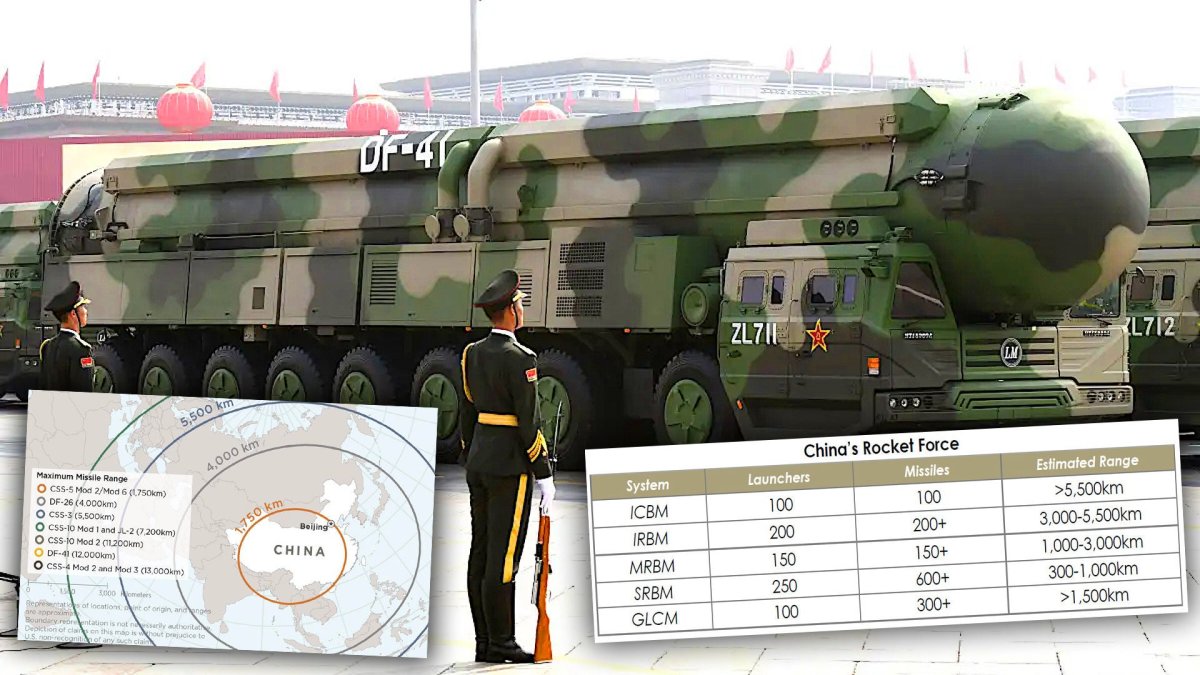
The Pentagon estimates that China has added 10 new ICBMs to its arsenal since its 2019 report, as well as 10 more launchers, including silos and road-mobile transporter-erector-launchers, to fire them. This brings to the estimated size of the country’s total operational IBCM force from 90 to 100.
The most notable addition are examples of the new DF-41 ICBM, also known to the U.S. intelligence community as the CSS-X-20, which reportedly has the ability to deploy Multiple Independently Targetable Reentry Vehicle warheads, or MIRVs , allowing a single missile to strike multiple targets. You can read more about the DF-41, which represents a significant technology leap over previous Chinese ICBMs and that the Chinese government publicly paraded for the first time last year, in this past War Zone piece . China has also been developing DF-5C and DF-31B variants of those existing ICBM types.
There is no year-over-year change in the number of short-range ballistic missile (SRBM) and medium-range ballistic missile (MRBM) launchers, though the number of total missiles in both cases have been revised. In 2019, the Pentagon said that China had between 750 and 1,500 SRBMs and between 150 and 450 MRBMs, while it simply said that the country had more than 600 SRBMs and more than 150 MRBMs in 2020. SRBMs are defined as ballistic missiles with ranges between 300 kilometers (186 miles) and 1,000 kilometers (621 miles), while MRBMs can reach distances of between 1,000 kilometers (621 miles) and 3,000 kilometers (1,864 miles).
The most dramatic change in the Pentagon’s assessment of the PLARF’s ballistic missile inventory between 2019 and 2020 was with regards to intermediate-range ballistic missiles (IRBM), which have ranges between 3,000 kilometers (1,864 miles) and 5,500 kilometers (3,417 miles). At present, China’s sole operational IRBM is understood to be the DF-26 , “which is capable of conducting both conventional and nuclear precision strikes against ground targets, as well as conventional strikes against naval targets,” according to the Pentagon. The Chinese military highlighted its long-range anti-ship ballistic missile capabilities in a recent major exercise in the South China Sea.
DF-26s on parade. , Imaginechina via AP
The new report says that the total number of DF-26 road-mobile transporter-erector-launchers has surged from 80 to 200, while the total number of actual missiles has risen from between 80 and 160 to over 200. The DF-26 is rapidly becoming one of the most important missiles in China’s arsenal, but there does not appear to have been any public discussion from Chinese authorities about such a significant expansion of this part of the PLARF. The Pentagon offers no context for how it arrived at this estimate.
The DOD’s estimates of the size of China’s ground-based ballistic missile and ground-launched cruise missile (GLCM) arsenals as of 2020., DOD
Those same estimates as of 2019., DOD
Adding 120 new TELs would very likely reflect a notable increase in the overall DF-26 force, as well as supporting elements and infrastructure. Experts have openly questioned whether this might be a typo, with the launcher figure being an accidental copy-paste of the missile figure, or some kind of other error. There is at least one clear quantitative error elsewhere in the new Pentagon report, with another section of the text saying the PLARF only has 200 SRBM launchers, instead of 250, as found in tables in both the 2020 and 2019 editions.
In addition to the ground-based ballistic missiles, the Pentagon report also notes that the People’s Liberation Army has six Type 094 Jin class ballistic missile submarines , “four operational and two outfitting at Huludao Shipyard,” each of which can carry up to 12 nuclear-tipped JL-2 submarine-launched ballistic missiles . The combination of the Type 094s and the JL-2s, which China also paraded publicly last year, represent “the country’s first viable sea-based nuclear deterrent.” The Chinese are also working to develop a follow-on ballistic missile submarine, known as the Type 096, as well as an improved submarine-launched ballistic missile, the JL-3.
JL-2 submarine-launched ballistic missiles on trucks during a parade in 2019., China Military
The DOD report also raises the possibility that the People’s Liberation Army Navy’s Type 055 warships , which it classifies as cruisers, rather than destroyers, may be able to carry anti-ship ballistic missiles of some kind in the future. It has been previously reported that the CM-401 short-range anti-ship ballistic missile, which the China Aerospace Science and Industry Corporation unveiled in 2018, might be a future armament for the Type 055. The assessment does not appear to be talking about the integration of larger ballistic missiles, such as anti-ship variants of the DF-21 or DF-26 , onto these ships.
“In October 2019, China signaled the return of the airborne leg of its nuclear triad after the PLAAF publicly revealed the H-6N as its first nuclear-capable air-to-air refuelable bomber,” the report adds. “The H-6N features a modified fuselage that allows it to carry externally either a drone or an air-launched ballistic missile (ALBM) that may be nuclear capable.”
A view of the underside of an H-6N bomber showing a semi-recessed area at the rear of the fuselage that could be used to carry an air-launched ballistic missile or other oversized payloads., Chinese Internet
The report further notes that China continues work on a reportedly flying wing-type stealth bomber, known as the H-20, but it remains unclear when that aircraft may enter service. You can read more about the H-20 in these past War Zone pieces . There is no mention of a potential advanced regional bomber program, which the Defense Intelligence Agency discussed in its public report last year and is commonly referred to as the JH-XX. You can read more about that aircraft in this previous War Zone story .
The Pentagon says that these developments are, at least in part, a component of broader efforts to expand the size and scope of the People’s Liberation Army’s nuclear capabilities. The 2020 assessment includes, for the first time ever, an estimate of how many nuclear warheads China has – “in the low-200s” – with the possibility of that stockpile doubling in the coming years. As many as 200 warheads may be capable of threatening the United Staes within the next five years, according to the review.
A map showing the respective ranges of China’s existing nuclear-capable ballistic missiles, including the CSS-4 (DF-5) ICBM, CSS-5 (DF-21) MRBM, and CSS-10 (DF-31) ICBM, in addition to the DF-26 IRBM and DF-41 ICBM., DOD
Another map showing the range of China’s various SRBMs, as well as the DF-26, in comparison to other conventional strike capabilities, including ground and air-launched land-attack and anti-ship cruise missiles. The DF-17, a ballistic missile-type rocket booster armed with hypersonic boost-glide vehicle is notably included in the “land attack missile” ring., DOD
The report offers limited detail about how the Pentagon arrived at this assessment, saying that it is due in part to the expected introduction of more MIRVed DF-41s. However, it also says “China probably has enough nuclear materials to at least double its warhead stockpile without new fissile material production,” but that it “will require increased nuclear warhead production” in order to make this a reality. The “low-200s” warhead estimate is also notably lower than past Defense Intelligence Agency assessments , as well as those from experts outside of the U.S. government, and may only reflect deployed weapons and not those held in reserve.
This assessment itself is based in part in the Pentagon’s belief that China is looking to reorganize and improve its nuclear forces to better withstand a potential first strike. It says specifically:
“The PRC’s nuclear weapons policy prioritizes the maintenance of a nuclear force able to survive a first strike and respond with sufficient strength to inflict unacceptable damage on an enemy. China is enhancing peacetime readiness levels for these nuclear forces to ensure their responsiveness. In addition, China insists its new generation of mobile missiles, with warheads consisting of MIRVs and penetration aids, are intended to ensure the viability of its strategic nuclear forces in the face of continued advances in U.S. and, to a lesser extent, Russian strategic ISR [intelligence, surveillance, and reconnaissance], precision strike, and missile defense capabilities. India also plays a factor in China’s nuclear threat perceptions.”
Part of this increased peacetime readiness could include the expansion of the PLARF’s silo-based ICBM force, according to the Pentagon. With regards to this development, it says:
“Commercial imagery from 2019 has revealed that China has constructed an ICBM silo at one of the PLARF’s Western training ranges that is smaller than China’s existing CSS-4 (DF-5) silos. According to state media, the CSS-X-20 (DF-41) ICBM can be launched from silos; this site is probably being used to at least develop a concept of operations for silo basing this system. There are also some indications that China may be building new CSS-4 (DF-5) ICBM silos.” … “Their size precludes use by the DF-5 and may support concept development for a silo-based DF-41 or one of China’s smaller ICBMs. When taken with China’s past concerns about silo survivability and ongoing strategic early warning developments, these new silos provide further evidence China is moving to a LOW [launch-on-warning] posture.”
“Commercial imagery from 2019 has revealed that China has constructed an ICBM silo at one of the PLARF’s Western training ranges that is smaller than China’s existing CSS-4 (DF-5) silos. According to state media, the CSS-X-20 (DF-41) ICBM can be launched from silos; this site is probably being used to at least develop a concept of operations for silo basing this system. There are also some indications that China may be building new CSS-4 (DF-5) ICBM silos.”
“Their size precludes use by the DF-5 and may support concept development for a silo-based DF-41 or one of China’s smaller ICBMs. When taken with China’s past concerns about silo survivability and ongoing strategic early warning developments, these new silos provide further evidence China is moving to a LOW [launch-on-warning] posture.”
Launch-on-warning refers to a nuclear deterrent policy to launch a massive counterstrike upon detecting incoming nuclear threats. This helps ensure that a retaliatory strike can be successfully initiated before the hostile weapons reach their targets.
The Federation of American Scientists (FAS) was the first to spot the silo at the PLARF’s nuclear missile training site near Jilantai in the Gobi Desert and released its own assessment in September 2019. FAS said that it was possible that this silo, which is a distinctly different design from the ones China uses for the DF-5, could be part of the development of an alternate basing option for the DF-41 or for some other future solid-fuel ballistic missile.
Satellite imagery of the silo at the PLARF training site near Jilantai that DOD included in its 2020 report on China’s military to Congress., DOD
However, at present, there does not appear to be any further public evidence of new Chinese silo construction for the DF-41 to further support the Pentagon’s assessment. There is also mention of possible rail-mobile DF-41s, something China reportedly tested in 2015 , but it is unclear how seriously the PLARF is exploring this capability. The Soviet Union notably did deploy a similar system during the Cold War, the RT-23 Molodets , and Russia more recently looking into bringing that capability back before shelving those plans in favor of missiles armed with nuclear-armed hypersonic boost-glide vehicles, known as Avangard.
The Pentagon also separately said that China’s nuclear arsenal could grow to include new warheads, including a potential lower-yield warhead for the DF-26, and new delivery systems. A lower yield nuclear weapon could indicate that the Chinese military may bee looking at a so-called escalate-to-deescalate policy, in which a limited nuclear strike could be used to bring a quick end to a conflict before outside powers might be able to intervene or to otherwise dissuade them from doing so. The U.S. government says that Russia has such a policy in its nuclear doctrine, but experts dispute that it exists.
The U.S. government has accused China , as well as Russia , of conducting low-yield nuclear tests in violation of international agreements, which could support the development of new nuclear weapons, but has not publicly provided evidence to substantiate this. In addition, as The War Zone , among others, has pointed out in the past , so-called sub-critical nuclear testing, in which there is no actual nuclear detonation, is permitted under existing arms control regimes and the U.S. conducts such experimentation, as well.
All of this comes as the United States is engaged in negotiations with Russia about extending the New Strategic Arms Reduction Treaty (START), which limits the number of nuclear warheads and various strategic delivery systems that each country can have, and is otherwise set to sunset next year. The U.S. government has been campaigning to bring China into the discussions and potentially expand the deal into a trilateral arrangement.
China has expressed virtually no interest in doing so. Beyond a spike in geopolitical friction with Washington over a host of different issues, Beijing is unlikely to see any benefit in making itself a party to such an agreement in the near future given that its existing nuclear arsenal is so small compared to that of the U.S. and Russian militaries. The Pentagon looks to be making a case in its latest China assessment for getting them to accept limits now before they can expand the size of their stockpile. Chinese officials have already countered these calls by saying it would be willing to talk nuclear arms control with the United States if it agreed to reduce its arsenal to China’s level first.
Whether or not the Chinese grow their ballistic missile and nuclear forces in the ways that the Pentagon expects, it is clear that the People’s Liberation Army is working to significantly expand its capabilities in both regards to better challenge the United States, as well as other potential adversaries.
Contact the author: Joe@thedrive.com
Comments couldn’t be loaded. Please refresh the page.
作者:约瑟夫·特雷维西克
更新于美国东部时间2020年11月27日下午6:23。
五角大楼发布的一份新报告对中国的弹道导弹武库进行了最新的公开评估,显示其规模和能力范围均显著提升。这份年度中国军力评估报告还指出,这些发展至少在一定程度上与中国核态势及其相关理论和政策的重要发展密切相关。
五角大楼于2020年9月2日发布了最新版的中国军力及其能力报告。根据法律规定,五角大楼必须每年向国会提交该报告的更新版本。报告警告称,中国人民解放军在诸多重要先进技术领域持续取得长足进步,包括但不限于高超音速武器、人工智能、网络战、反太空系统、防空系统以及大型主力舰和先进潜艇的建造。报告中关于弹道导弹和核能力的讨论尤为重要,其中包括国防部首次公开估算的中国核武库规模。
报告称,“中国人民解放军火箭军研制并装备了多种常规机动陆基弹道导弹和巡航导弹。中华人民共和国正在研制新型洲际弹道导弹,这将显著提升其具备核能力的导弹部队实力。”
五角大楼估计,自2019年报告发布以来,中国已在其武器库中新增了10枚洲际弹道导弹,以及10套发射装置,包括发射井和公路机动运输-起竖-发射车。这使得中国现役洲际弹道导弹部队的规模估计从90枚增至100枚。
最引人注目的是新型东风-41洲际弹道导弹(DF-41 ICBM),美国情报界也称之为CSS-X-20。据报道,该导弹具备部署多弹头分导式再入飞行器(MIRV)的能力,使一枚导弹能够打击多个目标。您可以在之前的“战区”(War Zone)文章中阅读更多关于东风-41的信息。东风-41相比以往的中国洲际弹道导弹,技术上实现了重大飞跃,中国政府去年首次公开展示了该导弹。此外,中国还在研发现有洲际弹道导弹的改进型,例如东风-5C和东风-31B。
短程弹道导弹(SRBM)和中程弹道导弹(MRBM)发射装置的数量与上年相比没有变化,但两者的导弹总数均有所调整。2019年,五角大楼称中国拥有750至1500枚短程弹道导弹和150至450枚中程弹道导弹;而到了2020年,五角大楼则称中国拥有超过600枚短程弹道导弹和超过150枚中程弹道导弹。短程弹道导弹的射程在300公里(186英里)至1000公里(621英里)之间,而中程弹道导弹的射程在1000公里(621英里)至3000公里(1864英里)之间。
2019年至2020年间,五角大楼对中国人民解放军弹道导弹库存评估的最显著变化体现在中程弹道导弹(IRBM)方面,这类导弹的射程介于3000公里(1864英里)至5500公里(3417英里)之间。目前,据了解,中国唯一可投入使用的中程弹道导弹是东风-26,五角大楼称其“能够对地面目标进行常规和核精确打击,也能对海上目标进行常规打击”。中国军方在近期于南海举行的一次大型演习中,重点展示了其远程反舰弹道导弹能力。
DF-26战机列队亮相。(图片来自Imaginechina via AP)
最新报告指出,东风-26导弹公路机动运输起竖发射车的总数已从80辆激增至200辆,而实际导弹总数也从80至160枚之间增至200多枚。东风-26正迅速成为中国武库中最重要的导弹之一,但中国官方似乎并未就中国人民解放军火箭军这一部分的如此大规模扩充进行任何公开讨论。五角大楼也未就其得出这一估计的依据提供任何背景信息。
美国国防部对截至2020年中国陆基弹道导弹和陆基巡航导弹(GLCM)武库规模的估计。
2019 年的这些估计与此相同。国防部
新增120套发射车很可能意味着DF-26导弹整体数量及其配套设施和基础设施的显著增加。专家们公开质疑这是否是笔误,发射车数量可能是导弹数量的误复制粘贴,或者存在其他错误。五角大楼这份新报告中至少还有一处明显的量化错误,另一部分内容称中国人民解放军火箭军只有200套短程弹道导弹发射车,而2020年版和2019年版表格中均显示为250套。
除了陆基弹道导弹外,五角大楼的报告还指出,中国人民解放军拥有六艘094型晋级弹道导弹潜艇,“四艘已投入使用,两艘正在葫芦岛造船厂进行舾装”,每艘潜艇最多可携带12枚核弹头巨浪-2潜射弹道导弹。094型潜艇与巨浪-2导弹的组合(中国去年也曾公开展示过巨浪-2导弹)代表了“中国首个切实可行的海基核威慑力量”。中国还在研发后续的096型弹道导弹潜艇以及改进型潜射弹道导弹巨浪-3。
2019年阅兵式上,中国军方展示了装载在卡车上的巨浪-2潜射弹道导弹。
美国国防部的报告还提出,中国人民解放军海军的055型巡洋舰(报告将其归类为巡洋舰而非驱逐舰)未来可能具备携带某种反舰弹道导弹的能力。此前有报道称,中国航天科工集团于2018年发布的CM-401短程反舰弹道导弹可能是055型巡洋舰未来的武器装备之一。该评估似乎并未提及将更大口径的弹道导弹,例如DF-21或DF-26的反舰型,集成到这些舰艇上的可能性。
报告补充道:“2019年10月,中国空军公开展示了首款具备核打击能力的空中加油轰炸机轰-6N,标志着中国核三位一体空中力量的回归。轰-6N的机身经过改进,可以外挂无人机或空射弹道导弹(ALBM),后者可能具备核打击能力。”
一张H-6N轰炸机底部的照片,显示机身后部有一个半凹陷区域,可用于携带空射弹道导弹或其他超大型有效载荷。(图片来自中国互联网)
报告还指出,中国仍在继续研发据称采用飞翼式隐形轰炸机的H-20,但目前尚不清楚该机何时服役。您可以在之前的“战区”文章中了解更多关于H-20的信息。报告并未提及国防情报局去年在其公开报告中讨论的潜在先进区域轰炸机项目,该项目通常被称为JH-XX。您可以在之前的“战区”文章中了解更多关于该机的信息。
五角大楼表示,这些进展至少部分是扩大中国人民解放军核能力规模和范围的更广泛努力的一部分。2020年的评估报告首次估算了中国拥有的核弹头数量——“约200枚”——并且这一数字在未来几年内有可能翻一番。评估报告指出,多达200枚核弹头可能在未来五年内对美国构成威胁。
一张地图显示了中国现有可携带核弹头的弹道导弹的射程,包括CSS-4(DF-5)洲际弹道导弹、CSS-5(DF-21)中程弹道导弹和CSS-10(DF-31)洲际弹道导弹,以及DF-26中程弹道导弹和DF-41洲际弹道导弹。(美国国防部)
另一张地图展示了中国各种短程弹道导弹(包括东风-26)的射程,并与其他常规打击能力(包括陆基和空基对陆攻击导弹和反舰巡航导弹)进行了比较。值得注意的是,东风-17——一种配备高超音速助推滑翔飞行器的弹道导弹型火箭助推器——也被列入了“对陆攻击导弹”的射程范围。(美国国防部)
该报告并未详细说明五角大楼是如何得出这一评估的,仅表示部分原因是预计中国将部署更多多弹头分导式东风-41导弹。然而,报告也指出,“中国可能拥有足够的核材料,无需生产新的裂变材料即可将其核弹头库存至少翻一番”,但要实现这一目标,“中国需要增加核弹头产量”。此外,报告估计的“200枚左右”的核弹头数量也明显低于国防情报局以往的评估,以及美国政府以外的专家的评估,而且可能仅反映了已部署的武器,而非储备武器。
这一评估部分基于五角大楼的观点,即中国正寻求重组和改进其核力量,以更好地抵御潜在的先发制人打击。评估报告特别指出:
“中华人民共和国的核武器政策优先考虑维持一支能够承受先发制人打击并以足够力量进行反击,从而对敌人造成不可接受的损害的核力量。中国正在提高这些核力量的和平时期战备水平,以确保其反应能力。此外,中国强调,其新一代机动导弹,配备多弹头分导式导弹和突防辅助装置,旨在确保其战略核力量在面对美国(以及在较小程度上俄罗斯)战略情报、监视和侦察(ISR)、精确打击和导弹防御能力的持续进步时,仍能保持其有效性。印度也是影响中国核威胁认知的一个因素。”
五角大楼表示,提高和平时期战备水平的部分措施可能包括扩大解放军后备部队的井基洲际弹道导弹部队。关于这一发展,五角大楼指出:
2019年的商业图像显示,中国在解放军火箭军西部训练场建造了一个洲际弹道导弹发射井,其规模小于中国现有的CSS-4(DF-5)发射井。据官方媒体报道,CSS-X-20(DF-41)洲际弹道导弹可以从发射井发射;该发射井可能至少用于开发该系统从发射井发射的作战概念。此外,还有一些迹象表明,中国可能正在建造新的CSS-4(DF-5)洲际弹道导弹发射井。……“这些发射井的规模使其无法用于发射DF-5,但可能用于支持DF-41或其他中国较小型号洲际弹道导弹的发射井部署概念开发。考虑到中国过去对发射井生存能力的担忧以及正在进行的战略预警发展,这些新的发射井进一步表明,中国正在转向低预警发射姿态。”
2019年的商业图像显示,中国在解放军火箭军西部训练场建造了一个洲际弹道导弹发射井,其规模小于中国现有的CSS-4(DF-5)发射井。据官方媒体报道,CSS-X-20(DF-41)洲际弹道导弹可以从发射井发射;该发射井可能至少用于开发该系统从发射井部署的作战概念。此外,还有一些迹象表明,中国可能正在建造新的CSS-4(DF-5)洲际弹道导弹发射井。
“由于尺寸限制,DF-5 无法使用这些发射井,但这些发射井可能有助于研发井基 DF-41 或中国其他小型洲际弹道导弹。考虑到中国过去对发射井生存能力的担忧以及正在进行的战略预警发展,这些新型发射井进一步证明中国正在转向低预警发射态势。”
预警式反击是指在探测到来袭核威胁后立即发起大规模反击的核威慑政策。这有助于确保在敌方武器抵达目标之前成功发起报复性打击。
美国科学家联盟(FAS)率先在戈壁沙漠吉兰台附近的中国人民解放军核导弹训练场发现了该发射井,并于2019年9月发布了自己的评估报告。FAS表示,该发射井的设计与中国用于东风-5导弹的发射井截然不同,它可能是为东风-41导弹或其他未来固体燃料弹道导弹开发替代发射井方案的一部分。
美国国防部在其2020年提交给国会的中国军事报告中,包含了吉兰台附近解放军训练基地筒仓的卫星图像。
然而,目前似乎没有进一步的公开证据表明中国正在建造新的DF-41导弹发射井,以进一步支持五角大楼的评估。另有消息称,中国可能正在研发轨道机动式DF-41导弹,据报道中国曾在2015年进行过相关测试,但目前尚不清楚中国人民解放军对这项能力的探索程度。值得注意的是,苏联在冷战期间曾部署过类似的RT-23“青年”导弹系统,而俄罗斯近年来也曾考虑恢复该能力,但后来搁置了相关计划,转而发展搭载核弹头的高超音速助推滑翔飞行器(即“先锋”导弹)。
五角大楼还单独表示,中国的核武库可能会扩充,包括新型弹头,例如可能用于东风-26导弹的低当量弹头,以及新型运载系统。低当量核武器可能表明,中国军方正在考虑所谓的“升级降级”政策,即在外部势力介入之前,使用有限的核打击迅速结束冲突,或以其他方式阻止外部势力介入。美国政府声称俄罗斯在其核战略中也包含类似的政策,但专家对此表示质疑。
美国政府指责中国和俄罗斯违反国际协议进行低当量核试验,这些试验可能有助于新型核武器的研发,但并未公开提供证据来证实这一指控。此外,正如“战区”(The War Zone)等媒体此前指出的那样,所谓的次临界核试验(即不涉及实际核爆炸的试验)在现有的军控机制下是允许的,美国也进行此类试验。
这一切都发生在美俄就延长《新削减战略武器条约》(START)进行谈判之际。该条约限制了各国拥有的核弹头数量和各种战略运载系统,原定于明年到期。美国政府一直在积极推动中国参与谈判,并有可能将该条约扩展为三边协议。
中国几乎没有表现出任何参与此类协议的兴趣。除了与华盛顿在诸多问题上地缘政治摩擦加剧之外,鉴于中国现有的核武库与美国和俄罗斯相比规模较小,北京不太可能认为在近期内加入此类协议有任何好处。五角大楼在其最新的中国评估报告中似乎正在论证,应促使中国在扩大核武库规模之前接受限制。中国官员已经反驳了这些呼吁,称如果美国同意首先将其核武库削减到中国的水平,中国愿意与美国就核军控问题进行对话。
无论中国是否会按照五角大楼的预期发展其弹道导弹和核力量,很明显,中国人民解放军正在努力大幅提升其在这两方面的能力,以更好地挑战美国以及其他潜在对手。
联系作者:Joe@thedrive.com
评论加载失败,请刷新页面。