What if my child picks the wrong secondary school?如果我的孩子选错了中学怎么办?
Thanks to MOE’s more flexible pathways, a student’s future is no longer defined by a single track. Read more at straitstimes.com.
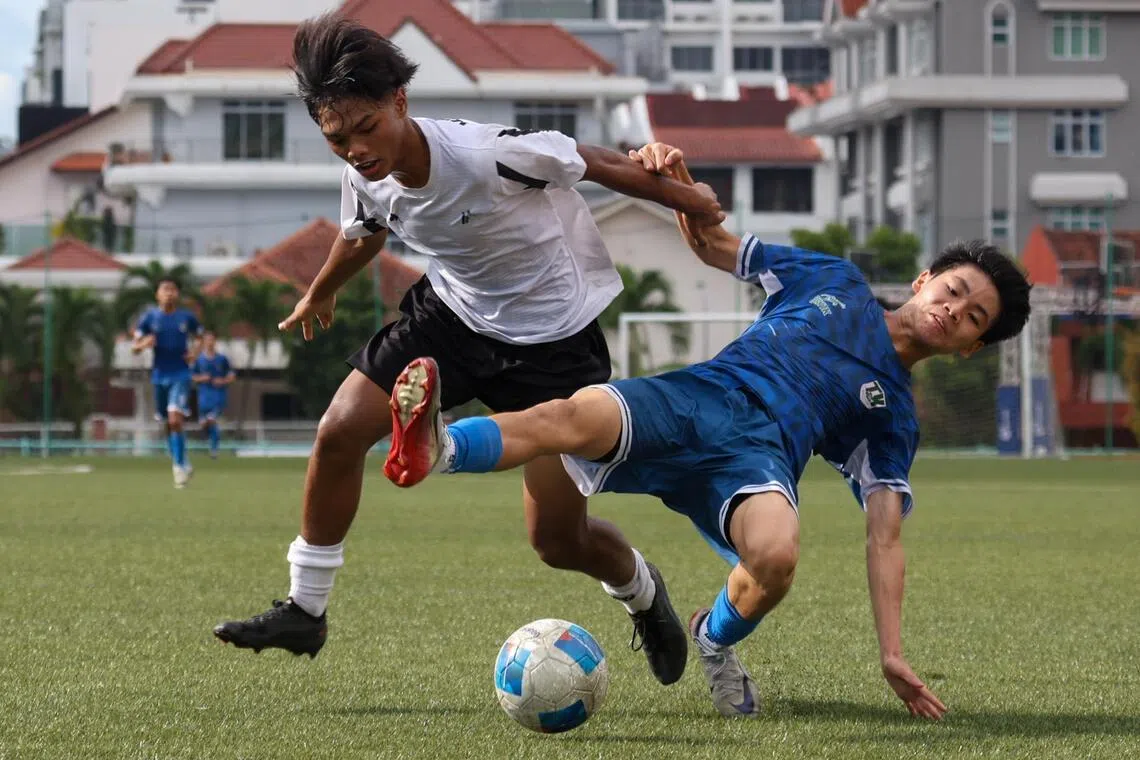
Parents should support their children’s growth by encouraging them to explore and try out different sports and activities in secondary school.
Published Nov 01, 2026, 08:45 AM
Updated Nov 01, 2026, 08:45 AM
Explore the PSLE Companion microsite for more insights and tips.
I am finding it hard to help my son choose a secondary school, as he keeps changing his mind about the type of school he wants to go to. For a while, he kept going on about an Integrated Programme (IP) school. Now, he says the O-level route may be better because he may want to go on to a polytechnic. We talked about CCAs and, again, he keeps jumping from one club to another and one sport to another. I am worried that he will pick the wrong school, and will be stuck in a pathway that doesn’t suit him and limits his post-secondary and university options.
Last week, ST Smart Parenting did a story on St Joseph’s Institution (SJI) , an independent school which offers the IP where students enrol in a seamless six-year track to a pre-university qualification without sitting the national examinations at Secondary 4.
What struck me was the advice from SJI principal Justin Pierre, who said parents should look for an environment where their child can become the best version of himself or herself.
He urged parents considering an IP school not to see the IP simply as the “more desirable” route.
Parents should bear in mind that children change considerably between the ages of 12 and 16. For instance, their interests mature, their strengths emerge and their aspirations can change, he said.
“Parents should therefore consider not only what their child is capable of academically today, but also the environment in which he or she is most likely to grow in confidence, independence and character,” he advised.
I hope parents heed his words when choosing a secondary school for their children.
Indeed, the ages from 12 to 16 represent a critical window when teens transition from childhood dependence to adult autonomy. They are likely to test out different identities, social groups and hobbies to figure out their likes and dislikes, as well as interests and aptitude.
Experts advise that where possible, parents should support this growth by encouraging them to explore and try out different things. While it can be frustrating and expensive for parents when a child abandons a hobby after a few weeks, none of that time is wasted.
A child who does a month of theatre gains public speaking confidence. Taking even a few classes on coding builds logic. A month of a new sport builds physical coordination and strength.
You are worried about your son being stuck in a school or pathway. In fact, over the years, secondary education has seen quite a few changes that allow more choices and flexibility for students to move from one track to another.
SJI, for example, despite being a popular choice among students considering the IP route, also offers the four-year programme which culminates in the Singapore-Cambridge Secondary Education Certificate. This is the new national exam that starts in 2027 and replaces the O-level exams.
So, as in the other IP schools, students who start in the six-year programme can switch to the four-year track , if they decide that it suits their further education aspirations better, such as heading to a specific diploma programme in the polytechnic instead.
Similarly, a student who starts on the O-level track may decide that he may benefit more from the IP programme and ask to switch.
In fact, based on Ministry of Education (MOE) figures, about 6% to 7% of the IP cohorts that graduated in 2022, 2023 and 2024 left before the six years were up. This translates to about 240 students in a cohort of 4,000.
MOE said about half transfer to the O-level route or join a polytechnic. Some move to other junior colleges, which, according to two students interviewed, suit them better and are less pressurising.
Others interviewed headed overseas or enrolled in international or private schools to take up degree or foundation programmes that will enable them to transfer to degree studies at British or Australian universities.
Some parents worry about the subject combinations that students can take up if they enrol in a non-IP school that offers subject-based banding.
While a student’s PSLE scores determine his or her initial posting group (PG1, PG2, or PG3) and subject levels at the start of Secondary 1, these placements are not permanent.
If your son starts Sec 1 taking a subject at G2 but demonstrates strong academic capability, he can move up to G3 in subsequent terms or years. Conversely, if a student is struggling to keep up at a G3 level, he or she has the flexibility to step down to G2.
Some parents worry that choosing certain secondary school pathways may limit their child’s post-secondary options – mainly having access to the JC and polytechnic routes and even transferring between the two pathways.
Again, quite a few students switch from the JC to polytechnic route and vice versa every year.
Some students even apply to pursue a polytechnic diploma after completing their A levels. They do so after discovering they have a talent or keen interest for a particular subject, which the polytechnic offers a course in.
And a few years ago, MOE made changes to offer a shorter pathway for A-level holders who want to take up a polytechnic diploma.
Thanks to MOE’s more flexible pathways, a student’s future is no longer defined by a single track.
Early, low-stakes exploration allows children to try different subjects and co-curricular activities. This hands-on experience builds the self-awareness they need to map out their strengths and weaknesses as they advance through the education system.
Join us at the ST Post-PSLE Forum by subscribing to the 24-month ST PSLE Companion package ($29.90 a month), and also get $180 worth of Scoot vouchers.
家长应该鼓励孩子在中学阶段探索和尝试不同的运动和活动,以此支持孩子的成长。
发布于 2026 年 11 月 1 日上午 8:45
更新于2026年11月1日上午8:45
浏览 PSLE 配套微网站,获取更多见解和技巧。
我发现很难帮儿子选中学,因为他总是改变主意,不知道该上哪种类型的学校。之前他一直念叨着要上综合课程(IP)学校。现在他又说O水准考试可能更好,因为他以后想上理工学院。我们聊过课外活动,但他又总是换着参加不同的社团和运动项目。我担心他选错了学校,走上了一条不适合他的路,限制了他升入中学和大学的选择。
上周,《海峡时报》旗下育儿栏目报道了圣约瑟书院(SJI),这是一所提供IP课程的独立学校,学生无需参加中学四年级的全国性考试,即可通过六年无缝衔接的课程获得大学预科资格。
最让我印象深刻的是圣若瑟书院校长贾斯汀·皮埃尔的建议,他说家长应该寻找一个能让孩子成为最好的自己的环境。
他敦促正在考虑私立学校的家长不要仅仅将私立学校视为“更理想的”途径。
他说,家长应该记住,孩子在12岁到16岁之间会发生很大的变化。例如,他们的兴趣会逐渐成熟,优势会逐渐显现,他们的抱负也会发生变化。
“因此,家长不仅应该考虑孩子目前的学业能力,还应该考虑孩子在怎样的环境中最有可能培养自信心、独立性和品格,”他建议道。
我希望家长们在为孩子选择中学时能听取他的建议。
事实上,12岁到16岁是青少年从儿童时期的依赖过渡到成人时期的自主的关键时期。他们可能会尝试不同的身份、社交群体和爱好,以了解自己的喜好、兴趣和天赋。
专家建议,家长应尽可能支持孩子的成长,鼓励他们探索和尝试不同的事物。虽然孩子几周后就放弃一项爱好会让家长感到沮丧和经济负担,但这些时间并没有白费。
孩子参加一个月的戏剧课程可以增强公开演讲的自信心。即使只上几节编程课也能培养逻辑思维能力。参加一个月的新运动可以提高身体协调性和力量。
您担心儿子会被困在某所学校或某条学习路径上。事实上,近年来中学教育已经发生了诸多变化,为学生提供了更多选择和灵活性,使他们能够从一条路径转到另一条路径。
例如,圣若瑟书院(SJI)虽然是考虑IP课程的学生的热门选择,但也提供四年制课程,最终获得新加坡剑桥中学教育证书(SGCSE)。这是将于2027年开始实施的新国家考试,并将取代O水准考试。
因此,与其他理工学院一样,参加六年制课程的学生可以转入四年制课程,如果他们认为四年制课程更适合他们未来的教育目标,例如转而前往理工学院攻读特定的文凭课程。
同样,一名原本选择 O-level 课程的学生可能会觉得从 IP 课程中获益更多,并要求转学。
事实上,根据教育部的数据,2022年、2023年和2024年毕业的IP班学生中,约有6%至7%在六年学业期满前就离开了学校。这意味着在4000名学生中,约有240名学生提前离校。
教育部表示,约有一半学生转而选择O水准考试路线或进入理工学院。部分学生则转入其他初级学院,据两位受访学生称,这些学院更适合他们,压力也更小。
其他受访者则计划出国深造,或者进入国际学校或私立学校攻读学位或预科课程,以便将来能够转入英国或澳大利亚的大学攻读学位。
有些家长担心,如果学生就读于提供科目分级的非IP学校,他们可以选择的科目组合会受到限制。
虽然学生的小学离校考试 (PSLE) 成绩决定了其在中学一年级开始时的初始分班组(PG1、PG2 或 PG3)和科目级别,但这些分班并非永久性的。
如果您的儿子在中一开始时选修的是G2级别的科目,但展现出较强的学习能力,他可以在后续学期或学年升入G3级别。反之,如果学生在G3级别学习遇到困难,他/她也可以灵活地降级到G2级别。
有些家长担心,选择某些中学升学途径可能会限制孩子未来的升学选择——主要是能否进入初级学院和理工学院,甚至能否在这两种途径之间转换。
每年都有不少学生从初级学院转到理工学院,反之亦然。
有些学生在完成A-level考试后,甚至会申请攻读理工学院文凭。他们这样做是因为他们发现自己对某个特定科目有天赋或浓厚的兴趣,而该理工学院恰好开设了相关课程。
几年前,教育部做出了一些改变,为希望获得理工学院文凭的A水准持有者提供了一条更短的途径。
得益于教育部更加灵活的升学途径,学生的未来不再局限于单一的路径。
早期、低风险的探索让孩子们有机会尝试不同的学科和课外活动。这种实践经验能够培养他们的自我意识,帮助他们在教育体系中不断进步,从而更好地了解自身的优势和劣势。
订阅 ST PSLE 24 个月伴侣套餐(每月 29.90 美元),即可加入 ST PSLE 后论坛,并获得价值 180 美元的酷航代金券。