Kedai Kopi Yee Fatt: A love letter to my favourite dry curry mee in Ipoh怡保义发咖啡店:写给我最爱的怡保干咖喱面的一封情书
IPOH, Nov 1 — For as long as I can remember, I have loved visiting Ipoh. The capital of Perak and a former tin-mining town surrounded by limestone hills, it has a food scene...
IPOH, Nov 1 — For as long as I can remember, I have loved visiting Ipoh.
The capital of Perak and a former tin-mining town surrounded by limestone hills, it has a food scene that needs no introduction.
It is the birthplace of white coffee. It is home to the best nga choy kai and kai si hor fun in the country. It is also my father’s hometown.
Every year, my family made the drive up numerous times: Chinese New Year, All Souls’ Day (my father was an altar boy growing up), and generally any long weekend, all spent visiting my grandparents in Canning Garden.
When I was seven, my great-grandmother died, and my parents told me we’d be heading to Ipoh in the middle of the week for the funeral.
I was over the moon. Skipping school and a trip to Ipoh? Jackpot. I couldn’t understand why everyone else looked so serious.
Shielded by my inability to grasp life and death, my memories of those trips are filled with vivid scenes: jagged limestone towers bathed in red as the setting sun cast its rays over the Kinta Valley; my own reflection in the long, seemingly endless mirror at Thean Chun, as I waited for a bowl of kai si hor fun ; and, most memorably, the thick, chunky sludge that is Hainanese dry curry at Yee Fatt.
Ipoh may be best known for kai si hor fun , but my favourite thing to eat in this city is dry curry mee .
And my favourite place to eat it is at Kedai Kopi Yee Fatt. It has stood across the Methodist Girls’ School on Jalan Raja Permaisuri Bainun since 1955, when the road was still named Jalan Kampar.
In the seven decades since, Yee Fatt has come to be defined by its dry curry, typically served over noodles with char siew , siew yoke or chicken (sometimes all three), and even on lo mai kai .
Klang Valley curry mee is a different thing: it’s much closer to curry laksa , and to laksa as a genre, than to dry curry, which is unique to Ipoh.
Its roots lie with the Hainanese, who arrived in the city much later than the Hokkien, Cantonese, Teochew and Hakka.
Many ended up cooking in colonial households or running kopitiams like Yee Fatt, combining the techniques and ingredients of the melting pot around them, and dry curry emerged as one of Ipoh’s emblematic creolised foods.
There are many temples to dry curry in the city: Xin Quan Fang, also known as ma ta liu (Cantonese for police station) for its proximity to the police station; Sun Seng Fatt, which made a short-lived attempt at expanding to KL ; and Yat Yat Seng, or as I knew it growing up, Fei Lou Wu, which fared much better in KL .
But none has a dry curry quite as thick or as complex as Yee Fatt’s.
In my admittedly nascent lifetime, I have never seen Yee Fatt have a quiet morning. The crowd comes early, and ever since pockets of the internet discovered the place, the weekend crowd has only grown.
Arriving before 8.30am is crucial to avoiding a wait and, more importantly, to getting there before the siew yoke and lo mai kai sell out.
My move is always to order the dry curry with all three meats (RM15) and a side of lo mai kai with curry sauce (RM7). They always ask if I want to take a look at the zhar liu . I always politely decline.
Then we wait, taking in the room: the classic tiling on the floors and walls, the marble tables, the occasionally chipped china.
The lo mai kai is usually the first to arrive, still under a steaming metal bowl, with a small bowl of curry on the side.
The first spoonful matters most: curry over soft, sticky glutinous rice, sometimes with a sliver of char siew or mushroom hiding in it.
It’s like smearing kaya on pulut tai tai , only spicier, more savoury, more robust. The subtle sweetness of the rice dovetails with the curry beautifully.
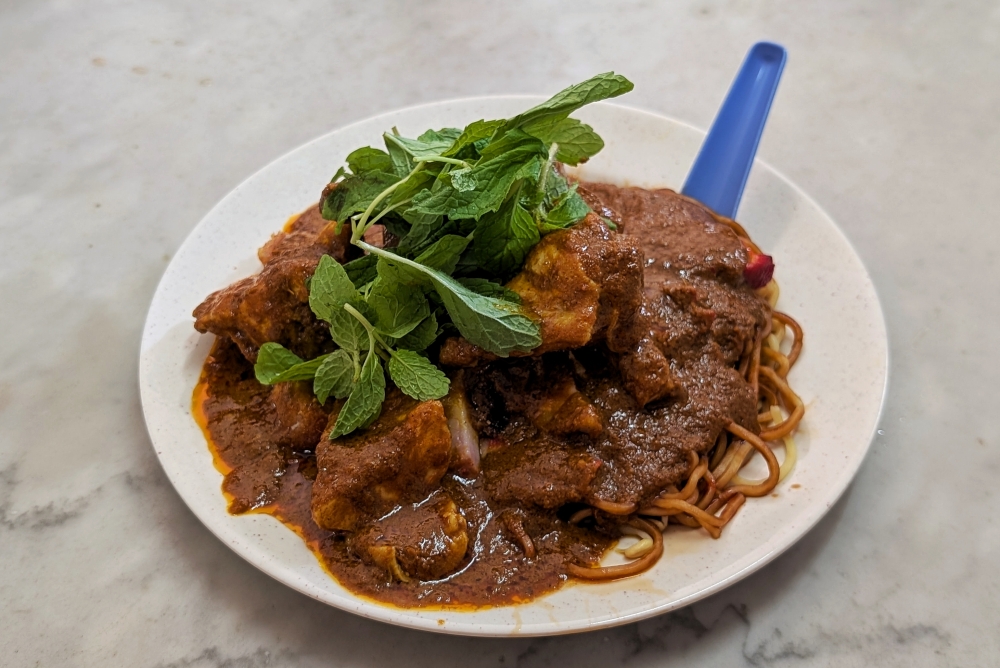
Then comes the centrepiece: a mountain of noodles, bean sprouts, chicken, siew yoke and char siew , completely smothered in a thick, reddish sludge of curry.
No word, or series of words, quite captures it. It clings to the lips, stays on the tongue and remains in the brain.
Rich, savoury, spicy, nutty and aromatically complex, thanks to a proprietary blend purported to contain 10 spices, it is unlike anything else I have eaten. That was true 20 years ago, and it is true to this day.
Every time I come back to Yee Fatt, I feel a pit in my stomach, worried that one day it might not be the same.
Of course, it isn’t identical to what I ate 20 years ago. The sign even got a facelift recently. But the dry curry tastes just as incredible.
The wait feels just as agonising. And the post-meal heaviness feels… well, just as heavy. Maybe heavier as I get older, actually.
Very few things in this world, especially restaurants, get to stay the same as the world changes around them. Selfishly, I hope Yee Fatt does.
It is a perfect slice of nostalgia and honest satisfaction, one of the last I have left. If this is the last plate of dry curry mee I ever have from Yee Fatt, I will mourn it.
But I will be immensely grateful to have eaten it at all.
39, Jalan Raja Permaisuri Bainun,
Open Tuesday to Sunday, 7.30am—2pm
Facebook: Yee Fatt Tea Shop
* This is an independent review where the writer paid for the meal.
* Follow us on Instagram @eatdrinkmm for more food gems.
* Follow Ethan Lau on Instagram @eatenlau for more tales of a childhood fuelled with curry mee .
From Slim River to rugby weekends: How Kelapa gives fresh coconut water a semi-frozen twist
Teochew House in Mont Kiara’s Steppes offers finer Teochew dishes and a superb sweet and sour pork
Battered Fish & Chip Co. brings a faithful British chippy experience to REXKL
Police detain 17 after viral clip alleges brawl at Ampang flats
RM30m Media Innovation Fund 2.0 to strengthen newsrooms and protect jobs, says Bernama CEO
One Bukit Changgang flood bank project ready next week, months ahead of January 2027 target, says Irrigation Dept
怡保,11月1日讯——我从小就喜欢去怡保。
霹雳州首府,曾经的锡矿小镇,四周环绕着石灰岩山丘,其美食无需赘述。
这里是白咖啡的发源地,也是全国最好的鸭豉鸡和鸡丝河粉的故乡,更是我父亲的故乡。
每年,我的家人都会多次驱车前往坎宁花园探望祖父母:春节、万灵节(我父亲小时候是祭坛侍童),以及任何长周末。
我七岁那年,我的曾祖母去世了,我的父母告诉我,我们将在周中前往怡保参加葬礼。
我简直欣喜若狂。逃学还能去怡保玩?太棒了!我不明白为什么其他人看起来都那么严肃。
由于我对生死一无所知,所以对那些旅行的记忆充满了生动的场景:夕阳西下,金塔谷的嶙峋石灰岩塔被染成红色;在天春餐厅,我等着吃一碗鸡丝河粉,镜子里映出我的身影;还有,最令人难忘的,是义发餐厅那浓稠厚实的海南干咖喱。
怡保可能以鸡丝河粉闻名,但我最喜欢在这个城市吃的是干咖喱面。
我最喜欢去的地方是义发咖啡店(Kedai Kopi Yee Fatt)。这家咖啡店自1955年起就位于拉惹柏迈苏里拜浓路(Jalan Raja Permaisuri Bainun)卫理公会女子学校对面,当时这条路还叫金宝路(Jalan Kampar)。
此后的七十年间,义发以其干咖喱而闻名,通常搭配叉烧、烧肉或鸡肉(有时三者兼有)浇在面条上,甚至搭配糯米鸡。
巴生谷咖喱面与其他地方的咖喱面有所不同:它更接近咖喱叻沙,也更接近叻沙这种菜系,而不是怡保特有的干咖喱。
它的根源在于海南人,他们比福建人、广东人、潮州人和客家人晚得多才来到这座城市。
许多人最终在殖民家庭中掌勺,或者经营像怡发咖啡店这样的咖啡馆,将周围文化熔炉中的烹饪技巧和食材融合在一起,干咖喱由此成为怡保最具代表性的克里奥尔美食之一。
吉隆坡有很多干咖喱店:新泉坊,又名“马太楼”(粤语意为警察局),因为它靠近警察局;新盛发,曾短暂尝试在吉隆坡扩张;还有逸逸生,或者我小时候所熟知的飞楼屋,它在吉隆坡发展得更好。
但没有哪家餐厅的干咖喱能像 Yee Fatt 的那样浓稠或味道复杂。
在我尚且短暂的人生中,我从未见过义发街清晨的宁静。人群总是很早就涌来,自从一些网络用户发现了这个地方,周末的人潮更是与日俱增。
早上 8 点 30 分之前到达至关重要,这样可以避免排队等候,更重要的是,可以赶在烧肉和糯米鸡售罄之前到达。
我每次都点一份干咖喱,里面有三种肉(15令吉),再加一份咖喱糯米鸡(7令吉)。他们总是问我想不想看看炸柳,我总是礼貌地拒绝。
然后我们等待着,打量着房间:地板和墙壁上经典的瓷砖,大理石桌子,偶尔出现的缺口瓷器。
捞麦鸡通常是最先端上来的,还盛在热气腾腾的金属碗里,旁边还会配上一小碗咖喱。
第一口最重要:咖喱浇在软糯的糯米饭上,有时里面还会藏着一小片叉烧或蘑菇。
这就像在糯米饭上抹咖椰酱,只是更辣、更鲜美、更浓郁。米饭的淡淡甜味与咖喱完美融合。
接下来是主菜:一座由面条、豆芽、鸡肉、烧肉和叉烧组成的小山,完全被浓稠的红色咖喱酱汁覆盖。
任何词语,甚至任何词语组合,都无法完全捕捉到它。它萦绕在唇边,留在舌尖,久久不散。
它味道浓郁、鲜美、辛辣、带有坚果香气,而且风味层次丰富,这要归功于一种据称包含十种香料的独家配方,它与我吃过的任何其他食物都截然不同。20年前如此,至今依然如此。
每次回到义发,我都会感到心里忐忑不安,担心有一天这里会变得不一样。
当然,这和我20年前吃到的味道不一样。就连招牌最近都翻新过了。不过,干咖喱的味道依然棒极了。
等待的过程同样令人煎熬。饭后那种沉重感……嗯,也同样沉重。或许随着年龄增长,这种沉重感还会加剧。
世间万物,尤其是餐厅,能够随着时代变迁而保持不变的寥寥无几。说实话,我真心希望怡发餐厅能够如此。
这道菜完美地承载了怀旧之情和真挚的满足感,也是我仅存的几份之一。如果这是我最后一次在义发吃到干咖喱面,我会非常难过。
但我会无比感激自己曾经吃过它。
39, Jalan Raja Permaisuri Bainun,
周二至周日,上午7:30至下午2:00营业
Facebook:义发茶店
* 这是一篇独立评论,作者自行支付了餐费。
* 关注我们的Instagram账号@eatdrinkmm,获取更多美食资讯。
* 在 Instagram 上关注 Ethan Lau @eatenlau,了解更多关于他与咖喱面相伴的童年故事。
从斯利姆河到橄榄球周末:Kelapa 如何赋予新鲜椰子水半冰冻的独特风味
位于满家乐草原的潮州楼提供更精致的潮州菜和一流的糖醋里脊。
Battered Fish & Chip Co. 为 REXKL 带来正宗的英式炸鱼薯条体验
警方拘留17人,此前一段疯传的视频显示安邦组屋发生斗殴事件。
马新社首席执行官表示,将设立3000万令吉媒体创新基金2.0,以加强新闻编辑室并保障就业。
灌溉部表示,武吉昌岗一号防洪堤项目将于下周完工,比原定于2027年1月的目标提前数月。