I went on an aerial obstacle course twice with my adult daughter with autism. Here’s what I learnt我陪着患有自闭症的成年女儿两次体验了空中障碍赛。以下是我的心得体会。
A mother reflects on doing an aerial obstacle course twice with her adult daughter with autism at Outward Bound Singapore. Read more at straitstimes.com.
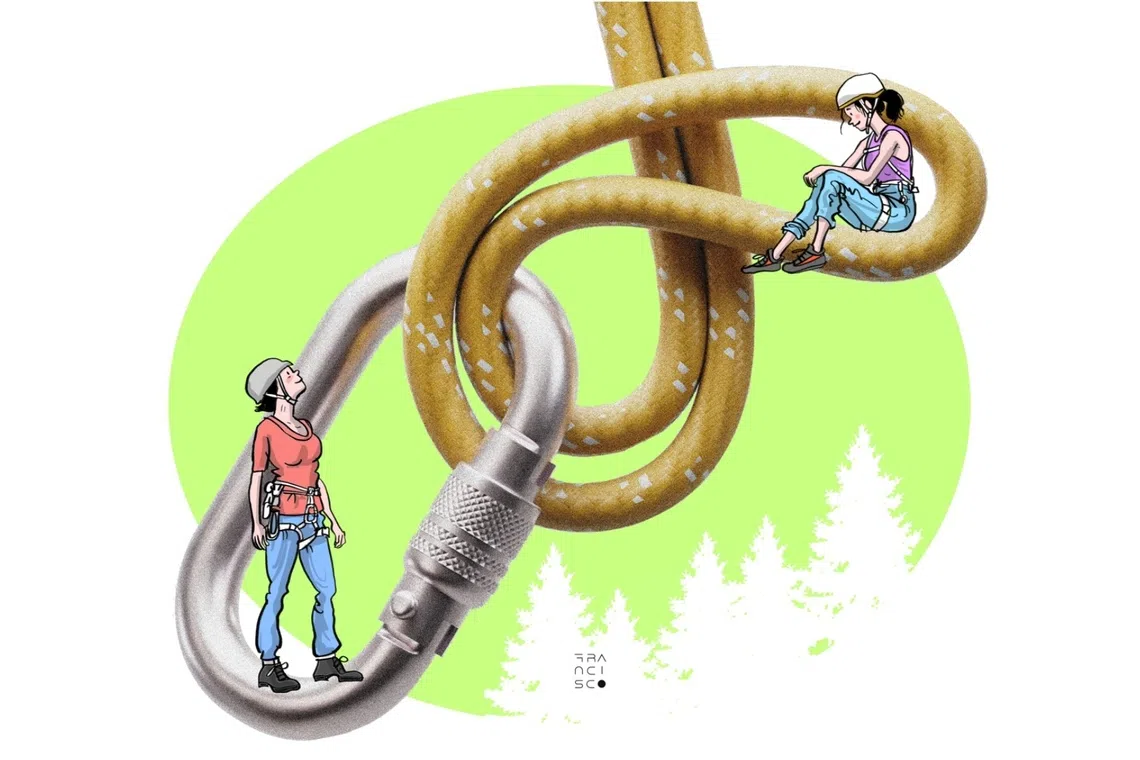
The writer and her 22-year-old daughter with autism, Kate, tackled an obstacle course in the trees, navigating safety gear, suspended planks and fears.
ST ILLUSTRATION: MANNY FRANCISCO
Published Nov 01, 2026, 11:45 AM
Updated Nov 01, 2026, 11:45 AM
A mother and her 22-year-old daughter with autism tried an aerial obstacle course in Singapore.
The daughter coped better than expected, while the mother struggled with harnesses, carabiners and fear.
They returned three days later and finished more easily, leaving the mother with more confidence and plans to try again.
SINGAPORE – There we were, my adult daughter with autism, Kate, and I on an obstacle course among the trees.
Why? Because of my impulse to do something adventurous after reading about the new Outward Bound Singapore campus in September .
A week later, 3m above the ground, I felt a stab of regret. Also, nervousness, timidity, tension and a touch of self-pity.
My initial concern had been for Kate, who is 22 and somewhat resistant to new and difficult things. Would she struggle out of her safety harness? Have a meltdown? Or – nightmare – freeze mid-course, unable to move forward or backwards ?
Ironically, Kate did swimmingly. She stepped confidently over large gaps and across swinging elements of the obstacle course. She didn’t like it much, but she kept going.
I was the one painfully inching my way along a narrow plank, clinging to any handhold within reach, hopelessly trying to pull a suspended board closer and finally, gingerly, putting out a foot because I had to.
Before starting our session on the most basic kids’ course (“ages five and up”), we had to step into our harnesses and pull them up to our waists.
While the harness felt bulky around my thighs and uncomfortably tight around my waist, Kate seemed unfazed. My hopes for a successful outing rose.
She willingly gave the introductory practice circuit a try. However, getting used to the safety gadgets was trickier.
The carabiner we each had, linked to our harnesses, looked effortless to open with one hand during the trainer’s demonstration.
On the actual circuit, I was all fingers and thumbs when I had to hook the carabiner onto the safety line or back onto my belt loop.
Unfamiliar with where the belt loop was – to the left and towards the back of my harness – I often missed the loop or hooked my carabiner onto the wrong strap. I needed two hands and all my attention to get it right.
Adding to my stress, I had to do this for Kate as well, all while trying to keep her happy – picture me singing The Carpenters’ cheerful Top Of The World while I fumbled as fast as I could.
I tried to get her to do it on her own, but there are moments when a repeated instruction can take you only so far.
Kate could not coordinate her fingers and also did not seem to be able to picture how to use the safety gadgets. I mostly stepped in before frustration erupted for both of us.
Another challenge was getting used to the pulley or trolley, a safety device connected to the harness by a cord.
The trolley slides onto a safety line and rolls alongside the user throughout the course.
It was reassuring from a safety point of view, but it sometimes complicated our progress.
For example, it could get slightly stuck. Wiggling it would get it moving again, but Kate didn’t always manage that and I had to free her device for her.
At one point, she was going down some winding steps ahead of me when her trolley stopped. Oblivious, she continued heading down and the cord was pulled taut, fixing the trolley in place.
What Kate needed to do was climb back up to give the cord some slack, but she wanted only to keep going, and when she couldn’t, she became agitated, jerking forward harder and harder.
Because space was tight, I was unable to reach her.
I can only thank my lucky stars that, from the step above, I was able to bend practically double at the waist to haul her up a tiny bit, just enough for me to wiggle the trolley loose with my other hand.
If I had not done that, we would have been stuck there for much longer, and she could have become violently upset.
It was a good reminder that even as I see to her activities and fitness, I also need to work on my own strength, flexibility and range of motion for our sakes.
Not just to tick a box
We completed the basic course with no major mishaps and I decided to stop while Kate’s mood remained upbeat, so she would remember the day and activity positively.
However, I didn’t want the experience to feel like a check in the box, where one whizzes through something just to say it has been done. So we went again three days later.
On our second try, everything felt more familiar and less daunting. I was more confident on the swinging slats and clutched at the ropes less. The height no longer troubled me. I handled the carabiner better, even managing it with one hand at times.
Kate was calmer, smiled more and could occasionally attach her carabiner to the safety line herself, with verbal prompts.
Buoyed by the experience, I hustled her towards the more challenging section of the kids’ course once we finished the basic one.
That went mostly smoothly too, aside from one moment on the rope net, which Kate had already completed.
We had to traverse the rope net from right to left. I was in the middle, hating the softness of the ropes that sank under my feet. I felt inept, my arms ached, my hands were sore and the whole rope contraption swung. I even called out to the staff: “Can I leave this and go down those stairs?”
They cheerfully urged me on and I eventually joined Kate at the platform at the end of the net, from where we completed the course with a clumsy zip-line landing.
My takeaways from our two adventure-filled days:
Kate is probably stronger and more capable than I realise. I need to figure out how to channel that hidden ability.
I am probably stronger and more capable than I realise.
I will count it as a blessing when I am taken out of my comfort zone by a loved one.
Adventures are good. Difficult, tiring, but also exhilarating and potentially life-affirming.
Kate left without a look back, but I swore to myself that we would do this again. Maybe we will even attempt the junior course, for ages 10 and up.
Jill Lim is a mother of three and a book editor with Straits Times Press. She has written four children’s books, including My Colouring Book Is Ruined!, about a child with autism.
这位作家和她患有自闭症的 22 岁女儿凯特一起挑战了树林中的障碍赛,她们需要借助安全装备、悬挂的木板,克服恐惧。
插图:曼尼·弗朗西斯科
发布于 2026 年 11 月 1 日上午 11:45
更新于2026年11月1日上午11:45
一位母亲和她患有自闭症的22岁女儿在新加坡尝试了空中障碍赛。
女儿的表现比预期的要好,而母亲则在安全带、登山扣和恐惧中挣扎。
三天后,他们返回并顺利完成了任务,这让母亲更有信心,并计划再次尝试。
新加坡——当时,我和我患有自闭症的成年女儿凯特正在树林间进行障碍训练。
为什么?因为我在九月份读到关于新加坡户外拓展训练营新校区的报道后,就萌生了冒险的念头。
一周后,在离地3米的高空,我感到一阵强烈的后悔。同时,还有紧张、胆怯、焦虑和一丝自怜。
我最初担心的是凯特,她22岁了,对新事物和困难的事情有些抗拒。她会不会挣脱安全带?会不会情绪崩溃?或者——噩梦——在半路上僵住不动,既不能前进也不能后退?
讽刺的是,凯特表现得非常出色。她自信地跨过宽阔的缝隙,穿过障碍赛道上摇晃的障碍物。她并不太喜欢这项运动,但她坚持了下来。
我当时正艰难地沿着一条狭窄的木板挪动,紧紧抓住任何可以抓住的东西,绝望地试图将悬空的木板拉近,最后,我不得不小心翼翼地伸出一只脚。
在开始我们最基本的儿童课程(“五岁及以上”)之前,我们必须穿上安全带,并将其拉到腰部。
虽然安全带勒得我大腿很臃肿,腰部也勒得难受,但凯特似乎毫不在意。我对这次出行成功的希望也随之高涨起来。
她欣然尝试了入门练习赛道。然而,适应安全装置却比较棘手。
在教练的演示中,我们每个人身上都带着一个与安全带相连的登山扣,看起来用一只手就能轻松打开。
在实际的赛道上,当我需要将登山扣钩到安全绳上或挂回腰带环上时,我总是手脚不便。
由于不熟悉腰带环的位置——它在安全带的左侧后方——我经常找不到腰带环,或者把登山扣挂错带子上。我需要双手并用,并且全神贯注才能正确操作。
更让我感到压力的是,我还要为凯特做这件事,同时还要努力让她开心——想象一下,我一边笨手笨脚地笨拙地摸索,一边唱着卡朋特乐队欢快的《世界之巅》。
我试着让她自己去做,但有些时候,反复的指示也只能起到有限的作用。
凯特的手指不协调,而且似乎也无法想象如何使用那些安全装置。我及时介入,才避免我们俩都感到沮丧。
另一个挑战是习惯使用滑轮或小车,这是一种通过绳索连接到安全带的安全装置。
手推车滑到安全线上,并在整个赛道上伴随使用者滚动。
从安全角度来看,这令人安心,但有时却使我们的进展变得复杂。
例如,它可能会稍微卡住。晃动一下就能让它重新动起来,但凯特并非每次都能做到,这时我就得帮她把设备弄出来。
有一次,她走在我前面,沿着蜿蜒的台阶往下走,这时她的手推车停了下来。她浑然不觉,继续往下走,结果拉绳被拉紧,手推车被固定住了。
凯特需要做的就是爬回去放松一下绳子,但她只想继续往前走,当她走不动时,她变得焦躁不安,越来越用力地向前猛冲。
由于空间狭小,我无法接近她。
我只能庆幸自己站在上面的台阶上,几乎弯下腰,把她稍微拉起来一点,这样我就可以用另一只手把手地把手推车弄松。
如果我没有那样做,我们就会在那里被困更久,她可能会变得非常生气。
这提醒我,即使我照顾她的活动和健身,为了我们俩,我也需要努力增强自己的力量、柔韧性和活动范围。
不仅仅是为了勾选一个选项
我们顺利完成了基础课程,没有发生任何重大事故。我决定趁凯特的心情还不错的时候就停下来,这样她就能对这一天和这项活动留下积极的印象。
然而,我不想让这次体验感觉像是为了完成任务而匆匆忙忙地过一遍。所以三天后我们又去了一次。
第二次尝试时,一切都感觉更熟悉了,也不再那么令人畏惧。我在摇摆的木条上更有信心了,抓绳子的次数也减少了。高度不再让我感到害怕。我更好地操控了登山扣,有时甚至能单手操作。
凯特变得更加平静,笑容也更多了,偶尔还能在口头提示下自己把登山扣扣到安全绳上。
受到这次经历的鼓舞,我们完成基础课程后,我便催促她前往儿童课程中更具挑战性的部分。
除了绳网上的一个小插曲(凯特已经完成了)之外,其他一切都进行得很顺利。
我们必须从右往左穿过绳网。我站在中间,讨厌那柔软的绳子陷进脚底的感觉。我觉得自己笨手笨脚的,胳膊酸痛,手也疼,整个绳网还在摇晃。我甚至冲着工作人员喊道:“我可以离开这里,走下楼梯吗?”
他们兴高采烈地鼓励我,我最终和凯特一起到达了网的尽头的平台上,我们从那里笨拙地滑索着陆,完成了整个课程。
两天充满冒险的旅程,我的心得体会如下:
凯特可能比我意识到的更强大、更有能力。我需要想办法引导她发挥这种隐藏的才能。
我可能比自己意识到的更强大、更有能力。
如果能被心爱的人带出舒适区,我会把它视为一种福气。
冒险是件好事。虽然艰难、疲惫,但也令人兴奋,甚至可能让人重拾人生意义。
凯特头也不回地走了,但我暗暗发誓我们一定要再来一次。也许我们还会尝试一下10岁及以上儿童的初级课程。
吉尔·林是三个孩子的母亲,也是《海峡时报》出版社的图书编辑。她写过四本儿童读物,其中包括讲述一个自闭症儿童故事的《我的涂色书毁了!》。