askST: What are deregistered vehicles, and why are they a problem?askST:什么是注销车辆?为什么注销车辆会造成问题?
The driver of the Audi that caused the fatal Tampines crash on Oct 29 is alleged to have used a deregistered vehicle. Read more at straitstimes.com.
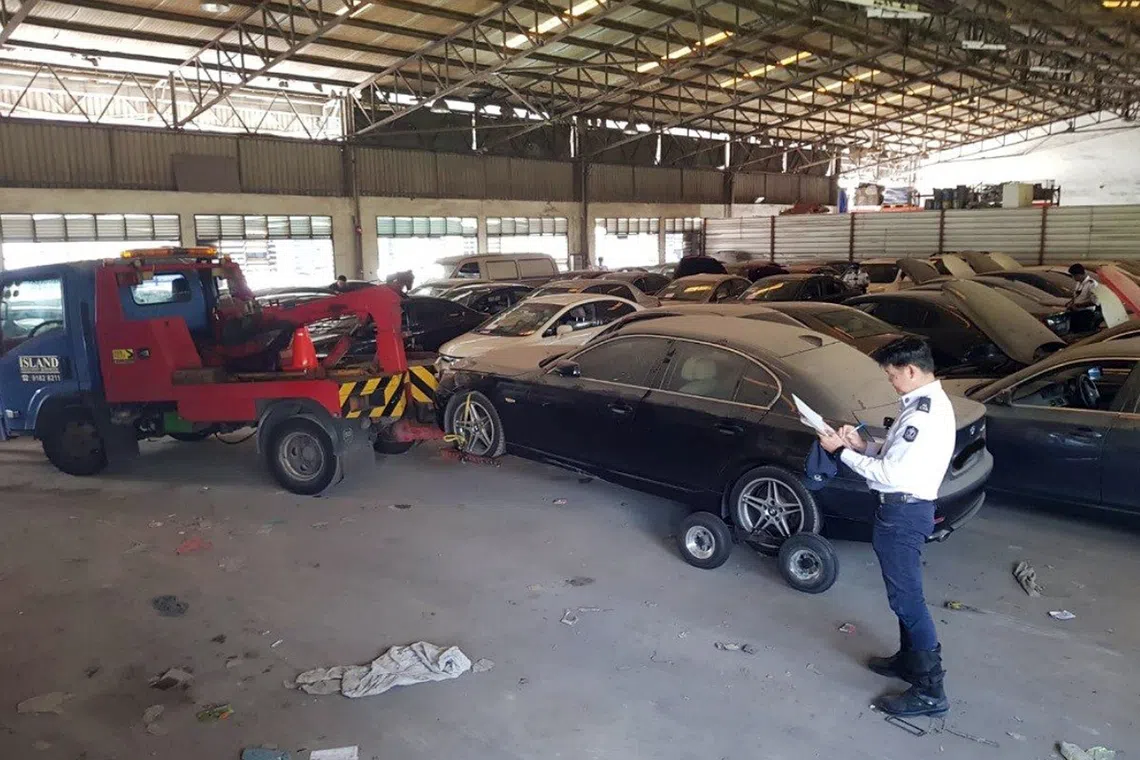
Deregistered vehicles that were seized in 2018. There has been an increasing number of reported cases of deregistered vehicles being used on roads here.
Published Nov 02, 2026, 05:40 PM
Updated Nov 02, 2026, 05:40 PM
Deregistered vehicles have had their registration cancelled, so they have no valid road tax, insurance or COE. They are illegal on roads and pose serious safety risks.
They have been linked to hit-and-runs and crime, including drug trafficking. Cases rose from 40 in 2022 to 245 in 2025, with 122 more in the first five months of 2026.
Singapore is tightening enforcement and laws. New bills raise penalties and make authorised exporters responsible, with tougher offences for selling or supplying such vehicles.
SINGAPORE – The fatal Tampines crash on Oct 29 involved a blue Audi that ploughed through the road divider and slammed into a motorcycle and another car along Tampines Avenue 12, killing the motorcyclist and his pregnant wife who was riding pillion.
Although the Audi driver and his passenger fled the scene, they were arrested the next day.
The driver, Muhammad Zulfiqar Abdul Aziz, 30, was handed nine charges on Oct 31, including one for using a deregistered vehicle.
There has been an increasing number of reported cases of deregistered vehicles being used on roads here.
More than 240 cases of such vehicles were investigated in 2025 for their involvement in criminal activities and hit-and-run accidents.
What are deregistered vehicles?
Deregistered vehicles are motor vehicles that have had their official registration cancelled, and no longer have valid road tax, insurance or a certificate of entitlement.
These include both cars and motorcycles.
Typically, owners deregister their vehicles close to the end of their 10-year certificate of entitlement.
Deregistration entails an administrative process that includes clearing financial obligations and submitting proof of disposal to the Land Transport Authority (LTA).
The vehicle is supposed to be either scrapped at an LTA-appointed scrapyard, exported, or stored temporarily at an LTA-appointed Export Processing Zone pending export.
Alternatively, owners can engage a motor dealer to help them dispose of the vehicle.
Once deregistered, the vehicles are illegal to use.
The authorities also say these vehicles pose serious road safety risks as they do not have valid insurance and are not roadworthy.
How are these vehicles on Singapore’s roads?
LTA had said it could not disclose how deregistered vehicles find their way back onto Singapore’s roads, citing confidentiality of investigations.
However, past court cases provide some idea.
In 2021, a man was jailed for selling and renting deregistered cars which were used to commit crime. The scheme involved buying cars with certificates of entitlement close to expiry, and grinding off their chassis and engine numbers.
The licence plates of these cars were replaced with clones of existing registered cars of similar colour, make and model.
Their in-vehicle units were also replaced with those of other registered vehicles.
Documents that made the vehicles appear to have been exported or about to be exported were submitted to the authorities.
The modified cars were touted as untraceable, and were sold and rented on a no-questions-asked basis.
No checks were conducted on whether the buyers were even legally allowed to drive.
Deregistered cars sold and rented by the man were used in at least six other criminal cases , including those involved in road traffic violations and in a case of unlicensed moneylending-related harassment.
There have also been instances of rogue exporters failing to properly dispose of or export deregistered vehicles.
Q: What sort of activities have deregistered vehicles been used for?
Many of them were involved in hit-and-run accidents and criminal activities, including drug trafficking.
In 2024, a deregistered car was found abandoned in the middle of the PIE after it collided with four other vehicles.
There were 40 such cases in 2022, and 39 in 2023. This jumped to 75 in 2024 and 245 in 2025.
In the first five months of 2026, LTA investigated 122 cases.
These cases included a dramatic car chase in Geylang in January that led to the arrest of a teen driving a deregistered car while under the influence of drugs.
The next month, the police caught two 16-year-old girls riding a deregistered motorcycle on the ECP.
Q: How are the authorities dealing with the problem?
It is difficult to identify deregistered cars just by looking at them, even when they go through gantries or pass through the land checkpoints.
The authorities have been clamping down on deregistered vehicles in recent years, running targeted operations and enforcement checks.
Following an islandwide crackdown in September, the authorities found 91 deregistered vehicles that they then impounded.
In addition, new laws have been introduced to tighten the deregistration process and to impose heavier penalties for non-compliance.
In February, the Land Transport and Related Matters Bill was passed, raising the maximum penalties for keeping or using unregistered or deregistered vehicles.
Previously, those caught keeping or using a deregistered vehicle could be fined up to $2,000 and jailed for up to three months for a first offence, while repeat offenders could be fined up to $5,000 and jailed for up to six months.
The punishment was increased to up to two years’ jail and a $20,000 fine for first-time offenders, and double that for repeat offenders.
In October, the Land Transport and Related Matters (No. 2) Bill was passed.
This shifts responsibility for deregistered vehicles from their owners to authorised exporters via the new Authorised Exporter Scheme .
Under the scheme, deregistered vehicles must be exported through LTA-authorised exporters.
It also introduced a new offence for people who sell or supply deregistered vehicles knowing, or without considering whether, the vehicles will be kept or used on Singapore roads.
The penalties mirror those for keeping or using a deregistered vehicle.
David Sun is The Straits Times’ crime correspondent. He has a background in criminology and is a licensed private investigator.
2018年查获的已注销车辆。据报道,本地道路上使用已注销车辆的案例越来越多。
发布于2026年11月2日下午5:40
更新于2026年11月2日下午5:40
已注销车辆的登记已被取消,因此它们没有有效的路税、保险或拥车证。它们在道路上行驶属于违法行为,并构成严重的安全隐患。
它们与肇事逃逸和犯罪活动(包括毒品走私)有关。案件数量从2022年的40起上升到2025年的245起,2026年前五个月又增加了122起。
新加坡正在加强执法力度并完善法律。新法案提高了处罚力度,并追究授权出口商的责任,对销售或供应此类车辆的行为规定了更严厉的违法行为。
新加坡——10 月 29 日在淡滨尼发生的致命车祸中,一辆蓝色奥迪冲破道路隔离带,撞上一辆摩托车和另一辆汽车,地点位于淡滨尼 12 道,导致摩托车驾驶员和坐在后座的怀孕妻子死亡。
虽然奥迪车司机和乘客逃离了现场,但他们第二天就被逮捕了。
10 月 31 日,30 岁的司机穆罕默德·祖尔菲卡尔·阿卜杜勒·阿齐兹被控九项罪名,其中包括使用已注销车辆。
据报道,本地道路上使用已注销车辆的案例越来越多。
2025 年,有超过 240 起此类车辆涉嫌犯罪活动和肇事逃逸事故的案件被调查。
什么是注销车辆?
注销车辆是指其官方登记已被取消,不再具有有效道路税、保险或所有权证书的机动车辆。
其中包括汽车和摩托车。
通常情况下,车主会在 10 年车辆使用权证书即将到期时注销车辆登记。
注销登记涉及一个行政程序,包括清偿财务义务并向陆路交通管理局 (LTA) 提交处置证明。
该车辆要么在陆路交通管理局指定的报废场拆解,要么出口,要么暂时存放在陆路交通管理局指定的出口加工区等待出口。
或者,车主可以委托汽车经销商帮助他们处理车辆。
车辆一旦注销登记,即属违法使用。
当局还表示,这些车辆存在严重的道路安全隐患,因为它们没有有效的保险,也不符合道路行驶标准。
这些车辆在新加坡道路上的行驶状况如何?
陆路交通管理局曾表示,由于调查保密,无法透露已注销车辆是如何重新驶入新加坡道路的。
然而,过去的法庭案例可以提供一些参考。
2021年,一名男子因出售和出租已注销车辆用于犯罪而被判入狱。该犯罪团伙的作案手法是购买即将过期的车辆登记证,然后磨掉底盘号和发动机号。
这些车辆的车牌被更换为与现有已注册车辆颜色、品牌和型号相似的车牌。
他们的车载设备也被更换为其他已登记车辆的车载设备。
向有关部门提交了使这些车辆看起来像是已经出口或即将出口的文件。
这些改装车被宣传为无法追踪,并且以不问缘由的方式出售和出租。
没有对买家是否拥有合法驾驶资格进行任何核查。
该男子出售和出租的已注销车辆至少还被用于其他六起刑事案件,其中包括交通违章案件和一起无证放贷骚扰案件。
也曾出现过一些不法出口商未能妥善处置或出口已注销车辆的情况。
问:已注销车辆都被用于哪些类型的活动?
他们当中许多人参与了肇事逃逸事故和犯罪活动,包括贩毒。
2024 年,一辆已注销登记的汽车在与另外四辆车相撞后,被发现遗弃在 PIE 高速公路中间。
2022 年有 40 例此类案件,2023 年有 39 例。2024 年跃升至 75 例,2025 年跃升至 245 例。
2026 年前五个月,陆路交通管理局 (LTA) 调查了 122 起案件。
这些案件包括今年 1 月在芽笼发生的一起惊险的汽车追逐事件,最终导致一名青少年在吸毒后驾驶一辆已注销车辆而被捕。
次月,警方在东海岸公园大道上抓获了两名骑着已注销摩托车的 16 岁女孩。
问:有关部门是如何处理这个问题的?
即使车辆通过龙门架或陆路检查站,仅凭外观也很难识别已注销的车辆。
近年来,当局一直在严厉打击注销车辆,开展有针对性的行动和执法检查。
9 月份,当局在全岛范围内开展打击行动,查获了 91 辆已注销登记的车辆,并将其扣押。
此外,还出台了新的法律,以加强注销程序,并对不遵守规定的行为处以更严厉的处罚。
今年2月,《陆路交通及相关事项法案》获得通过,提高了持有或使用未注册或已注销车辆的最高处罚。
此前,初犯持有或使用已注销车辆者,最高可被处以 2000 美元罚款和三个月监禁;再犯者最高可被处以 5000 美元罚款和六个月监禁。
对于初犯,处罚提高至最高两年监禁和 2 万美元罚款;对于累犯,处罚加倍。
10月,《陆路运输及相关事项(第二号)条例》获得通过。
通过新的授权出口商计划,这将注销车辆的责任从车主转移到授权出口商。
根据该计划,注销车辆必须通过陆路交通管理局授权的出口商出口。
该法案还引入了一项新的罪行,即出售或供应已注销车辆的人,无论其是否明知或未考虑这些车辆是否会在新加坡道路上保留或使用,均构成犯罪。
处罚与持有或使用已注销车辆的处罚相同。
大卫·孙是《海峡时报》的犯罪记者。他拥有犯罪学背景,并且是一名持证私人侦探。