Here’s the USMC’s Plan for ‘Lightning Carriers’ Brimming With F-35Bs以下是美国海军陆战队关于“闪电航母”搭载大量F-35B战斗机的计划
The concept is a modern and much more potent iteration of the "Harrier Carrier" concept that has been used in the past.
Updated Jul 3, 2020 4:14 AM EDT
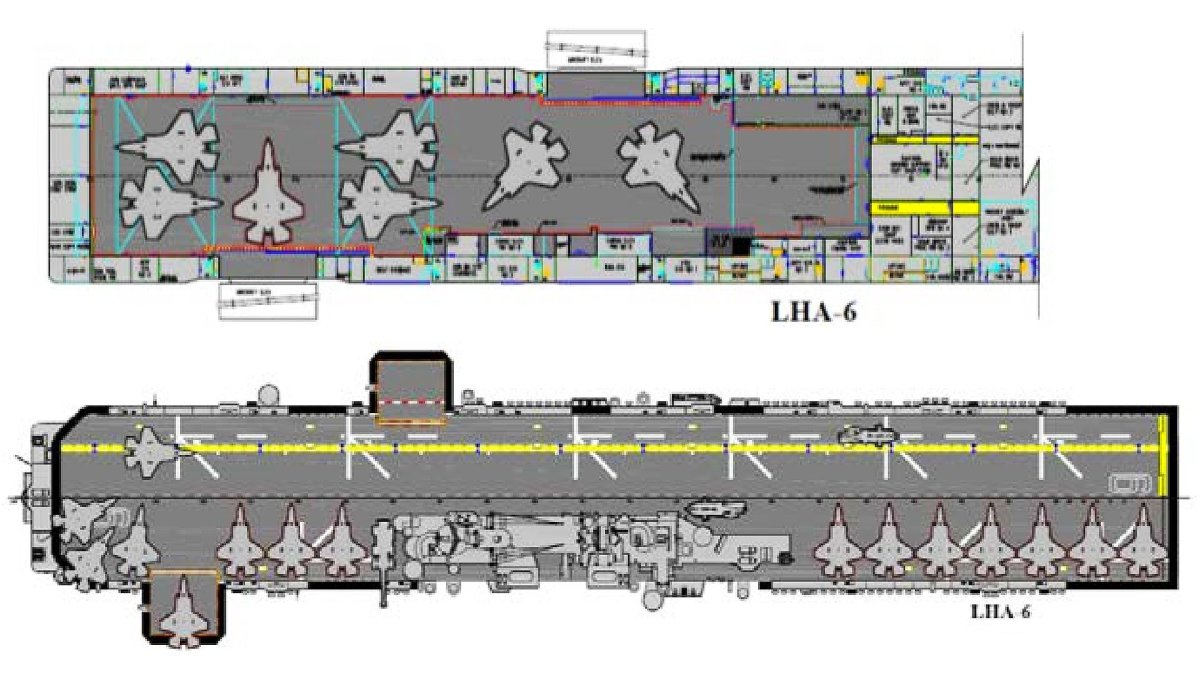
The USMC wants to be able to deploy between 16-20 F-35Bs to its amphibious assault ships, turning them into so called “Lightning Carriers” (CV-L). The new America class (LHA-6) flattops , which do not have a well deck and are more focused on aviation capabilities, could field nearly two dozen of the 5th generation jump jets under the concept.
Really, the idea is nothing new. In decades past, “Gator Navy” amphibs were turned into “Harrier Carriers” loaded with dozens of AV-8Bs. This came at the expense of not deploying the usual Air Combat Element dominated by a full range of helicopters. Such a capability begins to encroach on the mission of America’s hugely expensive fixed-wing carrier fleet, although Harriers have operated from these ships in the past as well. And still, the Harrier has limited capabilities compared to what the aircraft from a supercarrier’s Air Wing can provide.
USS Bataan being used in the “Harrier Carrier” role for Operation Iraqi Freedom in 2003. , USN
Aside from a reduction in combat radius, the inability to carry 2,000lb class munitions internally and some smaller differences, the F-35B will be just as capable as any fighter flying off the decks of America’s supercarriers, or those on land for that matter. Also, the F-35’s high-end sensor suite and electronic warfare capabilities make it less dependent on Airborne Early Warning and Control and dedicated electronic attack assets in most threat environments compared to its 4th generation fighter counterparts.
In essence, the F-35B is the most relevant of the Joint Strike Fighter family as it gives America’s eight “other carriers”—the amphibious assault ships—a very high-end multi-role fighter capability that can be used on the first day of a major conflict. Under normal circumstances, like its Harrier forbearers, just six to eight F-35Bs will be deployed aboard one of these ships, but under the “Lightning Carrier” concept this is not the case. I went into this reality in great detail years ago in my piece Seven Things The Marines Have To Do To Make The F-35B Worth The Huge Cost (as a side note, it is amazing how many of my recommendations have been satisfied or are in the process of being satisfied). I also discussed how the Harrier Carrier concept could be adapted to the F-35B to great effect, stating:
“During multiple conflicts, these Gator Navy flattops have been used as “Harrier Carriers,” where dozens of the jump jets were packed aboard for sustained operations. The F-35B will make this concept even more relevant with its ability to accomplish a full range of missions, including taking the first shots of a conflict—in effect tearing down the enemy’s surface-to-air missile, aircraft and sensor network barriers so that other, less survivable aircraft can eventually operate over enemy territory in a safer manner. The new LHA “America” class of amphibious assault ships was built with just this in mind, doing away with the traditional well dock to carry a larger air wing with more fuel and munitions stores. Some concepts exist where a pair of amphibious assault ships work together within a single, albeit larger, Expeditionary Strike Group (ESG). One carrying a couple dozen F-35Bs and the other carrying a few dozen helicopters. Such a concept would allow for a continuous F-35B presence over the battlefield, and would even allow for the ESG to mount fixed wing “alpha strikes,” where the majority of the F-35B force prosecutes a set of strategic enemy targets during a single mission, much like a Navy carrier air wing currently is capable of. An ESG configured in this manner is in many ways even more capable than a nuclear carrier’s deployed air wing as it also retains an incredibly powerful ground assault capability. This ability to “surge” assets and integrate them directly into a single ESG represents a true multirole flotilla, able to flexibly threaten any foe within hundreds of miles of the ocean, not just via air strikes but also via amphibious or inland assaults. Seeing as the F-35B has the potential to almost double America’s “first day of war” carrier footprint, a great thing during a time when the nuclear carrier force will most likely continue to shrink, and it will allow an ESG to operate much more independently than ever before, the Marines have to look seriously at maximizing this game changing technology.”
“During multiple conflicts, these Gator Navy flattops have been used as “Harrier Carriers,” where dozens of the jump jets were packed aboard for sustained operations. The F-35B will make this concept even more relevant with its ability to accomplish a full range of missions, including taking the first shots of a conflict—in effect tearing down the enemy’s surface-to-air missile, aircraft and sensor network barriers so that other, less survivable aircraft can eventually operate over enemy territory in a safer manner.
The new LHA “America” class of amphibious assault ships was built with just this in mind, doing away with the traditional well dock to carry a larger air wing with more fuel and munitions stores. Some concepts exist where a pair of amphibious assault ships work together within a single, albeit larger, Expeditionary Strike Group (ESG). One carrying a couple dozen F-35Bs and the other carrying a few dozen helicopters. Such a concept would allow for a continuous F-35B presence over the battlefield, and would even allow for the ESG to mount fixed wing “alpha strikes,” where the majority of the F-35B force prosecutes a set of strategic enemy targets during a single mission, much like a Navy carrier air wing currently is capable of. An ESG configured in this manner is in many ways even more capable than a nuclear carrier’s deployed air wing as it also retains an incredibly powerful ground assault capability. This ability to “surge” assets and integrate them directly into a single ESG represents a true multirole flotilla, able to flexibly threaten any foe within hundreds of miles of the ocean, not just via air strikes but also via amphibious or inland assaults.
Seeing as the F-35B has the potential to almost double America’s “first day of war” carrier footprint, a great thing during a time when the nuclear carrier force will most likely continue to shrink, and it will allow an ESG to operate much more independently than ever before, the Marines have to look seriously at maximizing this game changing technology.”
Now, the USMC in its 2017 Marine Aviation Plan seems to agree, stating:
“In the 2017-2027 time frame the Marine Corps will possess the majority of naval 5th generation aircraft. By 2025, the Marine Corps will operate185 F-35Bs—enough to equip all seven L-Class ships. While the amphibious assault ship will never replace the aircraft carrier, it can be complementary, if employed in imaginative ways. The CV-L concept has previous been employed(five times) utilizing AV-8B Harriers in a “Harrier Carrier” concept. TheARG/MEU’s mission, and 13 mission essential tasks (METs), will not change; however, a Lightning Carrier, taking full advantage of the amphibious assault ship as a sea base, can provide the naval and joint force with significant access, collection and strike capabilities.”
Under the Lightning Carrier plan, over 40 sorties across a wide spectrum of air combat missions sets, can be fielded in a single 14 hour period with 16 F-35Bs., USMC
The thing is, not only could the Lightning Carrier concept take some pressure off America’s supercarriers, especially for supporting smaller conflicts, but it can also be mixed and matched with different assets, including embedding it into a supercarrier’s own flotilla. In doing so, a Lightning Carrier could drastically augment the 5th generation fighter capacity forward deployed as part of a Carrier Strike Group.
Currently, the Carrier Air Wing of the future is slated to include one F-35C squadron of roughly 12 jets, and possibly two squadrons for most Air Wings as the 2020s roll on. As such, a LHA configured in “Lightning Carrier” mode could nearly triple the amount of F-35s the Carrier Strike Group has to play with. But really where such a concept shines the most is for operations as part of a larger, more capable and operationally independent Expeditionary Strike Group.
The USMC states that it is likely the Lightning Carrier concept will include a quartet of MV-22 Ospreys equipped as aerial tankers. Although this may take away a small amount of room for F-35Bs, it would be a massive force multiplier, and allow the F-35Bs to fly longer missions and ones that take the jet deeper into enemy territory. It would also add a margin of safety to flight operations and decrease the overall sortie demands on the ship, which are limited compared to their catapult and arresting gear equipped supercarrier counterparts. The V-22 Aerial Refueling System is should hit the fleet within the next year.
V-22 Aerial Refueling System prototype (VARS) in action., Bell
Although the USS America (LHA-6), and to even a greater degree her sister ship, the USS Tripoli , have their decks strengthened and other modifications made to allow them to sustain higher sortie rates of F-35Bs and MV-22s, the existing Wasp class LHDs do not. As such, it is unlikely they could take full advantage of the Lightning Carrier/CV-L concept, at least without more extensive modifications. That’s not to say they cannot carry a full load of F-35Bs, but sustaining continuos flight operations at a very high tempo is likely impossible due to the high thermal loads put out by F-35B, and to some degree the MV-22.
Still, as the Navy struggles with its “carrier gap,” and while some, including the author, have called for building smaller, more flexible and more plentiful aircraft carriers, the America class in particular and the “Lightning Carrier” concept is definitely intriguing.
Contact the author: Tyler@thedrive.com
Comments couldn’t be loaded. Please refresh the page.
更新于美国东部时间2020年7月3日凌晨4:14
美国海军陆战队希望能够在其两栖攻击舰上部署16至20架F-35B战斗机,将其改装成所谓的“闪电航母”(CV-L)。根据这一概念,新型的“美利坚”级(LHA-6)两栖攻击舰(没有坞舱,更侧重于航空作战能力)可以搭载近24架第五代垂直起降战斗机。
实际上,这个想法并不新鲜。几十年前,“鳄鱼海军”两栖攻击舰被改装成“鹞式航母”,搭载数十架AV-8B战斗机。但这却导致它们无法部署通常由各种直升机组成的空中作战力量。这种能力开始与美国耗资巨大的固定翼航母舰队的任务有所冲突,尽管鹞式战斗机过去也曾在这些航母上起降过。而且,与超级航母舰载机联队所能提供的作战能力相比,鹞式战斗机的能力仍然有限。
2003年,美国海军“巴丹”号两栖攻击舰在伊拉克自由行动中担任“鹞式航母”角色。
除了作战半径缩短、无法内置携带2000磅级弹药以及其他一些细微差别外,F-35B 的性能与从美国超级航母甲板上起飞的任何战斗机,乃至陆基战斗机都毫不逊色。此外,与第四代战斗机相比,F-35 的高端传感器套件和电子战能力使其在大多数威胁环境下对空中预警与控制以及专用电子攻击设备的依赖性更低。
从本质上讲,F-35B是联合攻击战斗机家族中最具现实意义的机型,因为它为美国的八艘“其他航母”(即两栖攻击舰)提供了一种高端多用途战斗机能力,可以在重大冲突的第一天就投入使用。通常情况下,就像它的“鹞”式前辈一样,每艘航母上只会部署六到八架F-35B,但在“闪电航母”概念下,情况并非如此。多年前,我在《海军陆战队必须做的七件事才能使F-35B物有所值》一文中详细探讨了这一现实(顺便一提,令人惊讶的是,我的许多建议已经得到落实或正在落实)。我还讨论了如何有效地将“鹞”式航母概念应用于F-35B,并指出:
在多次冲突中,这些“鳄鱼”级海军平底船曾被用作“鹞式航母”,搭载数十架垂直起降战斗机进行持续作战。F-35B战斗机将使这一概念更具现实意义,因为它能够执行全方位的任务,包括率先发起冲突——实际上就是摧毁敌方的地对空导弹、飞机和传感器网络屏障,从而使其他生存能力较弱的飞机最终能够更安全地在敌方领空作战。新型“美国”级两栖攻击舰正是基于此理念建造的,它摒弃了传统的坞舱,以便搭载更大的舰载机联队以及更多的燃料和弹药储备。目前存在一些方案,即两艘两栖攻击舰在同一个远征打击群(ESG)内协同作战,尽管该打击群规模更大。其中一艘搭载数十架F-35B战斗机,另一艘搭载数十架直升机。这样的方案将使F-35B战斗机能够在战场上保持持续存在。这种配置甚至能让远征打击群(ESG)执行固定翼“首轮打击”任务,即F-35B战机主力在一次任务中集中攻击一系列战略敌方目标,其能力与海军航母舰载机联队目前的能力非常相似。以这种方式配置的远征打击群在许多方面甚至比核动力航母的舰载机联队更胜一筹,因为它还保留了极其强大的对地攻击能力。这种“快速部署”资源并将其直接整合到单个远征打击群的能力,代表着一支真正的多用途舰队,能够灵活地威胁数百英里范围内的任何敌人,不仅可以通过空袭,还可以通过两栖或内陆突击。鉴于F-35B战机有可能使美国“战争第一天”的航母部署规模几乎翻一番,这在核动力航母部队很可能继续缩减的当下尤为重要,而且它将使远征打击群的独立作战能力远超以往,海军陆战队必须认真考虑如何最大限度地利用这项颠覆性技术。
在多次冲突中,这些“鳄鱼”级海军平底船曾被用作“鹞式航母”,搭载数十架垂直起降战斗机进行持续作战。F-35B将使这一概念更具现实意义,因为它能够执行全方位的任务,包括率先发起冲突——实际上就是摧毁敌方的地对空导弹、飞机和传感器网络屏障,从而使其他生存能力较弱的飞机最终能够更安全地在敌方领空作战。
新型“美国”级两栖攻击舰正是基于此理念建造的,它摒弃了传统的坞舱,以便搭载更大的舰载机联队,并携带更多燃料和弹药。目前有一些方案设想,两艘两栖攻击舰组成一个规模更大的远征打击群(ESG),其中一艘搭载数十架F-35B战斗机,另一艘搭载数十架直升机。这种方案能够确保F-35B在战场上空持续存在,甚至允许远征打击群执行固定翼“首轮打击”任务,即大部分F-35B战机在一次任务中集中攻击一系列战略敌方目标,这与海军航母舰载机联队目前的作战能力非常相似。以这种方式配置的远征打击群在许多方面甚至比核动力航母的舰载机联队更胜一筹,因为它还保留了极其强大的对地攻击能力。这种“快速调动”资源并将其直接整合到单个ESG中的能力,代表着一支真正的多用途舰队,能够灵活地威胁数百英里范围内的任何敌人,不仅可以通过空袭,还可以通过两栖或内陆突击。
鉴于 F-35B 有可能使美国“战争第一天”的航母部署规模几乎翻一番,这在核动力航母部队很可能继续缩减的时期是一件好事,而且它将使远征打击群比以往任何时候都更加独立地行动,海军陆战队必须认真考虑如何最大限度地利用这项改变游戏规则的技术。
现在,美国海军陆战队在其2017年海军陆战队航空计划中似乎也同意这一观点,其中指出:
在2017年至2027年期间,海军陆战队将拥有海军第五代战机的绝大部分。到2025年,海军陆战队将装备185架F-35B战斗机,足以装备全部七艘L级两栖攻击舰。虽然两栖攻击舰永远无法取代航空母舰,但如果运用得当,它可以起到补充作用。此前,CV-L概念已在“鹞式航母”概念中应用过五次,并搭载了AV-8B“鹞”式战斗机。两栖戒备群/海军陆战队远征部队的任务及其13项关键任务(MET)不会改变;然而,一艘“闪电”级航母,充分利用两栖攻击舰作为海上基地的优势,可以为海军和联合部队提供重要的登陆、情报收集和打击能力。
根据“闪电航母”计划,16架F-35B战斗机可在14小时内执行超过40架次的作战任务,涵盖广泛的空战任务类型。(美国海军陆战队)
关键在于,“闪电航母”概念不仅可以减轻美国超级航母的压力,尤其是在支援小型冲突方面,而且它还可以与其他装备灵活搭配,包括将其编入超级航母自身的舰队。如此一来,“闪电航母”就能大幅提升作为航母打击群一部分前沿部署的第五代战斗机的作战能力。
目前,未来的舰载航空联队计划配备一个约12架F-35C战斗机的中队,随着2020年代的推进,大多数舰载航空联队可能会配备两个中队。因此,一艘配置为“闪电航母”模式的两栖攻击舰(LHA)几乎可以使航母打击群可操控的F-35数量增加两倍。但这种概念真正发挥最大优势的地方在于,它可以作为规模更大、能力更强、作战更独立的远征打击群的一部分执行作战任务。
美国海军陆战队表示,“闪电”航母概念很可能包括四架MV-22“鱼鹰”倾转旋翼机作为空中加油机。虽然这可能会占用少量F-35B战斗机的空间,但却能极大地提升战力,使F-35B能够执行更长时间的任务,并深入敌方领空执行任务。此外,它还能提高飞行作业的安全性,并降低航母的整体出动架次需求——与配备弹射器和阻拦装置的超级航母相比,该航母的出动架次需求较为有限。V-22空中加油系统预计将于明年交付舰队。
V-22空中加油系统原型机(VARS)实战演示,贝尔公司
尽管“美国”号两栖攻击舰(LHA-6)及其姊妹舰“的黎波里”号(程度更甚)的甲板经过加固和其他改装,使其能够承受更高频率的F-35B和MV-22战机出动,但现有的“黄蜂”级两栖攻击舰并未进行此类改装。因此,它们不太可能充分利用“闪电”航母/CV-L概念,至少在不进行更广泛的改装的情况下是如此。这并非意味着它们无法搭载满载的F-35B战机,而是由于F-35B(以及一定程度上MV-22)产生的高热负荷,维持高强度的持续飞行作业几乎是不可能的。
尽管海军仍在努力解决其“航母缺口”,而且包括作者在内的一些人呼吁建造更小、更灵活、数量更多的航空母舰,但美国级航母和“闪电航母”概念无疑令人感兴趣。
联系作者:Tyler@thedrive.com
评论加载失败,请刷新页面。