US Marines train beach landings Down Under with old allies, new rides美国海军陆战队与老盟友在澳大利亚进行海滩登陆演习,并使用了新的装备。
One key subplot to the July 24 landings was the first ever touchdown of the Marine Corps’ new Amphibious Combat Vehicle in Australia.
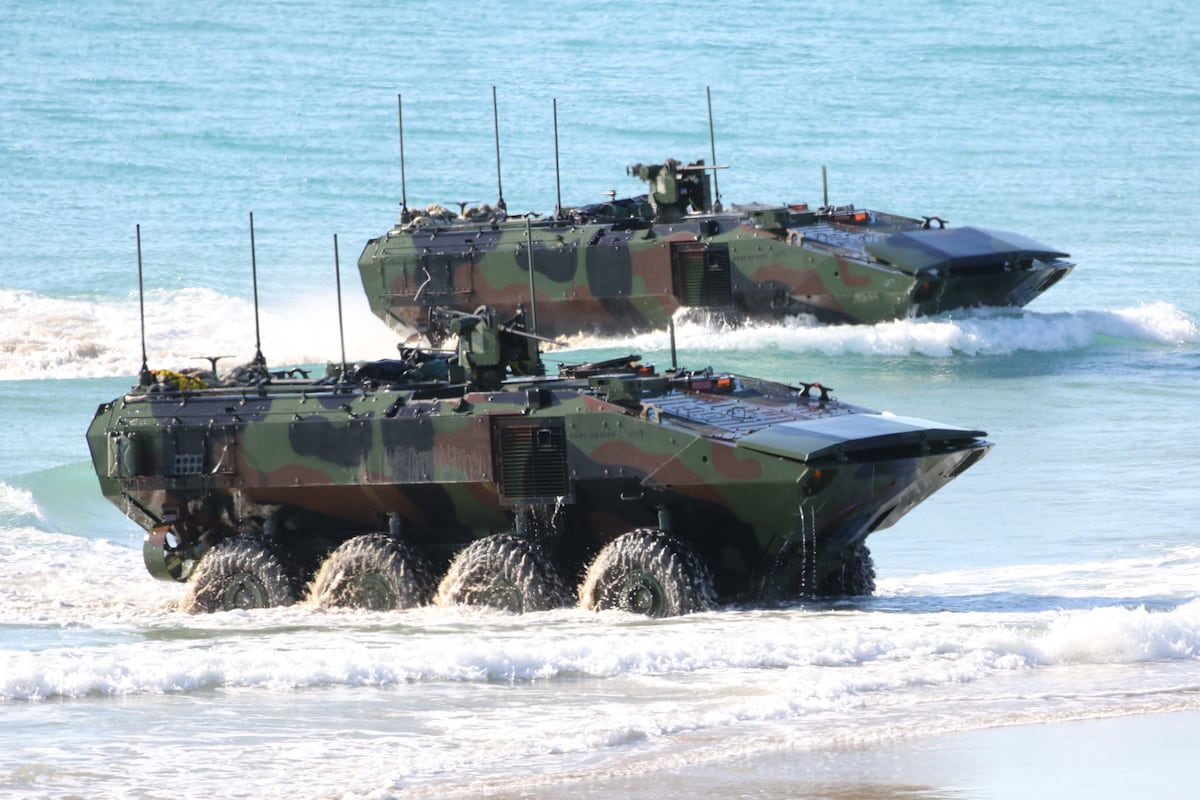
ROCKHAMPTON, Australia — In the dawn light of July 24, Japanese and American amphibious vehicles churned through the sparkling coastal waters of the Coral Sea, before emerging onto the sands of a central Queensland beach in Australia.
Two hours to the east, another amphibious lodgment was occurring simultaneously at Freshwater Beach. This time the main participants were Australia and South Korea.
The two events, part of a combined joint forcible entry operation, formed the culminating activity for Exercise Talisman Sabre 2025, held in Australia from July 13-27. They were the most sophisticated amphibious landings ever attempted in the eleven iterations of Talisman Sabre so far.
“We maintained a high operational tempo during Exercise Talisman Sabre 25, which was designed to provide intense training to ensure our forces are capable, interoperable, deployable on short notice and combat ready,” Rear Adm. Tom Shultz, commander of Expeditionary Strike Group Seven (ESG-7) and therefore in charge of the U.S. amphibious contingent, told Defense News.
Shultz said the Navy “embraced cooperation and interoperability,” demonstrated by interactions with 14 ships and expeditionary forces from six nations.
An important subplot to the July 24 landings was the first ever touchdown of the Marine Corps’ new Amphibious Combat Vehicle in Australia. These 8x8 ACVs are being inducted into the U.S. service as a much-needed replacement for the AAV7A1 family of vehicles that has soldiered on for 50 years.
Marines stopped using the AAV7A1 family for amphibious operations after a fatal accident in California in 2020. The deployment of ACVs with the Okinawa-based 31st Marine Expeditionary Unit – or 31st MEU – thus marked an important return of armored amphibious operations to the Indo-Pacific region.
1st Lt. Brooks Wright, the ACV Platoon commander, said his unit swam five ACVs ashore during Talisman Sabre landings.
Wright described the ACV as a “fabulous vehicle.” He explained that it “adds a lot of combat power for the Marine Corps, and allows us to do a lot of things we haven’t been able to do the last couple of years without the AAV around.”
He said the ACV represented a significant upgrade for the Marines; it does “everything that we advertise that we’re able to do – the ship-to-shore movement, getting troops to shore, and then pushing inland to objectives”.
Lt. Col. Andy Hornfeck, commanding officer of the 1st Battalion, 7th Marines – currently acting as the 31st MEU’s battalion landing team – described four main lines of effort for the formation during Talisman Sabre 2025.
The first was a MEU live-fire assault on Townshend Island using the full repertoire of weaponry available. This included F-35B fighters, AH-1Z Viper helicopters and M777 artillery pieces, for example.
The MEU then transitioned into force integration training with partners, which featured useful “cross-pollination” of skills, according to Hornfeck.
Thirdly, the 31st MEU conducted two assaults in Queensland’s Bowen region, including an air assault and small-boat raid.
The final effort was the combined joint forcible entry operation, where the MEU had British and Dutch personnel attached to the pre-landing reconnaissance force.
Hornfeck said the Marines worked more slowly and deliberately than if they were acting alone, since it was important to stay synchronized with their Japanese partners.
“Fighting as a coalition is challenging,” he acknowledged. Nonetheless, he deemed Talisman Sabre a realistic experience.
Elsewhere, the U.S. Marine Corps’ 2,500-strong Marine Rotational Force—Darwin (MRF-D) conducted a series of “island hopping” movements across the Outback by air.
First, MRF-D captured an airstrip at Timber Creek, 375 miles south of Darwin. Next up was Nackeroo, and finally the MRF-D seized an airfield at Cloncurry.
These efforts mimicked the Pacific island-hopping campaign of World War II, and these are tactics the U.S. military would use against China in the event of a war.
Laced with missiles and troops, the First Island Chain – extending south from Japan through Taiwan and the Philippines to Indonesia – is a natural geographic barrier of islands and land masses that would form a critical line of defense to contain the People’s Liberation Army.
Gordon Arthur is an Asia correspondent for Defense News. After a 20-year stint working in Hong Kong, he now resides in New Zealand. He has attended military exercises and defense exhibitions in about 20 countries around the Asia-Pacific region.
澳大利亚罗克汉普顿——7 月 24 日的黎明时分,日本和美国的两栖车辆在波光粼粼的珊瑚海沿岸水域中穿行,然后驶上澳大利亚昆士兰州中部海滩的沙滩。
向东两小时航程,淡水海滩也同时上演了另一场两栖登陆作战。这次的主要参与者是澳大利亚和韩国。
这两项活动是联合强制进入行动的一部分,也是2025年7月13日至27日在澳大利亚举行的“护身军刀”演习的压轴活动。它们是迄今为止“护身军刀”演习11次尝试中最复杂的两栖登陆行动。
“在‘护身军刀 25’演习期间,我们保持了高强度的作战节奏。此次演习旨在提供密集的训练,以确保我们的部队具备作战能力、互操作性、可快速部署和随时准备作战的能力。”美国远征打击群第七(ESG-7)指挥官、美国两栖部队负责人汤姆·舒尔茨海军少将告诉《防务新闻》。
舒尔茨表示,海军“秉持合作与互操作性”,与来自六个国家的 14 艘舰艇和远征部队进行了互动,证明了这一点。
7月24日登陆行动的一个重要副线是海军陆战队新型两栖作战车辆在澳大利亚的首次着陆。这些8x8两栖作战车辆正在列装美国军队,作为服役50年的AAV7A1系列车辆的急需替代品。
2020 年加利福尼亚州发生一起致命事故后,海军陆战队停止使用 AAV7A1 系列两栖突击车进行两栖作战。因此,驻扎在冲绳的第 31 海军陆战队远征部队(或 31st MEU)部署 ACV 标志着装甲两栖作战在印太地区的重要回归。
ACV排长布鲁克斯·赖特中尉说,他的部队在“护身军刀”登陆行动中将五辆ACV游到了岸上。
赖特称 ACV 是一款“非常棒的车辆”。他解释说,它“大大增强了海军陆战队的作战能力,使我们能够完成过去几年没有 AAV 时无法完成的许多事情”。
他说,ACV 对海军陆战队来说是一次重大升级;它能做到“我们宣传的所有能力——从舰岸到岸的运输,将部队送上岸,然后向内陆推进到目标”。
海军陆战队第 7 团第 1 营指挥官安迪·霍恩费克中校(目前担任第 31 海军陆战队远征部队的营级登陆队)在“护身军刀 2025”演习期间描述了该部队的四个主要工作方向。
第一次演习是海军陆战队远征部队(MEU)在汤森岛进行实弹突击,动用了所有可用武器装备,例如F-35B战斗机、AH-1Z蝰蛇直升机和M777型火炮等。
据霍恩费克称,随后海军陆战队远征部队与合作伙伴进行了部队整合训练,这带来了有益的技能“交叉融合”。
第三,第 31 远征军在昆士兰州鲍恩地区进行了两次突袭,包括一次空中突袭和一次小艇突袭。
最后的尝试是联合强行进入行动,海军陆战队远征部队将英国和荷兰人员配属到登陆前侦察部队。
霍恩费克说,海军陆战队员们行动比单独行动时更加缓慢谨慎,因为与日本伙伴保持同步非常重要。
他承认:“以联盟形式作战充满挑战。”尽管如此,他认为《护身军刀》是一次非常真实的体验。
除此之外,美国海军陆战队 2500 人的达尔文轮换部队 (MRF-D) 通过空中力量在澳大利亚内陆地区进行了一系列“跳岛”行动。
首先,MRF-D 夺取了位于达尔文以南 375 英里处的廷伯克里克 (Timber Creek) 的一个简易机场。接下来是纳克鲁 (Nackeroo),最后 MRF-D 占领了克朗克里 (Cloncurry) 的一个机场。
这些举措模仿了二战时期太平洋岛屿争夺战,也是美军在战争中对中国将要使用的战术。
第一岛链从日本向南延伸,途经台湾和菲律宾,直至印度尼西亚,部署了大量导弹和军队,是一道由岛屿和陆地组成的天然地理屏障,构成了一道重要的防线,可以遏制中国人民解放军。
戈登·阿瑟是《防务新闻》的亚洲特派记者。在香港工作20年后,他现居新西兰。他曾到访亚太地区约20个国家,参加过军事演习和防务展览。