Too many air quality indicators may complicate public messaging for haze: Grace Fu过多的空气质量指标可能会使雾霾的公共信息传递变得复杂:傅慧玲
Fu also fielded questions on the Government’s response to the haze situation. Read more at straitstimes.com.
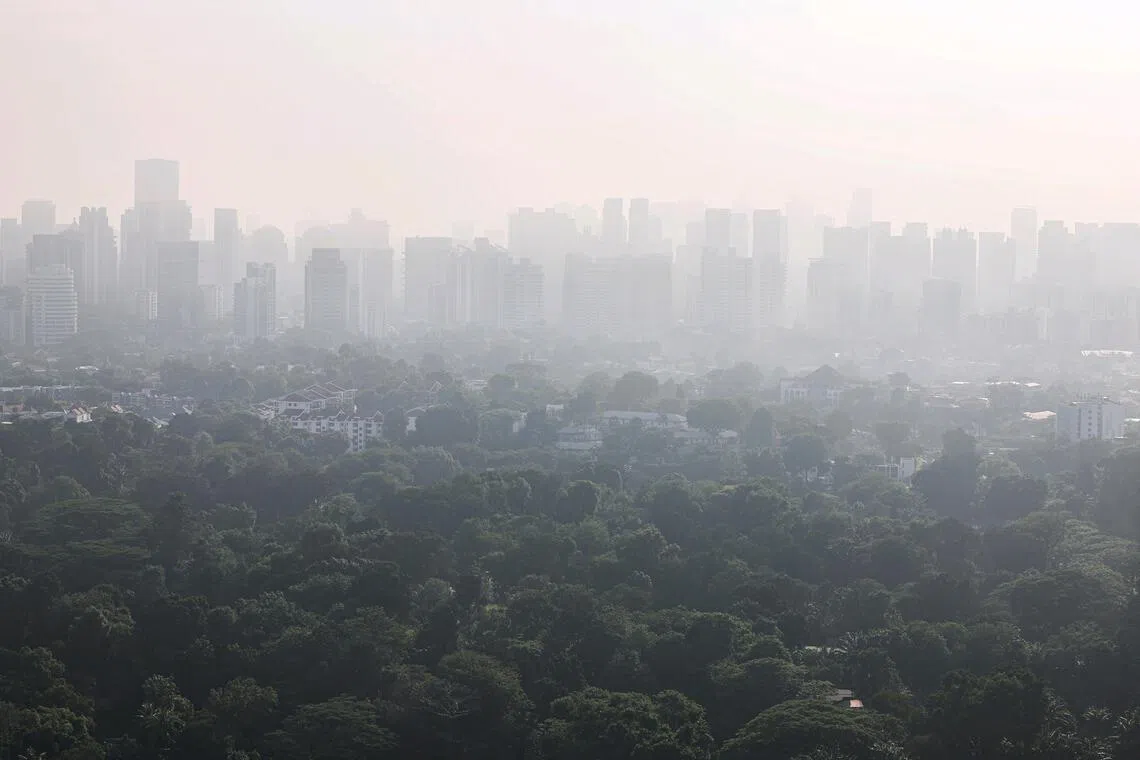
Haze situation in the direction of Orchard at 8.30am on Oct 30, 2026. The 24-hour Pollutant Standards Index (PSI) reading for the central region was 63 at 8am, in the moderate range, while the one-hour PM2.5 reading was 21, in the normal band. Can be used for stories on private property, condominium, resale market, housing market, property cooling measures. ST PHOTO: BRIAN TEO
Published Nov 03, 2026, 01:23 PM
Updated Nov 03, 2026, 01:23 PM
SINGAPORE – Having too many air quality indicators may complicate the government’s messages for the public during haze episodes, said the Minister for Sustainability and the Environment Grace Fu on Nov 3.
The use of forecast 24-hour Pollutant Standards Index (PSI) for planning and hourly PM2.5 for taking decisions has worked well, Fu told Parliament.
“We don’t think there is a need to include 12-hour, 24-hour or 48-hour PM2.5 forecasts as having too many indicators may complicate our public messages,” she added.
She was responding to a question from WP’s Fadli Fawzi (Aljunied GRC), who had asked if the National Environment Agency (NEA) under her ministry can provide PM2.5 forecasts to help Singaporeans plan their daily activities during haze.
“I’m very minded that… our forecast and advisory are clean, succinct, (allowing) people to (easily) manage activities,” she said.
PM2.5 are small particles that are the dominant pollutant during transboundary haze episodes.
The NEA currently provides two indicators of air quality: a PSI forecast for the next 24 hours, and an hourly PM2.5 reading.
The 24-hour PSI forecast indicates what the air quality is expected to be in the next 24 hours and can be used to plan activities ahead of time.
The forecast takes into account the prevailing air quality, local and regional weather conditions, and the regional hotspot and haze situation assessed through satellite imagery, said Fu.
Meanwhile, PM2.5 readings refer to concentrations of the dominant pollutant particle during haze episodes. It provides a more reflective indicator of current air quality.
It is based on the readings from its 23 air quality monitoring stations installed across the country.
People should refer to the PM2.5 values for planning their immediate activities, and to the PSI forecast if they are planning an outdoor activity the next day.
The National Environment Agency (NEA) will continue to review how its forecasting and public information services can be enhanced to provide more useful guidance, said Fu, adding that providing timely and reliable information is an important part of its ministry’s public health response.
Fu also said that NEA releases fortnightly forecasts but noted that the forecast is less accurate as the horizon of the forecast increases.
The 1-hour PM2.5 readings provide the shortest possible forecast and is the “most accurate” in giving the public a sense of the air quality before conducting an activity, she said.
During the sitting, Fu also fielded questions on the Government’s response to the haze situation – the worst experienced in Singapore in over a decade since the 2015 crisis.
Nadia Ahmad Samdin (Ang Mo Kio GRC) also raised questions on whether the ministry has assessed the impact of prolonged haze on agricultural productivity locally and in Singapore’s food import sources, and if there are risks to the food supply resilience and affordability here.
Fu said that the recent haze has not affected Singapore’s food supply.
“Singapore imports food from more than 180 countries and regions. Sourcing broadly helps to reduce concentration risks and enables industry to switch to alternative sources when needed,” she added.
While wholesalers have feedbacked that prolonged haze may impact vegetable growth, Fu said that for local farms, the overall impact has generally been “minimal” with operations returning to normal following recent improvement in air quality.
The Singapore Food Agency (SFA) will continue to monitor the impact on food supply and implement measures to address concerns as necessary, she said.
Fu also noted that while the haze has affected footfall at hawker centres and markets, it is also compensated by increase in take-away orders.
She added that NEA will continue to monitor the impact on hawkers, although there is currently no plan to introduce additional haze-specific financial assistance.
Ministry of Sustainability and the Environment
National Environment Agency
SFA/Singapore Food Agency
2026年10月30日上午8点30分,乌节路方向出现雾霾。上午8点,中部地区24小时空气污染指数(PSI)读数为63,属于中等范围;一小时PM2.5读数为21,属于正常范围。可用于报道私人住宅、公寓、二手房市场、房屋市场以及降温措施等相关内容。海峡时报摄影:BRIAN TEO
发布于 2026 年 11 月 3 日下午 1:23
更新于2026年11月3日下午1:23
新加坡——永续发展及环境部长傅海燕于11月3日表示,过多的空气质量指标可能会使政府在雾霾期间向公众传递的信息变得复杂。
傅海燕在国会表示,利用 24 小时污染物标准指数 (PSI) 预测值进行规划,利用每小时 PM2.5 值进行决策,效果很好。
她补充说:“我们认为没有必要纳入 12 小时、24 小时或 48 小时 PM2.5 预测,因为指标过多可能会使我们的公共信息变得复杂。”
她当时正在回答工人党议员法德利·法兹(阿裕尼集选区)提出的问题。法德利·法兹询问,她领导的国家环境局(NEA)能否提供 PM2.5 预报,以帮助新加坡人在雾霾期间规划日常活动。
“我非常希望……我们的预测和建议清晰明了、简洁明了,以便人们能够轻松地安排各项活动,”她说。
PM2.5是跨境雾霾事件中的主要污染物。
新加坡国家环境局目前提供两项空气质量指标:未来 24 小时的 PSI 预报和每小时的 PM2.5 读数。
24 小时 PSI 预报显示未来 24 小时内的空气质量预期情况,可用于提前规划活动。
傅先生表示,该预测考虑了当前的空气质量、当地和区域天气状况,以及通过卫星图像评估的区域热点和雾霾情况。
同时,PM2.5读数指的是雾霾期间主要污染物颗粒的浓度。它能更准确地反映当前的空气质量。
它是根据其在全国范围内安装的 23 个空气质量监测站的读数得出的。
人们应该参考 PM2.5 值来计划他们近期的活动,如果计划第二天进行户外活动,则应该参考 PSI 预报。
傅女士表示,国家环境局将继续检讨如何加强其预测和公共信息服务,以提供更有用的指导,并补充说,提供及时可靠的信息是该部门应对公共卫生问题的重要组成部分。
傅先生还表示,国家环境局每两周发布一次天气预报,但他指出,随着预报时间的延长,预报的准确性会降低。
她表示,1 小时 PM2.5 读数提供了最短的预报时间,也是让公众在进行活动前了解空气质量“最准确”的方法。
在会议期间,傅海燕还回答了有关政府应对雾霾情况的问题——这是自 2015 年危机以来新加坡十多年来经历的最严重的雾霾情况。
纳迪亚·艾哈迈德·萨姆丁(宏茂桥集选区)也提出疑问,农业部是否评估了长期烟霾对本地农业生产力和新加坡食品进口来源的影响,以及这是否会对本地食品供应的韧性和可负担性构成风险。
傅女士表示,近期的雾霾并未影响新加坡的食品供应。
她补充说:“新加坡从180多个国家和地区进口食品。广泛采购有助于降低集中风险,并使企业能够在需要时转向替代来源。”
虽然批发商反馈说,长时间的雾霾可能会影响蔬菜生长,但傅先生表示,对于当地农场来说,总体影响通常是“最小的”,随着最近空气质量的改善,农场运营已经恢复正常。
她表示,新加坡食品局(SFA)将继续监测对食品供应的影响,并根据需要采取措施解决相关问题。
傅先生还指出,虽然雾霾影响了小贩中心和市场的客流量,但外卖订单的增加也弥补了这一影响。
她补充说,国家环境局将继续监测雾霾对小贩的影响,但目前还没有计划推出额外的专门针对雾霾的财政援助。
可持续发展与环境部
国家环境局
新加坡食品局