Here Is How The Pentagon Comes Up With Code Words And Secret Project Nicknames以下是五角大楼如何想出代号和秘密项目昵称的
We venture into the dark, fascinating, and often misunderstood world of the Defense Department's code word and nickname generating processes.
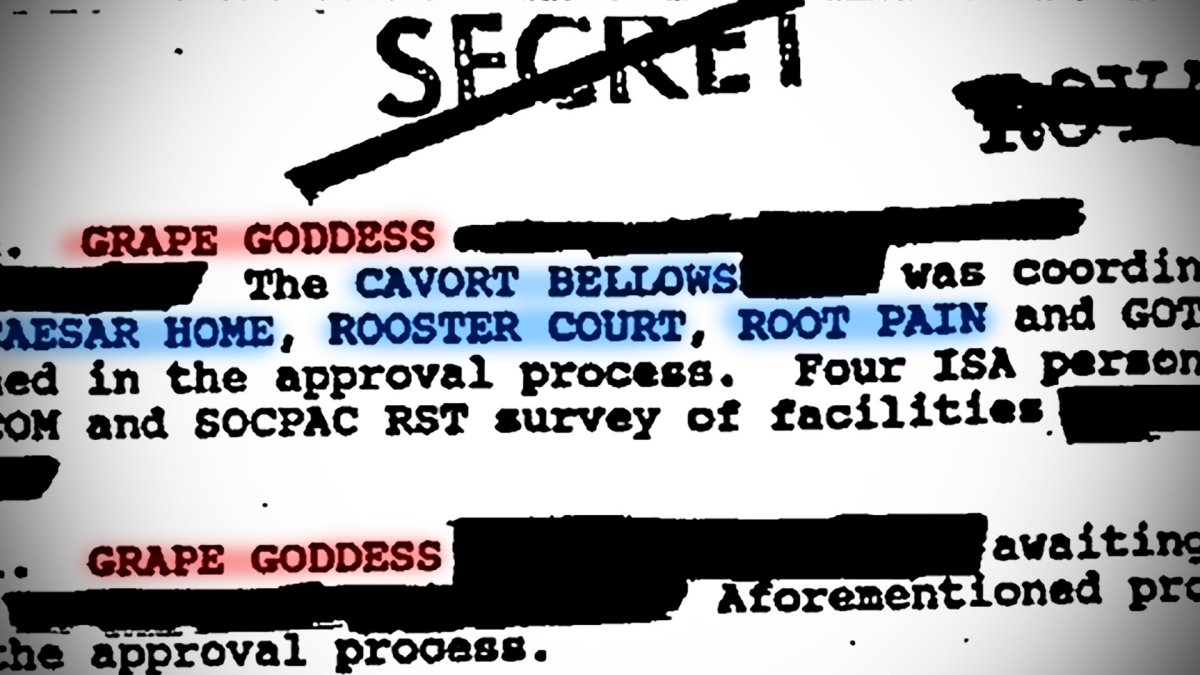
Updated Dec 1, 2019 5:57 AM EST
If there’s one place one can find plenty of nicknames, it’s within the sprawling landscape of the armed forces. When it comes to the greater civilian world, there’s no historical precedent or agreed upon social norm for how someone or something gains a substitute informal title. However, given the Department of Defense’s fondness of rigid structure, it should be no surprise that when it comes to nicknames, there’s a policy for them, too.
Prior to 1975, names for military operations and projects were exclusively chosen at the behest of military commanders. As a result, within the annals of American military history one can find a diverse range of interesting titles from Operation Killer —a major 1951 counter-offensive during the Korean War—to Operation Beaver Cage —a U.S. Marine Corps operation that occurred during the spring of 1967 as part of the Vietnam War.
However, shortly after the close of the Vietnam War, the Joint Chiefs of Staff (JCS) decided it was time to formalize the use of code words and nicknames by unveiling the Code Word Nickname and Exercise Term System, colloquially known as NICKA.
For the Department of Defense (DoD), NICKA is both a set of policies governing the selection of defense monikers and a military-wide computer system that archives and prevents duplication of terms.
Important to note, NICKA is primarily used for Department of Defense-related endeavors. Many operations or programs emerging from within the intelligence community use their own separate naming system.
For example, the Central Intelligence Agency uses the Cryptonym system for developing code words and names. It is also worth noting that the National Security Agency (NSA), National Geospatial-Intelligence Agency (NGA), Defense Intelligence Agency (DIA), and National Reconnaissance Office (NRO) all use the NICKA system
NICKA outlines three distinctive types of monikers that can be used within the DoD:
The two-word names of highly regarded secret programs like Tacit Blue, which was centered around Northrop’s very stealthy “Whale” demonstrator (seen above), are actually nicknames assigned to the programs and entered into the NICKA database. , Public Domain
In NICKA, a code word is a single word that’s assigned to any program or operational plan that’s classified confidential or higher. Each component agency in the Department of Defense are assigned blocks of code words by the Joint Staff. When needed, the NICKA computer program will randomly select and assign a code word from the originating agency’s allocated block of terms.
For example, in the lead up to the Gulf War, when the Combat Aviation Brigade of the 1st Armored Division needed a code word for their forward assembly area, the NICKA computer system pulled from one of the Army’s predetermined block designations and selected the amusingly mundane code word—LARRY.
Essentially a password for entry in an exclusive club, the preeminent role of code words is to restrict access to sensitive national security information to only those who have a need to know. Assisting security, a code word itself will be safeguarded by being classified by one of the three security classifications—confidential, secret, or top secret—based on the security level of the associated program.
Virtually anything conceivably classified, including programs, projects, locations, operations, objectives, missions, or plans, can be assigned a code word. One particular area code words can be highly prevalent is with Special Access Programs (SAP). As mentioned in The War Zone’s in-depth look at Special Access Programs , multiple components, sub-components, and projects can sprawl out from a single SAP “umbrella.” In this compartmentalized system of security, each of the different appendages of one SAP can potentially be assigned their own specific code word.
Once NICKA assigns a code word, it’s considered active. An active code word will remain unchanged for the life of a program and cannot be altered by its users. The one exception being if there’s a concern a code word had been compromised. In this instance, a new code word would be issued. Equally, in certain situations, an unclassified cover term may get applied to a program for counterintelligence purposes.
In addition to the obvious security and oversight reasons, the principal reason for a code word’s permanence relates to the significant role NICKA serves as an archive of all active and inactive code words. The system uses its database of terms to prevent any potential conflicts that could arise due to similarities or duplication of previous code words.
As a Department of Defense system, NICKA will only assign single-word code words. However, in some instances, the Pentagon may take over a project or program that originated outside of the DoD, such as from the Central Intelligence Agency (CIA), Department of Energy (DOE), commercial companies, or even foreign governments. In these instances, already assigned code words may not follow NICKA guidelines. In these occurrences, a program may be reassigned a new NICKA code word or the previous unregulated code name may be maintained.
Regardless, of whether it’s kept or not, the non-NICKA code name may still be added to the program’s database to stem off any future confusion or conflict.
For example, technically before NICKA’s time and not a DoD project, the 1960s A-12 reconnaissance plane was developed and operated under the CIA code word “ OXCART ”. However, Kelly Johnson and his pioneering team of engineers at Lockheed Skunk Works used the code word “ARCHANGEL” for the A-12. Furthering the spy plane’s eventual identity crisis, flight crews would nickname the A-12 “Cygnus.”
Though OXCART was the only officially assigned government code word, under NICKA, both the contract code word, “ARCHANGEL” and the A-12’s nickname “Cygnus,” would equally be archived to prevent duplicate use.
The SR-71 Blackbird (left) and A-12 (Right). , CIA
When it comes to code words. Many real-world military operations and programs, for example, “ HAVE BLUE, “ “ ACID GAMBIT ,” “AUTUMN RETURN ,” “SENIOR TREND ,” or the infamous “ YELLOW FRUIT ,” are often reported as being the “code word” for a classified operation or program. However, per DoD and the Joint Chiefs NICKA policy , a code word always consist of just a single word. By NICKA, the above named examples would be “nicknames” and not code words.
This does not mean that multiple code words cannot apply to a certain entity. Any intelligence product that contains Top-Secret NATO information would carry the code word “COSMIC” in addition to any other applicable ones. Certain categories of sensitive activities can even involve code words that become intrinsically linked and enter common usage linked together. “TALENT,” an overarching code word for aerial intelligence-gathering assets, such as the U-2 Dragon Lady and SR-71 Blackbird spy planes, and “KEYHOLE,” which covers intelligence-gathering satellites, are no longer treated as separate from each other officially and one will routinely see documents marked “TALENT KEYHOLE,” or using the abbreviation “TK,” as a single term.
As we briefly mentioned, when it comes to the designation of nicknames, NICKA offers some flexibility and gives military commanders the ability to be a little more creative.
Whereas NICKA only assigns single-word code words, by policy, nicknames must be comprised of two separate words. Similar to the code word process, each DoD component agency is assigned a set of designated numerical block assignments by NICKA. In turn, the agency’s numerical block assignment will correspond to “alphabetical assignment list,” which is a range of two-letter alphabetical sets. The first word of any nickname must come from within an agency’s assigned alphabetical range.
For example, using the now obsolete and unclassified NICKA block assignments, if a program within the Defense Intelligence Agency (DIA) needed to come up with a nickname, one would start by identifying the four numerical blocks assigned to the DIA (15, 33, 51, and 76).
US Government document
The next step would be identifying what ranges of two-letter combinations would be associated with an agency’s assigned blocks. Following along with the previous example, based on the alphabetical assignment list, the first word of a DIA program nickname would have to start with:
Block 15 – Letters DM – DR
Block 33 – Letters IA – IF
Block 51 – Letters MM-MR
Block 76 – Letters SS – SZ
Once the alphabetical block assignments are determined, for military commanders, the process then becomes a word-search of sorts in order to come up with an appropriate first word for a nickname that fits within the designated letter combinations. In our example, the words “DOOM,” “IDEAL,” “MOON,” or “STEREO” would all fit the criteria as being acceptable first words for a DIA nickname.
Below is a more specific set of examples straight from the U.S. Central Command’s (CENTCOM) regulation regarding NICKA:
When it comes to the second portion of the two-word requirement for nicknames, military planners have the unrestricted ability to get creative, provided phrases are not “improper” or “counterproductive.”
By NICKA guidelines, improper nicknames would be terms that are:
Inconsistent with traditional American ideals or current foreign policy.
Offensive to good taste or derogatory to a particular group, sect, or creed.
Offensive to U.S. allies or other free world nations.
Additionally, NICKA forbids nicknames from being:
Any two-word combination voice call sign found in the Joint Army Navy Air Force Publication Call Sign Book (JANAP-119).
Include the words, “Project, Exercise, or Operation.”
Words that may be used correctly either as a single word or as two words, such as “moonlight.”
Exotic words, trite expressions or well-known commercial trademarks.
By military standards—where one can often find rules for rules—NICKA guidelines on nicknames are fairly limited and debatably common sense. Thanks to the tempered flexibility NICKA gives to nicknames, the system still affords for some bellicose poetry like “Beast Master” —a 2006 Army operation to clear the Baghdad suburb of Ghazaliya—an area itself (unofficially) nicknamed “IED Alley East,” or “Viking Snatch” —a 2007 counterinsurgency operation in Iraq. Still, especially at lower levels of command and for short-duration operations, one still often sees nicknames that do not comply with NICKA, including ones with single words.
Photograph taken during Operation Beastmaster, December 2006., US Army
In contrast to code words, nicknames, including their descriptions, meanings, and relationship, are also, by policy, supposed to remain unclassified, though the branches of the U.S. military still routinely classify them on the ground of national security. In addition, NICKA guidelines stipulate nicknames are not required, but can be assigned to actual real-world events, projects, or activities. One caveat to “not required” being with Special Access Programs , which are required to have an unclassified nickname assigned to them.
Rounding out NICKA’s trifecta of officially sanctioned phrases, are exercise terms. As the name implies, exercise terms are monikers assigned to tests, drills, or exercises, which are assigned for the purpose of emphasizing the event is not an actual real-world operation. That said, the military has a bad habit of not sticking to DoD rules when it comes to publicizing or describing training exercises, often describing them as “operations.”
For example, “Llama Fury” was a week-long Explosive Ordnance Disposal (EOD) training exercise at Seymour Johnson Air Force Base in late summer of 2015. By NICKA policies, Llama Fury should have carried the “exercise” moniker. However, in press releases, multiple Air Force Public Affairs Offices described the event as “Operation Llama Fury.”
Though technically their own classification, exercise terms are more or less an extension of NICKA nicknames, with their selection and regulation falling under the same agency assigned alphabetical block system as the nicknaming process.
Since some military training evolutions are regularly repeated, certain specific exercises will carry the same name with an added numerical postfix indicating the month or year the event occurs. For example, held annually from 2006 to 2018, some of the largest U.S. military war games ever performed in the Pacific Ocean were all conducted under the exercise term “Valiant Shield.” Since this training event was repeated for twelve-years, a four-digit identifier for the year training maneuvers were performed would accompany the exercise term, producing “ Exercise Valiant Shield 2017, ” and so on and so forth.
Exercise Valiant Shield 2017. , US Navy
For exercises that occur multiple times in a fiscal year, like “ Swift Response ,” a large training event between the U.S. and its European allies, the second iteration of the exercise in 2017 would be called “Swift Response 17-2.”
Least ambiguous of NICKA’s trio, code words play an essential role safeguarding extremely sensitive secrets. However, when it comes to nicknames and exercise terms, this aspect of NICKA is arguably more significant.
For example, “Enduring Freedom,” (the U.S. Global War on Terrorism, though often applied solely to operations in Afghanistan), “Iraqi Freedom,” (the 2003 invasion of Iraq and subsequent occupation), or “Inherent Resolve,” (the U.S. military intervention in Iraq and Syria to combat ISIS), are not merely nicknames, these phrases are meant to inspire and express the overarching intent of military involvement.
More than just iconic inscriptions on military ribbons, medals, and service records, the perceptions associated with a few major military nicknames or terms become ingrained in the public’s collective conscious and often end up being enduring aspects of American history.
So, there you have it. All those cool-sounding program nicknames, secretive code words, and intense sounding military exercises you probably heard of over the years, all likely came from a highly structured, yet obscure Department of Defense system puzzlingly named NICKA.
Contact the editor: Tyler@thedrive.com
Comments couldn’t be loaded. Please refresh the page.
更新于美国东部时间2019年12月1日凌晨5:57。
如果说哪个地方最能找到绰号,那非庞大的军队莫属。而在更广阔的平民世界里,对于一个人或事物如何获得非正式的替代称谓,既没有历史先例,也没有公认的社会规范。然而,鉴于国防部一贯重视严格的组织结构,他们对绰号也有相应的政策也就不足为奇了。
1975年以前,军事行动和项目的名称完全由军事指挥官决定。因此,在美国军事史册中,我们可以找到各种各样有趣的名称,从朝鲜战争期间1951年的一次大规模反攻行动“杀手行动”,到越南战争期间1967年春季美国海军陆战队的一次行动“海狸笼行动”。
然而,越战结束后不久,参谋长联席会议 (JCS) 决定正式使用代号和绰号,并推出了代号绰号和演习术语系统,俗称 NICKA。
对于美国国防部 (DoD) 而言,NICKA 既是一套管理国防绰号选择的政策,也是一个全军计算机系统,用于存档和防止术语重复。
需要注意的是,NICKA 主要用于国防部相关项目。情报界内部的许多行动或项目都使用各自独立的命名系统。
例如,中央情报局使用密码系统来制定代号和名称。值得注意的是,国家安全局(NSA)、国家地理空间情报局(NGA)、国防情报局(DIA)和国家侦察局(NRO)都使用NICKA系统。
NICKA概述了国防部内可以使用的三种不同类型的代号:
像“沉默蓝调”(Tacit Blue)这样备受瞩目的秘密项目,其双词名称实际上是分配给这些项目的昵称,并已录入NICKA数据库。“沉默蓝调”的核心是诺斯罗普公司极其隐蔽的“鲸鱼”演示样机(如上图所示)。(公共领域)
在NICKA系统中,代码词是指分配给任何机密或更高级别机密项目或作战计划的单个词语。国防部的每个组成机构都由联合参谋部分配代码词组。需要时,NICKA计算机程序会从发起机构分配的代码词组中随机选择并分配一个代码词。
例如,在海湾战争爆发前,当第一装甲师战斗航空旅需要一个前线集结区的代号时,NICKA 计算机系统从陆军预先确定的区块名称中抽取了一个滑稽而平凡的代号——LARRY。
本质上,密码就像进入一个专属俱乐部的密码,其主要作用是限制对敏感国家安全信息的访问,只有那些确有必要知晓的人员才能接触到这些信息。为了保障安全,密码本身也会根据相关项目的安全级别,被划分为三种安全等级之一——机密、秘密或绝密。
几乎所有可能被列为机密的信息,包括项目、计划、地点、行动、目标、任务或方案,都可以被分配一个代码词。代码词在特殊访问项目(SAP)领域尤为普遍。正如《战区》对特殊访问项目的深入分析中所述,多个组件、子组件和项目可以从同一个SAP“伞状结构”中衍生出来。在这种分级安全系统中,一个SAP的每个不同分支都可能被分配一个特定的代码词。
一旦 NICKA 分配了代码词,该代码词即被视为已激活。激活的代码词在程序的整个生命周期内保持不变,且用户无法更改。唯一的例外是,如果怀疑代码词已被泄露。在这种情况下,将发布一个新的代码词。同样,在某些情况下,出于反间谍目的,可能会对程序使用非密级掩护词。
除了显而易见的安全性和监管原因外,代码词永久保存的主要原因在于 NICKA 系统作为所有活跃和已失效代码词的存档库所发挥的重要作用。该系统利用其术语数据库来防止因代码词相似或重复而可能出现的任何潜在冲突。
作为国防部系统,NICKA 只分配单字代码。然而,在某些情况下,五角大楼可能会接管源自国防部以外的项目或计划,例如来自中央情报局 (CIA)、能源部 (DOE)、商业公司甚至外国政府的项目或计划。在这些情况下,已分配的代码可能不符合 NICKA 的指导原则。此时,项目可能会被重新分配一个新的 NICKA 代码,或者保留之前不受限制的代码名称。
无论是否保留,非 NICKA 代码名称仍可能添加到程序数据库中,以防止将来出现任何混淆或冲突。
例如,严格来说,A-12侦察机在NICKA时代之前,并非国防部项目,而是在20世纪60年代以中央情报局的代号“OXCART”研发和运营的。然而,洛克希德·马丁公司臭鼬工厂的凯利·约翰逊及其先锋工程师团队却为A-12使用了代号“ARCHANGEL”。更糟糕的是,飞行员们还给A-12起了个绰号“天鹅座”(Cygnus),这进一步加剧了这款间谍飞机的身份危机。
尽管 OXCART 是唯一正式分配的政府代码词,但在 NICKA 的指挥下,合同代码词“ARCHANGEL”和 A-12 的昵称“天鹅座”都会被存档,以防止重复使用。
SR-71“黑鸟”(左)和A-12(右)。,中央情报局
说到代号,许多现实世界的军事行动和项目,例如“HAVE BLUE”、“ACID GAMBIT”、“AUTUMN RETURN”、“SENIOR TREND”或臭名昭著的“YELLOW FRUIT”,经常被报道为机密行动或项目的“代号”。然而,根据美国国防部和参谋长联席会议的NICKA政策,代号始终只能由一个单词组成。按照NICKA政策,上述例子应为“昵称”,而非代号。
这并不意味着多个代号不能用于同一实体。任何包含北约绝密信息的情报产品,除了其他适用的代号外,还会带有代号“COSMIC”。某些敏感活动类别甚至可能涉及内在关联并经常一起使用的代号。“TALENT”(代表空中情报收集资产,例如U-2“龙夫人”和SR-71“黑鸟”侦察机)和“KEYHOLE”(代表情报收集卫星)这两个代号,在官方层面已不再被视为彼此独立的代号,人们经常会看到标有“TALENT KEYHOLE”的文件,或者使用缩写“TK”作为单个术语。
正如我们之前简要提到的,在昵称的指定方面,NICKA 提供了一定的灵活性,使军事指挥官能够更具创造力。
尽管 NICKA 只分配单字代码,但根据政策,昵称必须由两个独立的单词组成。与代码分配流程类似,NICKA 会为每个国防部下属机构分配一组指定的数字区块。反过来,机构的数字区块分配将对应于“字母分配列表”,该列表包含一系列双字母字母组合。任何昵称的第一个单词都必须来自机构分配的字母范围内。
例如,如果国防情报局 (DIA) 内的某个项目需要想出一个昵称,那么使用现已过时且未分类的 NICKA 区块分配,首先要确定分配给 DIA 的四个数字区块(15、33、51 和 76)。
美国政府文件
下一步是确定哪些双字母组合范围与机构分配的区块相关联。沿用之前的例子,根据字母顺序分配列表,DIA 项目昵称的第一个单词必须以以下字母开头:
第 15 组 – 字母 DM – DR
第 33 组 – 字母 IA – IF
第 51 块 – 字母 MM-MR
第 76 块 – 字母 SS – SZ
一旦确定了字母分组,对于军事指挥官来说,接下来的过程就变成了一种类似单词搜索的过程,目的是找到一个合适的、符合指定字母组合的昵称首字母。在我们的例子中,“DOOM”、“IDEAL”、“MOON”或“STEREO”都符合DIA昵称首字母的要求。
以下是美国中央司令部(CENTCOM)关于 NICKA 的规定中更具体的示例:
对于绰号的第二个要求(两个字),军事策划者可以不受限制地发挥创造力,只要短语不是“不恰当的”或“适得其反的”。
根据 NICKA 指南,不恰当的昵称包括以下词语:
与美国传统理念或现行外交政策不符。
有伤风化或贬损特定群体、教派或信仰。
对美国盟友或其他自由世界国家具有冒犯性。
此外,NICKA 禁止使用以下类型的昵称:
联合陆军海军空军出版物呼号手册(JANAP-119)中收录的任何两个单词组合的语音呼号。
请包含“项目”、“演习”或“行动”字样。
有些词既可以作为一个词正确使用,也可以作为两个词正确使用,例如“moonlight”(月光)。
生僻词、陈词滥调或知名商业商标。
以军事标准来看——在军事领域,规则往往层层递进——NICKA关于绰号的规定相当有限,而且可以说是相当符合常识。由于NICKA对绰号有一定的灵活性,因此该系统仍然允许一些带有战斗色彩的绰号出现,例如“野兽之王”(Beast Master)——这是2006年美军在巴格达郊区加扎利亚(Ghazaliya)开展的一次清剿行动的绰号,该地区本身(非正式地)被称为“东部简易爆炸装置巷”(IED Alley East);又如“维京劫掠”(Viking Snatch)——这是2007年在伊拉克开展的一次反叛乱行动的绰号。然而,尤其是在较低级别的指挥机构和短期行动中,我们仍然经常看到一些不符合NICKA规定的绰号,甚至包括一些由单个词语组成的绰号。
这张照片拍摄于2006年12月“兽王行动”期间,美国陆军。
与代号不同,昵称(包括其描述、含义和关联关系)按政策规定也应保持非机密状态,尽管美国军方各部门仍会出于国家安全考虑对其进行例行保密。此外,NICKA 指南规定,昵称并非强制要求,但可以分配给现实世界中的事件、项目或活动。但特殊访问项目除外,这些项目必须分配一个非机密昵称。
NICKA官方认可的三大短语之二是演习术语。顾名思义,演习术语是分配给测试、演练或演习的名称,其目的是为了强调这些活动并非真正的实战行动。然而,军方在宣传或描述训练演习时,常常不遵守国防部的规定,而是将其称为“作战行动”。
例如,“羊驼之怒”(Llama Fury)是2015年夏末在西摩·约翰逊空军基地举行的一次为期一周的爆炸物处理(EOD)训练演习。根据NICKA的政策,“羊驼之怒”应该使用“演习”的名称。然而,在新闻稿中,多个空军公共事务办公室将此次活动描述为“羊驼之怒行动”(Operation Llama Fury)。
虽然从技术上讲,运动术语是它们自己的分类,但它们或多或少是 NICKA 昵称的延伸,它们的选择和监管都属于与昵称命名过程相同的机构指定的字母区块系统。
由于某些军事训练演习会定期重复进行,因此某些特定演习会沿用相同的名称,并在其后添加数字后缀,以表示演习发生的月份或年份。例如,从2006年到2018年,美国在太平洋地区举行的一些规模最大的军事演习均以“英勇之盾”(Valiant Shield)为演习名称。由于该演习连续进行了十二年,因此会在演习名称后添加一个四位数的年份标识符,例如“英勇之盾2017演习”,以此类推。
2017年“英勇之盾”演习,美国海军
对于像“快速反应”这样在一个财政年度内多次举行的演习(美国与其欧洲盟友之间的大型训练活动),2017 年的第二次演习将被称为“快速反应 17-2”。
在NICKA的三项规则中,暗语是最不含糊的,它在保护极其敏感的秘密方面发挥着至关重要的作用。然而,就昵称和训练术语而言,NICKA的这一特性或许更为重要。
例如,“持久自由”(美国全球反恐战争,尽管通常仅指在阿富汗的行动)、“伊拉克自由”(2003 年入侵伊拉克及随后的占领)或“坚定决心”(美国为打击 ISIS 而对伊拉克和叙利亚进行的军事干预),不仅仅是绰号,这些短语旨在激励和表达军事介入的总体意图。
一些主要的军事绰号或术语不仅仅是军功章、勋章和服役记录上的标志性铭文,它们所代表的观念也深深植根于公众的集体意识中,并最终成为美国历史中持久的组成部分。
所以,真相就是这样。这些年来你可能听说过的所有那些听起来很酷的程序昵称、神秘的代号和听起来很激烈的军事演习,很可能都源自一个结构严密但又鲜为人知的国防部系统,这个系统的名字令人费解地叫做 NICKA。
联系编辑:Tyler@thedrive.com
评论加载失败,请刷新页面。