F-15EXs May Finally Get Missile Warning Systems The USAF Originally Skimped On BuyingF-15EX战机或将最终配备导弹预警系统,而美国空军最初在采购该系统时却吝啬投入。
The F-15EX is already designed to host a system to spot incoming heat-seeking missiles and its omission has become increasingly more glaring.
新闻视频
By Joseph Trevithick
Published Sep 30, 2026 3:14 PM EDT
Staff Sgt. Jacob Stephens
The U.S. Air Force is looking at adding a missile warning system (MWS) to its new F-15EX Eagle II fighters . This will give the aircraft a way to optically detect incoming missile threats, especially passively guided ones like heat-seeking infrared-guided missiles, which they currently lack. The continued absence of an MWS has become more pronounced in light of recent combat experiences over Iran .
The F-15EX is derived from earlier F-15 variants that all have MWSs, and it had seemed logical to expect the Eagle II would feature this capability . So it was puzzling when the first examples rolled out without such a system, and no apparent plans to install one on a jet already costing upwards of $100 million. The omission has been glaring for years now, especially given that the aircraft has all the provisions for such a system, including blanked-over spots for the sensors.
The 22nd F-15EX for the US Air Force seen departing Boeing’s plant in St. Louis, Missouri, in August 2026. USAF/Senior Airman Melany Bermudez
The Air Force has 22 Eagle IIs in inventory now and currently plans to acquire a total fleet of 267 of the jets. The aircraft’s manufacturer, Boeing, is on contract now to build 120 F-15EXs, including a lot of 22 jets through a new $2.38 billion deal also announced yesterday.
Now, the Air Force Life Cycle Management Center’s (AFLCMC) Fighters & Advanced Aircraft Directorate “is seeking sources for the procurement of an operationally qualified threat missile launch and approach warning system for rapid integration into the United States Air Force (USAF) F-15EX Eagle II fighter aircraft,” per a contracting notice put out yesterday. “The MWS must alert the F-15EX aircrew to the presence of missiles that may threaten the aircraft without unreasonably distracting the aircrew with false alarms.”
As mentioned, the F-15EX is already configured to accommodate an MWS, inside and out, something AFLCMC’s notice emphasizes. This is a result of the Eagle II having been directly derived from the F-15QA variant for Qatar , which itself was an outgrowth of the F-15SA for Saudi Arabia . While many of the F-15EX’s advances come from these aircraft, the first F-15 variant to get an MWS was actually Singapore’s F-15SG . The Advanced Eagle line and the F-15SG are part of Boeing’s extended F-15E Strike Eagle family .
A pair of Qatari F-15QA Advanced Eagles. USAF
“The MWS must use the six (6) pre-existing F-15EX sensor locations, data cables, power cables, and cooling,” the contracting notice says. “It must be easily, safely, rapidly, and organically installable and removable in the field by USAF military aircraft maintenance personnel without requiring any change to aircraft configuration beyond installation of MWS line replaceable units (LRUs) in the six (6) pre-existing locations in the aircraft dedicated for missile warning.”
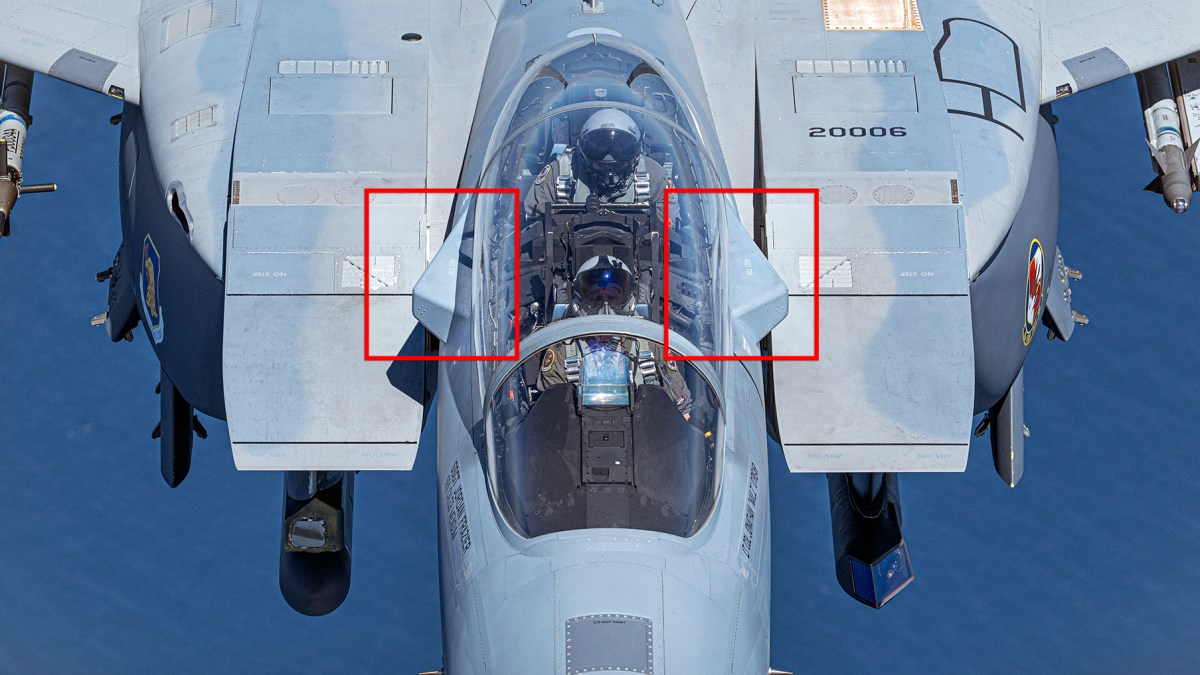
Those most visually prominent of those pre-existing sensor locations are two horn-like sponsons, one on each side of the forward fuselage right below the cockpit canopy. There are two more locations at the ends of the jet’s tail booms. The last two locations are situated so additional sensors can face straight up and down to provide total 360-degree coverage.
A closer look at the nose end of an F-15EX, with the right-side horn-like sponson under the cockpit plainly visible. USAF/Master Sgt. Steph Sawyer
The F-15EX also has pre-existing locations for MWS sensors at the ends of its tailplanes, as can be seen in this picture. USAF
The sources sought notice does not mention any specific MWS and invites prospective vendors to submit proposals. It also stresses that the Air Force is still in the “market research” phase of the contracting process and that it “does not constitute [a] solicitation and shall not be construed as a commitment” to buy such a system.
The F-15SA uses the AN/AAR-57 Common Missile Warning System (CMWS), and this system is understood to also be found on the F-15QA. Beyond F-15 variants, versions of the AN/AAR-57, for which BAE Systems is currently the prime contractor, are fielded today on a wide variety of other fixed-wing aircraft and helicopters, including various types in U.S. military service. CMWS variants are notably found across the U.S. Army’s AH-64, UH-60, and CH-47 helicopter fleets.
A picture of a Saudi Arabian F-15SA Advanced Eagle. Jamie Hunter
Another close-up look at a Saudi F-15SA, offering a particularly good view of one of the aircraft’s missile warning sensors. USAF/Staff Sgt. Isaiah Soliz
All versions of the CMWS consist of several electro-optic missile sensors (EOMS), the number of which varies from platform to platform, linked to a central electronic control unit (ECU). The system is also designed to be integrated into larger defensive suites.
A picture showing five of the electro-optic missile sensors (EOMS) used in the AN/AAR-57, as well as the electronic control unit. BAE Systems
While the AN/AAR-57 is a proven system with years of successful integration on the F-15 and other platforms, it is just one option of the open market today. The Air Force could choose to take another route, possibly with a new system that offers added functionality .
The addition of any MWS will give the F-15EX a valuable, if not increasingly critical, boost in defensive capability. The Eagle II does already have an extremely powerful self-protection suite, including the Eagle Passive/Active Warning Survivability System (EPAWSS). However, it is heavily geared toward defending against radar-based threats that pump out signals that can be detected and jammed. Infrared-homing anti-air missiles zero in on their targets passively.
In general, MWSs also typically make use of passive infrared sensors to spot the heat plumes of missile launches and the thermal signatures of those threats as they continue their approach. BAE Systems says current-generation versions of the AN/AAR-57 are sensitive enough to detect infantry anti-armor rockets being launched , as well as small arms fire from the ground, under the right circumstances. Though an MWS is not an active countermeasure unto itself, the early warning it provides gives critical time to deploy flares or employ other defensive capabilities, or just take evasive action.
TWZ touched on all of this last month after The New York Times reported new details about the shootdown of an F-15E Strike Eagle over Iran in April. A shoulder-fired, heat-seeking surface-to-air missile, also known as a man-portable air defense system (MANPADS), is said to have been responsible, thought his remains unconfirmed. The Strike Eagle also lacks an MWS. The Times ‘ story said that the F-15E’s defensive suite provided the crew with only half a second of warning. As we noted at the time , it would actually have provided no warning given that the Strike Eagle also lacks an MWS.
A picture showing one of the tailfins of the F-15E shot down over Iran in April 2026. Iranian state media
Even before the current conflict with Iran broke out, TWZ had questioned the F-15EX’s lack of this capability given the general focus on increased survivability to match expanding threat ecosystems globally . EPAWSS is already a reflection of that reality, and could be made even more capable when tied together with an MWS. In May, we had reached out to the Air Force about any plans to integrate an MWS onto the F-15EX in light of observations from the ongoing conflict with Iran. The service told us then that it had no details to share. Whether the service now has any plans to add MWSs to the Strike Eagle fleet, which would require more significant integration work, is also unknown.
Buying F-15EX and not springing for the missile approach warning system is absolutely the dumbest thing. $100M fighter, but let's save a few bucks on a key defensive advantage. You are not always going to get a radar spike from a threat, even at altitude. — Tyler Rogoway (@Aviation_Intel) April 4, 2026
Buying F-15EX and not springing for the missile approach warning system is absolutely the dumbest thing. $100M fighter, but let's save a few bucks on a key defensive advantage. You are not always going to get a radar spike from a threat, even at altitude.
They also didn't buy conformals for the first EXs. So silly. — Tyler Rogoway (@Aviation_Intel) April 4, 2026
They also didn't buy conformals for the first EXs. So silly.
Infrared homing anti-air missiles, as well as air defense systems that use passive infrared sensors for target detection and cueing, are certainly not threats limited to Iran. In Yemen, Iranian-backed Houthi militants have been making good use of these capabilities for years now, something else we have explored in great detail in the past . The Houthis claimed to have downed a Saudi Arabian F-15 just earlier this month and, per a now-long standing modus operandi, subsequently released video captured through a ground-based forward-looking infrared (FLIR) system as evidence. The group also shared images of the wreckage of what looked to be an F-15SA Advanced Eagle , underscoring the dangers posed even to aircraft equipped MWSs.
Onboard footage of a Houthi SAM system shooting down a Saudi F-15 overnight over Yemen’s Marib province. pic.twitter.com/6mh23B2Ovu — OSINTtechnical (@Osinttechnical) September 16, 2026
Onboard footage of a Houthi SAM system shooting down a Saudi F-15 overnight over Yemen’s Marib province. pic.twitter.com/6mh23B2Ovu
These threats are not limited to the Middle East more broadly, either, and are only increasingly likely to be encountered in future conflicts globally. The emergence of ever-more capable and longer-range anti-air missiles with infrared or dual-mode guidance systems is a significant factor in all this. Expanding use of passive infrared search and track (IRST) systems on aircraft and infrared sensors on ground-based air defense systems are part of this larger equation , as well.
How the Air Force ultimately decided to proceed with the integration of an MWS onto the F-15EX fleet remains to be seen. However, the Eagle II’s lack of this capability is only becoming more striking, especially in light of the conflict with Iran.
Contact the author: joe@twz.com
Comments couldn’t be loaded. Please refresh the page.
作者:约瑟夫·特雷维西克
发布于美国东部时间2026年9月30日下午3:14
参谋军士雅各布·斯蒂芬斯
美国空军正考虑为其新型F-15EX“鹰II”战斗机加装导弹预警系统(MWS)。这将使该型战机能够以光学方式探测来袭导弹威胁,特别是被动制导导弹,例如目前F-15EX所缺乏的红外制导导弹。鉴于近期在伊朗上空发生的战斗经验,F-15EX缺乏导弹预警系统的问题显得尤为突出。
F-15EX源自早期所有配备微型武器系统的F-15系列,因此人们理所当然地认为“鹰II”战斗机也会具备这项能力。然而,当首批样机交付时却并未配备该系统,而且似乎也没有计划在这款造价已超过1亿美元的战机上加装该系统,这着实令人费解。多年来,这一疏漏一直十分显眼,尤其考虑到该机已具备安装此类系统的所有条件,包括预留的传感器安装位置。
2026年8月,美国空军第22架F-15EX战斗机从位于密苏里州圣路易斯的波音工厂起飞。(美国空军/高级空军兵梅拉尼·贝尔穆德斯摄)
美国空军目前拥有22架F-15E-2“鹰”式战斗机,并计划最终采购267架。该机制造商波音公司目前已签订合同,将生产120架F-15EX战斗机,其中包括昨天宣布的一项价值23.8亿美元的新合同中的22架。
根据昨天发布的一份合同公告,美国空军生命周期管理中心(AFLCMC)战斗机与先进飞机局“正在寻求供应商,采购一套具备作战能力的导弹发射和逼近预警系统,以便快速集成到美国空军(USAF)F-15EX“鹰II”战斗机上”。公告称,“该导弹预警系统必须在存在可能威胁飞机的导弹时向F-15EX机组人员发出警报,同时避免因虚假警报而对机组人员造成不必要的干扰。”
如前所述,F-15EX 的内外设计均已预留安装微型武器系统 (MWS) 的空间,空军生命周期管理中心 (AFLCMC) 的通知也强调了这一点。这是因为“鹰 II”型直接源自卡塔尔的 F-15QA 型,而 F-15QA 型本身又是沙特阿拉伯 F-15SA 型的衍生机型。虽然 F-15EX 的许多先进技术都来自这些飞机,但首款配备微型武器系统的 F-15 机型实际上是新加坡的 F-15SG。“先进鹰”系列和 F-15SG 均属于波音公司扩展的 F-15E“攻击鹰”系列。
两架卡塔尔空军的F-15QA先进鹰式战斗机。美国空军
“导弹预警系统必须利用F-15EX原有的六个传感器安装位置、数据线、电源线和冷却系统,”合同通知中写道。“该系统必须能够由美国空军军用飞机维护人员在现场轻松、安全、快速且自然地安装和拆卸,无需对飞机配置进行任何更改,只需在飞机上六个用于导弹预警的现有位置安装导弹预警系统的可更换单元(LRU)即可。”
在这些预先设置的传感器位置中,最显眼的是位于驾驶舱盖正下方机身前部两侧的两个喇叭状凸起。此外,飞机尾梁末端还有两个传感器位置。后两个位置的设计使得额外的传感器可以垂直向上和向下,从而实现360度全方位覆盖。
近距离观察F-15EX的机头,可以清晰地看到座舱下方右侧的喇叭状短翼。美国空军/一级军士长斯蒂芬·索耶
如图所示,F-15EX的尾翼末端也预留了MWS传感器的安装位置。
此次征求意见稿并未提及任何具体的MWS系统,而是邀请潜在供应商提交方案。意见稿还强调,空军目前仍处于合同流程的“市场调研”阶段,并且“该意见稿不构成招标,也不应被解释为购买此类系统的承诺”。
F-15SA战斗机使用AN/AAR-57通用导弹告警系统(CMWS),据了解,F-15QA战斗机也配备了该系统。除了F-15系列之外,AN/AAR-57的各种型号(目前由BAE系统公司担任主承包商)目前还部署在多种其他固定翼飞机和直升机上,包括美军现役的多种机型。值得注意的是,CMWS的各种型号均装备于美国陆军的AH-64、UH-60和CH-47直升机机队。
一张沙特阿拉伯空军F-15SA“先进鹰”战斗机的照片。杰米·亨特
另一张沙特阿拉伯F-15SA战斗机的近距离照片,清晰地展示了该机的一个导弹告警传感器。美国空军/参谋军士以赛亚·索利兹
所有型号的CMWS均由多个光电导弹传感器(EOMS)组成,传感器数量因平台而异,这些传感器与中央电子控制单元(ECU)相连。该系统还设计为可集成到更大型的防御系统中。
图片展示了AN/AAR-57导弹系统中使用的五个光电导弹传感器(EOMS)以及电子控制单元。英国航空航天系统公司(BAE Systems)
虽然AN/AAR-57是一款久经考验的系统,多年来已成功集成到F-15和其他平台上,但它只是当今市场上众多选择之一。空军也可以选择其他方案,例如采用功能更强大的新系统。
加装任何一款导弹防御系统(MWS)都将显著提升F-15EX的防御能力,即便这种提升并非至关重要。F-15“鹰”式II战斗机本身已拥有极其强大的自卫系统,包括“鹰”式被动/主动预警生存系统(EPAWSS)。然而,该系统主要针对雷达威胁,而雷达信号可以被探测和干扰。红外制导防空导弹则依靠被动方式锁定目标。
一般来说,导弹预警系统(MWS)通常也利用被动红外传感器来探测导弹发射的热焰以及这些威胁在接近过程中产生的热特征。英国航空航天系统公司(BAE Systems)表示,目前一代的AN/AAR-57雷达灵敏度足够高,在特定情况下可以探测到步兵发射的反装甲火箭以及地面小口径武器的射击。虽然导弹预警系统本身并非主动对抗措施,但它提供的早期预警可以为部署干扰弹、采取其他防御措施或采取规避行动争取宝贵时间。
上个月,《纽约时报》报道了4月份伊朗上空F-15E“攻击鹰”战斗机被击落的更多细节后,TWZ就此进行了探讨。据称,一枚肩扛式红外制导地对空导弹(也称便携式防空导弹系统,MANPADS)是造成此次击落的原因,但这一说法尚未得到证实。“攻击鹰”战斗机也没有配备导弹防御系统(MWS)。《纽约时报》的报道称,F-15E的防御系统只给了机组人员半秒钟的预警时间。正如我们当时指出的,考虑到“攻击鹰”战斗机本身就没有导弹防御系统,实际上它根本无法发出任何预警。
一张照片显示的是2026年4月在伊朗上空被击落的一架F-15E战斗机的尾翼。伊朗国家媒体
早在与伊朗的冲突爆发之前,TWZ就曾质疑F-15EX缺乏这种能力,因为目前全球都在致力于提升战机的生存能力以应对不断扩大的威胁环境。EPAWSS系统正是对这一现实的体现,如果与MWS系统结合使用,其性能将得到进一步提升。今年5月,我们曾就F-15EX是否计划集成MWS系统一事联系过美国空军,当时空军表示没有相关细节可以透露。目前,空军是否计划为F-15EX战机加装MWS系统(这将需要进行更深入的集成工作)也尚不得而知。
购买F-15EX却不选配导弹逼近预警系统,绝对是最愚蠢的做法。价值1亿美元的战斗机,却在关键的防御优势上省钱。即使在高空,你也不总能从威胁中探测到雷达信号峰值。——泰勒·罗格威(@Aviation_Intel)2026年4月4日
买F-15EX却不选配导弹逼近预警系统,简直是愚蠢至极。价值1亿美元的战斗机,却在关键的防御优势上省钱?即使在高空,你也不总能从威胁中探测到雷达信号峰值。
他们也没给第一批EX飞机买保形衬垫。真是太蠢了。——Tyler Rogoway (@Aviation_Intel) 2026年4月4日
他们也没给第一批EX车型买防脱圈套。真是太傻了。
红外制导防空导弹以及利用被动红外传感器进行目标探测和引导的防空系统,其威胁绝非伊朗独有。在也门,伊朗支持的胡塞武装多年来一直在充分利用这些能力,我们此前也对此进行过深入探讨。胡塞武装声称在本月初击落了一架沙特阿拉伯的F-15战斗机,并按照其惯用的伎俩,随后公布了通过地面前视红外(FLIR)系统拍摄的视频作为证据。该组织还分享了疑似F-15SA“先进鹰”战斗机的残骸照片,凸显了即使是配备此类武器系统的飞机也面临着巨大的威胁。
机载视频显示,胡塞武装的防空导弹系统在也门马里卜省上空击落了一架沙特阿拉伯的F-15战斗机。 pic.twitter.com/6mh23B2Ovu — OSINTtechnical (@Osinttechnical) September 16, 2026
机载视频显示,胡塞武装的防空导弹系统在也门马里卜省上空击落了一架沙特阿拉伯的F-15战斗机。 pic.twitter.com/6mh23B2Ovu
这些威胁不仅限于中东地区,而且在未来的全球冲突中出现的可能性只会越来越大。性能更强、射程更远、配备红外或双模制导系统的防空导弹的出现是造成这一切的重要因素。此外,飞机上被动红外搜索跟踪(IRST)系统和地面防空系统中红外传感器的广泛应用也是这一更大问题的一部分。
空军最终如何决定将导弹武器系统(MWS)整合到F-15EX机队中,目前尚不得而知。然而,鉴于与伊朗的冲突,F-15“鹰”式战斗机缺乏这种能力这一点显得尤为突出。
联系作者:joe@twz.com
评论加载失败,请刷新页面。