Bedok South, Xilin and Sungei Bedok MRT stations to open on Dec 26勿洛南、西林和双溪勿洛地铁站将于 12 月 26 日开放
The three new stations on theThomson-East Coast Line and Downtown Line will improve rail connectivity in eastern Singapore, with commuters expected to save up to 25 minutes on some journeys.
The three new stations on theThomson-East Coast Line and Downtown Line will improve rail connectivity in eastern Singapore, with commuters expected to save up to 25 minutes on some journeys.
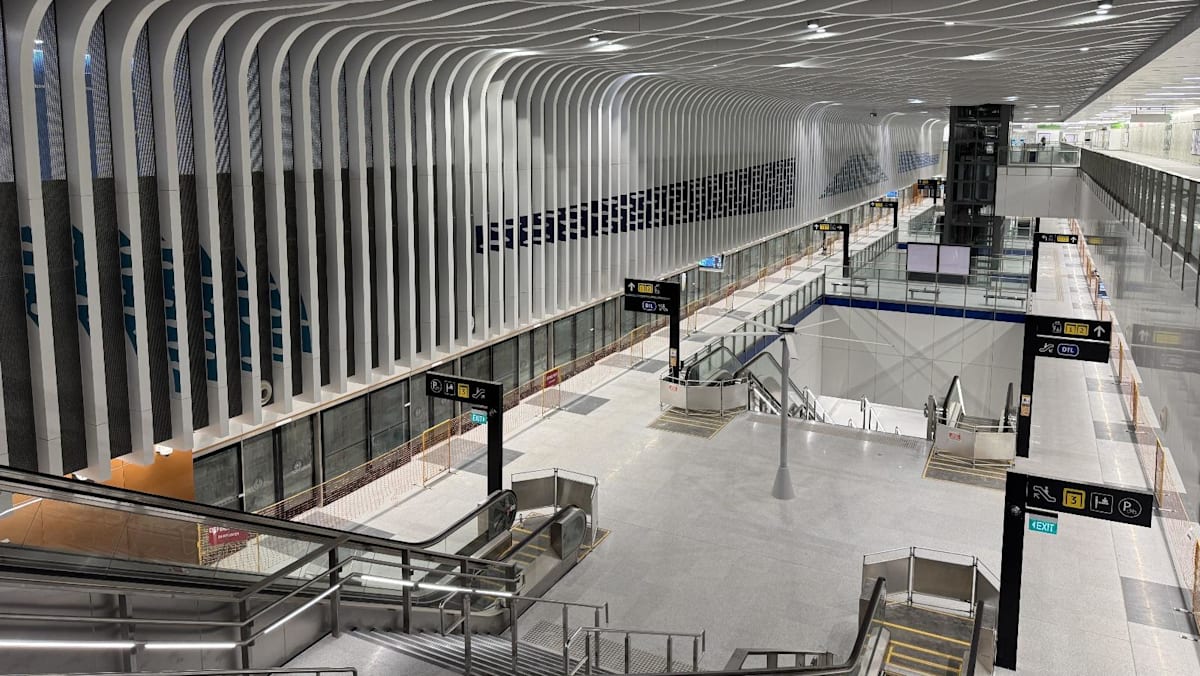
The interior of Sungei Bedok Station. (Photo: LTA)
This audio is generated by an AI tool.
SINGAPORE: Three new MRT stations in eastern Singapore - Bedok South on the Thomson-East Coast Line, Xilin on the Downtown Line and Sungei Bedok, an interchange connecting both lines - will open for passenger service on Dec 26.
Announcing the opening date on Wednesday (Nov 4), Transport Minister Jeffrey Siow said the stations would link two major rail corridors, providing commuters with new routes and faster journeys.
"In fact, residents in the east may even be able to take the Thomson-East Coast Line continuously into the city centre, up north to Woodlands, and maybe conveniently across the Straits into Malaysia very soon," said Mr Siow, who was speaking at the opening ceremony of the Singapore Urban Mobility Week 2026 at Suntec Convention Centre .
The Land Transport Authority (LTA) said the opening of Bedok South and Sungei Bedok, which make up Stage 5 of the Thomson-East Coast Line (TEL), will bring more than 240,000 households within a 10-minute walk of a TEL station.
CNA Games Guess Word Crack the word, one row at a time Buzzword Create words using the given letters Mini Sudoku Tiny puzzle, mighty brain teaser Mini Crossword Small grid, big challenge Word Search Spot as many words as you can Show More Show Less With the opening of Xilin and Sungei Bedok stations, which form the Downtown Line 3 Extension (DTL3e), more than 220,000 households will be within a 10-minute walk of a Downtown Line (DTL) station. Commuters travelling from Havelock to Changi Business Park via the two lines can expect their journey times to be cut from 70 minutes to about 45 minutes, saving up to 25 minutes. Travelling from Marine Parade to Tampines via both lines will also take up to 10 minutes less than it does today. IMPROVED CONNECTIVITY IN THE EAST The new stations span a combined 4.3km of rail extensions. Bedok South station, located along Upper East Coast Road, will improve rail connectivity for nearby residents and schools, including those in the Bayshore precinct. Sungei Bedok station, an underground interchange connecting the TEL and DTL, will be the second interchange between the two lines after Stevens station. Xilin station will improve access to the Changi South industrial estate, Changi Business Park and surrounding employment hubs. It will also provide more direct rail connections between eastern Singapore and the city centre, LTA said.
With the opening of Xilin and Sungei Bedok stations, which form the Downtown Line 3 Extension (DTL3e), more than 220,000 households will be within a 10-minute walk of a Downtown Line (DTL) station.
Commuters travelling from Havelock to Changi Business Park via the two lines can expect their journey times to be cut from 70 minutes to about 45 minutes, saving up to 25 minutes.
Travelling from Marine Parade to Tampines via both lines will also take up to 10 minutes less than it does today.
IMPROVED CONNECTIVITY IN THE EAST
The new stations span a combined 4.3km of rail extensions.
Bedok South station, located along Upper East Coast Road, will improve rail connectivity for nearby residents and schools, including those in the Bayshore precinct.
Sungei Bedok station, an underground interchange connecting the TEL and DTL, will be the second interchange between the two lines after Stevens station.
Xilin station will improve access to the Changi South industrial estate, Changi Business Park and surrounding employment hubs. It will also provide more direct rail connections between eastern Singapore and the city centre, LTA said.
The interior of Bedok South station. (Photo: LTA)
The interior of Xilin station. (Photo: LTA)
The TEL began operations in 2020 with three stations in Woodlands, before expanding progressively in stages from Springleaf to Bayshore.
The line was initially expected to be completed in 2024, but its completion timeline was pushed back , partly due to the COVID-19 pandemic.
The opening of Stage 5, which extends the line from Bayshore to Sungei Bedok, will complete its planned five-stage opening, bringing the TEL to 29 operational stations spanning 42.8km.
With the future extension to Changi Terminal 5, the TEL is expected to serve about one million commuters daily in the longer term, LTA said.
The DTL, which began operations in 2013, currently runs from Bukit Panjang to Expo, connecting the north-western and eastern parts of Singapore through the city centre.
With the addition of Xilin and Sungei Bedok, the line will have 37 operational stations spanning 44.6km.
Another three stations are planned to link Bukit Panjang to the North-South Line by 2035.
QUARTERLY REPORT ON AUTONOMOUS VEHICLES
In his speech, Mr Siow also announced that Singapore will begin publishing quarterly reports on autonomous vehicle deployments from December.
The reports will cover the scale of deployments, passengers' experiences and safety outcomes, allowing the public to assess the vehicles' performance based on evidence rather than perception, he said.
Singapore currently has 25 autonomous passenger vehicles on its roads, alongside a handful of autonomous commercial vehicles undergoing trials.
In April, the first autonomous shuttle service opened to the public in Punggol.
"Public feedback, especially on the passenger vehicles, has been very positive. Once you're past the novelty of the first ride, actually they find the journeys quite boring, but smooth and comfortable," Mr Siow said, adding that vehicles have proven to be "very safe".
"But as we scale up, we want to do so with complete transparency, so that we can strengthen public confidence in autonomous vehicles," he added.
Mr Siow noted that Singapore has been electrifying its buses, with the aim of having more than 3,000 electric buses by 2030 and beyond.
LTA said on Wednesday that it will progressively deploy 660 new electric buses with driver-assistance systems and longer-lasting batteries from the end of 2026.
The new electric buses have been designed based on feedback from commuters, bus captains and public transport operators, the authority said.
Key features include a low-floor design, with no steps along the main passageway and lower seating platforms, making it easier for commuters to board, alight and move around the bus.
A new full-colour rear electronic display system will show its service number and destination.
From 2027, the displays will also provide real-time visual alerts to other road users, indicating when a bus is stopping, moving off or allowing passengers to board and alight.
The buses will also be equipped with driver assistance systems, including onboard CCTV surveillance, collision warnings, surround-view functions, driver fatigue monitoring and camera mirrors.
These features will help bus captains maintain awareness of their surroundings and respond to potential road hazards, LTA said.
Advances in battery technology will also allow the new buses to travel further on a single charge.
Single-deck buses will have an operating range of up to 310km, compared with 280km previously, while double-deck buses will be able to travel up to 240km, up from 215km.
The longer operating ranges will allow for more flexible and efficient bus operations, LTA said.
Get our pick of top stories and thought-provoking articles in your inbox
Stay updated with notifications for breaking news and our best stories
Join our channel for the top reads for the day on your preferred chat app
汤申-东海岸线和市区线上的三个新车站将改善新加坡东部的铁路连接,预计通勤者在某些行程中最多可节省 25 分钟。
双溪勿洛站的内部。 (照片:陆路交通管理局)
这段音频由人工智能工具生成。
新加坡:新加坡东部的三座新地铁站——汤申-东海岸线的勿洛南站、市区线的西林站以及连接这两条线路的换乘站双溪勿洛站——将于12月26日开通客运服务。
交通部长萧敬腾(Jeffrey Siow)在周三(11月4日)宣布新车站的开通日期时表示,这些车站将连接两条主要的铁路走廊,为通勤者提供新的路线和更快的旅程。
“事实上,东部的居民甚至可以乘坐汤申-东海岸线一路直达市中心,向北到达兀兰,或许很快就能方便地跨越海峡前往马来西亚,”萧先生在新加坡新达城会展中心举行的2026年新加坡城市交通周开幕式上说道。
陆路交通管理局 (LTA) 表示,作为汤申-东海岸线 (TEL) 第五阶段的勿洛南站和双溪勿洛站的开通,将使超过 24 万户家庭步行 10 分钟即可到达 TEL 地铁站。
CNA游戏 猜词游戏 逐行破解单词 流行词游戏 用给定的字母组成单词 迷你数独 小谜题,脑力挑战 迷你填字游戏 小方格,大挑战 单词搜索 尽可能多地找出单词 显示更多 显示更少 随着西林站和双溪勿洛站的开通,构成了市区线3号延长线(DTL3e),超过22万户家庭将可在10分钟步行范围内到达市区线(DTL)车站。从哈弗洛克站乘坐这两条线路前往樟宜商业园的通勤者,预计行程时间将从70分钟缩短至约45分钟,最多可节省25分钟。从马林百列站乘坐这两条线路前往淡滨尼的行程时间也将比现在减少最多10分钟。 东部地区交通连接得到改善 新车站的总长度为4.3公里。位于东海岸路上段的勿洛南站将改善附近居民和学校(包括海湾滨海区)的铁路交通。双溪勿洛站是连接汤申-东线和滨海-塔科马线的地下换乘站,将成为继史蒂文斯站之后这两条线路的第二个换乘站。陆路交通管理局表示,锡林站将改善樟宜南工业区、樟宜商业园及周边就业中心的交通,并提供新加坡东部与市中心之间更直接的铁路连接。
随着西林站和双溪勿洛站的开通,构成了市区线 3 号延长线 (DTL3e),超过 22 万户家庭将在 10 分钟步行范围内到达市区线 (DTL) 车站。
乘坐这两条线路从哈弗洛克前往樟宜商业园的通勤者,预计行程时间将从 70 分钟缩短至约 45 分钟,最多可节省 25 分钟。
从马林百列站到淡滨尼站,乘坐这两条线路都将比现在节省最多 10 分钟的时间。
东部地区网络连接改善
新建车站横跨总长 4.3 公里的铁路延伸段。
位于东海岸路上段的勿洛南站将改善附近居民和学校(包括海湾滨海区)的铁路交通连接。
双溪勿洛站是连接汤申-东线和市区线的地下换乘站,将是继史蒂文斯站之后这两条线路的第二个换乘站。
陆路交通管理局表示,锡林站将改善樟宜南工业区、樟宜商业园及周边就业中心的交通状况,并将提供新加坡东部与市中心之间更直接的铁路连接。
勿洛南站内部。(图片:陆路交通管理局)
锡林站内部。(图片:陆路交通管理局)
汤普森轻轨 (TEL) 于 2020 年开始运营,最初在伍德兰兹设有三个站点,之后分阶段逐步扩展,从春叶站延伸至海滨站。
该线路最初预计于 2024 年完工,但由于 COVID-19 疫情等原因,完工时间被推迟。
第五阶段的开通将把线路从海湾大道延伸至双溪勿洛,完成其计划中的五阶段开通,使汤申-东南线拥有29个运营车站,总长42.8公里。
陆路交通管理局表示,随着未来延伸至樟宜机场 5 号航站楼,从长远来看,汤申-东南线预计每天将服务约 100 万通勤者。
新加坡市中心轻轨(DTL)于 2013 年开始运营,目前从武吉班让站延伸至博览站,通过市中心连接新加坡的西北部和东部地区。
随着西林站和双溪勿洛站的加入,该线路将拥有37个运营车站,全长44.6公里。
计划到 2035 年再修建三个车站,将武吉班让站与南北线连接起来。
自动驾驶汽车季度报告
萧先生在讲话中还宣布,新加坡将从12月开始发布关于自动驾驶汽车部署情况的季度报告。
他表示,这些报告将涵盖部署规模、乘客体验和安全结果,使公众能够根据证据而不是感知来评估车辆的性能。
新加坡目前道路上有 25 辆自动驾驶乘用车,另有少量自动驾驶商用车正在进行试验。
今年四月,榜鹅首个自动驾驶接驳巴士服务正式向公众开放。
“公众的反馈,尤其是对客运车辆的反馈,非常积极。一旦过了第一次乘坐的新鲜感,实际上他们会觉得旅程相当无聊,但平稳舒适,”萧先生说,并补充说,这些车辆已被证明“非常安全”。
“但随着我们扩大规模,我们希望以完全透明的方式进行,以便增强公众对自动驾驶汽车的信心,”他补充道。
萧先生指出,新加坡一直在推进公交车的电气化,目标是到 2030 年及以后拥有 3000 多辆电动公交车。
陆路交通管理局周三表示,将从 2026 年底开始逐步部署 660 辆配备驾驶辅助系统和更持久电池的新型电动巴士。
该部门表示,新型电动公交车是根据通勤者、公交车司机和公共交通运营商的反馈意见而设计的。
主要特点包括低地板设计,主通道没有台阶,座椅平台较低,方便通勤者上下车和在公交车内走动。
全新的全彩后部电子显示系统将显示其服务编号和目的地。
从 2027 年起,这些显示屏还将向其他道路使用者提供实时视觉警报,指示公交车何时停车、起步或允许乘客上下车。
这些公交车还将配备驾驶员辅助系统,包括车载闭路电视监控、碰撞预警、环视功能、驾驶员疲劳监测和摄像头后视镜。
陆路交通管理局表示,这些功能将帮助公交车司机保持对周围环境的感知,并对潜在的道路危险做出反应。
电池技术的进步也将使新型公交车单次充电后行驶更远的距离。
单层巴士的运营里程将达到 310 公里,而此前为 280 公里;双层巴士的运营里程将达到 240 公里,而此前为 215 公里。
陆路交通管理局表示,更长的运营里程将使公交车运营更加灵活高效。
订阅我们的邮件,即可获取精选热点新闻和引人深思的文章。
订阅通知,第一时间获取突发新闻和精彩报道。
加入我们的频道,即可在您常用的聊天应用上获取当日热门文章。