'Absurd and novel': Shanmugam dismisses WP MP’s call to raise issues at Singapore’s meetings with foreign counterparts“荒谬且新奇”:尚穆根驳斥工人党议员呼吁在新加坡与外国同行会晤中提出问题的提议
Opposition Workers’ Party MP Fadli Fawzi argued that the home affairs ministry should have raised Singapore’s position on Israeli settlements and settler violence during a meeting with Israeli officials.
新闻视频
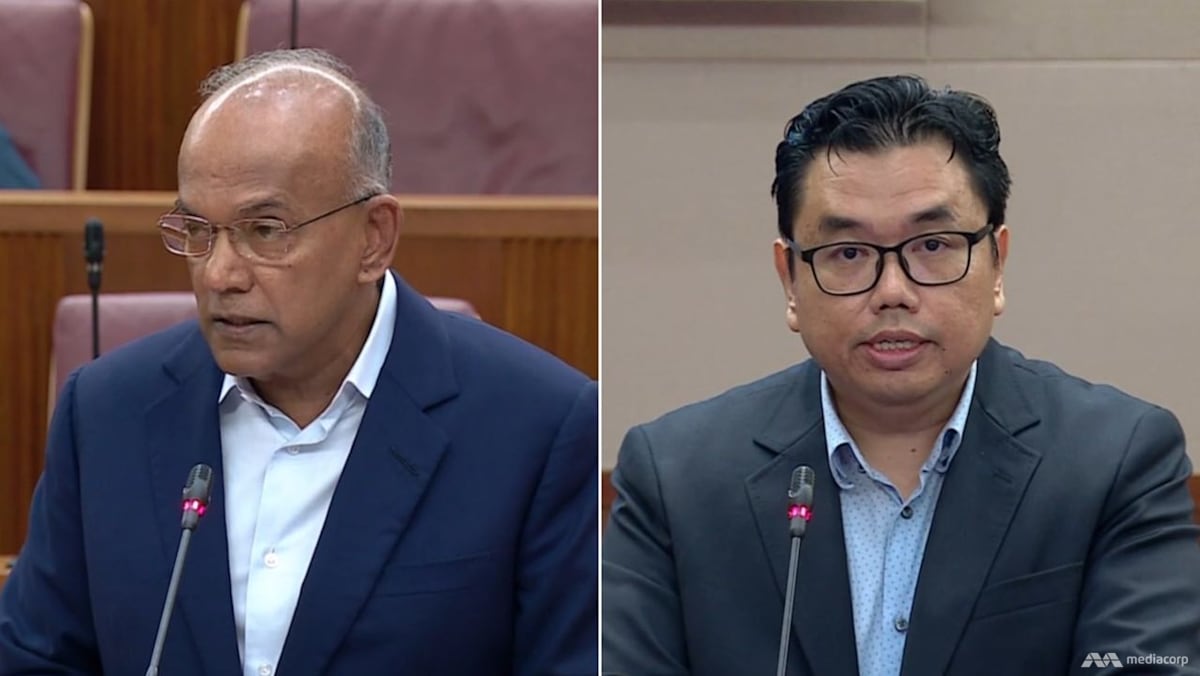
Opposition Workers’ Party MP Fadli Fawzi argued that the home affairs ministry should have raised Singapore’s position on Israeli settlements and settler violence during a meeting with Israeli officials.
Senior Minister K Shanmugam (left) and Workers' Party MP Fadli Fawzi speaking in parliament on Nov 4, 2026.
This audio is generated by an AI tool.
SINGAPORE: Singapore cannot conduct foreign relations on the basis that every ministry should raise international law issues whenever it meets foreign counterparts, Senior Minister K Shanmugam said in parliament on Wednesday (Nov 4), calling such an approach "absurd and novel".
Mr Shanmugam, who is also Coordinating Minister for National Security and Home Affairs, was responding to Workers’ Party (WP) MP Fadli Fawzi, who argued that the Ministry of Home Affairs should have raised Singapore’s position on Israeli settlements and settler violence during a meeting with Israeli officials. Mr Shanmugam also accused Mr Fadli of sending "two messages to two different audiences": one to the general public that the WP was focused on Singapore’s national interests, while another was directed specifically at the Malay-Muslim community that the government was "unprincipled and soft on Israel".
"That's what this question and the subsequent explanation is all about - getting people to view our international relationships through the prism of race and religions, race and religion," said Mr Shanmugam. "That is just wrong." In response, Mr Fadli said he rejected the characterisation that he was motivated by race and religion. He added that he did not suggest that Singapore should raise every bilateral or foreign policy issue at every meeting, and it was not the Workers' Party's position.
The 18-minute exchange between the two men arose from a parliamentary question Mr Fadli had submitted on Oct 7 on a meeting between Singapore and Israeli officials.
CNA Games Guess Word Crack the word, one row at a time Buzzword Create words using the given letters Mini Sudoku Tiny puzzle, mighty brain teaser Mini Crossword Small grid, big challenge Word Search Spot as many words as you can Show More Show Less The MP asked whether Singapore had discussed how to address illegal settlements and settler violence in the West Bank during the meeting, whether Singapore requested that the meeting be secret, and if not, why a correction order under the Protection from Online Falsehoods and Manipulation Act (POFMA) was not issued against a news report in Israel news outlet Haaretz. The Haaretz newspaper had reported on Sep 7 that a delegation comprising representatives from the Israel Prison Service and National Security Ministry made a "secret visit" to Singapore that month. The report also claimed that the death penalty was discussed during the meeting, with the Ministry of Home Affairs (MHA) later disputing this . Mr Shanmugam’s written reply on Oct 7 set out how Singapore regularly holds discussions with international counterparts on security and law enforcement matters, as well as why MHA responded to Haaretz but did not issue a POFMA notice. He had also asked Mr Fadli to say whether MHA should raise broader concerns about a country’s policies during bilateral engagements, and whether this should apply consistently beyond Israel. If so, Mr Fadli should explain how such an approach would serve Singapore’s overall interests.
The MP asked whether Singapore had discussed how to address illegal settlements and settler violence in the West Bank during the meeting, whether Singapore requested that the meeting be secret, and if not, why a correction order under the Protection from Online Falsehoods and Manipulation Act (POFMA) was not issued against a news report in Israel news outlet Haaretz.
The Haaretz newspaper had reported on Sep 7 that a delegation comprising representatives from the Israel Prison Service and National Security Ministry made a "secret visit" to Singapore that month. The report also claimed that the death penalty was discussed during the meeting, with the Ministry of Home Affairs (MHA) later disputing this .
Mr Shanmugam’s written reply on Oct 7 set out how Singapore regularly holds discussions with international counterparts on security and law enforcement matters, as well as why MHA responded to Haaretz but did not issue a POFMA notice.
He had also asked Mr Fadli to say whether MHA should raise broader concerns about a country’s policies during bilateral engagements, and whether this should apply consistently beyond Israel.
If so, Mr Fadli should explain how such an approach would serve Singapore’s overall interests.
On Wednesday, Mr Fadli said that it would have been relevant to clearly reiterate at the meeting Singapore's principled position that Israeli settlements in the West Bank are illegal under international law, and the deep concerns about settler violence against Palestinian civilians in the West Bank.
Referring to Mr Shanmugam's question on whether this principle should apply only to Israel or consistently to all countries, Mr Fadli said: "I believe that the principle that Singapore should address issues that are relevant to our concerns and our commitments and in our interests, should be applied consistently to all countries with which the Ministry of Home Affairs engages with".
“It is also my belief that when engaging with foreign counterparts, Singapore should maintain a whole of government approach in upholding our commitment to international law and a rules-based international order.”
In response, Mr Shanmugam asked if Mr Fadli meant that every ministry must raise international law issues when meeting a counterpart ministry, even if the issues are not directly relevant to the ministry.
"Can I ask, sir, on that logic, it would be even more important as a rule, to raise bilateral issues as well between two countries, regardless of which ministries' meeting?"
Mr Fadli reiterated that Singapore should raise an issue during a bilateral engagement “if it is relevant and in our interest to do so”.
Mr Shanmugam said Mr Fadli had maintained that the principle should apply to all countries, but had not answered whether it should also extend to the full range of bilateral issues between Singapore and those countries.
The suggestion of how Singapore's bilateral business between countries should be conducted, that every ministry when meeting Israel or any other country must raise all possible issues of international law and all possible bilateral issues would "certainly be novel", said Mr Shanmugam.
He explained that the Ministry of Foreign Affairs and the Cabinet as a whole decide on Singapore's overall stance towards any particular country, as well as the extent of meetings, including whether these take place at all.
Each ministry also deals with issues directly relevant to them, he added.
As a small country, it is important for Singapore that international law be upheld. But this does not mean repeating its principles at every meeting.
"These things are dealt with, with common sense and skill. And if (the) Member believes that meetings with Israel on the West Bank settler issue, every meeting should raise those issues, put down an adjournment motion and we can debate it," he said.
ICJ ELECTION "TESTAMENT" TO SINGAPORE'S DIPLOMACY
Mr Shanmugam cited an example of Ambassador for International Law Rena Lee who has been elected as a judge of the International Court of Justice (ICJ) , becoming the first Singaporean and first woman from Southeast Asia to do so. Ms Lee, 57, secured the highest number of votes in the United Nations (UN) General Assembly with 151 out of 191 votes, and also received the joint-highest number in the UN Security Council with 13 out of 15 votes. The Ministry of Law and Ministry of Foreign Affairs worked very hard to lobby countries, said Mr Shanmugam, adding that he too was involved in early meetings.
Ms Lee's votes were a "testament" to Singapore's skill in diplomacy and the way the country conducts itself, he added.
He put forth a scenario of meeting the five permanent countries of the UN Security Council and bringing up the weapons they have supplied to conflict zones where there are breaches of international law.
"You start out by listing this category of international law issues, and then you say, 'by the way, can you please support us?' I think Members and Singaporeans can see how absurd and novel such a position is," said Mr Shanmugam.
Mr Shanmugam said that there was a “more fundamental point” about Mr Fadli’s statements.
"To jump on this Haaretz article, make absurd suggestions on how we conduct and how we should engage in the belief that people won't understand how inter-ministry conversations really take place, in the complete belief that people will ignore the details of how Singapore conducts its relationships, and try and present the picture that the government is unprincipled and soft on Israel."
Mr Shanmugam added that it is wrong to try to view Singapore's international relationships through the prism of race and religion.
Mr Fadli rejected the characterisation that his position was motivated by race and religion.
"This is primarily an issue about how Singapore can uphold its commitments to international law, consistently impartially and objectively," he said.
He added that Singapore should be raising concerns only when they are “relevant”.
He maintained that in the case of the Israeli meeting, the existence of illegal settlements was relevant as the Haaretz article had named two officials in the Israeli delegation linked to the construction of illegal outposts in the West Bank.
In response, Mr Shanmugam said he could not understand how the issue of settler violence is relevant to MHA’s discussions when Mr Fadli does not know what was discussed between both sides.
“I have said in my speeches that the primary point of international law and approach has got to be enlightened self-interest,” he said.
He added that Mr Fadli should have realised from Mr Shanmugam’s question that his position was “absurd”.
“Instead of that, he walks in further and doubles down,” said Mr Shanmugam.
On whether Singapore requested that the meeting with Israeli officials be kept a secret, Mr Shanmugam said meetings between MHA and its counterparts are almost always kept confidential, except when parties request for them to be made public.
He reiterated that he had given his answer that one party requested that the meeting be made public.
Get our pick of top stories and thought-provoking articles in your inbox
Stay updated with notifications for breaking news and our best stories
Join our channel for the top reads for the day on your preferred chat app
反对党工人党议员法德利·法齐认为,内政部本应在与以色列官员的会晤中提出新加坡对以色列定居点和定居者暴力问题的立场。
2026年11月4日,高级部长尚穆根(左)和工人党议员法德利·法齐在国会发表讲话。
这段音频由人工智能工具生成。
新加坡:新加坡高级部长尚穆根周三(11月4日)在国会表示,新加坡不能以每个部门在与外国同行会面时都应提出国际法问题为基础来处理外交关系,称这种做法“荒谬且新颖”。
尚穆根先生同时也是国家安全统筹部长兼内政部长,他此番言论是对工人党议员法德利·法齐的回应。法德利·法齐认为,内政部本应在与以色列官员的会晤中提出新加坡在以色列定居点和定居者暴力问题上的立场。尚穆根先生还指责法德利先生向两个不同的受众传递了“双重信息”:一方面是向公众传递工人党关注新加坡国家利益的信息,另一方面则是专门针对马来穆斯林社群传递政府“对以色列缺乏原则且态度软弱”的信息。
尚穆根先生说:“这个问题以及随后的解释,其目的就是要让人们透过种族和宗教的棱镜来看待我们的国际关系。这完全是错误的。”对此,法德利先生回应说,他否认自己是出于种族和宗教动机。他还补充说,他并没有建议新加坡在每次会议上都提出所有双边或外交政策问题,这也不是工人党的立场。
两人之间长达 18 分钟的交流源于法德利先生 10 月 7 日向议会提交的一项关于新加坡和以色列官员会晤的质询。
CNA游戏 猜词游戏 逐行破解单词 流行词游戏 用给定的字母组成单词 迷你数独 小小的谜题,强大的脑力挑战 迷你填字游戏 小方格,大挑战 单词搜索 尽可能多地找出单词 显示更多 显示更少 议员询问新加坡是否在会晤期间讨论了如何解决西岸的非法定居点和定居者暴力问题,新加坡是否要求会晤保密,如果没有,为什么没有根据《防止网络虚假信息和操纵法》(POFMA)对以色列新闻媒体《国土报》(Haaretz)的一篇报道发出更正令。《国土报》9月7日报道称,一个由以色列监狱管理局和国家安全部代表组成的代表团当月对新加坡进行了“秘密访问”。该报道还声称,会晤期间讨论了死刑问题,但内政部后来对此予以否认。尚穆根先生10月7日的书面答复阐述了新加坡如何定期与国际同行就安全和执法问题进行磋商,以及内政部为何回应《国土报》的问询但并未发出《防止网络虚假信息和网络操纵法》(POFMA)通知。他还询问法德利先生,内政部是否应在双边会谈中提出对一国政策的更广泛关切,以及这一做法是否应一视同仁地适用于以色列以外的国家。如果应如此,法德利先生应解释这种做法如何符合新加坡的整体利益。
该议员询问新加坡在会晤期间是否讨论了如何解决西岸的非法定居点和定居者暴力问题,新加坡是否要求会晤保密,如果没有,为什么没有根据《防止网络虚假信息和操纵法》(POFMA)对以色列新闻媒体《国土报》的一篇新闻报道发出更正令。
《国土报》9月7日报道称,由以色列监狱管理局和国家安全部代表组成的代表团当月对新加坡进行了“秘密访问”。报道还声称,会晤期间讨论了死刑问题,但以色列内政部随后否认了这一说法。
尚穆根先生在 10 月 7 日的书面答复中阐述了新加坡如何定期与国际同行就安全和执法问题进行讨论,以及内政部为何回应《国土报》但并未发出《防止网络虚假信息和网络操纵法》通知。
他还要求法德利先生说明,内政部是否应该在双边交往中对一个国家的政策提出更广泛的关切,以及这是否应该始终如一地适用于以色列以外的国家。
如果真是如此,法德利先生应该解释一下这种做法如何符合新加坡的整体利益。
周三,法德利先生表示,在会议上明确重申新加坡的原则立场,即以色列在西岸的定居点违反国际法,以及对定居者在西岸对巴勒斯坦平民施暴的深切关注,是十分必要的。
针对尚穆根先生提出的这一原则是否应仅适用于以色列还是应一视同仁地适用于所有国家的问题,法德利先生表示:“我认为,新加坡应处理与我们的关切、承诺和利益相关的问题,这一原则应一视同仁地适用于内政部与之接触的所有国家。”
“我也认为,新加坡在与外国同行交往时,应坚持政府整体方针,维护我们对国际法和基于规则的国际秩序的承诺。”
对此,尚穆根先生问道,法德利先生的意思是,每个部委在与对口部委会面时都必须提出国际法问题,即使这些问题与该部委没有直接关系。
“先生,按照这种逻辑,是不是应该更加重视在两国之间提出双边问题,而不管是由哪个部委开会?”
法德利先生重申,如果某个问题与新加坡相关且符合我们的利益,新加坡就应该在双边会谈中提出该问题。
尚穆根先生表示,法德利先生一直坚持认为该原则应适用于所有国家,但他没有回答该原则是否也应扩展到新加坡与这些国家之间的所有双边问题。
尚穆根先生表示,关于新加坡与各国之间的双边业务应如何开展的建议,即每个部委在与以色列或任何其他国家会面时,都必须提出所有可能的国际法问题和所有可能的双边问题,这“肯定是新颖的”。
他解释说,外交部和内阁作为一个整体,决定新加坡对任何特定国家的总体立场,以及会晤的范围,包括是否举行会晤。
他还补充说,各部委也负责处理与自身直接相关的问题。
作为一个小国,新加坡非常重视国际法的维护。但这并不意味着每次会议都要重复其原则。
“这些事情需要用常识和技巧来处理。如果议员认为每次与以色列就西岸定居者问题举行的会议都应该提出这些问题,那么就应该提出休会动议,以便我们进行辩论。”他说。
国际法院选举是新加坡外交的“见证”
尚穆根先生举例说,国际法大使李丽娜当选为国际法院法官,成为首位获此殊荣的新加坡人和东南亚女性。57岁的李女士在联合国大会上以191票中的151票获得最高票数,并在联合国安理会15个席位中获得13票,并列最高票数。尚穆根先生表示,律政部和外交部为此做了大量游说工作,他还补充说,他本人也参与了早期的会谈。
他补充说,李女士的投票“证明了”新加坡的外交技巧和国家行事方式。
他提出了一个方案,即与联合国安理会五个常任理事国会面,提出他们向违反国际法的冲突地区提供的武器问题。
尚穆根先生说:“你们先列出这一类国际法问题,然后说,‘顺便问一下,你们能不能支持我们?’我认为议员们和新加坡人都能看出这种立场是多么荒谬和新奇。”
尚穆根先生表示,法德利先生的言论中存在一个“更根本的问题”。
“抓住《国土报》这篇文章不放,就对我们如何开展工作以及如何参与相关活动提出荒谬的建议,认为人们不会理解部际对话的真实情况,完全认为人们会忽略新加坡处理关系的细节,并试图描绘出政府对以色列不讲原则且软弱的形象。”
尚穆根先生补充说,试图通过种族和宗教的视角来看待新加坡的国际关系是错误的。
法德利先生否认他的立场是出于种族和宗教动机。
他说:“这主要是一个新加坡如何能够始终如一地公正客观地履行其对国际法的承诺的问题。”
他还补充说,新加坡应该只在“相关”的情况下才提出关切。
他坚持认为,就以色列会议而言,非法定居点的存在是相关的,因为《国土报》的文章点名了以色列代表团中的两名官员,他们与在西岸建造非法前哨站有关。
对此,尚穆根先生表示,他无法理解定居者暴力问题与内政部讨论有何关联,因为法德利先生并不知道双方讨论了什么。
他说:“我曾在演讲中说过,国际法和国际方针的首要原则必须是开明的利己主义。”
他还补充说,法德利先生应该从尚穆根先生的问题中意识到,他的立场是“荒谬的”。
“他非但没有那样做,反而走得更远,变本加厉,”尚穆根先生说。
关于新加坡是否要求与以色列官员的会晤保密,尚穆根先生表示,内政部与其对口部门之间的会晤几乎总是保密的,除非当事方要求公开。
他重申,他已经答复说,一方要求公开此次会议。
订阅我们的邮件,即可获取精选热点新闻和引人深思的文章。
订阅通知,第一时间获取突发新闻和精彩报道。
加入我们的频道,即可在您常用的聊天应用上获取当日热门文章。