More S’pore university, polytechnic graduates land jobs by the one-year mark after leaving school新加坡大学和理工学院毕业生在毕业一年内找到工作的比例更高。
About seven in 10 university graduates who were unemployed initially, found paid work within a year. Read more at straitstimes.com.
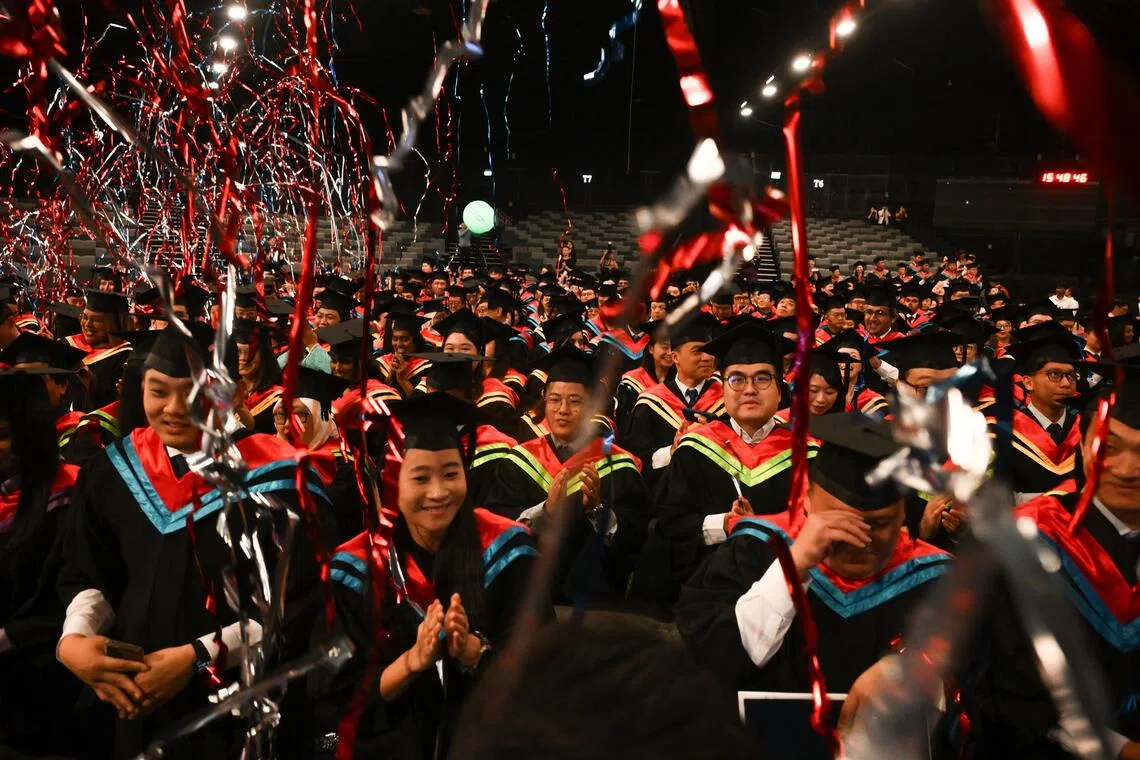
The six autonomous universities had said in a statement that based on past cohorts, employment rates improve beyond the six-month mark.
ST PHOTO: SHINTARO TAY
Published Nov 04, 2026, 05:10 PM
Updated Nov 04, 2026, 05:10 PM
Seven in 10 university graduates who were unemployed after six months found jobs by one year, showing better outcomes for fresh graduates in Singapore.
Polytechnic and ITE graduates also improved, with about eight in 10 and nine in 10, respectively, in work or further study by the one-year mark.
Ministers said weaker hiring and fewer vacancies slowed job searches, while some graduates may be studying, freelancing, or working overseas.
SINGAPORE - About seven in 10 university graduates who were unemployed six months after their final examinations had found jobs by the one-year mark, according to new government data.
In a written parliamentary response on Nov 3, Education Minister Desmond Lee noted similar improvements across the graduates from other tertiary tracks who were unemployed at six months.
Among polytechnic graduates who were unemployed six months after graduation, about eight in 10 had found paid work or enrolled in full-time studies at local institutes of higher learning by the one-year mark.
The corresponding figure for Institute of Technical Education (ITE) graduates was nine in 10.
Lee was responding to Wan Rizal (Jalan Besar GRC), who asked about unemployment rates of 2025 graduates one year after their graduation, and the support for those who remain unemployed.
The latest data, which comes after concerns over weaker employment prospects for fresh graduates, offers a fuller picture of the job market, indicating that fresh jobseekers may take longer to find employment, but most do so eventually.
The latest graduate employment survey, released on March 5, showed that 74.4% of university graduates secured full-time positions six months after graduation in 2025, down from 79.4% in 2024.
They attributed the outcomes partly to more cautious hiring amid economic uncertainty and geopolitical developments, as well as a moderation in job vacancies from the post-pandemic peak.
Lee said the Education Ministry (MOE) uses administrative data to track the outcomes of graduate cohorts beyond the six-month snapshot provided by the graduate employment survey.
However, these records only show whether graduates are in paid employment, not whether a job is full-time or permanent.
He added that the ministry is unable to determine the proportion of graduates who are still unemployed at the 12-month mark.
“The remaining graduates without paid employment records could be pursuing studies in private education institutions or overseas, or working overseas or as freelancers,” said Lee.
In a separate parliamentary reply on Nov 3 , Acting Minister for Manpower Jasmin Lau gave figures showing a similar improvement in graduate employment outcomes .
The unemployment rates of 2025 fresh graduates from autonomous universities fell from 16.6% at the six-month mark to 7% at the one-year mark.
For graduates from private education institutions (PEIs), the rate dipped from 24.1% to 7.1%, while that for polytechnic graduates fell from 12.8% to 3.2%.
Addressing Mariam Jaafar (Sembawang GRC), who asked for a breakdown of graduate unemployment rates by field of study, Lau said a large proportion of polytechnic graduates pursue further studies. This varies significantly across course clusters.
Sciences, engineering, and arts, design and media were the three course clusters among the 2025 autonomous university graduates that recorded the highest unemployment rates six months after graduation, ranging from about 22.5% to 19.9%.
For PEI graduates, those who studied information and digital technologies had the highest unemployment rate, at 34.2 per cent.
Elisha Tushara is a correspondent at The Straits Times, specialising in Singapore’s education landscape.
Singapore Parliament
Ministry of Education
Universities - Singapore
这六所自治大学在一份声明中表示,根据以往的毕业生情况,就业率在六个月后会有所提高。
照片:郑信太郎
发布于2026年11月4日下午5:10
更新于2026年11月4日下午5:10
新加坡大学毕业生就业前景良好,10名失业大学毕业生中有7名在毕业六个月后找到了工作,这表明新加坡应届毕业生的就业前景更好。
理工学院和工艺教育学院的毕业生就业情况也有所改善,到一年后,分别有约 80% 和 90% 的毕业生找到了工作或继续深造。
部长们表示,招聘力度减弱和职位空缺减少减缓了求职速度,而一些毕业生可能正在海外深造、从事自由职业或工作。
新加坡——根据政府最新数据,约有十分之七的大学毕业生在毕业考试后六个月内失业,到一年后找到了工作。
教育部长李智陞在11月3日的一份书面国会答复中指出,其他高等教育专业的毕业生在毕业六个月后失业的情况也有类似的改善。
在理工学院毕业生中,毕业六个月后失业的人数中,约有十分之八的人在一年内找到了有偿工作或在当地高等院校注册了全日制学习。
工艺教育学院 (ITE) 毕业生的相应比例为 90%。
李是在回应万里扎尔(惹兰勿刹集选区)的提问,万里扎尔询问的是2025届毕业生毕业一年后的失业率,以及对那些仍然失业的人的支持。
最新数据显示,应届毕业生的就业前景较为疲软,这反映了人们对就业市场的担忧。数据显示,应届求职者可能需要更长时间才能找到工作,但大多数人最终都能找到工作。
3月5日发布的最新毕业生就业调查显示,2025年,74.4%的大学毕业生在毕业六个月后找到了全职工作,低于2024年的79.4%。
他们将部分结果归因于经济不确定性和地缘政治发展导致的招聘更加谨慎,以及疫情后职位空缺数量的减少。
李表示,教育部利用行政数据来追踪毕业生群体的就业情况,而不仅仅局限于毕业生就业调查提供的六个月的快照。
然而,这些记录只显示毕业生是否从事有偿工作,并不显示工作是全职还是长期职位。
他还补充说,该部无法确定毕业 12 个月后仍处于失业状态的毕业生比例。
李说:“其余没有带薪就业记录的毕业生可能正在私立教育机构或海外深造,或者在海外工作或成为自由职业者。”
11月3日,人力部代理部长刘嘉敏在另一次国会答复中提供了数据,显示毕业生就业情况也有类似的改善。
2025 年自治大学应届毕业生的失业率从六个月时的 16.6% 下降到一年时的 7%。
私立教育机构(PEI)毕业生的失业率从 24.1% 下降到 7.1%,而理工学院毕业生的失业率从 12.8% 下降到 3.2%。
刘议员回应了玛丽亚姆·贾法尔(三巴旺集选区)提出的按专业划分的毕业生失业率细分数据的要求,他表示,很大一部分理工学院毕业生会继续深造。但不同专业类别之间的差异很大。
在 2025 年自治大学毕业生中,科学、工程、艺术、设计和媒体这三个专业的毕业生在毕业六个月后的失业率最高,失业率在 19.9% 到 22.5% 之间。
在爱德华王子岛的毕业生中,学习信息和数字技术专业的学生失业率最高,达到 34.2%。
Elisha Tushara 是《海峡时报》的记者,专门报道新加坡的教育领域。
新加坡国会
教育部
新加坡大学