USAF Widens Lower-Cost Cruise Missile Effort To Also Include Glide Bombs美国空军扩大低成本巡航导弹项目范围,将滑翔炸弹也纳入其中
A new 'spiral' to the Extended Range Attack Munition program includes calls for unpowered and powered designs.
新闻视频
By Joseph Trevithick
Published Nov 4, 2026 8:24 AM EST
The U.S. Air Force is seeking options for a new unpowered 500-pound air-launched glide bomb as part of a new ‘spiral’ to its Extended Range Attack Munition (ERAM) program. The service has already been acquiring two different lower-cost jet-powered cruise missiles under ERAM, including batches of these munitions for Ukraine . Adding glide bombs to the mix could create additional streams of even cheaper weapons that still offer valuable extended reach.
The Air Force Life Cycle Management Center’s Stand-In Strike division (AFLCMC/EBI) put out a request for information (RFI) for what it is currently calling Extended Range Attack Munition Glide (ERAM Glide) yesterday. AFLCMC/EBI also put out a separate RFI for additional powered ERAM options .
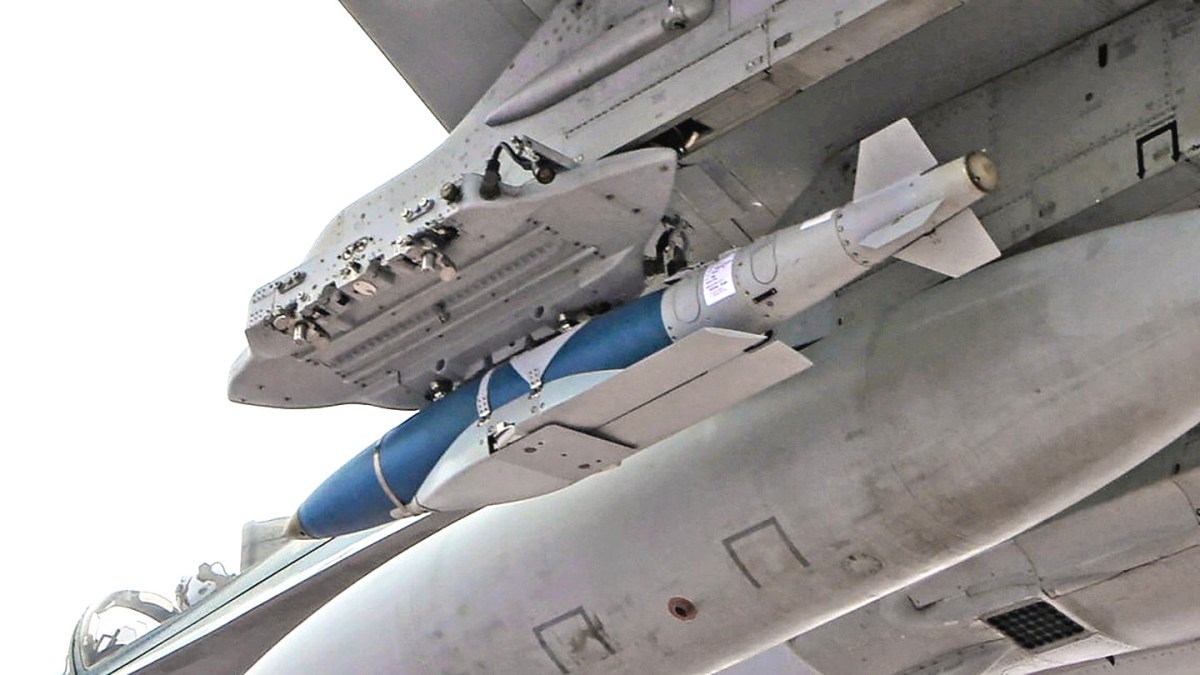
The Rusty Dagger lower-cost cruise missile, seen here under the wing of a US Air Force F-16 during a test, is one of two munitions the service has already been acquiring under the ERAM program. USAF
For ERAM Glide, a “500lb class weapon desired, with the equivalent warhead with approximately 105lbs of explosive and associated fuzes,” according to the contracting notice. The warhead has to be “capable of blast / frag / and limited penetration effects.”
For navigation, proposed munitions have to use “M-Code GPS with a CRPA [Controlled Reception Pattern Antenna] antenna capable of operating in a GPS degraded environment,” the notice adds. It does not call for any particular form of guidance in the terminal phase.
However, ERAM Glide munitions will need to have an accuracy of “CEP [Circular Error Probable] 50 w/in 10m both in non-EMI (Electromagnetic Interference) and high EMI environments (includes GPS degraded).” This means they hit, on average, within 10 meters, or approximately 33 feet, of the specified impact point at least 50 percent of the time. This also happens to be the stated accuracy requirement in the original ERAM RFI put out back in 2024 .
A sequence of images showing a Rusty Dagger munition hitting a target during a test. USAF
The ERAM Glide contracting notice notably does not include a range target, but does specify “glide ratio of at least 10:1, and >15:1.” When it comes to unpowered glide munitions, range is especially dependent on the speed and altitude of the launch platform. Tactics like toss bombing can also help extend the reach of glide munitions even when the launching aircraft starts at a lower altitude.
The Air Force is also looking for munition designs that are already at a high level of developmental and production maturity for ERAM Glide.
There are potentially relevant munitions in production today in the United States. A prime example is Boeing’s Joint Direct Attack Munition-Extended Range (JDAM-ER). The JDAM-ER is really more of a kit that turns various types of unguided bombs into the ‘warheads’ for the resulting precision-guided munitions. JDAM-ER builds on the basic JDAM concept by adding a pop-out wing kit that allows the weapons to glide out to a maximum range of around 45 miles (72.4 kilometers) depending on the aforementioned launch factors. A standard JDAM can also glide, but only for around 15 miles (24 kilometers) at most, according to the Air Force . JDAM-ER kits are available in 500-, 1,000-, and 2,000-pound-class flavors.
There are other glide bomb options on the open market in the U.S. and elsewhere globally today , as well. This includes the SPICE family from Israel’s Rafael and the French AASM 250 Hammer , among others. However, many of them are smaller than the 500-pound-class weapons the Air Force is seeking for ERAM Glide.
The GBU-39/B Small Diameter Bomb (SDB), examples of which are seen here, is another example of a glide bomb in production today. However, it is also a 250-pound-class munition. USAF
For ERAM Glide, prospective vendors might also put forward unpowered derivatives of lower-cost cruise missiles. Eliminating the need for an engine and fuel to power it could free up additional space and weight for larger warheads or other payloads, or just lower overall weight. Reduced weight could, in turn, translate to extended glide range. Developing an unpowered variation of an existing design could also offer sustainment and manufacturing benefits, as well as reduce unit costs. There might even be a possibility for a modular design that can be readily configured for powered or unpowered use.
As already mentioned, the Air Force is already acquiring two lower-cost cruise missile designs through ERAM. These are the Rusty Dagger from Zone 5 Technologies (now a subsidiary of Norwegian defense company Kongsberg) and CoAspire’s Rapidly Adaptable Affordable Cruise Missile (RAACM). Zone 5 and CoAspire are already developing extended-range variants and derivatives of their respective designs for air- and surface-launched applications through two other U.S. military programs called Low-Cost Containerized Missile (LCCM) and Consolidated Affordable Ordnance System (CHAOS).
CoAspire’s original RAACM lower-cost cruise missile design, in front, together with the extended-range RAACM-ER, behind. CoAspire
ERAM, as well as CHAOS, are also heavily focused on providing lower-cost extended-range strike options to allies and partners. Ukraine was notably the first known recipient of munitions through ERAM. At the same time, the ERAM effort, and its subsequent spirals, have also been feeding into the Family of Affordable Mass Missiles (FAMM) program for the U.S. Air Force’s own use. ERAM Glide could similarly help provide additional munition streams for the U.S. military, as well as for export.
A 2025 US Air Force briefing slide showing the parallel relationship between FAMM and ERAM, as well as other lower-cost munition efforts. USAF
Overall, the broadening of the ERAM program to include ERAM Glide speaks to growing demand within the U.S. military, and elsewhere globally, for enlarged and more diversified supply chains for munitions. The Air Force alone plans to acquire 28,000 lower-cost cruise missiles in multiple different configurations over the next five years through FAMM.
The war with Iran, as well as other crises around the Middle East in recent years, together with the conflict in Ukraine , have made clear that just stockpiling munitions ahead of a major figh t is not enough. There also have to be realistic mechanisms to readily replenish those inventories, and do so in a cost-effective manner.
There has already been an explosion globally in the development of lower-cost air- and surface-launched cruise missiles for programs like ERAM. Many of these designs also blur the line between traditional cruise missiles, longer-range one-way-attack drones, and decoys. As noted earlier, the Air Force has also put out a call for new powered ERAM designs as part of the latest spiral to the program.
As these trends continue to grow, the Air Force is now looking to expand the ERAM program to include both powered and unpowered munitions.
Contact the author: joe@twz.com
Comments couldn’t be loaded. Please refresh the page.
作者:约瑟夫·特雷维西克
发布于2026年11月4日上午8:24(美国东部时间)。
美国空军正在为其远程攻击弹药(ERAM)项目寻求一种新型的500磅无动力空射滑翔炸弹,作为其“螺旋式”发展计划的一部分。此前,美国空军已根据ERAM计划采购了两种不同的低成本喷气式巡航导弹,其中包括向乌克兰交付的部分此类导弹。如果将滑翔炸弹加入该计划,则有望开发出更多价格更低廉且仍能提供有效远程打击能力的武器。
空军生命周期管理中心应急打击部门(AFLCMC/EBI)昨日发布了一份信息征询书(RFI),征求其目前称之为“远程攻击弹药滑翔弹”(ERAM Glide)的技术。AFLCMC/EBI 还单独发布了一份信息征询书,征求其他动力型 ERAM 弹药方案。
图中这枚名为“锈匕首”(Rusty Dagger)的低成本巡航导弹,正挂载在美国空军F-16战斗机的机翼下进行测试。它是美国空军根据ERAM计划采购的两种新型导弹之一。
根据合同公告,ERAM Glide导弹需要“500磅级武器,其弹头装药量约为105磅,并配有相关引信”。该弹头必须“能够产生爆炸/破片/有限穿透效果”。
该通知还补充道,为便于导航,拟议的弹药必须使用“配备CRPA(受控接收模式天线)天线的M码GPS,该天线能够在GPS信号减弱的环境下工作”。通知并未要求在末段使用任何特定形式的制导。
然而,ERAM Glide弹药需要在非电磁干扰(EMI)和高电磁干扰(包括GPS信号减弱)环境下,圆概率误差(CEP)均达到50/10米以内的精度。这意味着,平均而言,它们至少有50%的概率能击中指定弹着点10米(约33英尺)以内的弹着点。这恰好也是2024年发布的ERAM原始信息征询书中所述的精度要求。
一组图像显示,一枚“锈匕首”导弹在测试中击中目标。美国空军
ERAM Glide 合同公告中并未明确列出射程目标,但具体要求“滑翔比至少为 10:1,且大于 15:1”。对于无动力滑翔弹药而言,射程尤其取决于发射平台的速度和高度。即使发射飞机的起飞高度较低,抛投轰炸等战术也能有效延长滑翔弹药的射程。
空军也在寻找已经达到较高研发和生产成熟度的 ERAM Glide 弹药设计。
目前美国正在生产一些可能相关的弹药。波音公司的联合直接攻击弹药增程型(JDAM-ER)就是一个典型的例子。JDAM-ER 实际上更像是一个套件,可以将各种类型的非制导炸弹改装成精确制导弹药的“弹头”。JDAM-ER 在基本 JDAM 概念的基础上增加了一个可弹出的机翼套件,使武器能够滑翔飞行,最大射程可达约 45 英里(72.4 公里),具体射程取决于前述的发射参数。标准 JDAM 也可以滑翔,但根据美国空军的数据,最大射程仅为约 15 英里(24 公里)。JDAM-ER 套件有 500 磅级、1000 磅级和 2000 磅级三种规格。
目前,美国及全球其他地区公开市场上还有其他滑翔炸弹可供选择,例如以色列拉斐尔公司的SPICE系列和法国的AASM 250“铁锤”等。然而,它们中的许多都比美国空军为ERAM Glide项目寻求的500磅级武器要小。
GBU-39/B小直径炸弹(SDB),如图所示,是目前仍在生产的另一种滑翔炸弹。然而,它也是一种250磅级的弹药。美国空军
对于ERAM Glide项目,潜在供应商也可能提出低成本巡航导弹的无动力衍生型号。无需发动机和燃料即可提供动力,从而腾出更多空间和重量,用于搭载更大的弹头或其他有效载荷,或者降低整体重量。重量减轻反过来又可以延长滑翔航程。开发现有设计的无动力版本还可以带来维护和制造方面的优势,并降低单位成本。甚至有可能采用模块化设计,可以轻松配置为动力或无动力使用。
如前所述,美国空军已通过ERAM项目采购了两款低成本巡航导弹。它们分别是Zone 5 Technologies公司(现为挪威国防公司康斯伯格的子公司)的“锈匕首”(Rusty Dagger)导弹和CoAspire公司的“快速适应型经济巡航导弹”(RAACM)。Zone 5和CoAspire公司还通过另外两个美国军事项目——“低成本集装箱导弹”(LCCM)和“综合经济型军械系统”(CHAOS)——开发各自导弹的增程型和衍生型号,用于空射和地射用途。
CoAspire公司最初的低成本巡航导弹RAACM设计方案(前)与增程型RAACM-ER(后)并列。
ERAM和CHAOS项目都致力于为盟友和伙伴提供低成本的远程打击选项。值得注意的是,乌克兰是已知最早通过ERAM项目获得弹药的国家。与此同时,ERAM项目及其后续发展也为美国空军的“经济型大规模导弹系列”(FAMM)计划提供了支持。ERAM Glide项目同样可以为美国军方提供额外的弹药来源,并可用于出口。
2025年美国空军简报幻灯片,展示了FAMM和ERAM之间的平行关系,以及其他低成本弹药研发项目。
总体而言,ERAM项目扩展至包含ERAM Glide导弹,表明美国军方乃至全球对规模更大、更加多元化的弹药供应链的需求日益增长。仅空军就计划在未来五年内通过FAMM采购28000枚不同配置的低成本巡航导弹。
与伊朗的战争以及近年来中东地区的其他危机,再加上乌克兰冲突,都清楚地表明,仅仅在重大战争爆发前储备弹药是不够的。还需要建立切实可行的机制,以便能够迅速且经济高效地补充这些库存。
全球范围内,低成本空射和地射巡航导弹的研发已呈现爆发式增长,例如ERAM项目。许多此类设计模糊了传统巡航导弹、远程单向攻击无人机和诱饵之间的界限。如前所述,作为该项目最新进展的一部分,美国空军也已发出征集新型动力ERAM设计方案的邀请。
随着这些趋势的不断发展,空军现在正考虑扩大 ERAM 计划,使其涵盖动力弹药和非动力弹药。
联系作者:joe@twz.com
评论加载失败,请刷新页面。