MBDA high-speed strike missile to have range ‘far’ exceeding ExocetMBDA高速打击导弹的射程将远超飞鱼导弹。
Stratus RS, for rapid strike, is being developed for France and the United Kingdom, and MBDA is awaiting a development contract from France’s Directorate General for Armament.
Share on Facebook (Opens in new window) Facebook
Share on X (Opens in new window) X
Share on Bluesky (Opens in new window) Bluesky
Share on Reddit (Opens in new window) Reddit
Share on LinkedIn (Opens in new window) LinkedIn
Share using Native tools Share Copied to clipboard
Share on Mail (Opens in new window) Mail
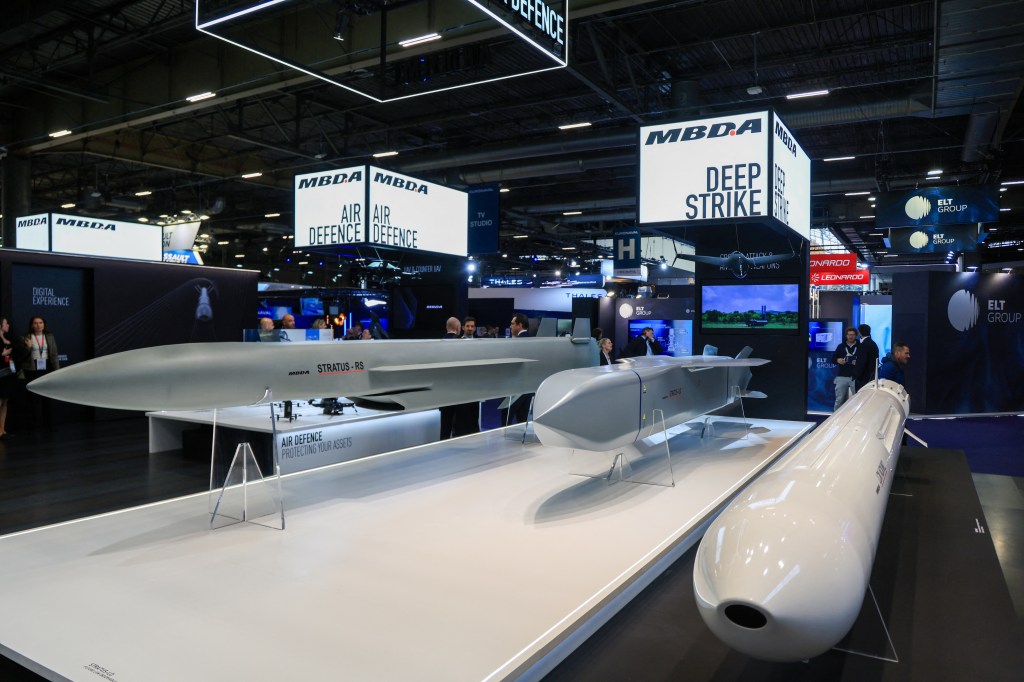
Models of MBDA missiles, including a Stratus RS (L), are displayed on the MBDA stand at the Euronaval 2026 naval defense equipment fair in Villepinte, near Paris, on Nov. 3, 2026. (Ludovic Marin / AFP via Getty Images)
PARIS — MBDA targets a range for its future high-speed strike missile Status RS that will be “far, far, far” beyond that of the Exocet anti-ship missile with its more than 200-kilometer range, said Olivier Gauffin, the company’s deputy director for sales and business development, at a briefing at the Euronaval maritime-defense exhibition on Tuesday.
The high-supersonic missile will cover four missions, including deep strike and anti-ship strike, suppression and destruction of enemy air defenses, as well as strikes against large aircraft including airborne warning systems and tankers, Gauffin said on Tuesday.
Stratus RS, for rapid strike, is being developed for France and the United Kingdom, and MBDA is awaiting a development contract from France’s Directorate General for Armament on behalf of the two partners.
The company is simultaneously working on a stealthy subsonic cruise missile with a larger warhead called Stratus LO, for low observable, on behalf of France, the U.K. and Italy.
“The goal is very clear, it’s to face the threat of the decades to come, and we have two options to do it, which are complementary,” Gauffin said. “One is more a Ferrari, and the other is more a truck, a stealth truck.”
The high-speed missile will be able to combine very low or very high trajectories to defeat hard-to-destroy targets such as frigates and destroyers or ground-based air defense systems, according to Gauffin. The missile will have a liquid ramjet engine that can be throttled, and will be highly maneuverable, the MBDA executive said.
Stratus RF will have a radio-frequency seeker combined with synthetic aperture radar, which provides the missile with a land-attack and a top-attack capability, according to Gauffin, who said Thales is providing the seeker technology. The idea for the slower, stealthy missile is to have only passive radio-frequency and infrared sensors, and no radar.
While the equipment in the Stratus RF missile will be new, it’s based on technology MBDA uses in other missiles, the executive said. The company has already done “a lot of trials” around the critical components, including propulsion, seeker, warhead and data management, and full development of the missile is expected to start “very soon,” Gauffin said.
MBDA uses ramjet technology in its Meteor air-to-air missile.
Both Stratus missiles will be able to be air-launched from platforms including the Rafale, the Eurofighter Typhon as well as the future aircraft being developed in the Global Combat Air Platform, with a size and mass “very close” to the Storm Shadow cruise missile. The missile will use a booster for launch from ships or land.
MBDA expects flight testing of both Stratus missiles to start before the end of the decade, with the missiles to enter in service at the beginning of the 2030s.
The size of the Stratus RF is not compatible with NATO-standard size torpedo tubes, meaning the missile is not envisaged as being submarine launched, according to Gauffin. For vertical launch, the missile would require a new, wider version of Naval Group’s Sylver vertical launch system, though Gauffin said there would be no change to the shipborne space occupied by the VLS.
The company also presented details on a new version of its Naval Cruise Missile, with production to start in early 2030. The updated version will be more resistant to satellite-navigation jamming, with increased survivability and new sensors, and keep the same size but with increased range and lethality, said Sophie Bourdais, vice-president for strike at MBDA.
The updated missile will also benefit from new mission-preparation software called Fastrike that cuts target planning down to minutes from hours, according to Bourdais. MBDA plans to integrate the capability in the SCALP EG/Storm Shadow cruise missile and the existing Naval Cruise Missile before 2030, the executive said.
The Naval Cruise Missile was presented as part of the European Long-range Strike Approach, and there is interest from a number of countries in the land-based variant MBDA has developed, according to the company.
MBDA is still waiting for a development contract from the DGA. The production line for the Naval Cruise Missile in France is inactive but remains in place, and can be restarted to produce the updated version, according to Bourdais.
Rudy Ruitenberg is a Europe correspondent for Defense News. He started his career at Bloomberg News and has experience reporting on technology, commodity markets and politics.
分享至 Facebook(在新窗口中打开) Facebook
分享至 X(在新窗口中打开)X
在 Bluesky 上分享(在新窗口中打开)Bluesky
分享到 Reddit(在新窗口中打开)
在领英上分享(在新窗口中打开)领英
使用原生工具分享 已复制到剪贴板
分享至邮件(在新窗口中打开)邮件
2026年11月3日,在巴黎附近的维勒潘特举行的2026年欧洲海军防务装备展上,MBDA展台上展示了MBDA导弹的模型,其中包括Stratus RS(L)导弹。(Ludovic Marin / AFP via Getty Images)
巴黎——MBDA公司销售和业务发展副总监奥利维尔·高芬周二在欧洲海军防务展上举行的新闻发布会上表示,该公司未来高速打击导弹Status RS的射程目标将“远远远远超过”射程超过200公里的飞鱼反舰导弹。
高芬周二表示,这种高超音速导弹将执行四项任务,包括纵深打击和反舰打击、压制和摧毁敌方防空系统,以及打击包括空中预警系统和加油机在内的大型飞机。
Stratus RS 是一款快速打击武器,是为法国和英国开发的,MBDA 公司正在等待法国军备总局代表这两个合作伙伴签订开发合同。
该公司同时还在为法国、英国和意大利研制一种名为 Stratus LO(低可观测性)的隐形亚音速巡航导弹,该导弹配备更大的弹头。
“我们的目标非常明确,那就是应对未来几十年的威胁,我们有两种互补的方案来实现这一目标,”高芬说。“一种更像法拉利,另一种更像卡车,一辆隐形卡车。”
据高芬称,这种高速导弹能够结合极低或极高的弹道,从而摧毁护卫舰、驱逐舰或陆基防空系统等难以摧毁的目标。这位MBDA高管表示,该导弹将配备可调节推力的液体冲压发动机,并具有极高的机动性。
据高芬称,Stratus RF导弹将采用射频导引头与合成孔径雷达相结合的设计,使其具备对陆攻击和对顶攻击能力。高芬还表示,泰雷兹公司提供了导引头技术。而速度较慢、隐身性能更强的导弹则仅配备被动式射频和红外传感器,不配备雷达。
这位高管表示,虽然Stratus RF导弹的设备是全新的,但它基于MBDA公司在其他导弹中使用的技术。高芬表示,该公司已经围绕关键部件进行了“大量试验”,包括推进系统、导引头、弹头和数据管理系统,导弹的全面研发预计“很快”就会启动。
MBDA公司在其“流星”空空导弹中使用了冲压式喷气发动机技术。
两款“云层”(Stratus)导弹均可从包括“阵风”(Rafale)、“台风”(Eurofighter Typhon)以及未来全球空中作战平台(Global Combat Air Platform)研发的战机在内的多种平台进行空射,其尺寸和质量与“风暴阴影”(Storm Shadow)巡航导弹“非常接近”。该导弹将使用助推器从舰船或陆地发射。
MBDA预计两款Stratus导弹的飞行测试将在本十年末之前开始,导弹将于2030年代初投入使用。
据高芬称,Stratus RF导弹的尺寸与北约标准尺寸的鱼雷发射管不兼容,这意味着该导弹并非设计用于潜射。若要进行垂直发射,则需要法国海军集团Sylver垂直发射系统的加宽版本,但高芬表示,垂直发射系统占用的舰载空间不会发生变化。
该公司还公布了其新型海军巡航导弹的细节,该导弹将于2030年初开始生产。MBDA公司负责打击系统的副总裁索菲·布尔代表示,升级后的导弹将更能抵抗卫星导航干扰,具有更高的生存能力和新的传感器,尺寸保持不变,但射程和杀伤力将有所提高。
据布尔代斯称,升级后的导弹还将受益于名为“Fastrike”的新型任务准备软件,该软件可将目标规划时间从数小时缩短至数分钟。这位高管表示,MBDA计划在2030年前将这项功能集成到SCALP EG/Storm Shadow巡航导弹和现有的海军巡航导弹中。
据该公司称,海军巡航导弹是作为欧洲远程打击方案的一部分而推出的,许多国家对MBDA开发的陆基版本很感兴趣。
MBDA仍在等待法国国防装备总局(DGA)的研发合同。据布尔代称,法国海军巡航导弹生产线目前处于停产状态,但设施仍然保留,可以重新启动以生产升级版导弹。
鲁迪·鲁伊滕贝格是《防务新闻》的欧洲记者。他的职业生涯始于彭博新闻社,拥有报道科技、大宗商品市场和政治方面的经验。