MPs raise questions on $20m fine, delay in strengthening haze law, in six-hour debate议员们在长达六小时的辩论中,就2000万美元罚款和加强雾霾法的延迟等问题提出质询。
Read more at straitstimes.com.
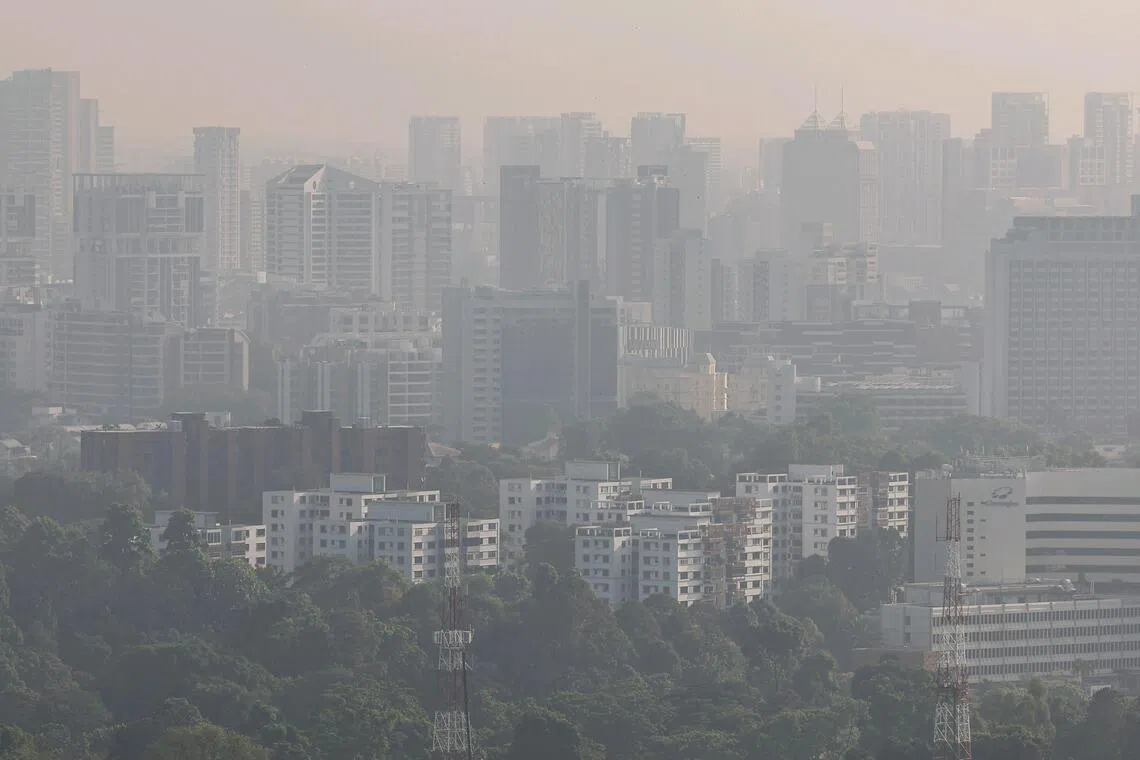
Haze situation in the direction of Orchard on the morning of Oct 30, 2026. The 24-hour Pollutant Standards Index (PSI) reading for the central region was 63 at 8am, in the moderate range.
Published Nov 04, 2026, 10:45 PM
Updated Nov 04, 2026, 10:45 PM
SINGAPORE - Investigations remain open into the four companies issued legal notices under Singapore’s Transboundary Haze Pollution Act in 2015, although time has lapsed because of procedural issues, said Minister for Sustainability and the Environment Grace Fu on Nov 4.
But three of the four firms have also been implicated in the 2026 haze episode, and their past actions will be considered as the authorities continue their probe into the current case, she added.
Fu gave this update in Parliament on the open cases under Singapore’s haze law, during a debate on a Bill to amend the legislation.
With the changes, which were passed after a six-hour debate, the authorities here will have more tools to investigate and act against firms linked to fires in the region.
All 24 MPs who spoke up supported the amendments, although they sought clarity from the minister on a range of issues.
Many MPs, including Poh Li-San (Sembawang West) and Non-Constituency MP Eileen Chong of the Workers’ Party, asked why it took 11 years to strengthen the law.
Poh also asked about the timeline of investigations and enforcements this time , since the amendments will not apply retroactively with the ongoing four cases .
Fu said says the amendments are intended for the Government to take quick action, either through legal or economic levers. “So I hope that we have a much faster resolution of the cases,” she said.
Lee Hui Ying (Nee Soon GRC) and Jessica Tan (East Coast GRC) were among the MPs who wanted to know how the authorities determined whether fires abroad would pose a risk of haze to the Republic.
Before the amendments kick in, the Act can be triggered if the haze causes the Pollutant Standards Index – a measure of air quality in Singapore – to stay in the unhealthy range in any part of the country for 24 hours or more.
But with the changes, the scope of the law will be expanded to include the risk of haze. This means entities can be held responsible as long as they cause or contribute to overseas fires that can potentially result in Singapore experiencing haze, even if the smoke plumes have not drifted here.
In response, Fu said that proving risk will be done through judgment based on scientific and meteorological data.
If the air quality is stable and in the healthy range, and weather conditions do not indicate any risk of haze pollution in Singapore, the National Environment Agency will not have any interest or reason to act, even if there are fires, she said.
However, if there is a “reasonable likelihood” of air quality worsening because of unfavorable weather conditions and significant forest fires, “NEA will have the basis to exercise a wider range of options without having to prove that the fire in a specific location has indeed caused haze pollution in Singapore,” she added.
“Our aim is to allow agencies to move and react in a timely manner... The government will still have to satisfy the court that all elements of the offence are (met),” said Fu.
Under the changes to the law, the maximum fine for those found guilty of causing or contributing to fires was also raised from $2m to $20m. But some MPs questioned if this was still too low to serve as a deterrent.
David Hoe ( Jurong East-Bukit Batok GRC ) pointed out that for a corporation making $500 million in profits, $20 million is just 4% of the company’s revenue.
He asked if turnover-based or profit-linked fines was considered, with the maximum fine set as a percentage of an errant company’s annual profit.
Fu said the maximum penalties were considered carefully to ensure that they are fair and practical, while providing a suitable deterrent.
“Turnover-based fines were considered, but we decided to go with an absolute figure, given the potential difficulties in obtaining information on turnover for every entity (we) want to go after,” she said.
“On the maximum fine defined in the legislation, penalties are ultimately decided by the courts based on the circumstances in each case. We do not expect that the maximum fine will always be imposed.”
A civil penalty framework with a maximum fine of $10 million was also added to the law, so that there is another route to take errant entities to task.
Fu explained that both the civil and criminal routes of action require different levels of proof.
“If we’re able to prove beyond reasonable doubt, we’ll definitely go for the criminal prosecution route, and therefore the $20 million maximum fine (will) apply, but having an option of civil liability basically gives NEA and the prosecutor an alternative route if we do not have that level of proof,” she added.
Fu was responding to Hany Soh ( Marsiling-Yew Tee GRC ) , who had asked why the civil penalty did not match the criminal penalty of $20 million.
MPs also asked if Singapore could do more to address the root cause of this year’s haze, which is the burning of peatlands in Indonesia that had been drained for plantation land. Slash-and-burn agriculture practices light up the dried habitats in infernos that are hard to put out.
Poh said: “If we want our solutions to prevail long-term, enforcement should be accompanied by measures that encourage sustainable land and water management, fire prevention, and ecosystem restoration.”
Aljunied GRC MP Gerald Giam added: “The law must treat deliberate canal excavation that turns wetlands into tinderboxes with the same urgency as the fires that inevitably follow.”
Giam sought clarification on whether the legislative intent of the revised law is to treat peatland drainage as conduct that causes or contributes to fire risk.
He suggested that the plantations linked to Singapore-based corporates should be required to maintain water table levels and submit audited fire prevention plans directly to NEA. Water table levels refers to the extent below the surface of the ground at which you start to find water.
Non-Constituency MP Andre Low from the Workers’ Party acknowledged that carbon credits can help to finance peatland restoration in the longer term.
He also noted that Singapore’s developing carbon-credit cooperation with Indonesia is an opportunity to examine how these arrangements could work in practice.
In response, Fu said the law could includes peatland restoration as one of the directives to prevent land or forest fires.
She clarified that the Transboundary Haze Pollution Act is not restricted to only fires on peatlands, and there are other causes of haze and fires that the law caters to.
“So I do not want to constrain ourselves or focus our attention too narrowly on whether we should have water table requirements or not, because these are details that we can work with later on, with the specific cases (and) remedial actions,” she said.
The amendments will give the Government more tools and paths, Fu says, but Singapore should be clear-eyed about what legislation can achieve.
She said: “There may be some companies that we can go after, but there are many more landowners or occupiers, including many small landowners that … we are not able to.
“We won’t be able to investigate all of them, we should also expect to continue to face challenges with securing and verifying evidence. There is no guarantee of a successful prosecution.”
Singapore Parliament
2026年10月30日上午,乌节路方向出现雾霾情况。上午8点,中部地区的24小时污染物标准指数(PSI)读数为63,属于中等范围。
发布于 2026 年 11 月 4 日晚上 10:45
更新于2026年11月4日晚上10:45
新加坡——新加坡永续发展及环境部长傅海燕于11月4日表示,尽管由于程序问题,时间已经过去,但对2015年根据新加坡《跨境烟霾污染法》发出法律通知的四家公司的调查仍在进行中。
但她补充说,这四家公司中有三家也牵涉到 2026 年的雾霾事件,当局在继续调查当前案件时,会考虑它们过去的所作所为。
傅海燕在国会就新加坡雾霾法下未决案件的情况作了最新汇报,当时国会正在辩论一项旨在修改该法的法案。
经过六个小时的辩论,这些修改获得通过,当地政府将拥有更多工具来调查和打击与该地区火灾有关的公司。
所有 24 位发言的议员都支持这些修正案,尽管他们就一系列问题向部长寻求澄清。
包括三巴旺西选区议员傅丽珊和工人党非选区议员张爱玲在内的许多国会议员质问,为什么加强这项法律花了11年时间。
Poh 还询问了此次调查和执法的具体时间安排,因为这些修正案不会追溯适用于正在进行的四起案件。
傅女士表示,这些修正案旨在让政府能够迅速采取行动,无论是通过法律手段还是经济手段。“所以我希望这些案件能够更快地得到解决。”她说。
李慧莹(义顺集选区)和陈慧珊(东海岸集选区)等国会议员想知道,当局是如何确定国外火灾是否会对共和国造成烟霾风险的。
在修正案生效之前,如果雾霾导致新加坡任何地区的污染物标准指数(衡量新加坡空气质量的指标)连续 24 小时或更长时间处于不健康范围内,则可以触发该法案。
但随着这些修改,法律的适用范围将扩大到包括雾霾风险。这意味着,只要相关实体造成或促成了可能导致新加坡出现雾霾的海外火灾,即使烟雾并未飘至新加坡,它们也可能被追究责任。
对此,傅先生表示,风险的证明将通过基于科学和气象数据的判断来进行。
她表示,如果空气质量稳定且处于健康范围内,并且天气状况没有显示新加坡存在任何雾霾污染风险,即使发生火灾,国家环境局也不会有任何兴趣或理由采取行动。
她补充说,但是,如果由于不利的天气条件和重大森林火灾导致空气质量“极有可能”恶化,“国家环境局将有理由采取更广泛的措施,而无需证明特定地点的火灾确实造成了新加坡的雾霾污染”。
傅先生说:“我们的目标是让各机构能够及时采取行动和做出反应……政府仍然需要向法院证明,犯罪的所有要素都已得到满足。”
根据法律修改,对造成或促成火灾者的最高罚款也从200万美元提高到2000万美元。但一些议员质疑,这一罚款金额是否仍然太低,不足以起到威慑作用。
David Hoe(裕廊东-武吉巴督集选区)指出,对于一家盈利 5 亿美元的公司来说,2000 万美元仅占该公司收入的 4%。
他询问是否考虑过按营业额或利润挂钩的罚款,最高罚款额按违规公司年度利润的百分比设定。
傅先生表示,最高处罚金额经过仔细考虑,以确保其公平合理,同时起到适当的威慑作用。
“我们考虑过按营业额罚款,但考虑到要获取每个我们想要追查的实体的营业额信息可能存在困难,我们决定采用绝对金额罚款,”她说。
“关于法律规定的最高罚款额,最终的处罚由法院根据具体案件情况来决定。我们预计并非每次都会处以最高罚款。”
该法律还增加了一项民事处罚框架,最高罚款额为 1000 万美元,以便对违规实体进行追究,提供另一种途径。
傅解释说,民事诉讼和刑事诉讼所需的证据级别不同。
她补充说:“如果我们能够排除合理怀疑地证明,我们肯定会走刑事诉讼途径,因此最高 2000 万美元的罚款也将适用;但如果我们没有达到那种程度的证据,民事责任的选择权基本上为国家环境局和检察官提供了一条替代途径。”
傅先生是在回应苏汉妮(马西岭-油池集选区)的提问,苏汉妮询问为什么民事罚款与 2000 万美元的刑事罚款不符。
议员们还询问新加坡是否可以采取更多措施来解决今年雾霾的根源问题,即印尼为种植园而排干泥炭地后焚烧泥炭地。刀耕火种的农业耕作方式点燃了干燥的泥炭地,引发难以扑灭的大火。
Poh表示:“如果我们希望我们的解决方案能够长期有效,那么在执法的同时,还应采取措施鼓励可持续的土地和水资源管理、防火和生态系统恢复。”
阿裕尼集选区议员严燕松补充道:“法律必须以同样的紧迫性来对待故意开挖运河将湿地变成火药桶的行为,就像对待随之而来的火灾一样。”
Giam寻求澄清,修订后的法律的立法意图是否是将泥炭地排水视为造成或加剧火灾风险的行为。
他建议,应要求与新加坡企业相关的种植园维持地下水位,并直接向国家环境局提交经审计的防火计划。地下水位是指地表以下开始出现水的深度。
工人党的非选区议员安德烈·洛承认,碳信用额度可以帮助长期资助泥炭地修复。
他还指出,新加坡与印度尼西亚正在发展碳信用合作,这是一个研究这些安排在实践中如何运作的机会。
对此,傅表示,该法律可以将泥炭地恢复作为防止土地或森林火灾的指导方针之一。
她澄清说,《跨境烟霾污染法》不仅限于泥炭地火灾,该法还涵盖了其他造成烟霾和火灾的原因。
“因此,我不想将我们自己或我们的注意力过于狭隘地集中在是否应该有地下水位要求这个问题上,因为这些细节我们可以稍后在具体案例和补救措施中加以处理,”她说。
傅先生表示,这些修正案将赋予政府更多工具和途径,但新加坡应该清醒地认识到立法能够取得哪些成果。
她说:“我们或许可以追究一些公司的责任,但还有更多的土地所有者或占用者,包括许多小土地所有者……我们却无能为力。
“我们不可能调查所有案件,而且在获取和核实证据方面,我们仍将面临挑战。我们无法保证一定能成功起诉。”
新加坡国会