AI can now help make entire films. What does that mean for Singapore’s film industry?人工智能现在可以辅助制作整部电影。这对新加坡电影业意味着什么?
As Singapore creators experiment with AI in filmmaking, questions are emerging over what it could mean for human creativity, jobs and authorship.
新闻视频
As Singapore creators experiment with AI in filmmaking, questions are emerging over what it could mean for human creativity, jobs and authorship.
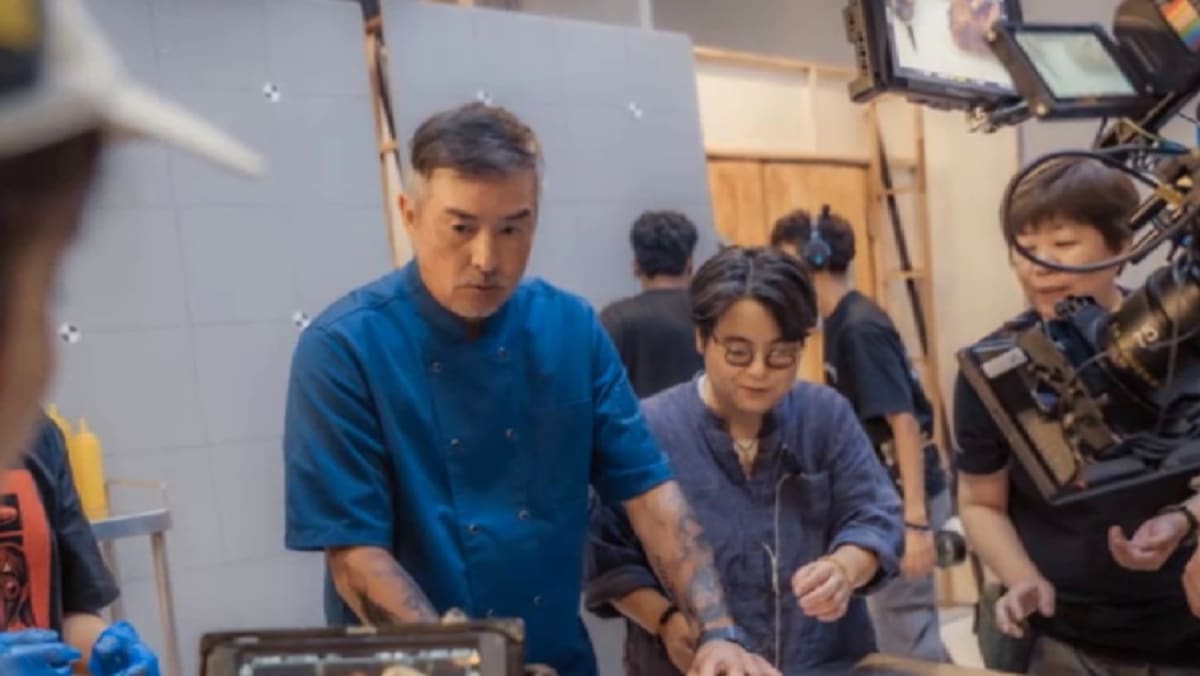
Actor Christopher Lee (centre) on the set of Singapore's first AI-hybrid drama, Crooks. (Photo: B-01 FILMS)
This audio is generated by an AI tool.
SINGAPORE: A two-and-a-half minute episode of Chinese AI-generated microdrama Master of Feng Shui amassed 100 million views within 12 hours of its debut, according to local media reports.
It is part of a growing wave of short-form dramas in China generated by artificial intelligence .
About 128,000 microdramas were released in the country in the first quarter of this year, of which more than 95 per cent were AI-generated, according to estimates published by China’s Netcasting Services Association.
According to digital content marketing company DataEye, the total output value of China's microdrama industry reached 100 billion yuan (US$14.35 billion) in 2025 – about twice the country's annual box office revenue.
CNA Games Guess Word Crack the word, one row at a time Buzzword Create words using the given letters Mini Sudoku Tiny puzzle, mighty brain teaser Mini Crossword Small grid, big challenge Word Search Spot as many words as you can Show More Show Less But using AI to generate a short-form drama is one thing. What happens when it is used for longer productions – and to the people who traditionally make them?
But using AI to generate a short-form drama is one thing. What happens when it is used for longer productions – and to the people who traditionally make them?
In Singapore, filmmakers are already testing that question.
The country’s first AI-hybrid drama, Crooks, still has actors performing on live-action sets, while AI is used to help build the environments around them.
More than 50 crew members across production, technical and editing roles are being reskilled for the project.
B-01 Films founder and executive producer Boi Kwong, the showrunner of Crooks, said AI has shifted more work towards the post-production process.
“With AI hybrid building the environment, most skills or most requirements are transferred to the post-production. So more people that used to do visual effects now have to upskill themselves with knowledge of AI, and then adapt it to how we shoot,” Mr Kwong said.
He added that the shift could create more jobs in post-production.
AI could also make filmmaking more accessible and speed up the production process.
“First, it lowers the entry barrier to get into the creative industry for many creators, and secondly, that (production) is much faster and it's easy to modify,” said Mr Pax Chen, founder and CEO of FizzDragon, a Singapore-headquartered AI filmmaking and digital creator platform.
MAKING A FILM IS EASIER, BUT MAKING A GOOD ONE ISN’T
But even as AI makes filmmaking easier, it does not guarantee success with audiences.
Two AI-generated local films released over the National Day weekend divided viewers. Trace Project, for example, drew criticism over its characters, dialogue and inaccuracies – including a Singapore flag with six stars.
The response points to a gap between what AI makes possible and what audiences find convincing. It also raises the question of how much of the creative process should be handed over to machines.
Visual artist Debbie Ding, who is also assistant professor of practice in digital arts at the Singapore University of Technology and Design, sees value in tools that make the creative work more accessible.
But she cautioned against tools that take over the entire process.
“It's a black box that the artist doesn't know what's inside,” she said, adding that this can obscure the amount of “skill and experience” behind an artist’s work.
For all the advances in generative video, one major limitation remains: human performance.
“AI still cannot replicate actors' performance, actors' real emotion, and how the actors react to the scene, to the people … small nuances that actually bring the performance to life,” said Mr Kwong.
Those imperfections are part of what makes performances believable, said chairperson of The Actors’ Society Laura Kee.
“You don't want to see perfect expressions. You want to see the sweat on the brow of the actors. You want to hear them perhaps muffling or stumbling over one word or two,” said Ms Kee.
“When it's all dictated by generative AI, sometimes it's difficult to bring that imperfection and that humanness to performance.”
Industry experts said AI is still unable to reproduce the emotional depth and subtle nuances of human performances. (Image: Bhaskar Arts Academy)
WHAT HAPPENS TO "CREATIVE FRICTION"
A production traditionally brings together directors, actors and other creatives with different ideas.
Automating more of that process could also remove some of the disagreements and negotiations that help shape a finished film product.
“What we're losing in this process is the kind of creative friction that enables a lot of interesting artistic work to emerge,” said assistant professor Pei Sze Chow, who specialises in digital culture and new media at Nanyang Technological University’s Wee Kim Wee School of Communication and Information.
She added that bringing together different creative perspectives can help produce a result that people feel confident about.
WHAT ABOUT AUTHORSHIP?
Generative AI also complicates another question: who is the author when a machine generates the images, music and performances?
Mr Justin Chan, founder of Designed for Good, a social initiative, said authorship ultimately requires creators to distinguish their work from that of others.
“I think what we call ''AI slop'' really is just aesthetic sameness,” said Mr Chan, who is also the founder of creative consultancy Fantastic Bureau.
“What worries me is that (creators) are going to generate a lot of things, but not really think through the process of design, who they are speaking to, what's the heart behind the message.”
Generative AI also raises questions about authorship. (Image: CNA)
The issue also raises concerns over ownership and control.
Unlike the United States, performers here lack a collective-bargaining framework for AI protection.
“We have no unions, so we have no bargaining power to protect actors, performers, and so it really depends on the individual actors' legal knowledge, their contract literacy, and their own ability to protect their rights now,” said Ms Kee.
More broadly, it remains unclear who gets to shape the stories audiences see when they are created using AI.
“Once you sort of devalue culture by outsourcing it to AI or outsourcing it to automation, then who's left to tell Singapore stories that will resonate with Singapore audiences?” asked Asst Prof Chow.
Get our pick of top stories and thought-provoking articles in your inbox
Stay updated with notifications for breaking news and our best stories
Join our channel for the top reads for the day on your preferred chat app
随着新加坡创作者们尝试将人工智能应用于电影制作,人们开始质疑人工智能对人类创造力、就业和创作的意义。
演员克里斯托弗·李(中)在新加坡首部人工智能混合剧集《Crooks》的拍摄现场。(图片:B-01 FILMS)
这段音频由人工智能工具生成。
新加坡:据当地媒体报道,中国人工智能生成的微剧《风水大师》一集时长仅两分半钟,在首播 12 小时内就获得了 1 亿次的观看量。
它是中国人工智能驱动的短剧浪潮的一部分。
据中国网络广播服务协会发布的数据显示,今年第一季度,中国共发布了约12.8万部微剧,其中超过95%是由人工智能生成的。
据数字内容营销公司 DataEye 预测,到 2025 年,中国微剧产业的总产值将达到 1000 亿元人民币(143.5 亿美元),约为该国年度票房收入的两倍。
CNA游戏 猜词游戏 逐行破解单词 流行词游戏 用给定的字母组成单词 迷你数独 小谜题,大挑战 迷你填字游戏 小方格,大挑战 单词搜索 尽可能多地找出单词 显示更多 显示更少 但是,使用人工智能生成短剧是一回事。当它被用于制作更长的作品时会发生什么?对于那些传统上制作这些作品的人来说又会发生什么?
但利用人工智能生成短剧是一回事。如果将其用于制作更长的剧集,又会发生什么?这对传统剧集制作人员又会造成怎样的影响?
在新加坡,电影制作人已经在尝试解答这个问题了。
该国首部人工智能混合剧集《骗子》仍然由演员在实景片场表演,而人工智能则用于帮助构建他们周围的环境。
超过 50 名剧组成员,涵盖制作、技术和剪辑等各个岗位,正在接受再培训以适应该项目。
B-01 Films 的创始人兼执行制片人、电视剧《Crooks》的制片人 Boi Kwong 表示,人工智能已将更多工作转移到后期制作过程中。
邝先生表示:“随着人工智能混合技术在构建环境中的应用,大部分技能或大部分要求都转移到了后期制作环节。因此,更多过去从事视觉特效的人员现在必须提升自身的人工智能知识,并将其应用于我们的拍摄方式。”
他还补充说,这种转变可能会在后期制作领域创造更多就业机会。
人工智能还可以让电影制作更加普及,并加快制作过程。
“首先,它降低了许多创作者进入创意行业的门槛;其次,(制作)速度更快,也更容易修改,”总部位于新加坡的人工智能电影制作和数字创作平台 FizzDragon 的创始人兼首席执行官 Pax Chen 先生说道。
拍电影容易,拍出一部好电影却难。
但即便人工智能让电影制作变得更容易,也无法保证获得观众的喜爱。
国庆周末期间上映的两部人工智能生成的本地电影引发了观众的争议。例如,《追踪计划》因其人物塑造、对话和不准确之处(包括一面只有六颗星的新加坡国旗)而受到批评。
这一反馈表明,人工智能所能实现的功能与观众认为可信的功能之间存在差距。这也引发了一个问题:究竟应该将多少创作过程交给机器?
视觉艺术家黛比·丁(Debbie Ding)同时也是新加坡科技设计大学数字艺术实践助理教授,她认为能够让创作更容易进行的工具很有价值。
但她告诫人们要警惕那些会接管整个流程的工具。
“这就像一个黑盒子,艺术家不知道里面是什么,”她说道,并补充说,这可能会掩盖艺术家作品背后所蕴含的“技巧和经验”。
尽管生成视频技术取得了长足进步,但仍然存在一个主要限制:人类的表现。
邝先生说:“人工智能仍然无法复制演员的表演、演员的真实情感,以及演员对场景、对人物的反应……这些细微之处实际上使表演栩栩如生。”
演员协会主席劳拉·基表示,这些不完美之处正是使表演可信的原因之一。
“你不想看到完美的表情,你想看到演员额头上的汗珠,你想听到他们或许会含糊不清,或者磕磕巴巴地说出一两个字,”基女士说。
“当一切都由生成式人工智能决定时,有时很难将那种不完美和人性化带入表演中。”
业内专家表示,人工智能目前仍无法重现人类表演的情感深度和微妙之处。(图片:巴斯卡艺术学院)
“创造性摩擦”会发生什么变化?
传统上,制作团队会将导演、演员和其他拥有不同想法的创意人员聚集在一起。
自动化该流程的更多环节还可以消除一些有助于最终电影作品成型的分歧和谈判。
“在这个过程中,我们正在失去那种能够催生许多有趣艺术作品的创造性摩擦,”南洋理工大学黄金辉传播与信息学院专门研究数字文化和新媒体的助理教授周佩思说。
她补充说,汇集不同的创意视角有助于产生让人感到满意的结果。
那么,作者身份又该如何界定呢?
生成式人工智能也使另一个问题变得复杂:当机器生成图像、音乐和表演时,谁是作者?
社会公益组织 Designed for Good 的创始人贾斯汀·陈先生表示,创作的最终目的是使创作者能够将自己的作品与他人的作品区分开来。
“我认为我们所谓的‘AI垃圾’实际上只是审美上的雷同,”陈先生说道,他同时也是创意咨询公司Fantastic Bureau的创始人。
“我担心的是,(创作者)会创作出很多东西,但却不会真正思考设计过程、他们的目标受众是谁、信息背后的核心是什么。”
生成式人工智能也引发了关于作者身份的问题。(图片来源:CNA)
这个问题也引发了人们对所有权和控制权的担忧。
与美国不同,这里的表演者缺乏人工智能保护方面的集体谈判框架。
“我们没有工会,所以我们没有谈判能力来保护演员和表演者,因此,这真的取决于演员个人的法律知识、合同理解能力以及他们自己保护自身权利的能力,”基女士说。
更广泛地说,目前还不清楚谁有权决定使用人工智能创作的故事最终呈现给观众的内容。
周助理教授问道:“一旦你通过将文化外包给人工智能或自动化而贬低了文化价值,那么还有谁能讲述能引起新加坡观众共鸣的新加坡故事呢?”
订阅我们的邮件,即可获取精选热门新闻和引人深思的文章。
订阅通知,第一时间获取突发新闻和精彩报道。
加入我们的频道,即可在您常用的聊天应用上获取当日热门文章。