Dassault CEO strikes dark tone on Europe’s sixth-gen fighter progress达索公司首席执行官对欧洲第六代战斗机的进展持悲观态度
Trappier's view contrasts with that of Airbus, which cited "strong progress" in a statement.
PARIS — Dassault Aviation CEO Éric Trappier slammed the cooperation with Airbus on developing a European sixth-generation fighter jet, telling French lawmakers that working together is “very, very difficult” amid continued bickering over work share.
“Something is not working,” Trappier said in a hearing of the National Assembly defense committee here on Wednesday. “So it needs to be reviewed. It’s not up to me to do that, it’s up to the states to get together to figure out how to better manage this ambitious program.”
France, Germany and Spain in December 2022 awarded Dassault Aviation, Airbus, Indra Sistemas and Eumet a €3.2 billion ($3.6 billion) contract for phase 1B of the Future Combat Air System (FCAS), covering research, technology and overall design. That’s after Dassault and Airbus reached agreement on the next-generation fighter earlier that month, after more than a year of squabbling.
Dassault is the prime contractor for the new generation fighter or NGF at the heart of the combat system, with Airbus the main partner on behalf of Germany and Spain. After the development phase, the next step will be building a demonstrator in phase 2, which France has previously said would be announced in 2026, for a first flight scheduled in 2029.
Wrangling between the partners over how to share the workload is causing delays, and reaching agreement on Phase 2 “is still going to take time, that’s for sure,” according to Trappier.
The French executive is typically outspoken, and has previously criticized how work on FCAS is organized. He has previously commented on working with Airbus, saying in a parliamentary hearing in May 2023 that FCAS was difficult with three partners, though the executive said at the time he was “very confident in our capability to jointly develop a demonstrator.”
In a response to his new testimony this week, Airbus said the FCAS program has made “strong progress,” including the concept selection review achievement within the phase 1B contract. “We are now on our way to phase 2 contracts,” the company said in an emailed statement to Defense News.
“We are committed to FCAS, which represents the backbone of the European defense industry and strategic autonomy,” Airbus said. “We do believe in FCAS as a collaborative European industrial program, even more so in the current geopolitical context. That is our commitment from the beginning, to pursue a system of systems that goes beyond a future European fighter.”
Meanwhile, Germany’s new government said this week it plans to swiftly continue development of FCAS, according to the coalition agreement between the conservative CDU/CSU and the center-left SPD.
Trappier said the fragmented work methodology of FCAS is a cause of delays, as “each time we reopen pointless, endless discussions” with a push for more co-development and cooperation. Trappier said he disagrees with that model, and focus should be on prioritizing the best skills.
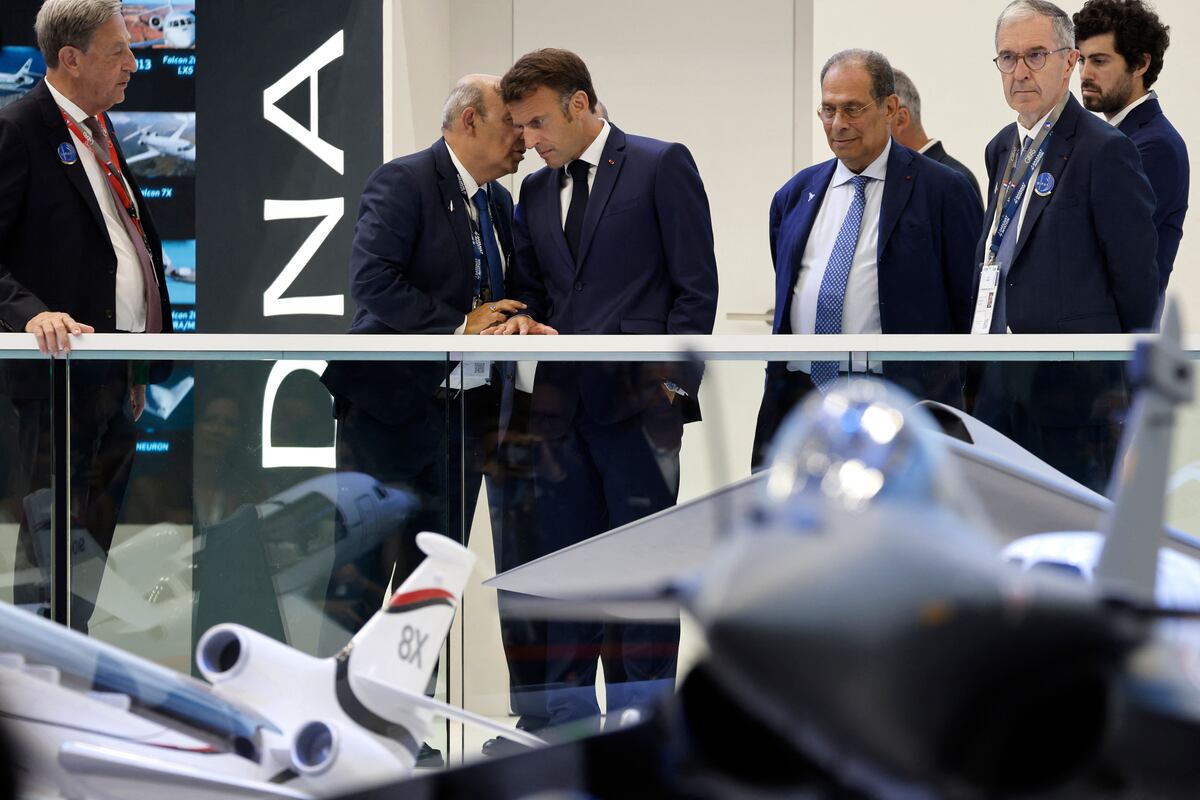
A mock-up of the European New Generation Fighter (NGF) for the Future Combat Air System (FCAS) is pictured at the Paris Air Show on June 18, 2023. (Julien de Rosa/AFP via Getty Images)
While Dassault is the prime contractor, the French company weighs for only a third in decision making, with Airbus having two-thirds of the vote on behalf of Germany and Spain, Trappier said. That means the lead company on the NGF can’t divvy up the work as it sees fit, the CEO complained.
“We have to constantly accommodate, constantly negotiate. It’s what’s called permanent negotiation. I hope we will reach an agreement to move forward,” he said.
Calculations on the shape of the future aircraft have been completed, “we know how to manufacture it, get it flying as quickly as possible,” the CEO said. “I would be very much in favor of speeding things up.”
Trappier mentioned the French-led nEUROn drone project as an example of what cooperation should look like, with six countries successfully developing an “ultra stealthy” combat drone on a tight budget. The CEO said Dassault as manager of the program didn’t compromise on the product for the sake of “geo return,” the practice of guaranteeing nations a work share proportional to their investment, which Trappier called “absolutely deadly for setting up a European cooperation.”
While cooperation was successful on nEUROn, “we don’t have that today on the NGF and I’m very sorry about that,” the executive said. He said Dassault finds itself alone against two partners, having to “persuade even more in order to reach decisions. It just takes a little more time.”
Trappier said some FCAS partners such as Thales are leaders in the field of defense electronics due to France’s history of seeking strategic autonomy, “so when you implement the geo return at every phase, it’s difficult.”
Meanwhile, when Dassault Aviation wants to work with German partners, certain technology derived from the Eurofighter is off-limits unless something “high-level” is provided in return, according to Trappier.
“Well, that doesn’t work. So we’re constantly bumping into these difficulties of work share,” he told lawmakers.
Dassault Aviation makes France’s Rafale fighter, while Airbus builds the Eurofighter in use in Germany and Spain. Both aircraft have roots in a multinational collaboration in the early 1980s on a future European fighter, with France opting to go it alone on the Rafale after disagreements over design authority and operational requirements.
France wants a next-generation aircraft capable of fulfilling the nuclear-deterrence role, able to perform its missions “without any constraints from any foreign country whatsoever,” and anything else would be a reason to stop the FCAS program, according to Trappier. The French fighter also needs to be able to operate from an aircraft carrier.
Trappier said that if France chooses a path of mutual dependency with allies, “there’s no going back,” an argument that may resonate with French lawmakers attached to the country’s policy of strategic autonomy in defense matters.
“We have to weigh what we are giving up to our allies, which may be normal in European cooperation and in a desire for European integration,” Trappier said. “But that also means we will depend on each other.”
Trappier was asked whether Dassault could go it alone should the FCAS program fail, and be able to provide France with a stealth-capable aircraft within a reasonable time frame.
“I don’t want to sound arrogant at all, but whose capabilities do I need other than my own to make a combat aircraft?” Trappier said. “So I’m willing to cooperate and share. I’m not against it, but I’m the one with the skills.”
Trappier said the future fighter doesn’t compete with the Rafale, which will operate alongside the new air combat system at some point. FCAS will be for beyond the 2040s, “more like 2045,” the CEO said.
Dassault is working on the future F5 standard for Rafale for 2030-2035, with a focus on connectivity and networking, and plans for a stealthy combat drone based on nEUROn as a loyal wingman.
“What we are trying to look at next is how we could make a future combat aircraft. Who with, that’s the question.”
The French state is committed to cooperation on FCAS to free up more resources and to contribute to “a slightly more united Europe,” Trappier said. “The problem is that when it comes down to the nitty gritty of the contracts, it’s more complicated.”
“We will do the NGF, as for with who, that’s not for me to answer,” Trappier said. “That’s up to the state, up to the politicians to say whether we should work with our traditional allies or not.”
He told lawmakers that if the future combat aircraft is produced as it is conceived today, with three partners, “Rafale will seem cheap to you.”
France in January 2024 announced the purchase of 42 Rafale jets for more than €5 billion, or a cost of at least €119 million per aircraft.
French President Emmanuel Macron said in March he intends to order more Rafale fighters, with plans for two squadrons at the air base of Luxeuil-Saint-Saveur, which currently doesn’t host the aircraft.
Trappier said Dassault would welcome additional French orders, though the company hasn’t received any yet.
Rudy Ruitenberg is a Europe correspondent for Defense News. He started his career at Bloomberg News and has experience reporting on technology, commodity markets and politics.
巴黎——达索航空首席执行官埃里克·特拉皮耶抨击了与空客在开发欧洲第六代战斗机方面的合作,他告诉法国议员,由于双方在工作分配问题上持续争吵,合作“非常非常困难”。
特拉皮耶周三在国民议会国防委员会的听证会上说:“有些地方出了问题,所以需要重新审视。但这并非我所能决定的,而是各州应该齐心协力,共同探讨如何更好地管理这项雄心勃勃的计划。”
2022年12月,法国、德国和西班牙授予达索航空、空客、英德拉系统公司和欧洲航空设备公司一份价值32亿欧元(36亿美元)的未来作战空中系统(FCAS)第一阶段B部分合同,涵盖研发、技术和总体设计。此前,达索和空客在经过一年多的争论后,于当月早些时候就下一代战斗机达成协议。
达索公司是新一代战斗机(NGF)的主承包商,该战斗机是整个作战系统的核心部件,而空客公司则是代表德国和西班牙的主要合作伙伴。研发阶段结束后,下一步将是建造第二阶段的验证机,法国此前曾表示将于2026年宣布该验证机的建造计划,并计划于2029年进行首飞。
特拉皮耶表示,合作伙伴之间就如何分担工作量进行的争论导致了延误,而且就第二阶段达成协议“肯定还需要时间”。
这位法国高管一向直言不讳,此前曾批评过未来空中交通系统(FCAS)的组织方式。他曾就与空客的合作发表评论,在2023年5月的一次议会听证会上表示,FCAS项目涉及三个合作伙伴,进展困难,但他当时也表示“对我们联合开发验证机的能力非常有信心”。
针对他本周的新证词,空客公司回应称,未来空中作战系统(FCAS)项目已取得“显著进展”,包括在第一阶段B合同中完成了概念选择评审。“我们现在正朝着第二阶段合同迈进,”该公司在发给《防务新闻》的电子邮件声明中表示。
空客表示:“我们致力于未来空中作战系统(FCAS)项目,它代表着欧洲国防工业和战略自主的基石。我们坚信FCAS是一个欧洲合作的工业项目,尤其是在当前的地缘政治环境下。从一开始,我们就致力于打造一个超越未来欧洲战斗机的系统。”
与此同时,德国新政府本周表示,根据保守派基民盟/基社盟和中左翼社民党之间的联合执政协议,计划迅速继续推进FCAS的研发。
特拉皮耶表示,FCAS分散的工作方式是造成延误的原因之一,因为“每次我们试图推动更多共同开发与合作时,都会重新开启毫无意义的无休止的讨论”。特拉皮耶表示他不同意这种模式,认为重点应该放在优先考虑最优秀的人才上。
2023年6月18日,在巴黎航展上,欧洲新一代战斗机(NGF)的模型亮相,该战斗机是未来空中作战系统(FCAS)的一部分。(Julien de Rosa/AFP via Getty Images)
特拉皮耶表示,虽然达索是主承包商,但这家法国公司在决策中只占三分之一的席位,空客代表德国和西班牙拥有三分之二的投票权。这位首席执行官抱怨说,这意味着NGF项目的牵头公司无法按照自己的意愿分配工作。
他说:“我们必须不断妥协,不断谈判。这就是所谓的持续谈判。我希望我们能达成协议,继续前进。”
关于未来飞机外形设计的计算已经完成,“我们知道如何制造它,并尽快让它试飞,”首席执行官说。“我非常赞成加快进度。”
特拉皮耶以法国主导的nEUROn无人机项目为例,说明了合作应有的模式。该项目由六个国家在预算有限的情况下成功研发出一款“超隐身”作战无人机。这位首席执行官表示,作为该项目的管理者,达索公司并没有为了所谓的“地缘回报”(即保证各国获得与其投资成比例的工作份额)而牺牲产品质量。特拉皮耶称这种做法“对建立欧洲合作绝对是致命的”。
这位高管表示,虽然在 nEUROn 项目上合作成功,但“目前在 NGF 项目上我们却无法做到这一点,对此我深感遗憾”。他指出,达索系统现在孤军奋战,要与两家合作伙伴抗衡,不得不“付出更多努力才能达成共识。这需要更多的时间。”
特拉皮耶表示,由于法国一直以来追求战略自主,一些FCAS合作伙伴,例如泰雷兹公司,都是国防电子领域的领导者,“因此,当你在每个阶段实施地理空间回归时,这很困难。”
特拉皮耶表示,与此同时,当达索航空想要与德国合作伙伴合作时,某些源自欧洲战斗机的技术是禁止使用的,除非提供一些“高水平”的回报。
“嗯,那样行不通。所以我们在工作分担方面总是遇到这些困难,”他告诉立法者。
达索航空公司生产法国的“阵风”战斗机,而空客公司则生产德国和西班牙使用的“台风”战斗机。这两款飞机都源于上世纪80年代初一项旨在研发未来欧洲战斗机的多国合作项目,但由于在设计权限和作战需求方面存在分歧,法国最终选择独立研发“阵风”战斗机。
特拉皮耶表示,法国希望研发出一种能够承担核威慑任务的下一代战机,能够在“不受任何外国任何限制”的情况下执行任务,否则将构成终止未来空中作战系统(FCAS)项目的理由。此外,法国战机还需要具备从航空母舰上起降的能力。
特拉皮耶表示,如果法国选择与盟友走相互依存的道路,“就没有回头路了”,这一论点可能会引起那些坚持法国在国防事务上实行战略自主政策的法国议员的共鸣。
特拉皮耶说:“我们必须权衡我们向盟友做出的让步,这在欧洲合作和欧洲一体化进程中或许很正常。但这同时也意味着我们将彼此依赖。”
有人问特拉皮耶,如果FCAS项目失败,达索公司是否能够独立完成,并在合理的时间范围内向法国提供具备隐形能力的飞机。
“我绝无意冒犯,但除了我自己的能力,我还需要谁的能力来制造战斗机呢?”特拉皮耶说道,“所以我愿意合作和分享。我并不反对,但我才是拥有这项技术的人。”
特拉皮耶表示,未来战斗机不会与“阵风”战斗机竞争,后者将在未来某个阶段与新型空中作战系统并肩作战。这位首席执行官说,未来空中作战系统(FCAS)的服役时间将晚于2040年代,“更可能是2045年”。
达索公司正在为 2030-2035 年的阵风战斗机研发未来的 F5 标准,重点是连接性和联网,并计划基于 nEUROn 技术研发一款隐形战斗无人机作为忠实的僚机。
“我们接下来要研究的是如何制造未来的战斗机。至于和谁合作,这才是问题所在。”
特拉皮耶表示,法国政府致力于在FCAS项目上开展合作,以释放更多资源,并为“一个更加团结的欧洲”做出贡献。“问题在于,当涉及到合同的具体细节时,情况就复杂得多。”
“我们会参加NGF,至于和谁一起,这不由我回答,”特拉皮耶说。“这取决于州政府,取决于政界人士,他们要决定我们是否应该与传统盟友合作。”
他告诉议员们,如果未来的战斗机按照今天的设想,由三个合作伙伴共同生产,“阵风战斗机在你们看来将会很便宜”。
法国于 2024 年 1 月宣布购买 42 架阵风战斗机,总价超过 50 亿欧元,即每架飞机至少 1.19 亿欧元。
法国总统埃马纽埃尔·马克龙在3月份表示,他打算订购更多阵风战斗机,计划在吕克瑟伊-圣索沃尔空军基地部署两个中队,该基地目前没有部署这种飞机。
特拉皮耶表示,达索公司欢迎法国方面增加订单,尽管该公司目前尚未收到任何订单。
鲁迪·鲁伊滕贝格是《防务新闻》的欧洲记者。他的职业生涯始于彭博新闻社,拥有报道科技、大宗商品市场和政治方面的经验。